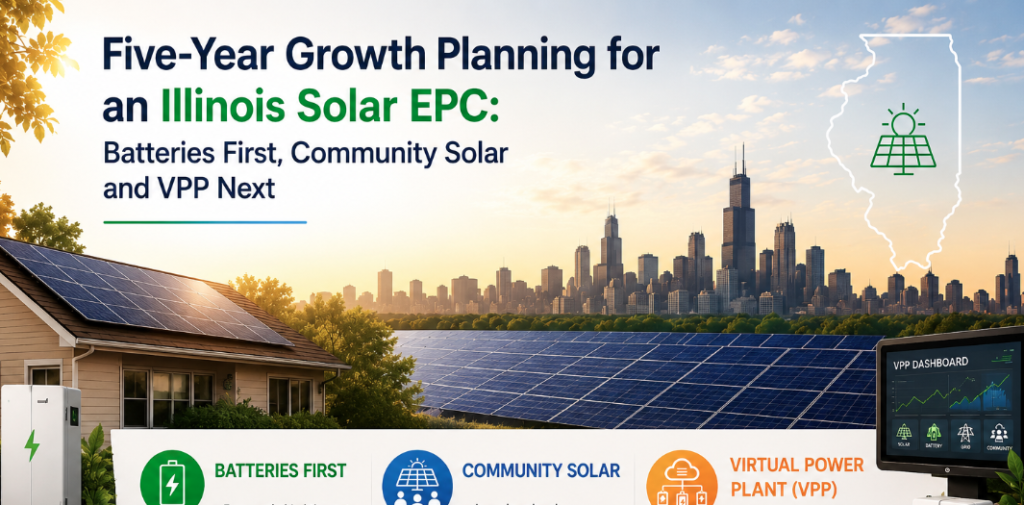
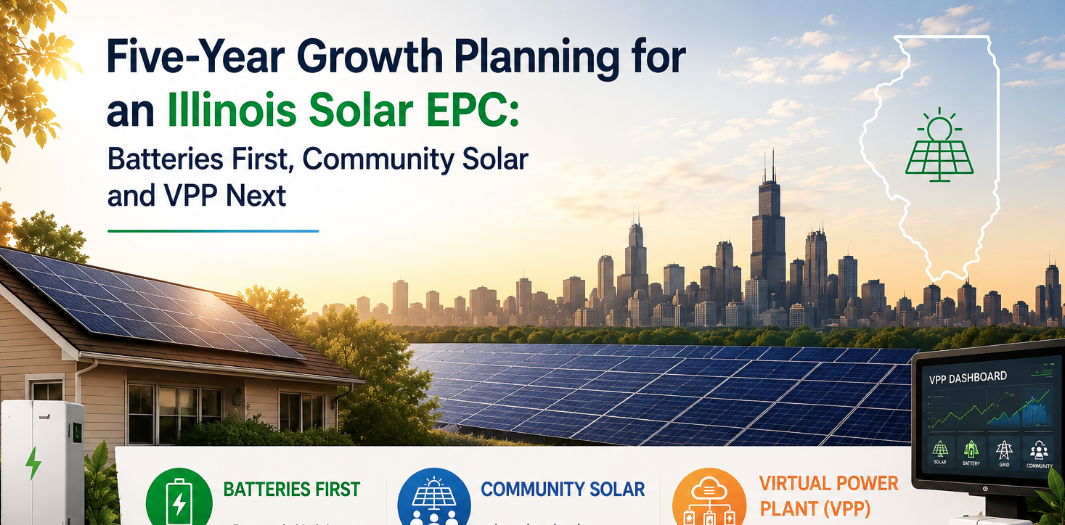
Most Illinois solar EPCs are still planning their next five years like it’s 2022. Rooftop residential and small C&I, modest storage attach, Illinois Shines as the headline policy. That plan is good, but there’s much more juice to squeeze. The market that’s actually coming is battery-led, with community solar and virtual power plants doing the heavy lifting on growth.
Here is how I’d frame the next five years if you run an EPC in the Illinois market today. And this frame applies to any strong Commercial Solar market.
Start with the policy stack, not the pipeline
Illinois is one of a handful of policy-driven solar markets in the country. Your five-year plan lives or dies on how well you read three documents:
1. The current Illinois Shines program rules, including REC pricing trajectory and the storage adder framework as it develops
2. The CRGA implementation timeline and what it signals about utility procurement of distributed storage
3. Ameren and ComEd’s hosting capacity and where DER aggregation will be valued
If you cannot point to specific provisions in those three documents that shape your hiring and capital plan, you are not planning. You are guessing.
Batteries first
The biggest mindset shift EPCs need to make is treating storage as the lead product, not an upsell on solar.
The reason is that the economics are flipping. Federal ITC dynamics under the OBBBA framework, combined with the state’s emerging storage incentive structure and rising commercial demand charges, mean that in a growing share of C&I projects, the battery carries the economics. Solar becomes the energy source feeding a storage asset that monetizes through demand and capacity charge reduction, time-of-use arbitrage, resilience value, and increasingly VPP enrollment.
A batteries-first EPC looks different from a solar-first EPC in concrete ways:
– Design starts with a load profile and a tariff analysis, not a roof or a parcel
– Energy Toolbase and SaaS partner modeling sits at the front of the sales process, not the back
– Sales conversations lead with resilience and demand charge reduction, then bring in solar
– Project economics get structured around stacked value streams, not a single ITC and net metering calculation
Most EPCs still sell solar with a battery option. The ones who will own the next five years sell storage with a solar component.
Community solar is the volume play
Illinois Shines community solar is the most underappreciated growth lane for regional EPCs right now. The program creates predictable offtake for projects in the 500 kW to 5 MW range, which is the sweet spot where a regional EPC can actually compete with or without a national developer’s capital stack.
The five-year question is not whether to participate. It’s what role you want to play:
– Pure EPC, building projects for outside developers who hold the REC contracts
– Developer-EPC hybrid, originating your own sites and either holding or flipping projects
– Subscriber-facing community solar provider, owning customer acquisition and recurring revenue
Each of these is a different business with different capital needs and different hiring sequences. Picking one and committing matters more than picking the “right” one. The EPCs that drift between all three end up undercapitalized for any of them.
VPP is the next layer, and it’s closer than most realize
Virtual power plants are where Illinois is heading, and the EPCs that are positioned now will own the customer relationships when the programs mature. Two reasons.
First, the CRGA (Clean Reliable Grid Act) and the utility grid plans are creating the framework for distributed storage to be aggregated and paid for grid services. The specific compensation mechanisms are still being worked out, but the direction is clear.
Second, the C&I customer you sell a battery to today is the same customer who will enroll that battery in a VPP next year. If you sold them the asset, you control the aggregation relationship. If a third party sold them the asset, you don’t.
For a five-year plan, that means designing every C&I storage project today with VPP enrollment in mind: open communication protocols, controls compatibility with major aggregation platforms, and contract language that preserves the customer’s flexibility to participate.
The four-pillar plan
Pulling this together, here’s the frame I use for EPC five-year planning:
Pillar 1: Product mix
Where does revenue come from today across residential, small C&I, community solar EPC work, and storage-led C&I? Where does it need to be in 2031? For most Illinois EPCs scaling up, community solar EPC revenue and storage-led C&I should each be 25 to 35 percent of the business by year five.
Pillar 2: Storage attach and storage-led mix
Residential attach moving from 10 or 15 percent today to 90 plus percent by year three. C&I moving from rare to default. And a growing share of C&I projects originating as storage projects with solar attached, not the reverse.
Pillar 3: Hiring sequence
In order: a project manager who can own C&I storage from contract to commissioning, a design engineer fluent in HelioScope and Energy Toolbase with real storage modeling experience, a C&I salesperson with facilities-manager and developer relationships, an operations lead, and a finance lead who understands ITC monetization and community solar economics.
Pillar 4: Capital and partnership structure
Decisions by year three on community solar role (EPC, developer-EPC, or subscriber-facing), VPP aggregation partnerships, and financing partners for C&I storage projects that customers cannot or will not pay cash for.
What the one-page plan looks like
– Revenue target by year, split by residential, C&I storage-led, and community solar EPC
– Storage attach rate target by segment by year
– Three concrete CRGA and utility grid plan assumptions
– Community solar lane chosen and committed
– VPP positioning strategy across every C&I storage project shipped
– Hiring sequence with quarterly targets for the next twelve months
– Three policy variables tracked: federal ITC trajectory, Illinois Shines block transitions, VPP compensation framework
Closing
The commercial solar EPCs that win the next five years will not be the ones with the most leads or the biggest crews. They will be the ones who saw that the product was changing from solar to storage, that community solar was a separate business worth committing to, and that VPP was a customer relationship to start protecting today.
If you are running an EPC and your five-year plan still leads with rooftop solar volume, it is time to redraw it. Tim Montague is the founder of Clean Power Consulting Group and host of the Clean Power Hour podcast. He advises solar EPCs scaling into commercial storage, community solar, and VPP-ready markets across Illinois and the Midwest.