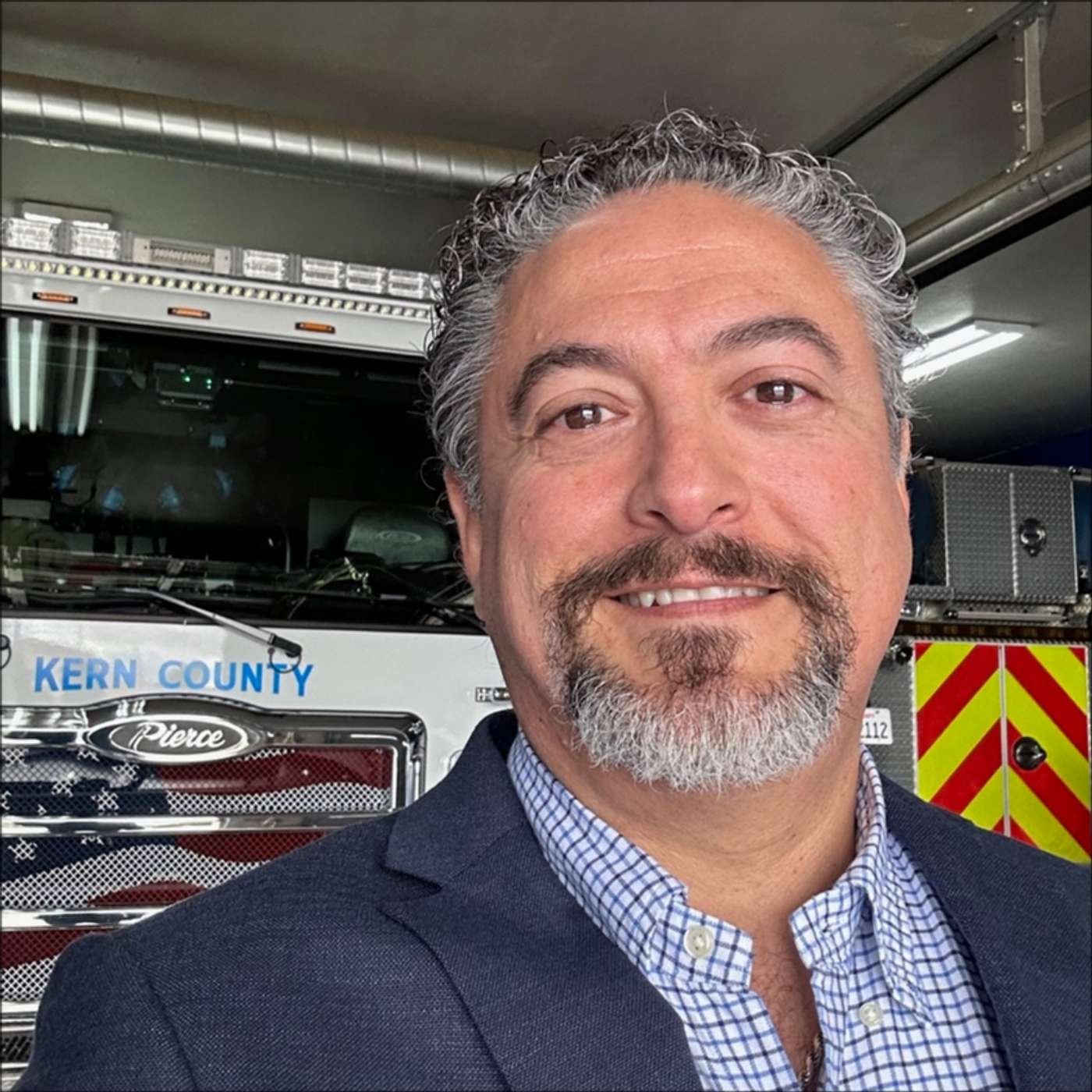
Battery energy storage fire safety is one of the most urgent permitting challenges facing solar and storage developers in 2026. Mike Nicholas, Energy Storage Specialist and Fire Consultant at Hiller Companies, brings a rare perspective: he built Kern County’s entire BESS permitting program from scratch in 2019, when no national standards existed, and now travels the country helping developers, EPCs, and fire departments get these projects to yes.
Kern County has the highest concentration of renewable energy and battery storage in California, including the largest active battery storage project in the world at roughly 3.2 GWh. Mike developed a 32-page submission guideline that standardized the permitting process and became a model other jurisdictions are now replicating. After retiring as a fire captain and assistant fire marshal in 2024, he joined Hiller, which represented about 85% of the battery storage clients that went through Kern County permitting. He now works with the Governor’s Office of Business and Economic Development and American Clean Power to build reference documents and videos for fire safety standardization.
Here is what you will learn in this conversation about battery energy storage fire safety:
- Find out why the Moss Landing disaster changed everything. A fire inside an enclosed former power plant building destroyed an estimated 240 megawatts. An outdoor containerized failure, under current standards, would be contained to the enclosure of origin, a fraction of 1% of that loss. You’ll understand why the industry is moving hard toward outdoor containerized deployments.
- Learn what UL 9540A and the new large-scale fire testing (LSFT) requirement in NFPA 855 (2026) actually require, and why they matter to first responders. You’ll hear why the test forces a fully populated unit into a worst-case thermal runaway with suppression disabled, and what it means for containing a fire within the enclosure of origin.
- Understand what a complete Hazard Mitigation Analysis must include. Find out why a generic OEM document will not pass, and what site-specific elements, from failure modes analysis to emergency response plans for construction, commissioning, and decommissioning, are required under NFPA 855.
- You’ll hear Mike’s step-by-step account of what should happen from the moment a fire alarm sounds to the moment the incident command is established. Learn why gas meters, IR cameras, and a fire alarm annunciator panel at the static water tank are critical tools for first responders who may be 15 to 20 minutes from the battery yard inside the site.
- Find out what developers and EPCs get wrong in permitting. Mike explains why early engagement with the fire department, before land use approval, is not optional, and why hiring a registered design professional who knows NFPA 855 is the difference between hitting your financing deadline and chasing it.
With BESS developers racing to lock in safe harbor and stay ahead of tightening FEOC and material-assistance thresholds, permitting delays and moratoria are a real threat to project timelines. Mike describes a shift already happening in California: under General Order 167-C, the California Public Utilities Commission now requires ESS operators to file emergency response plans and produce annual testing and maintenance reports, and Kern County has introduced an annual operational permit tied to emergency contact updates. These requirements are likely to spread nationally.
Connect with Mike Nicholas
Hiller Companies: https://hillerfire.com/
Connect with Tim
Clean Power Hour
Clean Power Hour on YouTube
Tim on Twitter
Tim on LinkedIn
Email tim@cleanpowerhour.com
Review Clean Power Hour on Apple Podcasts
The Clean Power Hour is produced by the Clean Power Consulting Group and created by Tim Montague. Contact us by email: CleanPowerHour@gmail.com
Corporate sponsors who share our mission to speed the energy transition are invited to check out https://www.cleanpowerhour.com/support/
The Clean Power Hour is brought to you by CPS America, maker of North America’s number one 3-phase string inverter, with over 6GW shipped in the US. With a focus on commercial and utility-scale solar and energy storage, the company partners with customers to provide unparalleled performance and service. The CPS America product lineup includes 3-phase string inverters from 25kW to 275kW, exceptional data communication and controls, and energy storage solutions designed for seamless integration with CPS America systems. Learn more at http://www.chintpowersystems.com
0:50
You know, we're taught to read the smoke in the, in the fire department, and so you show up, and you're looking at the smoke, and it's laying down, and it's lazy, and it's kind of puffing out of this enclosure, and they didn't realize it was actually off gas, and that it wasn't smoke, so as soon as it was such a rich environment, it couldn't even burn, but as soon as they breached the enclosure, it immediately changed that internal environment, provided oxygen, and it created an explosion. So, what we're really trying to deal with is early detection of hydrogen and combustible gasses to be able to begin that exhaust process, so that we're keeping that internal environment below 25% of that lower flammable limit. Our direction is still to never directly open these enclosures. There is, we do not risk a lot to save a battery enclosure. We risk a lot to save a lot. If there's a life involved, we put ourselves at risk, but a life is not worth an asset.
intro:
1:50
The clean energy industry is moving fast. The deals are getting bigger. The technology is evolving, and the stakes have never been higher. Welcome to the Clean Power Hour, the podcast for solar storage and microgrid professionals who want to stay ahead of it all. Each week, your host, Tim Montague, industry advisor and president of Clean Power Consulting Group brings you unfiltered conversations with the leaders actually building the energy transition. Now here's your host, Tim Montague,
Tim Montague:
2:25
today on the Clean Power Hour. Battery fire safety- it's a major topic because batteries are super important as we modernize and clean the grid. My guest today is Mike Nicholas. He is the energy storage specialist for Hiller Companies. Welcome to the show, Mike.
Mike Nicholas:
2:42
Thank you for having me, Tim.
Tim Montague:
2:43
Really appreciate you making time for the show. So we're going to get right into it, but before we get into fire safety and batteries, Mike, set the table. Tell us a little bit about your background and why you're here today.
Mike Nicholas:
2:56
Absolutely, so I retired from Kern County Fire Department in 2024 I was a fire captain there and the assistant fire marshal in charge of our battery energy storage program. I shamelessly combed the internet looking for any standards of reference back in 2019 as we began our permitting process, and would have gladly plagiarized and put Kern County stamp on it, and called it a day, didn't exist. So, in order to really sort of streamline the process for us, as well as to limit the liability in an emerging industry, we were blessed to contract with a third party consultant as our plan reviewer and expert, and so we put together a comprehensive submission guideline package. Now it's a living document at about 32 to 33 pages, and this helped to standardize the expectations for the applicants. They would come across the table, we pass this over to them, and advised this listed all of the relevant codes and standards that they and their project would be held to out of International Fire Code, California Fire Code, UL standards, NFPA standards, boiler and vessel standards, and this was really an attempt to try and create a standard process for us in Kern County. Kern County has the highest concentration of renewable energy in the state, and now has the highest concentration of energy storage as well. And now, fast forward two years, I've been working with Hiller as their fire consultant and energy storage specialist, traveling around the country and engaging with fire departments, teaching fire departments, engaging with planning departments, and planning commission hearings in support of the clients, and glad to be here on the show. Also, currently working with the Governor's Office of Business and Economic Development, and helping to develop their best toolkit, working with American Clean Power, also helping them put together reference documents and videos to help kind of create some sort of standardization within the within the industry for fire safety.
Tim Montague:
4:59
Well, thank you for your service in all of these regards. Because we really need more standardization, that's the real problem right now is that batteries are still new for many jurisdictions, and we, but we're at, we've reached a tipping point where the cost is low enough that mass adoption is happening, and so there's a tidal wave, as you've seen in California, but in many, many places now in the US, there's a tidal wave of storage projects. This is residential, commercial, and utility. The bulk, in terms of megawatt hours, is utility, but it truly is an all, all of the above. And I'm sympathetic to the AHJs and the fire service. Districts around the country, right, like they're drinking from a fire hose as well, and at the same time we want to achieve timely and realistic and affordable development and installation of batteries, because they're really good for consumers, business owners, and grid operators, and a key like truly batteries on mass is a key to modernizing the grid and meeting the growing demand from electrification from data centers, etc. So I would love it if we could start with the big picture, Mike, from your perspective and from Hiller's perspective. How big a problem are we facing because I just talked to the occasional guest who says, well, many jurisdictions are banning batteries now or putting a moratorium on battery development, so how big a problem are we facing here in Q of 2026
Mike Nicholas:
6:50
So I think we need to level set with this. This is an emerging technology and industry that has become very integral to our lifestyle, whether it's personal electronic devices, micro mobility devices in the home, we're seeing them in our vehicles and transportation, we're seeing the need for infrastructure to support the EV fleets that are happening, as well as the commercial and customer-based EV, and now we're getting into grid support as well. So we met with the California Energy Commission post Moss Landing last year, and the big kind of push was that we needed some sort of standardization, and my comment to the chairman was that we have a quality control and a quality assurance issue, because we do not have standardization of process, so jurisdictions are not aware of what they are allowed to ask for, what they are entitled to ask for, in terms of safety and documentation and installation oversight, and that's been the big push for me post public service, as the fire in the fire service, was to be able to take this message out to jurisdictions to sit across the table from them and really understand the position that they're in, trying to regulate an industry that is changing faster than they have codes of reference for, and so what we're starting to see is that if we can get ahead of this curve we're really looking at trying to come up with a way to get the utility scale standardized, the manufacturers of the batteries understanding what code compliance looks like, the EPCs and the subcontractors that are actually going to bid the jobs, understanding what that expectation is, and then the local jurisdictions having an understanding of how they can have a good, healthy relationship with these projects over the duration of these life cycle of these projects of 20 to 25 years, so we're seeing a big difference, even from 2019 when I first started in the industry regulating these from the fire department side to what we see now, as far as expectations go, for life safety, and the emphasis on preventing thermal runaway on coming up with designs and enclosures that are going to meet the needs of not just the off-takers but the people that are actually building these as well.
Tim Montague:
9:09
Yeah, and we've, you know, we've had some tough experiences. Right there have been some noteworthy battery fires. The ones that really make the national news are the ones in California, but we've had utility scale battery fires here in Illinois, and once you get lithium burning, it's very hard to put out, and I think that one of the emerging, you know, tidbits of information for everyone involved is just let it burn, let it burn out, obviously create a safe zone around it, but don't necessarily try to put out the fire, but I guess I want to return to that initial question, How big a problem is it for developers in terms of pushback from AHJs and HJs creating moratoria, and how big a problem is battery safety?
Mike Nicholas:
9:59
So, I think that as people become a little more comfortable with what this technology really is, they're going to have less concern about its deployment and siting in their jurisdictions, and it takes time. So, the chairman of the CEC made a great comment. He said, we've had wind and renewables, solar in this state for three decades plus, and they were our problem children at first, and we had some resistance to that. They are now our successful children studying abroad, and now battery energy storage is falling in that tumultuous teenage years of its kind of growth cycle, so I think that the more work that we do to spread information as to how these can be installed safely, and having references to jurisdictions like Kern County that have had these now in place for over half a decade, we're. Starting to see a little bit more of a comfort develop around the industry itself, and the having a standardized process that shows compliance. If you're looking at it from an age day perspective, the biggest concern is what liability are you assuming for a technology in an industry that you are not familiar with coming into your jurisdiction, not only from the view of the court of public opinion, but in terms of life safety for first responders. How do they directly engage these, or not? Are they going to be doing an indirect versus a direct attack on these? And we've had a lot of incidents of reference that have given us, I think, a good idea that the best way to treat these is an observe and contain approach, so we look at these more like an electrical hazmat. We identify the hazard, we isolate and deny entry, we establish exclusion zones and personal accountability, and then we manage the exposures in direct proximity to the enclosure of origin. So, what we've seen is kind of two pathways that these are deployed in buildings, and then outdoor containerized, and I think after Moss Landing, after Ote Mesa, we have a big push in the industry to pivot towards outdoor containerized deployment of these, and what that does for level setting at Moss Landing, there was about 300 megawatts of batteries in a repurposed power plant building, not even a dedicated use building. No fire separations between the racks, open rack storage. Say we lost conservatively 80% of that, that's 240 megawatts. What we see now in an outdoor containerized successful failure of one enclosure, we've got a fraction of 1% of what was lost at Moss Landing that would be involved in a loss in an outdoor containerized deployment. So, when we look at the safety side of it, we're growing as an industry, we're understanding where the risks are, we're understanding better how to manage these, both on the emergency response side, and also during the permitting side, I think moratorium or that jurisdictions pivot to is really a pause button until they find a palatable permitting process, and it really depends on the kind of climate of the local area. I've been escorted into planning commission hearings by armed flap jacketed security and police officers, and escorted out of the hearing chambers back to my car, because of such resistance. I've come into some public hearings where it's a very progressive community, they're very supportive of it, they want to know how this project is going to benefit them, how it's safe, and you know we're starting to get better data to support these things, because we have a lot of narratives that we're trying to overcome that are in the public sector in social media, and it's really difficult to get ahead of those narratives. We faced a big uphill task of trying to change hearts and minds based on technical data, but we are getting more reputable data to support these narratives that these are not going to kill every dog in a three mile area.
Tim Montague:
13:59
Well, and the statistic I've heard, and you can correct me if I'm wrong, is that battery fires are no more frequent than electrical fires, like electrical infrastructure can be problematic, and buildings catch on fire regularly because of the electrical infrastructure. Is there an added risk to adding batteries to our built environment?
Mike Nicholas:
14:26
I mean, there's no zero risk industry, and we can look to things like underground fuel storage tanks, and at the time that those were kind of coming into play, communities didn't want them anywhere near them. They were worried about polluting the underground water tables and contamination. And now, fast forward four or five decades, and if you don't have a gas station within five minute drive of your home, you're upset. So I think as the hazards that we have habituated to in our immediate environment begin to grow and encompass batteries as part of that, I mean, if we're really truly looking at risk to life safety, we have statistical data from FDNY from their task group that's showing that the vast majority of injuries and fatalities associated with batteries are in the residential and multifamily housing environment, from things like micro mobility devices and personal electronics, which are not listed to the same degree as utility scale in terms of UO listings. They're not destructively tested to the same degree, so unfortunately the utility scale has become the low hanging fruit, and everybody's favorite pinata to hit, and so when we really truly look at it objectively, we have tighter regulation and tighter oversight on utility scale, battery manufacturing, installation, ongoing testing, and maintenance and. We do not have anything close to that in the personal electronic device and micro mobility world, where we have these cohabitating with us in our homes.
Tim Montague:
16:54
So, you were part of the Kern County Fire District, and it sounds like you have established a playbook. What are the elements of the playbook in when you're traveling around now as a consultant that our listeners should know about?
Mike Nicholas:
17:13
So, NFPA 55 has developed 2020 edition, 2023 and now 2026 is available for jurisdictions to adopt, and each code cycle has revised and clarified things that we were interpreting as kind of the industry best practice back in 2020 and that language has been clarified over time in each edition. So, NFP 855 is one of the most important documents any jurisdiction can enforce a project to comply with it as a national stand fire protection association standard. This has it is a parent document. You're going to see the 2027 IFC International Fire Code pivot and point out of Chapter 12, or it might be 11, I'm not sure, in the IFC directly to NFP at 55 for its guidance, and so what we've seen in the most recent edition of NFP at 55 that I think are noteworthy changes are things like abandoning the word suppression because of it's a misnomer, and to your point, these are difficult to extinguish, and also pivoting back to a comment you made earlier about lithium being on fire, so there's no elemental lithium that we're really dealing with in these batteries, right? These are lithium ion batteries, so the problem that for extinguishment purposes is that when these batteries go into some sort of failure, they're producing their own fuel, so that hydrogen and combustible gasses that are being produced makes it very difficult to extinguish, and so we really have to look at it more as managing the incident. One of the things that we've also seen is a pivot away from explosion mitigation being satisfied through NFPA 68 only, which is your deflagration panel. So these are engineered weak points in the structure that would basically handle an over-pressurization event, and we're pivoting more towards NFPA 69 which is explosion prevention. So NFPA 68 assumes the explosion has taken place, so as a primary means of explosion mitigation, we want it prevented at best. Certainly, you can integrate in these deflagration panels and kind of weak points in the structure to handle an over-pressurization event, but if we're not doing something to directly address the internal environment through the combustible concentration reduction systems, which are basically integrated early gas and smoke and heat detection with exhaust fans and louvers to keep the internal environment in the enclosure on average below 25% of the lower flammable limit, so this has become a bit of the primary emphasis for explosion mitigation, and we're seeing a lot more clarification on what the expectation is for manufacturers to go through large scale fire testing, so you hear a lot about the UL 9548 tests cell level module and unit level, but from a first responders perspective, I'm showing up to a battery storage yard and I've got 2000 enclosures that I'm looking at as a first-end company officer, I'm making an immediate sort of strategic and tactical determination. What is my time on site going to be, and how many resources am I going to need to handle fire in a yard full of 1000 enclosures, because we didn't know definitively that with the presence of this large scale fire test requirement, that test is predicated on demonstrating that a fire in a closure of origin will not propagate to an adjacent enclosure at a certain specified distance, and they go through that test. So, what we've really done through this process is create a bounded finite scenario where we have a finite fire area that we're worried about, which is a single enclosure that's a big difference from a first and company officer perspective. I've got one enclosure and a handful of exposures that I'm going to be focusing on, instead of worrying that this is going to spread from enclosure to enclosure, and I could be looking at an entire battery yard on fire.
Tim Montague:
21:15
So we have a standard now that says the fire should never propagate beyond the enclosure that it starts in, we're never going to prevent 100% of the enclosure fires, right? Things are going to happen, but we can. Well, that I guess that that's a question. How, how good is that standard, and how hard is it to achieve, and how much peace of mind? Line should this give fire safety professionals,
Mike Nicholas:
21:46
so I think this again. There's no 100% guarantees on these. We have seen a couple of instances where it has began to involve an adjacent enclosure, but what we're seeing predominantly is that these are staying within the enclosure of origin, and that we basically create a unified command post or multi-agency command post with the fire officials and first responders and the on-site operators. They're going to have access to information coming out of the battery management systems that tell us if adjacent enclosures are getting too warm because of the radiant heat, and if we need to start doing some sort of indirect cooling, so we can take now an offensive approach towards handling exposures. We don't encourage putting water directly on the enclosure of origin for the simple fact that it's going to elongate the incident, it's not going to deal with the stranded energy, and having the fire not be in a full fire capacity, but instead having clean agents or suppressants on there, whatever they are, that aren't actually working to extinguish the fire, they're keeping the fire at a cooler temperature, which is also preventing some of the degradation of these flammable and toxic gasses that are coming off, so the heat of a fire actually helps to consume those, helps to consume the stranded energy, and makes the overall duration of the incident shorter. So, commitment of resources for first responders is, you know, a lower time commitment in that regard.
Tim Montague:
23:26
Yeah, but are you, are you in your opinion, is this standard to prevent container to container spread? Is that rigorous enough?
Mike Nicholas:
23:36
Absolutely, and we're seeing it become better defined, and I think that is going to be the thing in this next code adoption cycle that we're going to see better clarification on is what these design standards are. A lot of these batteries have thermal management prevention systems in there, so they're not even propagating to other cells in the same module, and it's like, well, we put this through a fire test and it didn't propagate, so we're good. It's like now this large scale fire test, they will externally force these fully populated units into a thermal runaway event, right? Whether it's through use of jet, they set it on fire, heaters, they will force it to be on fire, the whole thing. So that gives us our worst case scenario. First responders, we want to know what it's going to be on its worst day.
Tim Montague:
24:24
The Clean Power Hour is brought to you by CPS America, maker of North America's number one three-phase string inverter, with over 10 gigawatts shipped in the US. The CPS product lineup includes string inverters ranging from 25 kw to 350 kw. Their flagship inverter, the CPS 350 kW, is designed to work with solar plants ranging from two megawatts to two gigawatts. CPS is the world's most bankable inverter brand and is America's number one choice for solar plants. Now offering solutions for commercial utility, ESS, and balance of system requirements go to Chintpowersystems.com or call 855-584-7168 to find out more, right, and so if you're a developer or an EPC who's self-developing or even just tasked with installing a battery project. What is your advice to the developers and EPCs in the world about how to approach the development lifecycle and how to work with AHJs?
Mike Nicholas:
25:41
So, I think the first hurdle to overcome is good equipment procurement. Be knowledgeable in what you're purchasing. Do your due diligence to make sure it has gone through the large scale fire testing to make sure it has a UL 9540 listing for that iteration of that battery, and those are going to be big hurdles to overcome in your permitting, because otherwise you're looking at having to do something like an alternative means and methods approach, because it doesn't meet the letter of the code. So, once you procure good equipment, has gone through these large scale fire tests, you know, get a qualified industry expert, fire protection engineer to be able to aggregate all of the reports that are needed, and you know, at Hiller, Hiller represented about 85% of the clients that came through Kern County, and when I was the assistant fire marshal, when an application came across my desk from Hiller, it was drastically different than I was seeing from other, you know, fire protection engineering or engineering firms that were providing. For the submissions, Hiller actually created a checklist that showed everything that is required to be in the submission, and it showed whether it was included in this submission, whether it was a draft and being worked on, and if it wasn't available yet, the timeline that it was expected. They made it very clear for an AHJ how complete the submission was and how comfortable they could be in allowing a project to move beyond the hold for compliance position for permit issuance, so equipment procurement, large scale fire testing, you will listing 9540 listing, make sure that you've got a qualified design professional that's aggregating all of your submissions that can go in and actually speak with the fire officials and early engagement with fire departments. So we have now requirements here in California during the permitting for land use, they're requiring some sort of engagement with the fire department at that phase of the project. They want to know the fire department's at least been made aware of it, and from a developer standpoint, you want to know what the resources are. Are you dealing with a fully funded 567 100 person fire department with 5060 stations? Are you dealing with a volunteer fire department that's got one station and one piece of equipment? You know, how are you going to basically scale your interaction with these fire officials to be able to meet them where they are to understand what their needs are and how bringing a project of this magnitude into their jurisdiction is going to impact them and how well resourced and equipped are they to be able to deal with an incident if it occurs
Tim Montague:
28:22
and do you think fire stations or fire districts need to have special equipment to handle battery incidents.
Mike Nicholas:
28:34
One of the things that we're seeing a lot of the smaller fire departments and/or volunteer departments that maybe they don't have are four gas meters on their first line equipment. These are pretty basic tools to be able to use in addressing an incident like a battery fire. We're seeing jurisdictions add things to their wish list, like a drone and a thermal camera, or an IR camera, FLIR camera, maybe, so that they can actually get viable optics without committing personnel into an exclusion zone.
Tim Montague:
29:09
That first sensor that you mentioned, the gas sensor, that is for what purpose.
Mike Nicholas:
29:15
So, that is to set up your exclusion zones. So, really, what you're going to see, because of vapor density, the thing that's traveling horizontally away from the enclosure of origin, and that you'll probably pick up first on your gas meter is carbon monoxide. So, as you get into your PPE, and you have your SCBA on, and you're going from the uninvolved to involved, and you're actually walking into this fully protected with a gas meter on, when your gas meter gets that first tick, that's going to be the point of your exclusion zone, that'll be your carbon monoxide, right. And so those gas meters are critical to be able to establish how far this exclusion zone needs to be away from the enclosure of origin, and these fires, again, it's so difficult to really create any sort of singular expectation on these fires, because you've got state, the state of charge of the battery is going to be probably the largest influencing factor on the magnitude and intensity of this of an incident or a failure. If it's at a 30% state of charge, you're going to get a lot less off-gassing, a lot less heat. If it's at 100% state of charge, that's an entirely different animal,
Tim Montague:
30:25
and can you quickly explain why that is? Why does the state of charge affect the ferocity of the fire?
Mike Nicholas:
30:35
It's more stored energy, so the higher the stored energy is in the batteries itself, the more potential there is for heat flux and off-gassing,
Tim Montague:
30:46
yeah. And besides carbon monoxide, what are the other gasses of concern?
Mike Nicholas:
30:50
So you see carbon monoxide coming off of these, you see a combustible gas soup coming off of these, but really what we're looking at predominantly is going to, for fire risk, is going to be hydrogen. Now, based on the vapor density of hydrogen, it's racing to the moon at about 40 plus miles an hour, so we don't see a lot of horizontal spread of that. We see more of that as an issue within an enclosure that is sealed up. So, surprise, Arizona had a misidentified battery storage enclosure that was, you know, we're taught to read the smoke in the, in the fire department, and so you show up and you're looking at the smoke, and it's laying down, and it's lazy, and it's kind of puffing out of this enclosure, and they didn't realize it was actually off gas, and that it wasn't smoke, so as soon as it was such a rich environment, it couldn't. And burn, but as soon as they breached the enclosure, it immediately changed that internal environment, provided oxygen, and it created an explosion. So, what we're really trying to deal with is early detection of hydrogen and combustible gasses to be able to begin that exhaust process, so that we're keeping that internal environment below 25% of that lower flammable limit. Our direction is still to never directly open these enclosures. There is, we do not risk a lot to save a battery enclosure. We risk a lot to save a lot. If there's a life involved, we put ourselves at risk, but a life is not worth an asset.
Tim Montague:
32:24
Okay. so what else should developers let me just feedback what I heard. Be selective about procurement. Make sure your battery is 9540 certified. Have a checklist that goes through everything in the code that you need to meet and then have dialog with the fire station or fire district proactively, I think that's a big one, is being proactive and and communicative rather than putting the district on somehow on the defense, you know, so surprising them where, where you're in a hurry, then to get a permit to drive a project forward, right? You want to very early in the process get into dialog, so that you don't have any hiccups when the chips are down, and like we are now in 2026 right? We're in a, we're in a boom, we're in a period of time when people are rushing to get their solar and battery projects finished by the end of 2027 Oftentimes now the ITC is extended on batteries, and truly we're just at the bottom of the S curve for deployment, and we're, you know, we're just starting to deploy a lot of batteries. I like to say, you know, today maybe a fraction of a percent have batteries projects, whether those are solar projects or energy projects and facilities, and then you know, in 10 years it's going to be some 10s of percent, maybe 50% it's going to be dramatically different, but we're only, we're only helping ourselves as an industry, right, if we can be more proactive and communicative with the authorities having jurisdiction, and I would argue adding value, right, making their lives easier, and of course you know you and Hiller are doing the entire industry a favor. Where do developers and EPCs go for this playbook, though? You mentioned there are some documents that Kern County has made available, or who has
Mike Nicholas:
34:44
we made them public documents, and you can go to Kern County fire.org and go to their fire prevention tab, and then go to, I mean, they've changed the website a little bit, but I think it's permit requirements, and then they may actually have an independent battery storage tab now, and we've got that document listed there, and really that just aggregates all the relevant codes, because we were having developers come in and say,"Hey, I comply with Chapter 12, I'm good to go, and it's like,"Well, where's your 855 compliance by what? And so you know, if you're not hiring registered design professionals as a developer, you're doing yourself a disservice, because at day's end, you're going to end up hitting a deadline for financing and funding that you're going to be pushing hard to hit, and if you haven't given yourself a fighting chance by getting somebody who's going to be able to tell you where your holes in your submission are early enough in the process, you're going to be chasing that deadline, and so that's one of the things that Hillary gets brought in to do, we're asking the tough questions of the developers up front, so by the time they make it in front of the authorities having jurisdiction, there shouldn't be any surprises about what the expectation of compliance is.
Tim Montague:
35:55
Yeah, I was on a webinar with the Energy Safety Response Group, ESRG, which is one of the consulting firms that's well known in this space, and they were emphasizing this HMA, the hazard mitigation analysis report, and saying that you don't want to just give the HJ whatever the OEM has created for their product, you want to deliver something that's more comprehensive. What are the elements of an HMA that we could identify here in the Cliff Notes version?
Mike Nicholas:
36:32
Well, that's a big document, and really I'd encourage you to look at NFP 855 because it very clearly spells out what is required to be in there, your fire risk assessment, your failure modes, and. Effects analysis, your NFPA 68 and 69 reports, your emergency response plans during construction, hot commissioning, operation, and decommissioning. I mean, you've got a slew of things that are required, and Nick Warner and his group at ESRG are absolutely on point. An HMA cannot just be some generic OEM created document. An HMA is going to have site-specific considerations for your project in that area using that specific technology. It is not a generic report. Now, where we see some of the difficulty emerging right now is that planning departments for land use approval are asking for some version of an HMA, and at that time an applicant typically has not even procured equipment, because they haven't even got permission to use the land, so they're not likely going to go out and buy the equipment that they're going to be using the specific battery technology, much less developing these comprehensive reports that will require the technology to have been selected at the planning land use phase, so again we're kind of in this strange area where we're trying to appease the court of public opinion. The legislators and regulators are feeling that pressure from the public about the safety of these, they're looking for ways to be as compliant as possible in order to limit the liability that the local jurisdictions are shouldering, and so when you have code compliance, you've done the best job that you can at the regulatory side and the AHJ side. Developers are required to provide annual training to the fire departments for those specific projects, so that you have an opportunity to actually go out and create, say, a target hazard for this for your jurisdiction, so that you can put this in your computer automated dispatch system, and you know when you're responding to this particular address, it's not just a solar utility, you've actually got a battery site out there as well. Early identification, annual training, emergency contacts for access to the subject matter experts and to the OEMs that are out at site. These are critical things for a successful outcome of an emergency response.
Tim Montague:
38:57
In our last few minutes together, Mike, I would love it if from a from a fireman's perspective, if you would just lay down what is, what is the state of the art of, okay, there's a battery container, let's just say it's a 20 foot container, it could be a megawatt, it could be a couple of megawatts, let's say it's fully charged, it's on fire. I'm arriving on the scene. What is the state of the art of best practice for that authority to contain and create a safe situation for that situation?
Mike Nicholas:
39:43
Absolutely, so trying to tie all this back together. Early engagement with the fire department lets them know what the hazard is that's coming to their jurisdiction during permitting. The fire prevention unit makes contact with the field personnel and lets them know, hey, we're beginning construction in your first in response area. This is the type of project that it's going to be, and this is where it's located. The fire department or the fire station goes out and does pre-fire planning. They go look at the site, look for access. Where are our tools? Do we have water, municipal water outside? Are we looking for a static tank that's going to be there for us? Where is our incident command post going to be? We want this thing set back a safe distance, so that we can actually have equipment stage there. We create a multi-agency command post where we can have the first responders tying in with the site officials, emergency contact information. So preparation for the incident begins during construction. Now the bell goes off in the middle of the night, throw your boots on, get in the engine, and you're heading out to the site. You got a battery fire, right? You show up as a first in company officer, first engine on scene at the gate. There should be some sort of emergency contact information within that gate. There should be a document, locked document box that's going to have your laminated site map that shows where the battery yard is. And for context, in my former jurisdiction, one of our sites, which is a very big site, battery and PV. From the time you entered the site, it was a 15 to 20 minute drive back to the battery yard from the entrance. So, you've got to have a way to get to and identify that actual battery storage yard, hence your map. So, I'm going to show you where your incident command post is. Most of ours were in rural areas, where we required a tank, so that tank ends up becoming our incident command post. We have a fire alarm annunciator panel out there at that tank, because that is showing what is going on in the main fire alarm panel. The first responders do not have to go into the middle of the battery storage yard to look at the fire alarm panel and know what includes. Closures involved, and what initiation device was active? Is this a smoke detector going off, but we see no smoke and flames? Is it a heat detector going off? No smoke and flames. Is this a gas detector going off? No smoke and flames. Or do we have a scenario where one or all three of those are going off and we see visible smoke and flames? So you have low level events where you have initiation of devices, but no smoke and flames showing. You're starting to consider, is this an explosion risk? Do we want to keep people away? Has the exhaust system activated, and are the louvers open? Do I have comfort as a first in company officer, knowing that this critical life safety device of this concentration or combustible concentration reduction system, is it active? If that's the case, then I'm starting to feel a little more comfortable with the explosion mitigation approach. So, you show up on site, you make contact with the emergency contacts that are listed at the gate, you get the document box, you find out where the battery yard is some developers make agreements with the fire departments, it's like stage outside the fence till we get there. There's no reason to commit resources inside unnecessarily. Wait for us, we'll take you in. We go in together, we evaluate the risk from a safe distance. From an electrical hazmat perspective, these things are: identify the hazard, isolate and deny entry, establish exclusion zones and have a personal accountability report, and then manage exposures. So, once you get in into the yard, you're looking at the fire alarm annunciator panel. You've determined what the initiation devices are, you've determined what life safety devices have been activated in terms of the exhaust system and the louvers opening, and now you start worrying about what the exposures are, and that's where you hip up with the site operator and developer, and saying, what are the optics in your battery management system in your adjacent enclosures? Are we reaching any critical temperature thresholds that we need to start putting some indirect water cooling down, say, the cold aisle, narrow fog pattern, intermittent burst, 32nd burst, trying to absorb some of that heat to prevent the adjacent enclosures from becoming part of the incident again. The large scale fire testing should have demonstrated that it won't propagate beyond the enclosure of origin. Fire officials are always going to default to catastrophic worst case scenarios, so we're going to be worrying about the adjacent enclosures as well, you manage that incident, you start to see a decline eventually over a period of time in the heat production that's going on and the off-gassing that's happening. Incident is starting to stabilize. You reassess with the site representatives and you make an action plan. So, I mean, this is really about prep beforehand the training that takes place and the ongoing annual training that's required and I think an important point to mention is going to be how you do your ongoing testing and maintenance as a developer. How do I create as a good neighbor for the jurisdiction that I'm going to have a 25 year relationship with? How do I demonstrate that this site and this project is compliant, and that all of these critical life safety systems have been tested on an annual basis, and they are as operationally ready in year five, 710, 15, and 20 as they were in year one when you first came out and witness tested this, so it's a very comprehensive process to get to that ideal sort of packaging of these,
Tim Montague:
45:05
and what do I expect as a fire department? How long will a container of lithium iron phosphate batteries burn?
Mike Nicholas:
45:16
That's going to be determined by your large scale fire test. We see anywhere between about four and 12 hours for these things to consume themselves, again dependent on the state of charge, depending on how big these enclosures are. Is this something the size of a phone booth that's on a pallet with 10 other similar enclosures? Is this a 50 foot C train ISO container that we've got batteries completely involved? All of those things impact the duration of the incident,
Tim Montague:
45:44
and you're arguing that the days of multi container fires are largely behind us.
Mike Nicholas:
45:51
I don't know that I'm arguing, but I am stating that with a large scale fire testing that we are learning from incidents of the past that what we ultimately want is some level of assurance that we have got as much of a design criteria that will favor maintaining that fire within the enclosure of origin. From a design standpoint, we're trying to mitigate failure, and so that helps to demonstrate that to the age days. Those large scale fire tests,
Tim Montague:
46:22
is there anything that we didn't talk about that developers and EPC should know?
Mike Nicholas:
46:29
I touched a little bit on the testing and maintenance. One of the things in current that we've done that we're starting to see replicated in other jurisdictions is a very nominal annual operational permit that's required to update your. Our emergency contact list, as well as to provide your testing and maintenance reports. So, here in California, the California Public Utility Commission has come out with requirements and notifications to ESS operators that they will be required to produce these reports post incident, during an audit, or at the request of the fire department, so we're trying to get proactive in trying to ensure ongoing operational readiness for these units in every year of operation,
Tim Montague:
47:14
and as I like to say, what happens in California happens everywhere else, just a few years later, sometimes 10 years later. Is America ready for mass adoption of battery storage? Mike,
Mike Nicholas:
47:29
I think that depends on the state, but we're seeing a growing acceptance of these in our homes. We're becoming more reliant on them, and we're seeing new industries like data centers that are coming that are going to be more reliant on massive amounts of power, and our goal is to create a path forward that gets projects to yes, so that we can have some level of quality control and quality assurance and standardization of process to show due diligence, and of course to protect the first responders, the site operators, and the public.
Tim Montague:
48:07
Is there any other technology that is keeping fire chiefs up at night?
Mike Nicholas:
48:13
Wait, if you can come up with a new risk, it's always pawned off on the fire department to figure out a way to do it. When I left my jurisdiction, one of the big things that was coming our way was carbon capture and carbon sequestration, and so we see, you know, hybridized vehicles that are coming in with hydrogen and battery backups, all sorts of different things that always get thrown our way.
Tim Montague:
48:42
Hey guys, are you a residential solar installer doing light commercial, but wanting to scale into large C&I solar? I'm Tim Montague. I've developed over 150 megawatts of commercial solar, and I've solved the problem that you're having. You don't know what tools and technologies you need in order to successfully close 100 kw to megawatt scale projects. I've developed a commercial solar accelerator to help installers exactly like you. Just go to Cleanpowerhour.com click on strategy, and book a call today. It's totally free with no obligation. Thanks for being a listener. I really appreciate you listening to the pod, and I'm Tim Montague. Let's grow solar and storage. Go to Clean Power Hour and click strategy today. Thanks so much. Cool. Well, check out all of our content at Cleanpowerhour.com Please tell a friend about the show, do it today. That's the best thing you can do to help others find this content. Know that I'm writing a book called Wired for Resilience: The Battery and Micro Grid Playbook. If you know a subject matter expert on batteries or micro grids that you think would make a good guest or good subject matter expert, please reach out to me. You can find me on LinkedIn, you can find me at Cleanpowerhour.com Mike Nicholas with Hiller. How can our listeners find you?
Mike Nicholas:
50:10
You can reach me through Hiller, so mike.nicholas@Hillercompanies.com And certainly willing to talk to anybody that's interested.
Tim Montague:
50:22
Thank you so much, Mike Nicholas with Hiller, and I'm Tim Montague. Let's grow solar and storage. Take care, Mike.
Mike Nicholas:
50:29
Thank you, sir.
Unknown:
50:31
Bye.