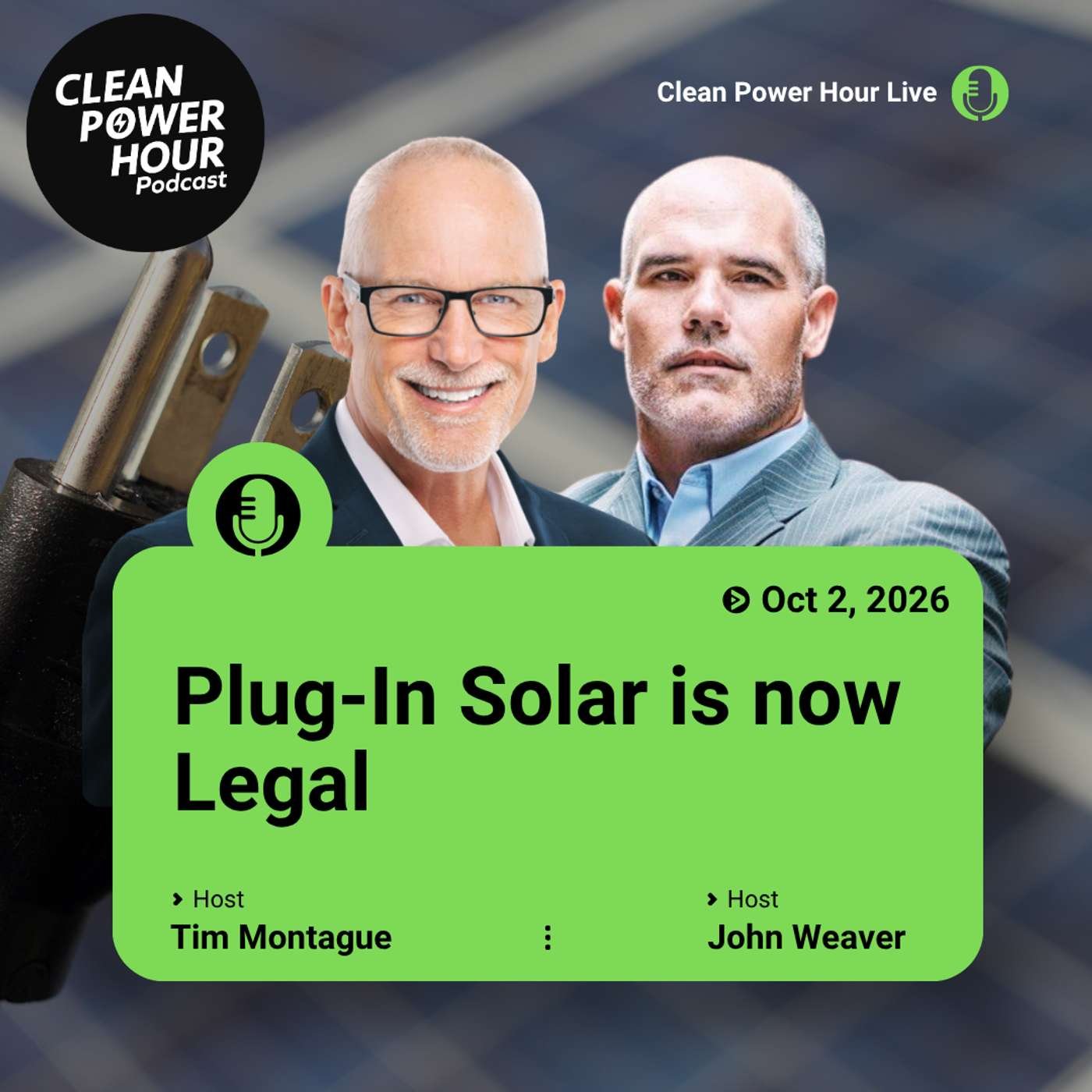
Solar and storage are moving into a new phase, and this week’s Clean Power Hour Live covers the technologies, policies, and market shifts shaping that transition.
Tim Montague and John Weaver break down the latest developments across solar, batteries, wind, grid infrastructure, and electrification.
In California, Governor Gavin Newsom has signed legislation supporting virtual power plants and making plug-in solar officially legal. The hosts discuss what these changes could mean for distributed energy, grid flexibility, consumers, and the future of behind-the-meter solar.
They also cover US solar manufacturer ratings, a Google pilot for hourly carbon accounting with battery storage, solar repowering, UK grid interconnectors, the world’s tallest wind turbine, and the 45X tax credit. These stories land as California utilities report record profits and power costs in the state run twice the US average.
Episode Highlights:
- Governor Newsom signed bills to contain utility spending and pay customers who let batteries, EVs, and appliances ease grid stress (Canary Media).
- Finlay Colville rates US solar manufacturers from AAA to C, with First Solar at number one (PV Magazine).
- A Google-backed pilot demonstrates hourly carbon accounting for US battery energy storage using granular certificates (Energy Storage News).
- A Foundry Logic study argues replacing old panels adds significant new capacity to the grid (Heatmap News).
- An insider quoted by Roth says, “We are moving into a positive political environment for solar” (Roth).
- Roughly 10 GW of UK grid interconnectors link Britain to Europe (Financial Times).
- Germany installed the world’s tallest wind turbine at 300 meters, as tall as the Eiffel Tower. Tim questions the economics, and John points to a higher capacity factor at greater heights.
This episode suits solar professionals, battery storage professionals, project developers, policy watchers, and clean energy investors. California’s new VPP and plug-in solar laws, the 45X tax credit debate, and the growth of solar repowering all affect project decisions right now.
Connect with Tim
Clean Power Hour
Clean Power Hour on YouTube
Tim on Twitter
Tim on LinkedIn
Email tim@cleanpowerhour.com
Review Clean Power Hour on Apple Podcasts
The Clean Power Hour is produced by the Clean Power Consulting Group and created by Tim Montague. Contact us by email: CleanPowerHour@gmail.com
Corporate sponsors who share our mission to speed the energy transition are invited to check out https://www.cleanpowerhour.com/support/
The Clean Power Hour is brought to you by CPS America, maker of North America’s number one 3-phase string inverter, with over 6GW shipped in the US. With a focus on commercial and utility-scale solar and energy storage, the company partners with customers to provide unparalleled performance and service. The CPS America product lineup includes 3-phase string inverters from 25kW to 275kW, exceptional data communication and controls, and energy storage solutions designed for seamless integration with CPS America systems. Learn more at http://www.chintpowersystems.com
0:51
Welcome to the Clean Power Hour Live. Today is october 2. I'm Tim Montague, your co-host, and we're bringing you the latest and greatest wind, solar, and battery news with none other than John Weaver, the commercial solar guy. Welcome to the show, John.
John Weaver:
1:06
I just bring more wind news, Tim. I bring more solar and storage, so that's good point. Wind is included here. By the way, Germany just installed the tallest wind turbine in the world. Really, twice as high. Yeah, it's really cool slash weird looking stuff. How
Tim Montague:
1:24
many megawatts is that turbine?
John Weaver:
1:27
I think it's a smaller 1234. You know, not a big one. It's just really tall. It's as tall as the Eiffel Tower.
Tim Montague:
1:34
What's the What's the point of making it so tall then if it's only a couple megawatts? Because they have turbines that are 15 megawatts offshore.
John Weaver:
1:42
Because more wind, higher capacity factor, the higher you go up. It's just kind of a nature. The way the Earth spins causes wind. So
Tim Montague:
1:50
like why? But you can get anyway. I don't get it. That sounds that sounds non economical.
John Weaver:
1:57
Well, it's the the largest size that you can put on the land, which is six seven megawatts. What they do, maybe eight,
Tim Montague:
2:05
yeah,
John Weaver:
2:05
higher.
Tim Montague:
2:07
Okay, you said two megawatts at first.
John Weaver:
2:10
Well, I don't know what it is. I just know it's the highest. I don't even care what the rating is. It's shiny. I care that it's shiny and cool. You brought up wind, not me. I know solar.
Tim Montague:
2:24
It's true. We're biased. We bring a lot of solar, solar and batteries, and you know, it's it's it is what it is. I I I live around a lot of wind farms. I thought I'd work in the wind industry before I worked in the solar industry because I saw so many wind farms coming into Illinois. But here I am. I found my way to solar. So
John Weaver:
2:48
cool, man. Yeah.
Tim Montague:
2:50
Should we talk about California, or
John Weaver:
2:53
we talk about all kinds of stuff? California is very recent. There's two two cool things that the governor signed, which people will like and will think are neat. VPP funding, so just a little bit of cash, and then the second one, which people will talk about a lot more, because it's going to affect a lot more people very directly, and that is that the balcony, no, the plug-in solar law is officially signed in California, so it's now legal. Whereas you could sort of do it before, but it's now legal to do plug-in solar in California. So we've got a
Tim Montague:
3:32
story from Jeff St. John in Canary Media. Newsom finally says yes to virtual power plants.
John Weaver:
3:38
Yes,
Tim Montague:
3:38
California's outgoing governor approved bills to contain utility spending and allow customers to get paid to let batteries, EVs, and appliances ease grid stress. Yeah, I mean this is a good thing for grid operators and consumers. It helps control costs. And Newsom was expected to not sign the legislation because he's frankly in the pocket of the utilities. But well,
John Weaver:
4:08
there's an additional piece of data. It's that in prior years he's actually vetoed VPP bills.
Tim Montague:
4:14
Yeah,
John Weaver:
4:14
and I thought it was only one, but until I read this article and I found out there were actually three, I knew of the one because I've written about it for PV Mag. So, so yeah, so it was just cool to see him sign it. It's like, all right, great, good job, thank you for signing it. I guess he used to work for or closely with PG and E, is what I've heard historically. But I don't know. Is he really in the pocket of the utilities, or is he just?
Tim Montague:
4:40
Oh, I think they're. I think they're giving him lots of lots of money to be a politician. But I, yeah, he's. That's why, frankly, I don't want to see him be our next president. I know he wants to be the next president, but I don't believe that we need someone like Gavin Newsom in the White House. That's my personal opinion.
John Weaver:
5:06
I think I think the VPP bill. I don't know if that's enough for me to vote for him for president, but he did also sign a second bill for plug-in solar. Ah, maybe that would make it close. So the plug-in solar bill is also kind of neat. Just it's just California doing something that's big because California is big. What I am, I mean, and we've talked about it here, so I don't know if there's anything new to say. It has to be UL 3700 approved, and and maybe we could review some of the new systems that are coming out. We actually talked about one a week or three ago, a few weeks ago, but I just you know. When California does it, it'll be cool, and I'm wondering if we will be able to see the effect of plug-in solar on hosting capacity maps. Like, will there ever be a hosting a plug-in solar density high enough that it actually has an effect on the grid and causes like a big. Will
Tim Montague:
6:12
will you have to register your plug-in solar project? No,
John Weaver:
6:16
no, not in California. No interconnection. So why would
Tim Montague:
6:18
how would anyone know that you have plug-in solar?
John Weaver:
6:21
I well statistical analysis. Your meter stops drawing. I mean, you'd have to be exporting, but I don't know. I mean, I I literally just wrote an article that we could even chat about if we wanted to. But any ISO New England ISO they just mentioned they had their 500th duck curve day. You know, for them that's great. California has it every day, but this is New England, and so they were proud of number 500, and within it, they talked about how they didn't explicitly know how much electricity behind the meter solar was generating. They only had an estimate because what do you know? You know, either a they shut off the light bulb or b they plugged in the solar. When it's just one panel, it's not exporting very much, so so I don't know if we'll ever know this. I mean, places that have VPPs related to solar, we might be able to know. But I've only seen VPPs with energy storage so far. So this
Tim Montague:
7:25
article doesn't reference the plug-in solar. But before we leave this article, you know, it does say that he vetoed. The governor did veto a bill on community solar. California strangely still does not have good community solar legislation, and it also said that says that the utilities were opposing the VPP legislation because it puts a cap on their ability to spend capital, and for which they earn regulated profits and recover via the rates they charge customers. Meanwhile, it also says that the cost of energy in California is twice that of the average in across the U.S. and that utilities are also reporting record profits. So that kind of is validation of my thesis that the governator is in bed with the utilities in California. But it's good that they have BPP legislation. I'm happy.
John Weaver:
8:31
Yeah, I I mean the California prices have nothing to do with our current the current governor of California. They were there before he got there. He's just existing within those time periods. They may have heavily started to arise when he was vice governor, because or vice yeah vice governor because it definitely had forest fire legislation happening, and that forest fire legislation is like 20% of their electricity bills out there.
Tim Montague:
9:03
Yeah,
John Weaver:
9:04
it's a big chunk of their bills. So
Tim Montague:
9:06
yeah,
John Weaver:
9:06
so that that's a thing. I mean, an interesting little nuance about California electricity bills. Yes, they're amongst the highest rates in the United States, but they are not the highest energy bills in the highest states.
Tim Montague:
9:23
Well, they have a very mild climate in a lot of the state, right?
John Weaver:
9:26
Well, they also have for states that are even have parallel climates, like say South Carolina, South Carolina has some of the highest bills in the nation. California doesn't because of efficiency. California requires high quality house builds, high efficiency, high this, high that. So California, I remember this argument because I've had it many times before, you know their electricity rates were going up for a long time, and then they started. And no, the electricity rates kept going, and their population kept going, but their electricity use as a state flattened out, and so this is because in the early 2000s they started working very hard from an energy efficiency standpoint. So yes, California has some of the highest rates, but they're not in the top 10 for highest bills. I think they're outside the top 10.
Tim Montague:
10:25
Yeah.
John Weaver:
10:25
So for whatever that means, you know.
Tim Montague:
10:28
Well, I'm glad that let's move on to the Finley Colville story. You found this in PV Magazine story by Finlay Caldwell who hosted a conference I don't know last week or two weeks ago in Texas on solar panel manufacturing in the
John Weaver:
11:37
U.S. in the U.S. specifically U.S. solar panel manufacturing and we're going to do.
Tim Montague:
11:43
We're gonna do a roundup with him and the editor of PV Magazine in I think a week, so that'll be coming out on the Clean Power Hour shortly, hopefully. But you see here they've done a triple A, double A, A, B, and C rating of of most or all of the manufacturers that make solar panels, and there's some surprising information here. I mean, I'm not surprised that First Solar is ranked number one, but
Unknown:
12:12
yeah,
Tim Montague:
12:13
I'm a little surprised about the the C ranking there. But what what do you what are your thoughts about this?
John Weaver:
12:22
Qell, I assume they would be higher. Canadian Solar, I assume they might have been lower, but Canadian is definitely higher than T1 and Boviet. Warri, Honan. I mean, Hounan, I know them. I guess they're kind of light.
Tim Montague:
12:41
Honan.
John Weaver:
12:43
Jinko, I would assume, but Jinko has a lot of financial issues, so they're kind of a challenging company. It's it's three quarters. Well, so what are the
Tim Montague:
12:53
what are the what are the criteria that he used to give this ranking?
John Weaver:
12:58
So there's a full. He actually has a very complex criteria that I've read about when he just looks at the whole industry, like he looks at a lot of people, and he looks the companies that tend to be at the top of his thing, and this is why First Solar is perfect for this, tend to be across the supply chain, because having control of your material, having control of your supplies from his perspective, is an important thing, and so First Solar just it literally makes the whole thing. It makes the cells. It makes the wafers. It makes everything because there are no cells. There are no wafers. It's just spray painted on a on a surface. So that's the number one. Then you get to the number two level. Maybe they're really big financially. Maybe they're a subsidiary of another company. That's why I like say Corning. They're poly. can still be way high up, even though it's probably on sketchy financial footing. And then as you go lower, it just turns into the financial backing of each of these companies. T1, which used to be Friar Battery, which is I guess an English group, Norwegian, Norwegian. Okay, I'm. That's interesting that they're at the same place as Q Cells because Q Cells I would have put in a similar bucket as Corning because Q Cells has a massive, massive Hanwha manufacturing conglomerate behind them, like one of the largest companies on earth is the owner of QCell. So I was surprised they were just an A. I would have assumed they would definitely be higher than Canadian Solar. I mean, Canadian Solar's module manufacturer who's probably barely breaking profit selling modules, if at all.
Tim Montague:
14:43
Well, it doesn't seem to be so much about their financial standing as like what what part of the value chain are they tackling? No,
John Weaver:
14:52
it does have to do with. I mean, that definitely financial standing matters as part of this. It really does. Yeah. Yes. If you get into if you get a chance to read some of his longer form and everything he writes is long. Just start scrolling. You'll be there for a while. He doesn't write short stuff. That's not his style, but it definitely has to do with financials and strength. And that's why crossing the various. That's why crossing the barrier. Really, he says
Tim Montague: right here:
15:17
companies with B and C ratings are typically active in one part of a silicon-based value chain, such as ES Foundry, Saniva for cells, and Seg Solar. Correct,
John Weaver:
15:30
but that's not like the driver of their thing. It's just that's where those companies happen to be because of because of who they are. Those who have the ability to cross all the supply chain tend to be the financially better companies. They tend to be, but that has an effect probably on his psyche. Saying, "All right, you know, are these people super stable at making sales, or are they just an average cell maker? Meaning they're inherently unstable because they're only in one space. It's just a little more complex. It just definitely has more layers than what what they're in, and yeah. So I like reading his stuff because it's really long, and I had to go back to it once or twice just because it's long. There's a lot to say.
Tim Montague:
16:23
Yeah,
John Weaver:
16:23
and and I learn new manufacturers and who's actually putting stuff in the ground, and this is kind of Eckert's baby. You know, you should. I know you're probably interviewing Ryan. Are you interviewing Ryan Candy? Yeah. So Ryan's awesome. That's a that's my boss. But Eckert, he has wanted to have an upstream. Manufacturers' perspective, and to get those types of people into the magazine and paying attention, and so this is kind of like this show and and working with Finlay. I mean, he's probably been he's been working at this for a while to have something like this. So if you ever see him, give him a pat on the back. I'm gonna I'll be doing it in Vegas at least and saying, hey, good job at getting your show, because Finlay Ryan Ryan's been working on the show. I mean, I know Finlay has, and Eckert though, because he's been asking me for people to call. But all of them have been working on this show for a very long time, so it was kind of cool to see it come to be. I wish I would have been there. I just just kind of busy, but now you know some manufacturers. So so that's it. Yeah,
Tim Montague:
17:25
and this sister story about the methodology and the capex. It says capex to reach 12 point 2 billion by end of 2026, but then you look at this graph.
John Weaver:
17:44
Yeah, three plus three is six. Plus four is 10. Plus two is 12.6. Yeah, so maybe 13, or maybe it's going to pick up this year. I don't know, but it's definitely only 3 million this year.
Tim Montague:
18:01
So that's the Cumulative, okay.
John Weaver:
18:05
He's big on capex spend, so I've been reading him a little more recently since he's been posting in PV Mag over the last few months. This is a new thing he's launched with Terawatt, and we covered it. So we've covered him in some of his launching articles because I was excited, and he and it's fun to read because this is stuff I don't know as much about, but he covers this capex stuff a lot. He said it used to be very big. It used to be much easier to research and a bigger thing for him to talk about because it was happening in Europe in public companies, and so every quarter you would get research on the capex that these companies were deploying, and he's like, "Man, that was just home run. But then he said, as it switched to private companies and Chinese companies who don't have the same regulatory data releases, it became more challenging. So maybe he's seeing, and I think he said something about U.S. companies having better data available than Chinese companies on this stuff, so he's kind of happy to see it. So I'm I'm look talk to him about. Well, have you already interviewed him, or is the interview in a week?
Tim Montague:
19:11
No, the interview is next week.
John Weaver:
19:13
Cool. Ask him who's going to spend the most money. I'm sure it's going to be first solar. Maybe Tesla. 10 gigawatts would be a huge amount. If they actually do it, I don't think they're going to do it. Maybe they will. They got tax. They got a tax approval for land in Texas.
Tim Montague:
19:31
Yeah.
John Weaver:
19:32
So I, you know, I don't. I don't see why.
Tim Montague:
19:34
I don't see why they wouldn't do it. Like they know, Elon knows that solar is where it's at, and he wants to put a lot of solar panels in space. Also, you know.
John Weaver:
19:48
Yeah, yeah. Well, okay. Next story is
Tim Montague:
19:52
Google backed pilot,
John Weaver:
19:54
huh?
Tim Montague:
19:55
Google backed pilot demonstrates hourly carbon.
John Weaver:
19:58
Yes. You know how they storage
Tim Montague:
20:01
news.
John Weaver:
20:03
Yeah, you know they say you can't. The sun goes down. Well, Google doesn't care. For Google, the sun never goes down. That's what the title should be. For Google, the sun never sets, which is also true because they got data centers all over the earth, and one of them is always in sunlight. But so the story is is
Tim Montague:
20:24
in energy storage news by April Bonner, Google Back Pilot demonstrates hourly carbon accounting for U.S. battery energy storage using granular certificates.
John Weaver:
20:35
Yes.
Tim Montague:
20:37
All right.
John Weaver:
20:39
So, Google has PPAs with clean energy, all kinds of stuff all over the world. In certain reasons, regions they know exactly the hour by hour, minute by minute when they're going to have energy from a certain resource, and when they don't get that energy, they buy it from just from the grid, which is dirtier. Because Google, I think, just maybe only buys clean energy, probably not the case with every data center, but so they buy the clean energy, but then they see gaps. You know, it's Thursday evening. It's in the winter. The wind isn't blowing yet, and there's a four-hour gap. Google is now contracting with batteries to purchase solar to fill the gaps, so that they can say around the clock they're getting pure, 100% green, clean electricity, and that's kind of neat because that's. Sunshine when you want it. What's that word they always say? Dispatchable is solar dispatchable? No, you don't control the sun. You don't control the wind. All right, good point. But that's not what needs to be controlled. The current, the photons, the electrons, and we are getting there with these batteries. I'm very interested to learn the cost of everything here and how pencils. Just that's that's part of the magic of this deal. Of course, you know, delivering sunshine whenever you exactly want it is really the magic. The PDF and the spreadsheet, isn't it? But but I'm just this is cool. This is cool. Dispatchable sunlight. No, the sun comes up when we demand it, Timothy. That's the that's what Google said.
Tim Montague:
22:29
Well, that's the that's the magic of batteries and why why I'm taking the battery MBA, right? Like that is why it's that is that it it's such a huge unlock that we didn't have five years ago, and and now every solar professional is a storage professional, and I just dropped an interview this week. We should probably put this on screen, John. Clean Power Hour. Go to cleanpowerhour.com, and you'll see my interview with Simon Engelke. Why batteries are the key technology behind the next energy economy with Simon Engelke. Okay, he is the founder of the Battery MBA.
Unknown:
23:18
Oh, cool!
Tim Montague:
23:19
And you know, so Simon is a good example of a battery first energy professional. Like that's what he did in college and grad school, and that's what he's doing professionally, right? Like that's his whole life as a professional. That's neat. And and yeah, it's it's very exciting. I mean the the people in this in this program, and when you listen to the interview, you're going to want to get in the program, and and you can find information at cleanpowerhour.com how to get$100 off on the NBA. But there are people from Fluence and major automakers, VW. So there's manufacturers, there's battery testing professionals. There's people interested in minerals and mining. The whole value chain is represented by the the students, and then there's a whole legacy of courses. I'm in I'm in cohort 18, but there's 17 cohort cohort cohorts before me, and you have access to all that information. So check it out at cleanpowerhour.com. All right, so I'm glad Google is going 365, 24/7. Right? They can. They're rich. Money's not an object. Like, it just isn't.
John Weaver:
24:42
Yeah, I mean, I guess their electricity bills aren't really an object. They're not that big. So, so good job, Google. I thought that was cool. It was cooler than just cool because it's you know solar 24/7, bro. And I kind of like that.
Tim Montague:
24:57
Microsoft has famously done this as well.
John Weaver:
25:01
24/7.
Tim Montague:
25:02
Yeah.
John Weaver:
25:06
Okay. And then, and
Tim Montague:
25:07
then, what they're trying to do is also like go back in time to like fill all the the gap. I don't know what's the starting year that they're going back in time too, but but you know the sun. We have to remember the sun rains down 10,000 times more energy than all of humanity uses. So we're
John Weaver:
25:29
just
Tim Montague:
25:30
we're just putting we're just putting our little pinky out and saying here let's let's power society, and it's totally doable, especially with batteries. It's either batteries or a Dyson sphere on Earth. I'm a big fan of a Dyson sphere on Earth, also. All
John Weaver:
25:47
right, blue sky. I got a cool map of the UK, and it's just a bunch of power lines
Tim Montague:
25:54
that connect the UK to the EU.
John Weaver:
25:57
10.3 gigs worth. I don't know the exact number. I could count them. 1-234-567-8910, 11am. I sharing it? I can share it. It's pretty picture.
Tim Montague:
26:11
I got it.
John Weaver:
26:13
Oh, you're faster than me. That is
Tim Montague:
26:16
a pretty picture. That looks like a pumped hydro facility. Is that what that
John Weaver:
26:19
is? It's hopefully it's power lines because this is an article about power lines, but
Tim Montague:
26:23
it looks like a power plant.
John Weaver:
26:26
Well, it's probably the point where the power lines go into the water.
Tim Montague:
26:30
Yeah,
John Weaver:
26:32
I mean that's how to keep the lights
Tim Montague:
26:33
on in an electrified world in the Financial Times.
John Weaver:
26:37
Yes, yes, I got the link to Blue Sky directly to the image that I want to look at because. Because I don't have an I don't have a subscription here, but keep scrolling. And there's cool map of the UK, and this stuff is neat. You'll just have to scroll through it for a little bit. But yep, keep going, keep going, keep going, keep going. Good article. Lots of good stuff in here to read. Go to the Financial Times. Great source. Sometimes they have good stuff. Sometimes they don't.
Tim Montague:
27:04
You're gonna tell me when to stop scrolling.
John Weaver:
27:06
Well, you see a cool map of the UK.
Tim Montague:
27:08
Is that what this is? Oh,
John Weaver:
27:09
you're almost there. Nope. That's cool though, but it's not the thing. Here we go. Interconnectors. So 10 gigs of electricity can move into or out of the UK. I don't know if it exactly happens at the exact time, but or if it could. It seems like it could, but if there's just power lines everywhere, I think that's kind of neat. At some point, I'm sure the people of the United Kingdom will start to say, "Hey, we need to have some more of our own electricity. Well, no. If you got 10 of them, that's that's the the the challenges of any one particular line falling kind of go away. Yeah, if you got 10 different lines connected. Well, it should also
Tim Montague:
27:54
show their indigenous resources. Obviously, they are they also have significant wind, mostly wind, I think, not solar so much. But
John Weaver:
28:03
they got they got decent amount of solar, like double digits of gigawatts.
Tim Montague:
28:06
I mean, when I see this, I think okay, they're they're buying cheap hydro from Norway. Norway has a huge amount of hydro, and then cheap wind from Denmark. Denmark has huge amount of wind power. I don't know about the Netherlands, but
John Weaver:
28:19
maybe it's a nuclear from France. You know, it's it's a mix. It's a mix.
Tim Montague:
28:24
Yeah,
John Weaver:
28:25
but it is pretty neat that that little island, which is trying its damnedest to break away, is tethered, tethered to the EU via its electricity needs. It's it's now there's no longer an escape. It's uh, it is it is
Tim Montague:
28:41
they they left the EU, right?
John Weaver:
28:44
Yeah, I know. Well, I don't. You know, I always mix up EU. See, there's Europe, and everything over there is in Europe. Then there's the EU, but then there's even other organizations as you go down the list.
Tim Montague:
28:54
Yeah.
John Weaver:
28:54
So
Tim Montague:
28:55
there's Schengen.
John Weaver:
28:58
So anyway, so they're not in the EU. They're just European, but the EU has their rips via electricity, and I just thought that was a really cool, neat link. Just I don't know. I know the U.S. even has a bunch of links. New England has a neat one into Boston, actually. All straight to Boston, we get hydro pumped from Canada. That's like the best thing in the world. I mean, who doesn't like that? I don't know if you can hear the background noise, but they're warping the buildings upstairs.
Tim Montague:
29:34
Just a little bit sounds like there's some construction going on.
John Weaver:
29:37
Absolutely, it sounds great. All right, so I do have a picture of that tall wind turbine. I threw it into the ad, into the paper, just so we could share it with everybody. On
Tim Montague:
29:46
blue sky.
John Weaver:
29:48
Yeah. Well, yeah. It's on blue sky, just so that people could, you know, see what the heck a a tall wind turbine looks like.
Tim Montague:
29:56
Okay, I got
Unknown:
29:59
it. Yeah. It's just tall.
Tim Montague:
30:03
That is quite the the tower. You look
John Weaver:
30:06
at that tower, dude. There's a lot of steel in that tower. A lot more than what's down low. I mean, jeez, that thing looks like a one of that old Lego set that I had when I was a little kid.
Tim Montague:
30:18
It's true. It really, it really is very Eiffel Towerish.
John Weaver:
30:24
It's true, and somebody was saying, "Hey, it also represents a really bad design from a bird roosting perspective. They said, "You don't want all that lattice because birds will try to hide there, and they all stop and hang out, and you want to make sure they don't. I was like,"Oh, isn't that going to
Tim Montague:
30:47
get killed by the blades?
John Weaver:
30:50
I maybe, but not necessarily. I mean, the blades are way up. Big birds are apparently much smarter and avoid this stuff really well, much more than the extremists would like you to believe. But apparently, roosting on them is an issue because they're so tall that tall that high flying birds will be like, "Oh, look, let's go hang out there, because it's not they don't have to go down that far or up that high. It's a it's a easy stop off versus all the way to the ground, which is kind of a tough stop off. Takes a lot of energy to get going.
Tim Montague:
31:23
How tall is the tower? Does it say?
John Weaver:
31:25
Oh, it does. Let me. Nah. I mean, come on. I should know this. Of course, I should know this. 300 meters. Three football fields.
Tim Montague:
31:37
So a normal two megawatt turbine that we would see here in the Midwest, two or three. Megawatt turbine is like 100 meters, maybe. I mean,
John Weaver:
31:47
maybe because if you look at those pictures, it was definitely double, more than double.
Tim Montague:
31:52
Yeah.
John Weaver:
31:53
But yes, yeah, maybe. Because that that thing was pretty huge. It looked like the rest of the guys looked like little tiny kid wind turbines that were hanging out.
Tim Montague:
32:03
Repowering existing solar farms. All right. Yeah, this is an important story.
John Weaver:
32:09
I think so.
Tim Montague:
32:11
Heat map news. All right.
John Weaver:
32:14
Oh, you might not be able to log in.
Tim Montague:
32:16
It's letting me see it so far.
John Weaver:
32:19
Well, we'll see. Well,
Tim Montague:
32:20
yeah. It it just gives me a preview. Do you want to share it?
John Weaver:
32:24
Sure, sure. I mean, I put the key info in the top that I think you could even just read off of, but I'll share the article.
Tim Montague:
32:30
So, heat map. It's a story by Emily Pontecorvo. The great solar repowering. A new study from energy company Foundry Logic argues that simply replacing old solar panels could add significant new capacity to the grid. The thing is, you know, when you do this, you also need to replace the inverters. You can't just repower with much higher wattage modules, right?
John Weaver:
33:00
Why not?
Tim Montague:
33:02
I don't think that works. I think. I think you have to upgrade the inverters.
John Weaver:
33:07
I don't think so. Not necessarily. I mean, you probably have to replace them. You can't increase the AC connection. You might need to upgrade the inverters for modern code requirements, UL and the such. But in terms of, you're just going to have wider shoulders.
Tim Montague:
33:24
Yeah,
John Weaver:
33:26
and batteries. I think the re. I think the real repower here. Everybody, here's a technique. Here's a tool that I shouldn't tell anybody, but I think all of you developers should do it. Buy up the land surrounding existing solar plants so that you can repower the plant, and then add solar plus storage behind its interconnection for the rest of the hours that aren't being used by the solar. So figure out how to make a 24 hour solar power plant and buy enough land to sur and surround it. So that's the key. So you want to surround it so that this interconnection can't connect to anybody else.
Tim Montague:
34:10
Yeah.
John Weaver:
34:11
You want to like buy up all the right of ways. I don't know if this is actually possible. This is just what I say in my head how I'm going to strike it rich one day, and and that buy up all the land. So that's the sales pitch. Give me a commission, please. Send it to my Venmo.
Tim Montague:
34:27
I would encourage you if you're interested in repowering, check out episode 341 with Matt Murphy. He has a company called Flux Energy, and what is it? They their sole business model is repowering solar farms. They're starting with community solar in Massachusetts, they're going to be moving to Illinois shortly, and probably New York. Right? You just think about where those community solar projects happen first, and they're retrofitting in batteries, and thereby avoiding upgrading the interconnection. So they're not getting a new interconnection to the grid; they're adding more wattage, you know, or kilowatts to the array, right? And then absorbing that juice with batteries.
John Weaver:
35:14
Now, as you say that, it also it made me think that you could, in fact, upgrade the inverters so that they can handle more wattage, but then derate them to match the original system's interconnection export, and I wonder, I you know, it's probably going to go that way because keeping crappy old inverters, unless they're just rock solid or something, may or may not work because of the way you know designing inverters and that kind of stuff works. So, but I thought that was neat. They were talking about doing, you know, 10s of gigawatts a year, which is, you know, an industry in and of itself. And we're getting asked to do a re-roof very shortly, sometime in the spring. It's going to be a a big mall nearby. has about 125 kW of solar that needs to come down, or at least be removed, stacked, palletized, and redone. So, looking forward to doing that. It's kind of a cool little job.
Tim Montague:
36:12
I've got a hard stop in 10 minutes, so just
John Weaver:
36:15
1010, That's it.
Tim Montague:
36:17
Keep that in mind here for the for the last couple of stories. We we don't want to forget your project of the week, John.
John Weaver:
36:24
Yeah. Well, let's we'll do that one. Let's let's do the ITC feel good, but not real story of the week. But let's do it, and then we'll do my project of the week, which is where I was at this morning, really early listening to electricians say things I don't understand, but. Sort of get, and I have to pay for. That's the worst, man. When people are saying things and they're asking you to approve it, and you're like, all of you know more than me. Why are you asking me to pay? And it's it's like, wow, you guys know so much cool stuff. I love hanging out with electricians. They just know a lot of stuff. It's neat, especially Patrick Edwards. He's our he's our main construction guy, and he's just been one of those guys that's been doing construction since he was kid. His dad was in construction. He hung out with people that were in construction, and I don't know. It's kind of fun to hang around and listen and learn. Makes me feel smart or less smart, but smarter at the end of the conversation. All right, this is Roth. I love Roth. I love reading them when they're insiders, and I just liked this sentence. I might even write this sentence for an article for PV Magazine. Is maybe jumping the shark, but somebody said that to Roth, and they quoted him. We are moving into a positive political environment for solar. That's pretty cool.
Tim Montague:
37:48
And why why do they feel this way?
John Weaver:
37:52
Um, I think it has. Well, later in this article, well, this was a pretty long article from Roth, and or just not an article, sort of. You know, they they do their reports, but they you know, they may put it in here in the layer things. Well, scroll down a tiny bit. Nah, that's just a picture I took from it, so that that won't do anything for you. Maybe I added some notes. Here we go. 45x. So they're talking about extending 45x. The number 140 5x supports American manufacturing. That's the manufacturing credit, but the manufacturing credit isn't worth much if the domestic content credit isn't there, because who the heck wants to buy super expensive stuff if you can get it cheaper, unless I'm getting a 10% tax credit. So I think them being tied together is something. Plus, to be honest, the people that love the tax credit the most. That's big bankers. That's wealthy people. I mean, I was literally in a conversation yesterday with a guy who sounds like he knows a whole bunch of stuff about batteries, and he owns assets. He's developed assets. He's been part of asset movements, and he said, "I can't wait for the tax credit to go away. It'll just make it easier. He goes, "It's just so hard selling with it. It's so hard. It's infinitely hard developing with it. And if you don't use it, you can't compete with the other people because prices are inflated and this and that. And it's like, I feel you, man. And I'm going through it right now, trying to sell our tax credit. Maybe I'll do a tax equity partnership. Maybe I'll do a tax transfer. And it's hard, and it's all new knowledge, and it's it's a different, it's a whole new career. And everybody I talk to that's in this is really good at it. And I hope the guy who's supposed to be helping me, he's literally calling me right now, Adam. I'm talking about tax credits, and you, and you literally called me back while I'm talking about selling my tax credits. So, Adam Shore is the guy who I'm trying to get to help me with this stuff. We've been playing phone tag, so now I'm now I'm gonna have to say something to him. But it's tough, but it's still coming, you know. So I, I think it's going to get approved. I remember, remember, Trump approved it. So think the tax credit got cut because of wind and because he wanted money to pay for ice. That's the reason it got cut. So I think it's coming back.
Tim Montague:
40:23
Yeah. Well, we'll see. Time will tell, and
John Weaver:
40:27
one
Tim Montague:
40:27
way or another, we're going to have a good solar and battery industry. So I'm not too worried about it. Well, the battery industry
John Weaver:
40:34
is going to be great because it's awesome. It's growing, and it's still got a tax credit. So, all right. So, project of the week. This is, and you know, we'll have one or two more stories after that, the most. But this is a project we're building in Fall River. Modules. Well, in this picture, this is last week. Modules were like just past 50% So
Tim Montague:
41:00
that whole roof is going to get solarized.
John Weaver:
41:02
Yes, sir.
Tim Montague:
41:03
And what's the size of the array when it's when it's all said and done?
John Weaver:
41:08
1794.
Tim Montague:
41:10
Wow,
John Weaver:
41:11
megawatts, about just short of 2900 Canadian solar 620s. We're using DCE racking. It's just just big giant square, and and let's see, and solar edge inverters, and it's just going to be. And I was on that roof this morning. I was actually in the lower right, where you can see the wall space is where our gear is going to be going, and. I met some electricians to talk about placement and what's going on, and then and then I went on the roof and just kind of walked around and talked to folks.
Tim Montague:
41:54
It's a 1.7 megawatt project.
John Weaver:
41:57
1.8.
Tim Montague:
41:58
Okay.
John Weaver:
41:58
1794.
Tim Montague:
42:00
Yeah. And what what is in the facility,
John Weaver:
42:05
they make jerseys for NFL teams, I believe.
Tim Montague:
42:09
All right,
John Weaver:
42:10
yeah, they're like the build. It's full of these cool giant threading machines, I guess. And and if you walk through it, and you're not allowed to take pictures because you know I want to take pictures of everything, but as you walk through, there's these just big cardboard boxes full of big rolls of, I guess, cotton thread, and it's pretty cool. So time for one
Tim Montague:
42:37
more story.
John Weaver:
42:38
Okay, one more story. Let's see. Let's see. Let's let's make it a. You know what? Do you want to make it a fun one or a hey? Solar is better than everybody in the world one.
Tim Montague:
42:48
Let's do fun.
John Weaver:
42:49
Okay, Friday. Let's do yeah, fun Friday. Let's do this one right here.
Tim Montague:
42:53
Bentley EV.
John Weaver:
42:55
Yeah, baby.
Tim Montague:
42:58
All right.
John Weaver:
42:58
Oh, you're not gonna be able to open that one. I'm gonna have to share that
Tim Montague:
43:01
one. Oh
John Weaver:
43:03
yeah. But you can read about it.
Tim Montague:
43:04
Bloomberg Bentley debuts first electric car, a merino-lined luxury SUV. Merino, as in merino wool.
John Weaver:
43:14
Yes, and notice it says it's an entry level, so it's just fine, Tim. It's just an entry-level car.
Tim Montague:
43:23
Yeah.
John Weaver:
43:25
It's one of the
Tim Montague:
43:25
and and the the the ticket on this merino lined luxury SUV is what
John Weaver:
43:31
I don't know, like 180 Gs or 180 euros.
Tim Montague:
43:35
Wow,
John Weaver:
43:36
plus probably an import tariff because you know it's just cool. It's a big electric EV, man. That's what I like. I just like that it's a cool EV, and all this technology that they put into these EVs. Come on, they got an ad. You guys aren't any cool. This stuff slowly does filter down how they do stuff. I mean, maybe not the merino wool and the fine leather, but the tech that they develop, it it just moves, and they figure out how to do stuff with it, and so, plus, I don't know. I'm not a car guy, but cool, shiny cars are pretty nice. I'm a, I'm a guy who likes. Here, let me see if I can find the original. Yeah, I can. So not a car guy, but a big, cool, neat EV that I don't know, just starts from the top down and and just changes the industry. You know, we're in a time of change of the car industry, and it seems like the companies that are most successful launching EVs are pure EV companies.
Tim Montague:
44:41
Yes, I
John Weaver:
44:42
don't. It just seems that way. the The most successful. I mean, VW's done great with some stuff, and BMW, Mercedes, but they're still, you know, they're still gas companies, gas car companies. So it's they're not as sharp. I don't know. Some of the EVs I've seen from BMW and Mercedes were really nice, just just luxurious because they make luxurious cars. I don't know, I don't know. My Hyundai is pretty awesome of an EV. Well, you know what? That's a good one. There's an example. Hyundai's making an EV, and it's it's my Hyundai Ioniq is a pretty awesome EV. So, all right, Tim, where can listeners find you?
Tim Montague:
45:24
Check out all of our content at CleanPowerHour.com. Tell a friend about the show. That's the best thing you can do to help others find this content. Reach out to me on LinkedIn. I love hearing from people on LinkedIn, and would definitely come visit us in Re Vegas at Re Vegas in November.
John Weaver:
45:43
There we go. How about you, John? How
Tim Montague:
45:45
about you?
John Weaver:
45:47
CommercialSolarGuy.com. That's my website. We're also on LinkedIn, and I like sharing stuff on Blue Sky a lot. So if you want to get a preview of what's going to happen here, and you like reading, then follow me on Blue Sky because pretty much everything I post here was posted on Blue Sky in the last two weeks. That's really how I do it. So you know, now you know my secrets to wealth and podcast fame.
Tim Montague:
46:13
Follow John on Blue Sky. That is really the key. All right. Well, John Weaver, I want to thank you for being here every other week, and we'll see you again on october 16. Let's grow solar and storage. I'm Tim Montague.