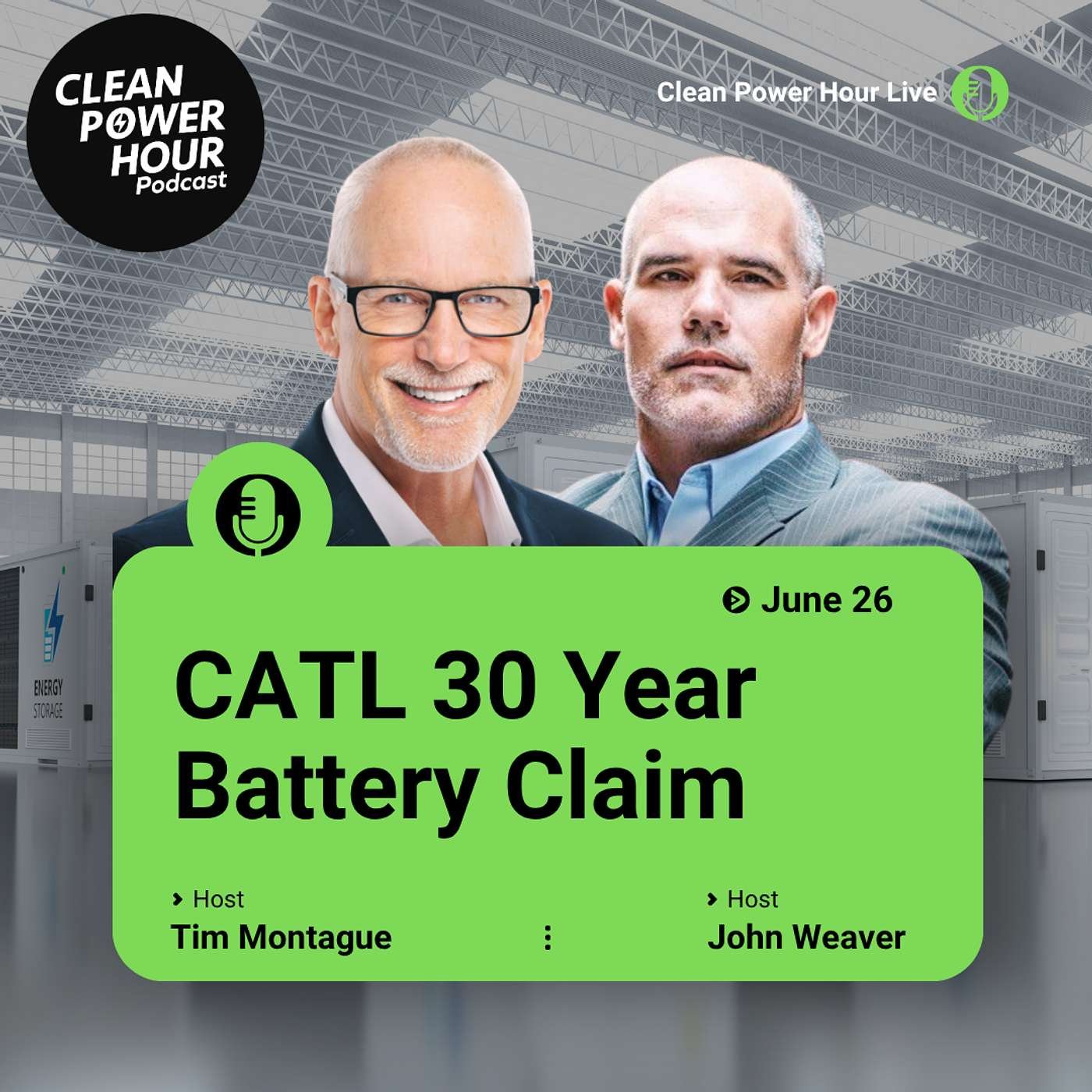
CATL unveiled its TENER Sodium energy storage system at Intersolar Europe in Munich, rated for 15,000 cycles to 70 percent state of health at room temperature. CATL frames that as a 25 to 30 year service life, and it takes only 34 modules to stand up a one gigawatt-hour site. That single specification changes how commercial storage professionals price, propose, and finance battery projects. Tim Montague and John Weaver dig into what it means, alongside Illinois growing from about 80 megawatts of solar a decade ago to over 6,000 megawatts today under the new CRGA law, SunBallast ballasted racking and what module stacking tells you about install labor, UK bids for 16 and 18 hour long-duration storage, perovskite modules reaching the residential market, El Niño shifting solar output across the US, and silver falling more than 50 percent from its 2026 peak.
Episode Highlights
- CATL sodium ion battery, 15,000 cycles: CATL launched its TENER Sodium system at Intersolar Europe in Munich. It is rated for 15,000 cycles to 70 percent state of health at 25 degrees C, which CATL frames as a 25 to 30 year service life, and just 34 modules build a 1 GWh site. (Energy Storage News)
- Sodium ion safety advantage: CATL claims its sodium cells cut expansion force by roughly 40 percent, generate about 35 percent less gas during thermal runaway, and hold peak surface temperatures far below comparable lithium ion. The fire and thermal-runaway story is a big part of why C&I buyers are paying attention to sodium. (Interesting Engineering)
- Sodium ion in the fast-response role: John flagged a detail from a CATL hybrid storage proposal where sodium was specified for the faster-response duty and lithium for the slower role. Worth keeping in context. This is one proposal’s configuration, not a blanket claim that sodium beats lithium on response everywhere.
- GM and Peak Energy sodium ion partnership: General Motors is moving into stationary storage with Peak Energy, backed by a strategic investment from GM Ventures. GM will develop the sodium ion cell in its Michigan battery lab and keep exclusive manufacturing rights, while Peak integrates the cell into its passively cooled storage systems. Peak energized the first U.S. grid-scale sodium-ion system, 3.5 MWh, in Watkins, Colorado, in 2025. (Inside Climate News)
- Illinois energy transition, 80 MW to 6 GW: Tim attended a Nexamp event at the company’s Chicago office, where IPA director Brian Granahan reported Illinois has grown from about 80 megawatts of solar a decade ago to over 6,000 megawatts energized today, with roughly 14.5 gigawatts of wind and solar developed under the state RPS (13 GW to date plus about 1.5 GW just approved). The engine is CRGA, the Clean and Reliable Grid Affordability Act (SB 25, pronounced “Surge”), which runs its first utility-scale storage procurement in August, the opening tranche toward 3 GW by 2030 via additional 2027 and 2028 rounds. Residential VPP enrollment opens in mid-July, with ComEd and Ameren customers able to put home batteries into a short-term scheduled-dispatch pilot this summer. (PV Magazine)
- SunBallast racking and install labor: The hosts walk through SunBallast ballasted, no-penetration racking and get into the labor economics of module mounting, including what the way different manufacturers stack modules for shipping tells you about handling time on the job site.
- UK long-duration storage bids at 16 and 18 hours: Fresh procurement results out of Scotland and England show projects awarded at 16 and 18 hours of duration. John notes it is the first time he has seen bids at that scale and ties it to Scotland’s wind-heavy generation profile. (Blue Sky)
- Trina Solar perovskite module hits residential market: Trina landed its first commercial order for a perovskite-silicon tandem module, going into New Zealand’s premium residential market. The record-setting module is 907 watts at 29.2 percent efficiency, certified by TUV SUD. (Perovskite Info)
- El Niño and solar irradiance shifts: John walks through regional solar output swings across the US and globally. Rajasthan, India, home to some of the world’s largest solar plants, is projected to run about 15 percent above its seasonal average this season. (PV Magazine)
- Silver prices fall more than 50 percent: Silver has dropped from its late-January 2026 record near 121 dollars to the upper 50s, more than half off the peak, on a stronger dollar and a hawkish Fed. It matters for PV because silver paste is a real line item, and World Silver Survey data shows solar’s silver demand down about 19 percent. (TheStreet)
This episode is essential for commercial solar installers, battery storage developers, community solar professionals, and clean energy policy watchers. The sodium ion story has direct and immediate implications for how professionals structure storage proposals, financial models, and customer conversations. Illinois developers will also want Tim’s firsthand account of the CRGA storage procurement and the residential VPP pilot going live this summer.
Connect with Tim
Clean Power Hour
Clean Power Hour on YouTube
Tim on Twitter
Tim on LinkedIn
Email tim@cleanpowerhour.com
Review Clean Power Hour on Apple Podcasts
The Clean Power Hour is produced by the Clean Power Consulting Group and created by Tim Montague. Contact us by email: CleanPowerHour@gmail.com
Corporate sponsors who share our mission to speed the energy transition are invited to check out https://www.cleanpowerhour.com/support/
The Clean Power Hour is brought to you by CPS America, maker of North America’s number one 3-phase string inverter, with over 6GW shipped in the US. With a focus on commercial and utility-scale solar and energy storage, the company partners with customers to provide unparalleled performance and service. The CPS America product lineup includes 3-phase string inverters from 25kW to 275kW, exceptional data communication and controls, and energy storage solutions designed for seamless integration with CPS America systems. Learn more at http://www.chintpowersystems.com
0:50
Tim, welcome to the Clean Power Hour Live. I'm Tim Montague, your host, bringing you the latest and greatest clean energy news every other week with none other than John Weaver, the commercial solar guy. Welcome, John.
John Weaver:
1:08
Hey, Tim, I heard that El Nino is hitting Illinois, and you and your travels are seeing short corn, and I have also seen other documents for solar weather across the US, and it's interesting to see how it's starting to affect solar output, so it's interesting that you're seeing it in the corn, which is kind of cool.
Tim Montague:
1:35
Yeah, I'm sure the community solar developers are bumming. We've had a very cloudy, cool, and wet summer in Illinois, and I'm not a meteorologist. I really am just shooting from the hip, from what I read about the super El Nino that's happening, but it does tend to cause cooler, wetter weather here in the Midwest, and that is indeed what we're having. I would guess, John, and I'm not a farmer either, but I have some friends I can, I can verify this with. I would guess the corn is two feet shorter than normal. It'll be fine in the long run. I'd rather have a little too much rain than not enough. It's no fun when we're in drought. We were in drought last year, so I can't complain. It's also pretty mild temps, which is great for pickleball, although rain is not good for the pickleball.
John Weaver:
2:30
If we want to, we can look at a topic on there's an article I have on some weather across the across the world, and how solar is affected in it, but let's go,
Tim Montague:
2:42
bro. I love that. Let's do
John Weaver:
2:43
it. It's the second article that's on our document, but it's good seeing you anyway, Tim. Nice to hope everything's going all right there.
Tim Montague:
2:51
Life is really good. Life is really good, and we're getting ready to be on vacation for a little while, for the Fourth of July, taking a long weekend to Pennsylvania to visit my brother and sister and father. So that's always a blast. We get to hang out, we get to splash in the Delaware River, at the clean end of the river, at the very source of the Delaware River, known as the water gap. All right, developing El Nino set to reshape global solar resource. If only I could put this on screen, I will do that. But what are you seeing in that story there, John?
John Weaver:
3:30
So, globally, there is some change, but you know, more particularly, they have a map of the US. If you scroll down a tiny bit, and you can see in the Midwest, not the upper Midwest, that it's tilting toward green, which is less solar irradiance. The South Central Texas, you know, along the border, it's tilting toward red, but then along the northeast, along the east coast, down into Florida, a strip across the Midwest, the upper Midwest into the plains, down into the southwest. It seems average-ish. There's a, you know, there's a bolt of green, light green that's across, so you know, on average it looks like across the whole of the US, it's average, but you can definitely see regional variation versus prior periods, and across the world, you can see a lot of variation. In fact, this article was really interesting. One thing I pointed out, it's that a region in India, Rajastha, Rajasthan, one of the large, some of the largest solar plants in the world are there, and they're expecting 15% greater solar output, and that's like, I wonder how that might even affect inverters if you got so much extra juice getting pushed, but I, they probably can manage it, but it's interesting.
Tim Montague:
4:55
So, the red is above average irradiance,
John Weaver:
4:59
yes,
Tim Montague:
4:59
and the yellow is average,
John Weaver:
5:01
average, and then green, and green is below
Tim Montague:
5:04
average,
John Weaver:
5:05
yes. So, it's just interesting little map of the US, you know, across the world, you can see plus or minus, this varies every year, and also you know, maybe this is a good moment to just say out loud to contractors and O and M people things they already know, but have it repeated that production goes up and down every year, and if a customer gets on your case and says, hey, you told me my system was going to produce x. You should respond and say no. The system is going to produce plus or minus x, and you, as a customer, should be cool. And I know it's hard to be cool as a customer when your system isn't generating the money you think it should, but I have a great example recently. Um, at a project in Bristol, which has been producing great for three years, in fact, 10% above for three years. It had two years in a row that were down, and customers started elbowing me, and I'm like, well, you know, this is the way weather works, and here's other systems in the region, and they, they didn't want to accept it, and and then there was also Canadian wildfires that were affecting it, and this is the summer after that, and they're like, well, maybe it's dirty, and I was like, all right, well, we can get you a cleaning, and so we, you know, we went through the process, we made sure to collect data before we have module level data, because it's a solar edge install, we did a cleaning, and there wasn't an ounce of difference, which was interesting. After four years, we clean solar panels. After five years, and it looked almost the same. We could see some visual on the edges of the modules, but we're near the ocean. We're in the Northeast. We're in a region that has heavy rain and heavy snow, and every year the modules get professionally cleaned by the snow gods, and so it was just very interesting to see, you know, and this year the system's come back, it's got some good strong production again. So it was a good example for me to see a system we installed performing well, to see it go up and go down with the weather, to see a cleaning not have an effect, which you know by default, you know, I'm like, yeah, clean it, but I've also been taught, you know, in certain regions you don't need to clean unless you got heavy pollen or this or that, and I just saw an example, and so here's a good example with El Nino: keep it in your head, folks, this year your production may be different. Weather patterns are evolving. You happen to be in an industry that's dependent on the sun, clouds, rain, and all that stuff. So,
Tim Montague:
7:42
yeah, the other thing is, I don't think developers think too much about, like, 20 years in the future. Well, and we really, when we're developing projects, we have to think 20 years into the future, because the projects are meant to be out there for 20 years, and like wind load, it's the weather is getting gnarlier, it's getting different, so it's not easy to predict the future, but you know, you got to be on the safe side. So, all right, cool. Well, let's move on. I got.. I wrote a little story here in PV magazine. Got to get this on stage. How Illinois is leading the country in the equitable energy transition. I was lucky enough to take Amtrak to Chicago on Wednesday, and I went to an event at Next Amp Chicago headquarters. Next Amp is the largest community solar developer in the United States. They're based in your fair city of Boston, Massachusetts, and you can look forward to an interview with Zada Shy, their CEO. I interviewed him just last week for the pod, so that's to be dropped. But this was a very cool gathering of a bunch of very influential people in the solar market here in Illinois, and I'm just going to give you a taste of who all that was. We had Zadashy, of course, the CEO of Next Amp. We had Kavi Chintum, Vote Solar's Illinois campaign manager. We had Jess Collingsworth, Nexamp Central Policy Director, Marcus Evans, he's the Illinois state representative, assistant majority leader, and current president of the National Conference of State Legislatures. Brian Granahan, our director of the IPA, the Illinois Power Agency, which is our PUC, Marion Jones, Vice President of Community Engagement and Workforce Development for Next Amp, which is cool that Next Amp has that role, and we were celebrating diversity, equity, and workforce development in the clean energy transition. There was a big panel discussion that Jess led, Jess Collingsworth, and shout out to Jess. Thank you for hooking me up with Zad Ash. It was long overdue for me to connect with Zad for an interview. I have a long history with Next Amp. I originated two community solar projects for them in, I think, it's Grundy County, I'm not even sure, but somewhere in the west suburbs of Chicago, back in the day. This is back in 2019 and you know they were, they were just very assertive about the Illinois community solar market, and, and you know, see so much runway that they propped up the second headquarters, but one of the coolest things about the evening was that they had a group of fellows there from from two groups, they had the City Colleges of Chicago that had. A partnership with Next Amp, their chancellor, Juan Salgado, was there, and there was an organization called Celi, the Clean Energy Leadership Institute, was there, and that is a nonprofit that, excuse me, mentors young professionals in clean energy, and they have programs in all the major metros, and that's a growing footprint, and they call their alumni sea lions, which was really fun, and the other, the other cool thing about the event was Audrey Steinbach was there, she's the energy storage director for the IPA, and we were talking a lot about Surja, the Clean Reliability Grid Affordability Act, the new energy legislation we have, which is unlocking VPP, which I highlight in this story. So, in, I think, next month, in July, the VPP is going to get rolled out, and then in August the state of Illinois is going to run their first utility scale procurement of energy storage, so ultimately Illinois is in the process of procuring three gigawatts of energy storage. Brian Granahan pointed out that in the last decade, John, Illinois has gone from 10, sorry, 80 megawatts of solar in 2016 to 6000 megawatts of solar that is now energized in the state, and together we're looking at around 13 gigawatts of wind and solar that is in the pipeline here in Illinois, so this legislation is a nice, I guess, counter balance and juxtaposition to markets like Texas, which I have nothing against. The Texas way, though, is to install a bunch of utility solar, that's how they've, you know, achieved a 50% solar and wind grid. It's 90% utility scale here in Illinois. It's more 5050 We have a lot of DG, including community solar and rooftop solar, and then we also have utility solar and storage. So I would encourage developers who are working in places like Illinois to lean into workforce, and they have to, I think, 14% is the statistic, they have to have 14% of their projects being built by equity eligible contractors and individuals and low-income communities. etc. etc. Any questions?
John Weaver:
13:37
You know, the biggest, coolest thing about, and you did talk a lot about Next Amp, but I think people should hear a lot about Next Amp, because, or try to learn more. They're just a go-at-ic company, very aggressive. They've worked real hard in many years to get ahead, they had a lot of techniques for growing. They used to knock on doors way back when. I think that's how they got their start in Massachusetts, trying to get people to sign up. They had a bunch of young folks going out there just with good energy, and they grew into New York, they grew into other community solar states in the Northeast, and then they just like a few others made a move to Illinois. When, when they decided, and you know, it's funny, I joke whenever I see a next amp press release, I always say next amp doesn't say much, they just put out press releases when they get 500 million bucks in finance, and that's saying a lot, you know. When you drop, get massive financing, you put out a press release, but that's all I really see them say in the press, you know. Maybe they talk here at events, so that they can collect other smart people to hang out with them, but they're not out there doing too many interviews. So, you getting them learning about them, talking about them, it's they're a company to watch, you know, they're like a, they should be more known, they're an industry famous company, but they should be like an energy famous company, because they're, you know, they got gigawatts of capacity, and they're growing, and I think they'll become more, especially with batteries, they probably have a probably have a massive amount of in-house talent of just intelligence, you know, those names you were running across as you first started saying their name, in my head I was like, I don't know them, but the job titles you were talking about, I was just saying to myself, wow, I mean, that must just be like decades and 10s of gigawatts of installation experience, all the little nuances that the people at Next Amp have learned must just be massive just to be able to dig through all this stuff, so yeah, and just last
Tim Montague:
15:37
week it's also noteworthy, I'll put this on screen, they made an announcement and did a ribbon cutting in Manon, Illinois, in Woodford County of a. Community Solar Project, that's a collaboration with Turning Point Energy, and this project was built on old coal mines in western Illinois, so it's central west Illinois. I've walked that ground, there's.. it's just old beat-up ground, you know, it was heavily mined, the, the easy fine, you know, the easy getting coal is gone, and but it's a great story. It's part of this transition, and I have a related announcement, John, and that is that I am now producing a short documentary film about the energy transition in Illinois, called A Just Transition, and I kicked it off with seven interviews at Inner Solar last week when I was in Chicago with some OGs in the industry, like Kevin Borja and Jonathan Roberts from Saltage, Kevin is from Sunvest and and so I'm going to tell the story, though. How a coal state and a nuclear state has become a solar, wind, and battery state, all the while looking out for jobs and justice, and it's a good story. And I have a long road to hoe here. This, this is a big project. It'll take me six to nine months, something like that, probably nine months. If we're lucky, it'll see the light of day in a year, in June of 2027 which would be sweet, because that's our 10th anniversary of Feja taking force in Illinois, that was our first major energy legislation that got signed in 2016 and went into force in June of 2017 So one
John Weaver:
17:44
thing I want to throw in there, though. Yeah, you said you're like, how it transitioned from being a coal and nuclear state to being a solar and storage state, but it's still a nuclear state. I mean, we very much are a
Tim Montague:
17:58
nuclear state. We're not leaving nuclear anywhere right now. We're subsidizing it with our energy legislation that started with Fiji, continued with CJ, and we have 40% of our grid power is from nuclear, so Illinois, Illinois is like already, I mean, effectively we're 100% net zero carbon because of the massive amount of nuclear, and we're exporting a lot of those resources, so Illinois produces more energy than it consumes in the state
John Weaver:
18:36
job. Illinois,
Tim Montague:
18:37
yeah, that was something that Granahan NJC Kibby from the state of Illinois was also there. I forgot to mention him. He is the climate.. I'm not sure climates are for the state of Illinois, for lack of a better word, but yeah, that was just a really cool event, and I would encourage, I've been talking with John Carson at Trajectory Energy, another community solar developer, about doing an event downstage, so we'll see if we can get something going. Similarly, I thought it was just a great way to celebrate our success and and highlight the goods that are happening both for the people and the industry. All right, let's move on.
John Weaver:
19:25
So something I wanted to show you from last week, or last time we were here, we were talking about Sun Ballast, our new racking system. Yeah, and I wanted to point out explicitly the attachments, because I didn't know exactly the units and how they were doing the mid clamp and different types of attachments, and so I got some good images on this, and within them are a couple of key images that we'll like, so here's just, you know, the modules being laid out, you can see the optimizers, the racking piece. There's an image from my Blue Sky account. So this is just a, you know, a nice blue. So that's
Tim Montague:
19:57
before the module is attached, obviously, because the ballast is going to be underneath the panel, right? No,
John Weaver:
20:04
this, this, the module on the left is attached. There will be, there will be a new module attached on the right, though. So the ones that you can see are fully attached. Oh,
Tim Montague:
20:13
I see it sloping to the right. Yeah,
John Weaver:
20:15
correct, correct. Left is on the north, the rights to the south. So, let's go to the next image somewhere in here. So, so this, well, here you start to see it. I have a better zoomed-in image, but you can see the two mid clamps that are just right between the modules, and you can see one of the mid clamps that will be attached on the brick at the bottom half of it, so they're just standard mid clamps that hold them down, but they're big and chunky mid clamps, and I do have an image that's nice and close. So this is a different version of a clamp, so this is a clamp connected to a mid support, and you'll see a different image of the. Structure of this mid support clamp, because it's a kind of a long arcing arm, which is a little different, but this just grabs on the side in the middle of the module to add a little bit of support and a little bit of lift, and so this is not a standard mid clamp, but it's in the middle, and it is a clamp, it's just a different arm, I don't know the technical name for it, but it's the central arm that offers support and holds it down,
Tim Montague:
21:16
and it looks like those clamps are pretty easy to install. Is that? Would you say that? Yeah,
John Weaver:
21:22
absolutely. In fact, I was talking to the installation crew, and they said the labor, they said it's heavier to deploy these units because they're big and chunky, but once they figured it out, the installation is fast. In fact, they caught up with the procurement team and outpaced us and led to a couple of days, two days of lost labor because we weren't ready for them. Once they got going, they started blazing through the labor of this, so we're going to do a review, because they're going to do two separate systems, and here's those mid clamps, they're super easy to attach, and you just bolt them down one one at a time, but we're going to do a review. Oh, so here are those strange mid clamps. So this is one of the middle support bricks, and this is that little arm, it reaches out above and below the module to clamp down, so it can grab, but the whole module goes completely above this, so there's no like center area, but this is a different way of grabbing onto the module in the center of it, where it calls for it, and this that arm kind of swings out it, and once they move it out a little, then they tighten it down. I like it.
Tim Montague:
22:40
It's pretty clean, I have to say. And yeah, this
John Weaver:
22:43
is nice and clean. So this is both sides attached. Wire management is ongoing here, so we're lots of clips, lots of lots of how do
Tim Montague:
22:54
you, yeah, just you're keeping the wires off the roof surface,
John Weaver:
22:59
yeah. So we have a bunch of metal S clips underneath that are grabbing onto it.
Tim Montague:
23:03
Okay,
John Weaver:
23:03
now this is like the Golden Rose, so they're still touched. So this was yesterday, but now as of today they're at like 55% modules down.
Tim Montague:
24:02
Wow,
John Weaver:
24:03
they're moving along,
Tim Montague:
24:05
and this is like a one megawatt project or something like that.
John Weaver:
24:09
So this specific project is 670 ish kw,
Tim Montague:
24:17
okay?
John Weaver:
24:17
Right next to it, these are the Helene modules. Right next to it is its sister project, unique parcel, unique structure, and it is 900 so between themselves they're 1.7 megawatts of modules, and then just some Helene labels, you know, but I just wanted to point out specifically that that clamping thing, I always wonder,
Tim Montague:
24:41
this is a really geeky question, but how did the manufacturers decide if they're going to stack their modules horizontally or vertically on the palette?
John Weaver:
24:54
You know, recently somebody told me it's industry standard to go vertical now. Why are you buying old style stacks? You're gonna.. I don't.. I don't
Tim Montague:
25:02
agree. I don't think that's.. I'm not
John Weaver:
25:04
smart enough to answer. I don't know this answer, but..
Tim Montague:
25:07
and I honestly, I wish there would be more horizontal. I understand why they do vertical. I think it's like when you stack plates for moving, they say stack them horizon, stack them vertically, it's stronger that way, but. but
John Weaver:
25:22
scary. What's nice about the
Tim Montague:
25:24
horizontal is it's easier for the robot to grab, and as soon as you unwrap the palette of the vertical, they can tend to want to, you know, domino over one way or the other. You have to build a jig sometimes to keep the palette from wobbling too much, right, because they got cardboard wrapped around them and shrink wrapped, right, but then you have to tear all that off, and then you got this kind of wonky dealing with the vertical, so I like them, I like the horizontal stack.
John Weaver:
25:58
Yay, hello, yeah, I so far we get mostly that stacked that way, I haven't actually had a portfolio where they were vertically stacked, though I see him online, and one of these days somebody's going to yell at me about it, so I just thought I thought that some ballast is pretty neat, you know, they're so far, you found
Tim Montague:
26:24
you found that a luminous video?
John Weaver:
26:27
No, this is called Ozzy. Ozzy's their competitor. Well, I don't know, maybe sort of competitor, but this isn't a robot, this is a human who's doing the work here.
Tim Montague:
26:38
Oh, an operator.
John Weaver:
26:40
Yes, I just.
Tim Montague:
26:42
Gonna get this on screen. This is a cool video. Yeah,
John Weaver:
26:46
I'm glad you agree.
Tim Montague:
26:50
Too many tabs, too many tabs, John.
John Weaver:
26:53
I only got one tab open, Tim. I'm focused on the show, just for our listeners and watchers. Tim, come on.
Tim Montague:
27:01
All right, check that out. So they're doing two rows simultaneously. That is interesting. I've never seen that where they work on both rows in parallel,
John Weaver:
27:13
and I'm sure there's so many other little nuances. Notice how the modules are stacked vertically. That was interesting. You know, they said 31 modules, so they did a palette. They said it took them 10 minutes, if you in the notes to deploy a palette. It's a seven person team, just very interesting stuff. I wonder if the vertical stack is better, and I noticed the last module was the other direction, that's to protect the backside, so there's so many little things to to watch and learn about, and you know, see how these folks learn. I mean, it's, you know, you see how quickly they attached. They saw a cracked
Tim Montague:
27:49
module in there too.
John Weaver:
27:51
Oh, did you? Holy crap,
Tim Montague:
27:52
I don't know. It was right towards the end. There was one that looked like it had a golf ball had landed in
John Weaver:
27:59
it. Oh, let's watch the last one. Oh, wait, it just froze. That's messing with us too much. Let's see what you get
Tim Montague:
28:08
there, right there. You see that?
John Weaver:
28:09
Well, no, that's the junction box, that's the backside. It's flipped.
Tim Montague:
28:13
Oh, okay. Bi facial modules.
John Weaver:
28:16
Yep. Yes, sir. Yes, sir. Yeah, so it's like the whole stack is facing outward, except for the back one. It's kind of like a loaf of bread, you want to make sure the inside of the module isn't exposed. I don't think that's a thing, but maybe it's to protect the wire. I don't know. Yeah, modules don't like fresh air, they get, you know, they get a crusty solar panels are in the air too long. That's not true. I don't think you're listening to me.
Tim Montague:
28:44
Well, dude, they do, they do age, okay. The second law of thermodynamics is a real thing. I wouldn't, I wouldn't want to install solar modules that have just been sitting in a warehouse for five years. Even personally, I think that shortens their field life, but I'm not a, I'm not a procurer of solar modules. I'm somebody who looks over the shoulder and says, yeah, I think that's a decent module. You should consider that. You know what I do, John? I take the module data sheet and I take the report card, right? Who does the report? Kiwi,
John Weaver:
29:29
yep,
Tim Montague:
29:30
is it Kiwi, Kiwi, Kiwa,
John Weaver:
29:31
Kiwa,
Tim Montague:
29:33
Kiwa, Kiwa,
John Weaver:
29:34
Kiladu, Reliability Scorecard, Reliability Scorecard. Let's see, and
Tim Montague:
29:43
then I feed, I feed the scorecard and the data sheet into Claude or ChatGPT, and I say, "Analyze this and give me a read. Now, they have to – the manufacturer has to have participated, obviously. And if the manufacturer isn't participating in these scorecards, that's also a yellow flag. I think you know it's not cheap for them to do that. Kiwa formally, what was the old name,
John Weaver:
30:10
P Vel.
Tim Montague:
30:10
Yeah, P Val. So, anyway, that's just for our listeners. If you're in the procurement business and you're comparing two modules, that's a very good, simple test to do. How does, how does the P Val reliability score card measure those two manufacturers and modules, and there, and it brings up subtle things that is kind of cool, like some will have slightly thicker glass, and those, and the, and the, and the chat GPT will say, if you're in a high hail zone, this might be a better choice than B, right? A versus B. All right,
John Weaver:
30:54
all right. Next one, Autovoltaics. This, in my opinion, is a bad solar plus car integration. Tim, you're right, you're right. It is. It is. So, let's see if we.. it's just.. it's just from the internet, Tim. I don't know the source. It's just, you know, all right. This is a
Tim Montague:
31:18
very bad.. Can you tell what kind of car that
John Weaver:
31:21
is? I have no idea. I like the rims. The rims are nice. Those are bifacial modules. And if you think about it, the solar held, is this real, or is
Tim Montague:
31:29
this.. is this.. is this AI?
John Weaver:
31:32
Oh no, this is real. This is real. I, I read the report on Reddit, and I asked a couple of questions. So, it's somebody crashed through a fence in their car, they. Hit a ground, a single axis tracker, and the car caught on fire, and so that speaks of the strength of the solar project. I mean, if you, I mean, it did go through two rows and it ripped up one tube, but the majority of the solar just kind of shook it off, and I bet you, I bet you, there's only like two or three strings of modules that are affected here, and so you know, car bombs, a solar is defensible against car bombs, you know, is maybe the new headline, you know, only small portion of solar farm taken out by..
Tim Montague:
32:18
Do you know where the particular graphically.
John Weaver:
32:21
Oh, I gotta go back to that link.
Tim Montague:
32:25
Solar Boy had a funny video on his channel recently. He had a crane that fell on a rooftop solar project, apparently it fell while he was in the vicinity, and he documented it somewhat in real time, but check out Solar Boy B O I on YouTube. I
John Weaver:
32:48
have a story of him that I am working on right now. He built a nice off-grid system whose purpose is to be connected and unconnected, so be reinstalled by people, by trades people who are training, so he's he's helping the world
Tim Montague:
33:07
unconnected.
John Weaver:
33:08
Yeah, sorry, just assembled and de-assembled, that's bad. It's not even connected to the grid, it's an off-grid system that's within a school, and I'll get to show you some cool pictures of it pretty soon, but it's, it's just he's helping kids learn solar at a trade school, and that makes me happy.
Tim Montague:
33:23
Yeah, yeah, he's a good guy, all right. Price of silver is falling pretty hard,
John Weaver:
33:30
yeah. I just wanted to show people that, because you know, price of silver is a chunky cost of modules, and it peaked at like almost 120 bucks, and now it's down by 50% plus it's down to like, like 60 bucks, it's.. it's, and so that makes me wonder, how module people will.. oh, you have to pay for this stuff, Tim. Maybe I have to share this one, because I pay for Bloomberg.
Tim Montague:
33:56
Yeah, if there's more to it, you can.. you can put this on screen.
John Weaver:
34:00
Yeah, just wanted to show the graph. Stop
Tim Montague:
34:02
sharing, so you can share,
John Weaver:
34:04
share screen s1 quote, so it's really just just showing what happened with solar, or the price of silver. I mean, we look over five years, there was a massive run up starting in 25 at peak in early 26 we can see here at like $101 it was actually higher than 101 and then now it's fallen off to under 60, and so this has led, this peak led to a change in the solar industry, where they're pushing away from using as much silver, they want to get tighter with it, but now it's fallen off, and so it's like, all right, How do you react? What's, you know, the this is a weird little industry that we're in. We have some commodity exposure. How do module manufacturers react? Is is silver going to stay? I know what's so silver going to do. Is it going to go back down to 20 and 30? I mean, people were already thinking about moving to copper. Some people already moved to copper with back contact, and so it's just interesting to see this happening. I'm wondering, how people are going to react.
Tim Montague:
35:15
Can you put, can you put copper on the same chart?
John Weaver:
35:20
Let's see if I can find it. I should be able to, let's see, metals, metals. Well, let's just do this. I'm just curious,
Tim Montague:
35:28
if this, if this is, if this fluctuation is wider than just silver. I don't know, so,
John Weaver:
35:36
so for gold, I can show you. First, we'll show gold. Gold has fallen off in a similar-ish manner, not as aggressively, but gold is down from its peak of like five, and it's down to like four, so it's down 20% so there is that, but then let's see, copper is C, you are no, that's silver, silver, silver, platinum, copper, here we go, so copper is up, but it's I don't think it has had the fall off. Yeah, damn it. So, copper is still on its march upward. It's over six bucks, you know. That's that's rough. I mean, I'm used to buying it in the fives, you know. And I'm told, you know, before this area is back down in the twos, so copper is still going up. There's, I mean, there's been a couple of big fall offs associated with Trump and tariffs and stuff, but it's still marching upward, man. So, this is copper. Keep buy some copper and hold it, or don't, I don't know. Don't, don't listen to me, I'm terrible at investing, but coppers, copper still marching, I.
Tim Montague:
36:43
Cool. Well, we have a story about battery production, which is marching forward. This is, this is pretty, pretty wild, I have to say, John. And is this.. we're about to put.. I'm about to put this on screen, but is this.. is this just us or global,
John Weaver:
37:04
just the US.
Tim Montague:
37:05
Okay, so this is Fred, the Federal Reserve Bank of St. Louis, and this is US durable goods battery manufacturing. By what is the.. what is the measure, though? 2017 equals 100 so just a, it's just
John Weaver:
37:26
a, yeah, it's a relative value. So the way the Fed collects stuff, they just say, you know, they set in 2017 the index set their original number, so that all of this is relative to the year 2017 And then I don't know, is this capacity, is it revenue? I'm not certain if it's revenue from batteries or just capacity. I'd have to look and learn about this a little better. Exactly what these numbers mean, but relative capacity, maybe industrial production and utilization, and capacity utilization is how it's defined.
Tim Montague:
38:05
Yeah,
John Weaver:
38:05
and I to learn more about the things I have to learn, but we're going to be talking, we're going to be
Tim Montague:
38:10
talking a lot about batteries here in the, in the last 1520 minutes of the show, but I think this graph is, is, is indicative of why we're, you know, talking about storage so much, and why I, and many others, say, you know, you're no longer a solar professional, you're a battery professional that does solar, and woe is you EPCs and developers who are not into batteries yet. In my opinion, there are many out there. What percentage? Here's a good question, and maybe the audience could chime in on when we post this. We'll post this on Tuesday, but what percentage of CNI installers are doing battery installation versus not? Do you think it's, I would guess it's 60 to 75%
John Weaver:
39:10
doing or not doing, doing. Yes, I was gonna say that, doing, I was gonna say two thirds are doing it in some way, whether they're developing
Tim Montague:
39:19
it
John Weaver:
39:20
and designing it is different than installing it, but I would guess that a lot of CNI people have touched a battery now. I wouldn't call us like active heavy installers. We've installed a couple, but we're still learning how to pitch them and get them out there, but we are, but we are trying to get them, and we are trying to, to, you know, build more, so it is, it is something we're trying for, and so we're trying, we want to get into it.
Tim Montague:
39:53
Well, you're, you're going pretty hard after it, because you're developing, and you're going to own one of those battery projects.
John Weaver:
40:01
Yeah, that's true. I forgot about that one. We're still digging through the agrivoltaic aspect of it. It's, it's a challenge, but, but yes, we may own a battery project before, before soon. It's a goal, big goal. All
Tim Montague:
40:15
right, we got a story from Ed Porter on Blue Sky. Long waited LDS results are here. The minded two projects are below. What does minded to mean?
John Weaver:
40:25
I think that's just the name of the minded to. I think that's just the projects that are being considered within their description. Minded to it's just it's the British and the way they do stuff, the way they make words. The reason this is interesting, look at the column to the right.
Tim Montague:
40:46
Yeah,
John Weaver:
40:47
that's hours,
Tim Montague:
40:49
right?
John Weaver:
40:50
Look at the most of the stuff in the middle there, Tim. All of those are longer than eight hour lithium ion batteries.
Tim Montague:
40:58
Yeah,
John Weaver:
40:59
16 and 18 hour batteries, Tim. These are specific
Tim Montague:
41:03
projects.
John Weaver:
41:04
Yes, the left column is the name of the project.
Tim Montague:
41:08
Yeah, but are these.. oh, okay. So, Scotland and England.
John Weaver:
41:12
Yes,
Tim Montague:
41:13
yeah.
John Weaver:
41:15
Now, somebody.. I've been reading about this just a tiny bit this morning, and people were talking about why this is happening. Scotland has so much wind, they're a different market, they, they just fundamentally, their energy generation curves are different, and this might be what occurs in wind markets, and it's just might be how you have to, I mean, we're just, I mean, maybe long duration starts in the wind markets more so. Know, because of the way wind can blow for three weeks straight, and then not blow for three weeks. I don't know, but first time I've seen a bid like this is the first time I've seen long duration. I'm told, though, we should be a little hesitant before latching on to this, because it's super early. So, all these people, Ed Porter, Tom Hatton, these people are people that know the European and particularly the UK market really well. I follow them on Blue Sky, and, and that, so it's, it's, it's, it's just new. It's come out. It literally hit the press this morning, and we're seeing fresh news for long duration coming from across the pond, and this is cool, seeing such 16 and 18 hour man. Think about that, Tim. If you coupled that with a solar plant, and the solar project ran for six hours plus an 18 hour battery, and the solar was big enough on the DC side,
Tim Montague:
42:45
right,
John Weaver:
42:46
that's 24 hour plant right there. So I'm just really interested in this, and batteries don't have to be charged by solar, we prefer this charged by solar, wind, hydro,
Tim Montague:
42:58
sure,
John Weaver:
42:58
but nuclear too, whatever it takes to fill them up, man. But this is long medium duration, this is, you know, it's just long, it's interesting, it's.. it's something that caught my attention.
Tim Montague:
43:12
All right, we're gonna have to be selective, we got a lot of stories here. And do you want to talk about Rob Scott?
John Weaver:
43:19
Well, we should talk about the kale, the sodium battery. It's okay, let's,
Tim Montague:
43:23
let's just bring that
John Weaver:
43:24
up one
Tim Montague:
43:26
gigawatt hour from 34 modules. Catal claims purpose-built sodium ion best can help solve uncertainties facing industry by Andy Cole Thorpe in Energy Storage News just a few days ago, and yeah, this story. I think this was brought to my attention by the Electric Viking. Do you ever watch that guy on YouTube?
John Weaver:
43:50
Nope, don't watch anything.
Tim Montague:
43:52
Yeah, check him out. He's an Australian YouTuber. They have an app, you know, John, that you can get on your phone and watch videos. It's really cool. And then you can hit the Gemini button, and it gives you a written summary. You can just read about the video, you don't have to watch the video. I like to
John Weaver:
44:08
read. Yeah,
Tim Montague:
44:10
you're a reader, so now YouTube is helping you.
John Weaver:
44:15
I read transcripts.
Tim Montague:
44:16
This is nuts. They have developed a 42 ton solution, one gigwatt hour using 34 connected modules. Each module is like 30 megawatt hours. Well,
John Weaver:
44:34
so be careful though. The 42 ton is per module, so it's not.. it's.. it's per subsection for each 34 each of the modules, so
Tim Montague:
44:44
thank you for not like
John Weaver:
44:46
it's not one gigawatt hour, yes, but they're huge, they're like nine megawatt hours, and they're there's another picture of this somewhere, and they're the tenor, they're double stacked, they're just, they're
Tim Montague:
44:57
it's not in this story, the double stack, so this is the, this is, did you get to talk to Catal about this when you were in China?
John Weaver:
45:06
No, I did not actually talk to Catal at all, but this wasn't even announced, but they were talking about sodium ion there. This was this was a lot announced at Inner Solar in Munich this week.
Tim Montague:
45:18
Okay, so yeah, this is what we have to emphasize here, is this is sodium ion, right? This is the next generation, right now. It's focused on stationary. It'll eventually percolate into electric vehicles, but you know, and and we have a sister story about a company called Peak, which has a deal with GM for stationary storage. Peak is an American company, but they're importing sodium modules from China, so China is the big dog in the sodium space. No, no surprise, really. China's the big dog in battery manufacture. But there, if you want to buy sodium modules, you have to go to China. I think there's really very few other places to acquire sodium, and Shel Khan covered it on his pod a couple times. He covered sodium, so check out Shell Khan's pod, and you can understand that the capex is still a little higher, right? The physical footprint is bigger per unit of energy, right. So it's, it's a little less efficient on a space per, you know, on a volume per energy basis. You need a little more space, but the opex is better, and the operating range is better. And then you were geeking out in the. Pre show about the reaction time. Explain that.
John Weaver:
46:46
Yeah, there's two two items. One, I saw a setup of a massive sodium battery, a massive lithium, and then some other type of store storage, and they explicitly said that the sodium was being used for the faster reaction time portion, and that lithium ion was the slower technology, and that took me a while, and I still don't understand it fully, but it was just surprising to see lithium ion as the second fastest thing, because lithium ion is fast, and so, as I joked in the show, I said at the beginning of the show, is it that lithium ion is a just hit the I'm already a subscriber, you can, you can lie, and is that makes lithium ion like NASCAR because it's fast, and then sodium is f because it's stupid fast, I don't know, but I just know I've seen setups where sodium is specified as the faster product from the CATL proposal or press release. Another thing they put out there, and that's what caught my attention on this press release, they said at a 25 degree life, so a standard average temperature range, plus or minus, you know, 15 degrees. This is a 30,000 cycle battery above 70 80% That's a 30 year battery if you're using it once a day, full cycle, that's a 30 year battery, Tim. You know, that's where that 30 years, man, that's before, not too long ago, not five years ago. Tim, you and I were talking about batteries and saying, yeah, they got a 10 year warranty with 70% and, and as we were saying it, we were annoyed because we wanted to align with solar panels. We want 80% after 30 years, because that's 87% that's where we're at with solar panels, right. Well, it's coming for batteries, Tim. We're going to have batteries that are just going to last forever now, and the game is it's going to be the same thing. So try to figure out how to place yourself mentally, professionally for the fact that these batteries are going to be there forever. They're going to have, you know, last week or a couple weeks ago, we talked about BYD. You just posted it on LinkedIn, everybody. So check out our little talk on LinkedIn about BYD on Tim's page, saying 1.4 cents levelized cost of electricity from batteries. It's because these batteries are going to last 30 years. You need to build your pads, your equations, your financial model, your sales proposal to these commercial customers and say, hey, we're not selling you, you know, this isn't a battery like for your cell phone, this is a professional grade grid tied battery that's going to last a generation of human existence. Like I said, it's a 30 year battery. The game is now professional, it's no longer experimental, and, and that's the coolest thing I thought from the sodium announcement was 30 years.
Tim Montague:
50:05
I have the inside climate news story, the sister story here. Why General Motors is betting on sodium ion batteries, written by Dan Guerino. And Peak Grid Storage is the company Peak Energy completed a system in Watkins, Colorado, in 2025 so peak is, I think, one of the leaders in sodium here in the US, and in the Shokan interview, the CEO said, "We're not wedded to sodium, this is just, we think, the best of breed battery technology for the near future, and they will pivot to whatever is most economical LCOE, right, and money talks, so you know, in 10 years we'll probably be doing all sodium ion, that seems to be where things are going, but we will see, and but it's interesting that GM is now entering the stationary storage business and partnering with Peak, getting into sodium, so for stationary storage, which you know space is not as much of a premium in stationary, right, you don't need the energy density that you need in electric vehicles, and that's, and that's why you can get away with a 20% delta, or whatever it is. And then the other question that's come up that I don't really know the answer to is, is it, is it cleaner to mine sodium than it is to mine lithium? I
John Weaver:
51:43
mean, I default, or yes, because it's salt,
Tim Montague:
51:50
it's salt, it's it's a commodity that we've been mining for much longer. I just don't know, as in terms of like the greater environmental impact, so and but just note that China, again, this story mentions CATL of China, you know, they're just going really hard now after sodium, both, and this specifically says for EVs and stationary storage, so I think it will come in in EVs
John Weaver:
52:28
this year. They're talking about cables putting it in EVs already. It's already.. I saw, as I was reading about this and other related stories this morning, yesterday I saw, you know, they're aiming for a gigawatt hour in cars this year.
Tim Montague:
52:41
Okay,
John Weaver:
52:42
just of EVs. So it's. it's coming, it's here. Let's put it that way.
Tim Montague:
52:46
Yeah, all right. Can we do
John Weaver:
52:49
one last story? And it's Rob Sky document,
Tim Montague:
52:54
one last story.
John Weaver:
52:56
Yes,
Tim Montague:
52:58
it's the last one on the docket.
John Weaver:
53:00
It's the last ones right here, it's right below you. It's a resident. residential program, residential projects in New Zealand. Apparently, Trina has gotten an official first order for their product. Makes sense that it's in the, in the residential market, high-end residential, they're less pressure from, you know, bankers and engineers still care about a good quality. It's based on their 900 watt tandem module, and they're, you know, they're inching along, they're inching along, it's they have a true tandem solar cell where the where the perovskite is on the cell, so it's not in the module like some other groups are doing it, not in the glass. Okay, there's there's a split right now, some groups are doing the perovskites and glass, there's a whole collection of them, and then another group of people are doing them on the cells, but you know, Trina has this module that's 900 watts, that's at like 30% efficiency, and this panel focused on the resi market is that is on the same platform with that, so it's just cool, and they're, you know, 29.2% is a 907 watt module, and so that's a module at 29% man. So, so this is just the first
Tim Montague:
54:35
window photo of the module. I want to see the module.
John Weaver:
54:38
Ah, well, I can probably find it for you if you want, but this is maybe click there. Oh, it announces
Tim Montague:
54:45
new 907 watt power output per offscape silicon tandem module record. I mean, 900 watt module, that is a big number, apparently. The module that is three meters squared. What's what's a standard US commercial module in meters squared?
John Weaver:
55:03
The three meters is the utility scale. Yeah, it's the exact same. It's I'm looking at the 2384 times 1303 millimeters, but so standard modules.
Tim Montague:
55:13
How are they using large format modules in residential? That's that's kind of
John Weaver:
55:18
no, it's not the module for residential, it's the same platform. So Trina has a residential 600
Tim Montague:
55:25
watt module, or 700 watt module.
John Weaver:
55:27
It's probably 550 if it's residential. 500 500 to 550 would be a 29% because they're already at 500 with 23% modules, 24 so maybe it's 600 I doubt it's 700 but but that's it. That's the last one I wanted to talk about. It's just cool. It's out there, it's in the world. Somebody's touching a perovskite residential module right now, somewhere around the world. It's happening, Tim. Somebody's touching it, they're like, that's the two. It's the two,
Tim Montague:
56:02
I guess it's two of the big changes that you know we're going to be dealing with, perovskite modules and sodium batteries, and sodium – the, we didn't, we didn't talk about this, but the other advantage of sodium is it's less fire prone, less thermal runaway issues, so that's a, that's a big bonus, it'll be easier for HJS to accept, you know, a lot of there's a lot of stories flying around about HJS and counties banning, you know, creating moratoria on batteries because they just want more time to digest the safety and hazard issues related, and so. This is good, you know, for developers. That's a this is a bonus if you're, if you're a battery developer, think about sodium bonus.
John Weaver:
56:53
Lot of stuff to think about.
Tim Montague:
56:56
All right. Well, we back on july 10. Have a great Fourth of July weekend, and check out all of our content, of course, at Clean Power hour.com Tell a friend about the show, reach out to me on LinkedIn. And how can our listeners find you, John?
John Weaver:
57:17
Uh, Commercial Solar Guy com, LinkedIn, those are my best places. You could, uh, come by one of our projects in Southeast Mass. If you wanted to, one of these days, give us a call. If you're a tax credit transfer person and you need some tax credits before the end of the year, we have a few projects that we're going to own, and we're wanting to sell some tax transfers. But LinkedIn Commercial Solar guy.com that's place to find us.
Tim Montague:
57:46
I'm Tim Montague. Let's grow solar and storage. Take care, John. Bye.