Battery storage is moving fast, and the numbers keep getting bigger.
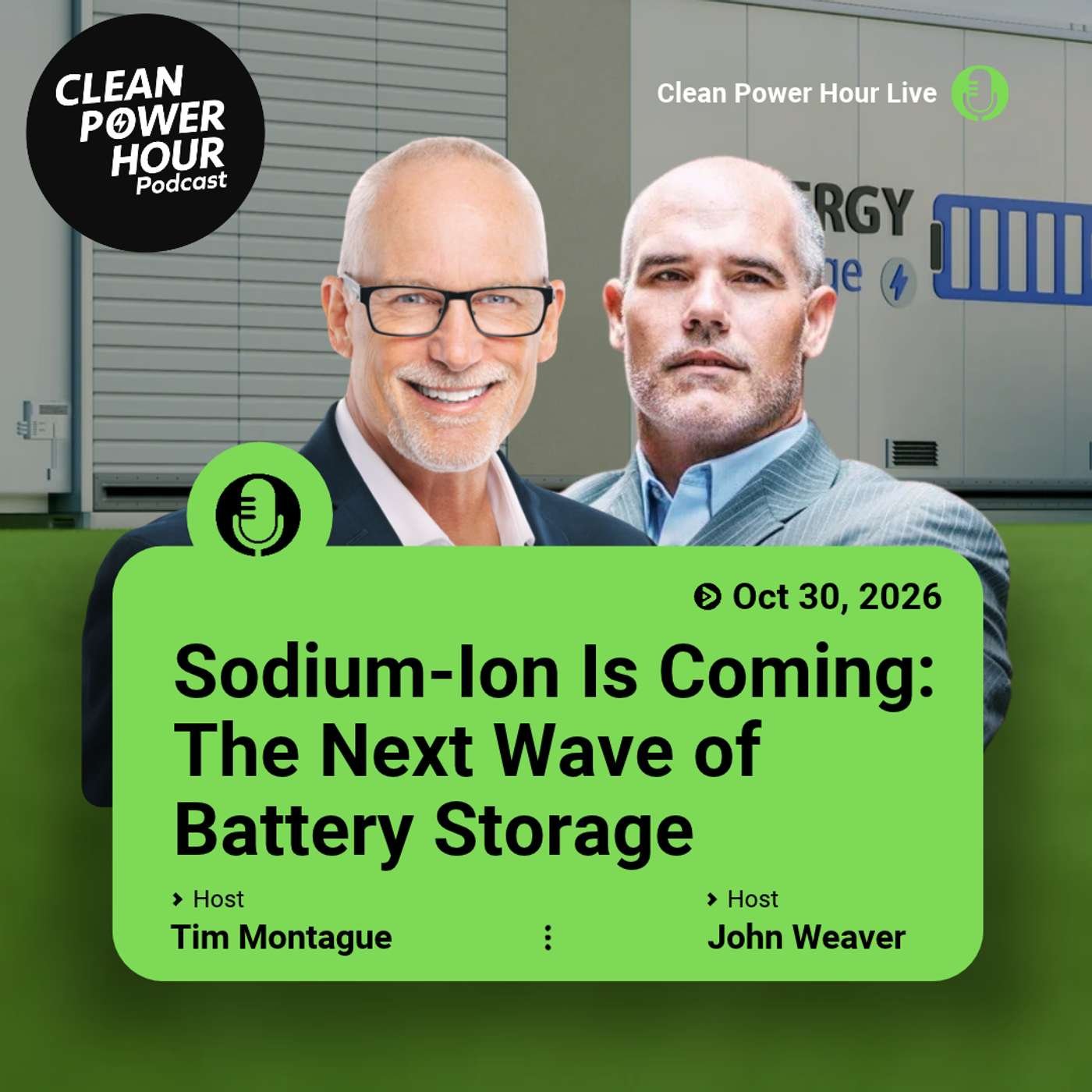
In this episode of the Clean Power Hour live, Tim Montague joins John Weaver from Melbourne, Australia, after attending All Energy Australia with CATL. They dig into what Tim learned about sodium-ion batteries, including CATL’s plans to significantly expand sodium battery production and why sodium could complement lithium rather than replace it. From there, Tim and John examine the accelerating global energy storage market, the growing role of microgrids in powering data centers, and how batteries are beginning to change the economics of daytime solar generation.
They also discuss Sonnen’s insolvency filing, T1 Energy’s solar cell import waiver, the evolution of vehicle-to-grid technology, silver and copper use in solar manufacturing, and the latest developments in high-efficiency solar modules.
Key Highlights
• Sodium-ion batteries are getting real. Tim shares what he learned from CATL at All Energy Australia, including plans to grow sodium battery production from roughly 1 GWh this year to between 10 and 40 GWh next year.
• Data centers are accelerating microgrid investment. Tim and John discuss how data centers are using combinations of solar, batteries, and generators to achieve “speed to power” while waiting for utility interconnection. [Reuters]
• Global battery deployment forecasts are rising fast. John highlights a major upward revision in projected 2026 energy storage deployments, with the forecast reaching 188 GW. [BloombergNEF]
• Sonnen files for insolvency. Tim and John discuss the German battery company’s insolvency filing, its ownership history, and what the development could mean for one of the longtime names in residential energy storage. [pv magazine]
• T1 Energy receives a Section 232 waiver. The company received permission to import up to 1.7 GW of solar cells to meet existing and expected contracted demand while its domestic cell manufacturing capacity develops. [StockTitan]
• Batteries are pushing Australian midday electricity prices higher. John explains why this could actually be positive for solar. Batteries are soaking up cheap daytime electricity and shifting it into higher-value periods, potentially improving the economics for additional daytime solar generation. [Renew Economy]
• Could cheaper silver slow solar’s shift toward copper? John examines how changing silver prices affect solar module manufacturing and discusses copper-based conductors and back-contact module designs as manufacturers work to reduce dependence on silver. [Bluesky]
• High-efficiency solar modules are reaching the 25% range. John reviews a ranking of commercially available high-efficiency modules and discusses why the relative lack of recent changes could reflect manufacturers focusing more heavily on profitability and existing production lines. [TaiyangNews]
• AIKO returns to profitability and pushes back-contact technology forward. Tim and John discuss AIKO Solar’s return to profit and its PERC-to-ABC manufacturing upgrade strategy, which could convert existing production capacity toward higher-efficiency back-contact cells and modules. [PV Tech]
This episode makes one trend especially clear: batteries are no longer a side story to solar. They are beginning to influence how projects are designed, how electricity is priced, how microgrids are built, and how solar itself gets deployed.
Connect with Tim
Clean Power Hour
Clean Power Hour on YouTube
Tim on Twitter
Tim on LinkedIn
Email tim@cleanpowerhour.com
Review Clean Power Hour on Apple Podcasts
The Clean Power Hour is produced by the Clean Power Consulting Group and created by Tim Montague. Contact us by email: CleanPowerHour@gmail.com
Corporate sponsors who share our mission to speed the energy transition are invited to check out https://www.cleanpowerhour.com/support/
The Clean Power Hour is brought to you by CPS America, maker of North America’s number one 3-phase string inverter, with over 6GW shipped in the US. With a focus on commercial and utility-scale solar and energy storage, the company partners with customers to provide unparalleled performance and service. The CPS America product lineup includes 3-phase string inverters from 25kW to 275kW, exceptional data communication and controls, and energy storage solutions designed for seamless integration with CPS America systems. Learn more at http://www.chintpowersystems.com
0:54
Coming to you live from Melbourne, Australia. It's the Clean Power Hour live news roundup with Tim Montague and John Weaver. Welcome to the show, John Weaver, commercial solar guy.
John Weaver:
1:05
Technically, it's only one half of the Clean Power Hour that's in Australia. I'm still in Cambridge, Massachusetts. It's cool, Tim, who got invited by somebody. I don't know if I'm allowed to say their name yet, but we'll figure it out. But got invited by
Tim Montague:
1:20
Michelle Samai. Shout out to to Michelle. She's the head of PR for CATL Americas. We had a wonderful trip here, John. You really, you really blew it. You stepped in at this time, brother. You should have come down under and postponed your your company meeting.
John Weaver:
1:38
Nah, not happening. How how'd it go? Like, did you get to go see a cool prod? So that's the company, C A T L. So Cato, I call him Cato though. C A T L. That's cool. So what'd you see? Did you see a project? Like, what went on? What was the coolest stuff?
Tim Montague:
1:53
So many cool things. So many cool things. I enjoyed just hanging out with the CATL crew and Blue Focus, their PR firm, and my photographer Jamie. Shout out to Jamie. We did not get to visit a storage project in the live project, unfortunately, so that was the only bummer. If there was a bummer, there really wasn't a bummer. But got to interview Amanda Shu. So I'm just going to give you a quick rundown of of some of the interviews we're going to be dropping in the coming weeks. Got to interview Amanda Shu. She's the CTO for ESS for CATL, and and president of ESS for Europe. So that was really cool. And then Ryan Turner, he's a local Australian executive. Gave me. They had this amazing model of a city in their in their booth, and we got to look at all these different applications for batteries. And then I got to interview a couple of creators. Shout out to Sam Evans, the Electric Viking, and Rosie Barnes, known as Engineering with Rosie. She is a wind energy expert, and Sam is an EV expert, and I had a homecoming with Energy Dome. I don't know if you remember John. Two or three years ago, we interviewed Claudio Spadatici or something like that. The the CEO of Energy Dome. I got to interview Paul Smith. He is the head of business development for Energy Dome, and Google has invested in Energy Dome, so they're getting traction. And we geeked out on long-duration energy storage. The best thing, though, John, was just getting to see a cosmopolitan city that was different than an American city. It was clean. There were not 1000s of home. There were not 1000s of homeless people. People were quiet and respectful, and it was very pleasant. It was like I likened it yesterday to the Netherlands, but like not grungy. All
John Weaver:
4:18
right. So
Tim Montague:
4:18
I've been to Melbourne.
John Weaver:
4:20
Melbourne was a cool city. It reminded me of New York City, but a little smaller. The streets were a little wider, consistently greener inside of the city, but you know New York City has Central Park. But then when you cross over like the bridges into the park area, it's really cool over there too. They got like a, I guess it's a zoo maybe over there. I don't know. Yeah, but it's pretty nice. It's great. Yeah, we went to the zoo
Tim Montague:
4:44
yesterday. All right, that was our that was our capstone event, so to speak, and I got to hang out with some kangaroos. We got really close to the kangaroos. They were very tame. They grew up on Kangaroo Island, this this breed of kangaroos, where there's no predators, and so they're not afraid of scary things like humans. All
John Weaver:
5:06
right. Well, so what'd you learn about batteries, though? So now I know you interviewed a whole bunch of people, you visited the cool city. What did you learn about batteries? That's because that's what I care about.
Tim Montague:
5:17
Yeah, what I learned is sodium is coming. Sodium is very real.
John Weaver:
5:22
It is.
Tim Montague:
5:23
It's not an either or. They will tell you. They like to use the metaphor of two legs: lithium and sodium, and this year their their their production is about a gigawatt hour. Next year it'll be between 10 and 40 gigawatt hours. So they're leaning they're leaning into sodium and starting to ship their first large sodium containers next year.
John Weaver:
5:51
Wow, that's big jump. 10 to 4010 to 40 is a big number. I just saw, and no, we'll cover it. But BNEF is saying, I don't know, we're in the 400 to 500 gigawatt hours. So 10 to 40, you know, 40 is a big number. That's almost 10% of global capacity that could be deployed, so that's a lot of volume. So that's good, growing. All right, what else? It is Friday. Thank you, Cole.
Tim Montague:
6:21
So the the advantages of sodium are that it has a wider temperature range where it can charge and and discharge both cold and hot, so if you have an extreme environment, it has greater cycle life than lithium, and just greater flexibility.
John Weaver:
6:40
Good.
Tim Montague:
6:41
It's. I think they don't lean on this factoid. The CATL folks don't, but the capex is currently still greater on the front end, but the opex is lower, and
John Weaver:
6:54
capex for sodium in the long game will be lower though, and that's one of the fundamental thoughts. Well, hypothesized to be lower. Supply chain, supply chain is
Tim Montague:
7:03
better.
John Weaver:
7:05
Well, it's salt. the The fundamental is salt. Salt costs less than lithium, and if you have salt, you're also going to have a simpler battery. You're not going to need as much cooling, as much risk management gear. So there's going to be not as much thermal,
Tim Montague:
7:19
yeah. There's not as much thermal issues. 50% less heat is generated by the battery in a sodium battery than in a lithium battery.
John Weaver:
7:29
50% didn't know it was that much. That's a that's a that's a low number. Okay, I'm gonna interview is it Elysium Elysium something like that? They're a U.S. company who does sodium. I'm gonna talk to them when I'm at RE Plus in November. So I'm gonna get a little insight from those folks. And I reached out to is it Peak Power maybe in Colorado,
Tim Montague:
7:53
sodium company.
John Weaver:
7:55
Yeah, and they never responded. But I want to see if I could talk to them about my agrovoltaic project. I wonder if they are interested in two and a half megawatt hours. So, so I'm gonna, you know, chat when I'm out at RE Plus looking for some batteries, some DC coupled batteries.
Tim Montague:
8:10
Yeah, I'm glad you brought up R.E. Plus. If you're listening to this, reach out to us about hanging out in Vegas, November 16 to 19. It's right around the corner.
John Weaver:
8:21
Yep. And Tim will put you on TV and make you famous. If you're charming, if you're kind of annoying, he might not. Which which really wonders why the heck I'm on this show. So anyway,
Tim Montague:
8:38
all right, let's get into the news.
John Weaver:
8:42
So, what do you like first? We talked about CATL. I got a bunch of good battery stuff. You got a Reuters article here. You know, data centers are everywhere, and what's their name? Anthropic. They're going public shortly, so that's going to be interesting.
Tim Montague:
8:59
I know, I know. $2 trillion public offering or something like that, right?
John Weaver:
9:06
And they are affecting batteries, and they are affecting growth. Still, in the total electricity usage, you know, they'll drive it for a little bit, but they're not gonna like. It's not gonna remake electricity usage. is is the first step. It's it's gonna add five to 10% by 2050. So that's a lot of electricity. That's we're talking, you know, 400, you know, point four terawatt hours, no petawatt hours. It's massive, but but it's not going to like make it. It's not going to make us double our electricity unless we do some science fiction type stuff and we start building these things everywhere. And which we might, you know, we might make a future surface brain of millions of data centers across the the planet. Who knows? Yeah,
Tim Montague:
9:56
I'm not going to put the writer story on on screen, but but because I don't have a subscription and the the pop up is quite annoying. But it's from October 27th or sorry 26th, and what I think a lot of energy professionals know this, but if you don't, this is an important trend to just notice. The data center growth is driving investment in microgrids, so that the data centers can bring their own power, so they can set up a solar array or a battery or a gas generator or a combination thereof, right, and get their center up and running while they wait for an interconnection agreement with the utility, and this is this is a good thing, only because it's going to commoditize micro. Hardware and software, right? Today, it's fairly bespoke, I would say. Developing microgrids, like if you talk to five different microgrid developers, you're going to see five different solutions. But
John Weaver:
11:57
you're kind of right. You're kind of right. There, it's still a very spread out market. So here, so here's a piece of data from your article, Tim, the U.S. microgrid markets forecast a rise from 8 billion in 25 last year to 21.2 in 2030, which is really not that far away because we're now in October of 26. But that's a it's a pretty big jump. That's almost that's two and a half x 16 yeah two and a half x over a five-year period. A lot of that, of course, is driven by cheaper batteries, but you know, the the cheaper batteries allow this to occur. But also, what's occurring though is the growth of data centers. I mean, what you just said. What you said, speed to power. I mean, that's fast power availability. They need it. They need it now. Speed to power, and data centers, I guess, give it, or microgrids give it. Pretty interesting. Yes,
Tim Montague:
12:58
exactly. It's simply solving for speed to power.
John Weaver:
13:03
Yeah, I learned about that term recently. I looked it up and I was trying to figure it out. So here's people getting by M and A investment, Scale microgrid. They got purchased. That's pretty cool. We should learn how to do speed to grid. So Scale is working on multiple new data center projects ranging from 200 to 500 megawatts, with several expected to exceed one gigawatt. So scale one of their original skills was integrating gas into their microgrid project. So that's
just like a skill they have:
13:30
is gas plus solar plus storage. You know, if they can really pound that with a data center, that's pretty awesome at the multiple 100 of megawatt level. I mean, that's pretty interesting. A microgrid that's 200 megawatts, 300 megawatts. It's a city level microgrid. I don't know about a city. There is a city, maybe a town. I don't know, but that's pretty multi-sized microgrid. Yeah, pretty cool. Pretty cool. I want to build a giant microgrid, Tim, for my I don't know I don't have anything that I need but whatever I got a company I just want to build it so I can pay bills how about that
Tim Montague:
14:12
well the future of the grid is a grid of microgrids see grid of today we today we we don't have a grid of microgrids and that makes the grid very fragile you know, to things like ice storms, for example.
John Weaver:
14:28
Sure.
Tim Montague:
14:29
And and so for resiliency, you want a grid of microgrids, and it'll happen. Just question of how quickly. Should we talk about your Bloomberg story
John Weaver:
14:44
absolutely
Tim Montague:
14:46
energy storage growth surge goes global three things to know
John Weaver:
14:52
so one thing I want to point out about this article that's very interesting it's even before the three things to know is that this article represents a significant uptick in their projections for 2026. So this article says that they're projecting 188 gigawatt hours or gigawatts in capacity to be deployed this year. Well, like three months ago, that number was 155. So they just jacked up their annual projection by 21%. That's even before the growth they were already expecting, which was massive. It was from like 112 to 155. So really, what we're probably going to see, I haven't exactly seen the numbers, but we're going to see like 50% growth this year. Maybe I don't know from like well maybe not so from 130 to 188 I could do math 130 minus 188 equals divided by 130 44.6% growth Tim we're gonna almost see 50% growth in capacity deployments of energy storage this year because of energy storage, so massive, just a massive number. That's that's it. That's the that's the one thing I wanted to point out. When you look at these numbers, they just got pushed upward, and that was already up. So 45%. Oh, it's right there at the top, Tim. Ha! I could just I could just read the article.
Tim Montague:
16:21
Well, India add is is adding 26 times more batteries than last year, and Australia will almost double its annual addition. So, yeah, what about the U.S.? Where are we going in the U.S.? Are we doubling? I would imagine. I think
John Weaver:
16:35
I think we're going up 30%. I just saw something energy storage deployment growth. By 30%. Let me double check that though. U.S. energy storage growth 2026. Think I was reading that article. BNEF. Here we go. Found it. So 30% more storage, but I think they upped actually. So that's what it is. They upped the growth by 30%, And so, so we're going to get 30% more here. So the United States installed 20.7 gigawatts, 66 gigawatt hours by the end of 25, and this year we're thinking, well, more. I'll find that number in a second. But it looks like it's at least 30% growth here. So, so nice, healthy number of of growth. Shorter than 44, but still pretty healthy. But it's but it's near. So, but I thought this global thing was interesting. It's big. It's the whole world. China's still growing here. You know, I had somebody tell me, "Hey, we might hit one terawatt hour really fast, faster than you expect, because of China." And he's a Chinese guy, and he's like,"Yeah, watch us. You might see something. You might be surprised." Similarly to how they surprised us with solar by just blasting the world and just changing things.
Tim Montague:
18:08
Well, certainly when you look at this bar graph, China is the one that's really on a steady clip of growth. The U.S. is slightly growing, but not dramatically.
John Weaver:
18:23
Well, actually, well, you need to be looking at the. So we got to break this up, though. First off, to the right is the future. 2026 is this year. If you look at that, the U.S. is growing a pretty big chunk. We're that blue one. I mean, we might. You know, I might have to double check these numbers. We might be doubling. Well,
Tim Montague:
18:39
from 25 to 26, there's significant growth. But then it's it's not. It's a projection.
John Weaver:
18:46
So I got a comment here. Jenny Chase is going to come on our show one day. She loves to call her monkeys. That's her word. Her monkeys cowards. It's a very fun thing where she's always elbowing her team to push their projections upward. Usually, because growth is always faster than we think. She literally thinks these numbers are low. Well, maybe not these numbers exactly for 26 because now they're firming up 26. But I guarantee you, she thinks the future projections are low, and so do I. Like if you scroll up a tiny bit, let's just say we do four hours, three and a half hours. So somewhere, you know, if we're doing three hours per gigawatt, then we're not going to break a terawatt per year until after 36. You know, me, mr. Super Optimist, you know, I'm thinking it's going to happen before 2030. So I think there's chart. I think like look at that curve, and I was fiddling with this on Blue Sky, but look at 2020. How tiny it is! It sort of doubled in 21. It like doubled or tripled in 22, and then in 23 it goes. But boom! Look at that China number, massive. 24 growing again. 25 again. Now the whole world is growing. Like China only growed a little bit in 26. Look at the rest of the world. The rest of the world almost doubled in 2026. The rest of the world's bigger than China. It includes India. It includes the United States. It includes, you know, 6.5 billion people. I think 27. I think the whole thing grows bigger. I think 27 is 250 gigawatts. I think. I think 28's breaking 300. I think the 28 number is where we're going to be in 2036.
Tim Montague:
20:30
Yeah, and honestly, the number doesn't matter. It's the the fact that storage is super important for energy professionals. You have to become storage professionals and understand the value stack in the market you're working in. Start to become versed in microgrids and their playbook. VPPs, another emerging phenomenon in the U.S. So it's it's rocket science, and that's why we have to give a shout out also to the Battery MBA. Check out Battery MBA, Battery MBA, literally. And if you go to CleanPowerHour.com, go to the Resources tab, you'll find a link where you can get $100 off your tuition. There's a new cohort starting in January, so check out the Battery MBA. I know you're going to be there, right, John? In January,
John Weaver:
21:29
maybe, maybe. We're we're going to see. We're going to see. But we
Tim Montague:
21:34
need to get you together with Simon Engelke.
John Weaver:
21:39
So I'm big on the bullish batteries. I'm talking to N. About one of their batteries, they got a new one for commercial that looks cool, and I think I could possibly integrate it into a project. So, kind of got to learn about batteries, man. We got to learn. So we're commercial project. Yes, yes, commercial project. Enphase commercial battery, yeah, bigger one. So, oh, this is sad. This next story is sad. Yes, Sheldon
Tim Montague:
22:07
has filed for bankruptcy.
John Weaver:
22:09
Yes. Oh, you know it's a little more complex. They weren't their own company for a long time. They were owned by Shell, and then Shell passed them to someone else, and then someone passed them on. So maybe this is some sort of strategic business thing. I don't know what's going to happen, but it uh, it's just you know I always wanted them.
Tim Montague:
22:29
This is in PV magazine. Sonnen files for insolvency by Sandra Encart.
John Weaver:
22:35
Yes, that's coming from the German magazine. Sandra is based in Berlin. Well, I don't know actually. She's in Germany, but she might
Tim Montague:
22:42
think of Sonnen as a German company.
John Weaver:
22:44
Yes, absolutely, absolutely they are. I'm sure she had a heartstring tug, Sandra, because she's been writing about them for 20 years.
Tim Montague:
22:55
Shell sold the company to Tevin, and it was probably their job
John Weaver:
23:01
to chop it up. I mean, that was probably already what was going to occur, you know. They knew the values, they knew how to distribute stuff. Experts at being a, you know. So we'll see. Um. Uh, I I want them. It'd be cool as heck. Their battery was always the one I wanted at my home. I don't know if that's the case anymore, but way back in the day, that was my my want because they had the coolest batteries way back first.
Tim Montague:
23:30
Well, speaking of residential batteries, the strangest thing about this conference I was at called All Energy Australia, which is like a miniature a miniature RE plus, Tesla had a booth. You never see Tesla booths at trade shows in the U.S. They had a booth. They were showing off the Powerwall three, and they've got a couple new flavors of the Powerwall three coming out. I didn't get to talk to a Tesla rep, so I don't know what that's about. But all I know is, with 20 million Powerwall threes, we could we could add 400 gigawatts of energy to the grid, and that's a good thing.
John Weaver:
24:16
I think. Did you get to hear anything about Australia's recent or ongoing residential energy storage boom that has been like remaking the grid to a degree. It's pretty interesting to watch. We've probably talked about it here. They've actually here one thing. They have so much. Well, the structure of the program is they get. I don't know what how you get the incentives, but the program, the structure of it, it's like you get to use the battery. I don't know where the energy comes from, but people are expanding their solar project to make use of the battery better. So, so this was the first place where I saw it, and it interests me. And I wonder how it may happen in other places. But this is the first time, and I want to do it with this Enphase battery, Tim. But this is the first time that I saw batteries directly lead to the increase in the average system size and total capacity being deployed. So because people were, and the way it occurred is that people in in Australia had been installing, say, 4.5 to 8.5 kW solar systems. You know, because they don't, they don't have such beneficial net metering stuff. They have so much solar they actually get charged for exporting. So you know, people are very conscious of how they size their systems. It's a delicate little task, and they know their stuff. But now you have a battery, and you can capture that excess and not export it to the grid. And so that led to bigger residential systems because I guess it's curtailment. I'm not sure if it's going to be curtailment or clipping. I guess it's curtailment. The forced curtailment is no longer a thing because you have a battery, and so that excited me, and I want to see how that starts affecting the world. When are we going to see more solar on average due to the existence of batteries on a system size, it's happening for me sometimes. I've DC coupled a project. I'm working through it. I'm partially Enphase, and here's we should talk about this at some point. Maybe not today, but they have a an AC coupled energy storage solution that is coupled with their that is coupled with their AC export grid limitations. That means you don't need a DC coupled battery. You can using their software say, "Hey, we'll never export more than two.". 100 kW to the grid, but you could have like 500 kW of inverters, and then you could put the battery right next to it, and the electricity can flow to the battery, but not have to be DC coupled, because the utilities trust that end phase will never export. And so, I'm going to install more modules and inverters on my project, the price won't scale as well because you still have to pay for micro inverters when I have high rates where it makes sense because I can capture the energy. So that's what happened in Australia, and it's going to start happening for me in Connecticut. Maybe that's my goal, and I don't know batteries, man. Batteries are cool, and this is a neat change. It's a neat thing that's happening. Yeah, Sam
Tim Montague:
27:26
Sam Evans, the electric Viking, talked a little bit about it. So we'll see that when we release that interview. Apparently, the the residential ESS market has been rocky here. Rocky
John Weaver:
27:40
now. Okay.
Tim Montague:
27:41
Yeah, it's been it's been boomy and busty.
John Weaver:
27:46
So yeah, so some of the nuances I saw is that initially the program started and it was through the roof, and only people with really big solar systems, or no, people with really big systems were taking advantage of it, and just like getting a massive incentive. Then they chopped off the top a little bit, so you could have a maximum out, and then maybe it's sold out, and then they re-add to start it. But this just started like two years ago, 2025. So this is a very recent boom that that's going on. So like last summer is when it started. So anyway, that's cool. So Sonnen, I hope they do better. This is a really short story, Tim. This is just a weird little thing. I saw it happen. I thought to bring it up, but T1 receives
Tim Montague:
28:30
Commerce Department Polysilicon 232 waiver.
John Weaver:
28:34
Yes, so they're going to be able to import some product and not have to pay a tariff. So does that mean that others are going to get the same? And then secondly, does that mean people like T1 are going to have a better price product? I mean, maybe the Doom 4347 cent per watt module isn't going to happen. Maybe it's only going to be a 37 cent module. I don't know, and it sells. Sorry, it's not poly. It's actually cells.
Tim Montague:
29:12
Right. They got permission to import up to 1.7 gigawatts of solar cells to meet existing and expected contracted demand At g1 Dallas,
John Weaver:
29:26
which is interesting because that means that g2 Dallas, which is a solar cell factory, isn't up and running yet. So t1 got a little end around. I wonder if they're politically connected? Drop the nice check for for you know right before the elections. You know how things go. Oh, there it is. It's mentioned right there. Look at the positive item number two on positive
Tim Montague:
30:01
construction. I don't I don't follow.
John Weaver:
30:04
I'll say so. There's a phase one is going at g2 Austin. g2 is the solar cell factory.
Tim Montague:
30:12
Yeah.
John Weaver:
30:13
So first cell. So look at this. So they're gonna get the first cells from their facility in q1 27. That's like three months away, bro. Why do they get 1.75 gigawatts of cells? Ah, I smell politics. I smell some campaign donations, Timothy. That's my thought. All right, one more, one more battery one, and it's in Australia again.
Unknown:
30:46
Okay, I was
John Weaver:
30:47
thinking about you this morning. What's the best thing you've eaten there? Have you had any alligator? No, crocodile or kangaroo. Kangaroo was gamey. I didn't like
Tim Montague:
31:02
it. I eat. I didn't eat anything too exotic. I had some lovely Peking duck last night.
John Weaver:
31:06
Oh yeah, you mentioned that. Good, good. Oh wait, so you were with the CATL folks, so you had expert eaters. I'm certain.
Tim Montague:
31:16
Well, we actually were with we were with Jamie, who's a foodie. Oh, my photographer, and he he's traveled a lot, so right. I was never I'd never had good duck, but when it's good, it's really good.
John Weaver:
31:32
Awesome, awesome, very cool. Big
Tim Montague:
31:34
fan of Peking duck.
John Weaver:
31:37
All right, so this next article is weird. Yeah, we try.
Tim Montague:
31:42
Daytime electricity prices up. I don't. I don't like to hear this.
John Weaver:
31:47
Yes, you do. Yes, you do.
Tim Montague:
31:50
Tell me why.
John Weaver:
31:51
Because daytime electricity prices, where there's heavy solar, are negative. They can't be negative. We need them positive. Or they can be negative. I don't know, but they got to be higher. Or hopefully they're higher. Hopefully we have enough batteries that we're now re motivated to build more daytime solar. So I'm hoping that what this is is going to be the start of a reinvestment phase. Tim, this goes back to what just happened with the residential thing I was just talking about a minute or two ago. This is also happening in California, and I love it happening in California. But if we could drive up the price of daytime electricity because batteries are grabbing it all for the evening and overnight because they're like, oh man, negative three cents a kilowatt hour, I'll buy some free electricity, but if they could get it for like a penny or two pennies, we're going to start driving up the price of daytime solar. If daytime solar gets expensive again, we're going to start building more solar, and we're going to have this beautiful little thing going on where the solar has to be built for the overnight storage. Because remember, Tim, in the 1990s and 2020 in 2000s, the price of daytime electricity in California was like 25 cents a kilowatt hour, 30 cents a kilowatt hour. It went down because we beat the crap out of it because we built solar. Now the charts on this thing are really funny. If you go to the next chart, it's actually okay, and it shows it to some degree. So the the bottom line, that like brownish line, that's the old, and the blue is the new. Now what you're seeing is that the blue in the daytime, the electricity is much more expensive, and then if you see in the evening, where that big old bump was, where the gas peakers are going, the electricity is lower. But what's interesting is that the average overall has gone up too. And I don't know exactly what that means yet, but both the daytime and the average has gone up with heavier batteries. With heavier batteries grabbing this daytime, buying it, getting the cheap stuff. I mean, look at that! All that cheap electricity just gone, and then they grab all of that right before the evening peak because they're like, "I'll just dump it right over there in like the next 30 minutes."
Tim Montague:
34:18
Okay, so by the way, this is a story in Renew.
John Weaver:
34:24
Yes, Renew
Tim Montague:
34:26
Economy, the great big solar soak. Batteries are starting to drive up midday electricity prices, but when they say electricity prices, they're referring to
John Weaver:
34:38
wholesale rates.
Tim Montague:
34:40
Yeah, and so if you have solar and your net metering, this gives you potentially an advantage, right?
John Weaver:
34:49
Yeah, yeah. I mean, yeah. If you already have solar in your net metering, you're offsetting it against hypothetically more expensive electricity, and so your net metered product can maybe mean more. Like, how about this?
Here's a crazy one:
35:01
batteries could become so expensive that they now want you to net meter because they're like, ah, we need cheap, more cheap daytime electricity. Oversize your solar systems. Give it to us. That's going to happen soon.
Tim Montague:
35:19
I I don't I don't think as solar penetration goes up, right? The utility wants less and less net metering. They they want that's the old utility.
John Weaver:
35:31
That's already that's already changing. We we're already talking about batteries. Still, the utility wanted that. It's going to take them, you know, the nature of the utility to be slow and plodding like elephants. But they're going to start begging again. It's going to happen. The batteries are coming. The cars are coming. The cars are going to charge in the daytime. The chargers going to charge overnight. This is going to drive up the solar. We're going to start doing more stuff with electricity. And this, by the way, renew economy there, Australia focused. So these folks are awesome.
Tim Montague:
36:07
I did see Sam Evans, the Electric Viking interview, Sun Grow, and Sun Grow is rolling out a residential product that has an it's a battery and an integrated car charger in in one device. It was. It's also you know scalable, so it's a stackable battery up to 120 kilowatt hours, which is really impressive for a residential. You know, a big residential battery is 30 kilowatt hours.
John Weaver:
36:41
That is big. So.
Tim Montague:
36:42
So I think that's really the future is integrating EV charging and giving you that flexibility, right?
John Weaver:
36:53
Absolutely.
Tim Montague:
36:54
I mean, I don't know if I need a home battery if I have an EV that can connect to the grid, right? V to G is also super important. Well,
John Weaver:
37:03
but I mean, you do need that still, though. Of course, you do, because there might be two people in the house, and the car leaves.
Tim Montague:
37:11
Yeah.
John Weaver:
37:12
So you want both. You want a smaller one, and you get a phone call. Tim, come home. The power's off. The battery's only got 37 minutes, because you'll just do a small battery in the house, and then you come home, plug in, bam! You got four days, maybe, maybe both, maybe at all. But those back and forth, you know, you know who's now shifting to V to G, mr. Montague, the long term holdout, who's changing his mind. It's coming. Everybody's gonna do V to G, Tim. It's just too big of a battery. It's too valuable. The Chinese have a massive plan to have a one terawatt hour V to G. So everybody's looking at V to G. It's it's just gonna come. All right, I got a neat one.
Tim Montague:
38:01
You really want to talk about silver?
John Weaver:
38:02
Why not? We don't have to. I like silver. We can go somewhere else. But the price of silver is down a whole bunch, and I wonder we could just hypothesize for 10 seconds. I wonder when manufacturers stop caring about the price of silver. Well, I don't think ever, ever. Well, true. Let's rephrase it. Good point. When do they stop trying to convert to copper? I mean, maybe that's always a thing. Yeah. So when it was 20 bucks, there wasn't much talk of going copper for the little things. It's like ah, that's okay. It's 6% of a module cost. But when it was 120, everybody's like, "Ooh, we got to get out of there." So now it's back to 50. It's probably about 10 to 11 percent of the cost of a 15 cent module. I did some math this morning because I was, you know, reading it, and I'm lonely, and I like to read about silver. Touch it, touch my my precious. I have a big old silver bar at home. I bought it because I'm in solar, and I thought that'd be funny. And it's it's being used copper in backside modules like Ico. They're my new favorite solar panel, and they're they're okay not having front side super fine perfect silver. So so I am interested in seeing how this keeps evolving if the price of silver goes down and the cost premium doesn't come. So just thing, just thing to see in the ICO
Tim Montague:
39:35
solar panel doesn't have silver conductors.
John Weaver:
39:38
Correct, they're copper. They're all backside, and it's okay that they're copper and backside because they're big and they have they're oxidized and you have to manage it in certain ways. I've read, but that's my new panel, my new favorite.
Tim Montague:
39:52
Yeah, I also saw some displays about replacing copper with aluminum.
John Weaver:
39:58
Oh,
Tim Montague:
39:59
as conductors.
John Weaver:
40:01
I mean, I do that on my projects on the for the long wire runs, but we're not talking about inside of modules. We're talking about on
Tim Montague:
40:10
this was inside batteries.
John Weaver:
40:13
Oh, interesting! Interesting.
Unknown:
40:15
Yeah. All right.
Tim Montague:
40:17
Quick shout out to Bill Grundlich. Grulick, he asks, let me know your thoughts on combining wind and solar. I I geeked out on this with Rosie Barnes, so you'll have to listen to my interview with Rosie because she's a wind expert. But yeah, they're complementary, seasonally complementary in in certain regions, like in in the Midwest, we get more wind. In the winter, we get less sun, so we get less solar. And there's also a day night complementarity also with wind and solar, but it totally depends on where you are. So, all right. What's next?
John Weaver:
41:08
I just saw all the good old questions we have here, man. I wish I knew about Acion salt battery from way back when. You know, somebody asked us. Let's see, Jason. Jason Ellsman asked, "What's the difference with the new sodium batteries versus Acion that we had in 2017, and I don't know as much about that battery, but maybe I'll read because they did have saltwater energy battery. It looks like, but this is a salt battery, salt ion. So we'll have to have to learn about it because that was a Massachusetts-based company, and then. The ESS growth in the U.S. capped from 2026. I bet you that's in the Bloomberg story, so we can look back at that later. But maybe not today. But cool, lots of people commenting. That's great. And Bill, my thoughts on combining. It's like peanut butter and jelly in the right places. There's, you know, I have a great chart that I like to keep handy because this is your because the places that really need it are Northern Europe. That is a unique population of large numbers of people far from the center of far from low altitudes. It's Northern Europe because most other places just we don't have huge numbers of people there in that area. So let me share this post real quick. And so this is like the the best reason to like wind and solar. This is on a annual level. There's also you know it's not perfect of course, but you know solar peaks in the summer, wind in the winter, and then on the daily level, I wish I had it. You can show that solar picks up at night, and of course, the sun goes down. So they're very complementary. Yeah, wind picks up at night, and solar does not pick up
Tim Montague:
42:56
at night.
John Weaver:
42:57
Ah, that's true, Tim. You're being technical. It's night on the other side of the Earth, right? Come on!
Tim Montague:
43:06
It's a busy week. They're complementary, but you have to have a wind farm, right? So you can't do rooftop wind. And Rosie explains this in in engineering terms because of the this cube law.
John Weaver:
43:22
Yes, you want to be up really high, and you want big things. The
Tim Montague:
43:26
power of a wind turbine is the cube of the wind speed, and so you want higher wind. And you just you're not going to get that close to the ground with a building integrated system, which is why we don't have rooftop wind. It's okay. We have we have rooftop solar, and then you put this the wind farm on the edge of the city.
John Weaver:
43:55
I agree.
Tim Montague:
43:57
Got to have an edge.
John Weaver:
43:59
Yeah, I like wind. Big fan of wind. I like offshore. I like floating wind. I think that stuff's awesome. All right, big old list of solar modules. This isn't really something to talk about. I just the the real interesting thing. I mean, you could go through the list and share it with people, but I don't know what's exactly happening. But this this group, Tang Yang, Tai Yang, they said that there have been no new modules, no efficiency upgrades, and no delistings of modules from July, and that's abnormal for them. Normally, there's always a module moving, so these are the highest efficiency modules. At the far left is an ICO and a Lon G module at 25%, and then it's just a nice long list of commercial modules that you can buy from from all over. And the efficiencies are just beautiful. But it's just interesting that the the list hasn't really changed too much because, and I have a hypothesis, but I haven't really delved into it. But the hypothesis is that with the market, Chinese market trying to reorganize toward profitable, they're trying to make use of their gear and Titan, and be a little more prudent, maybe, in their manufacturing line upgrades. That's my only guess, and so they're just like, you know what? These are the modules we have. We're gonna go with them. They're selling. They're making money. Let's rock. And and that, or they're not making money, and we not need not spend extra because right now there's profitability challenge due to competition. So, so just cool list, and I like reading. Yeah, so here are some of the badge of
excellence:
45:48
Ico, Astro. I don't know how to say their name: DMEGC, Domangic, Hao Sun. They're one of my favorites because they make some great HJT modules. I've always been a fan of HJT. So Tongwei is great because they're on the front edge of making a whole bunch of poly. So I'm sure they control their whole. Well, I assume they control their whole supply chain, top to bottom. I kind of like that idea.
Tim Montague:
46:18
Kind of surprised Canadian sellers not here.
John Weaver:
46:23
I mean, I got a 23% module from them. I can't. I don't understand why they wouldn't be on there. And this list would include a 23 percenter.
Tim Montague:
46:34
Yeah, it seemed like the efficiencies ranged from 22 to 25, which is pretty pretty tight cluster, actually. Anything else about this?
John Weaver:
46:47
Nah, that was it. I just thought it was pretty neat to see that high-level stuff, and that it's a it's a pretty cool list. I like to share it every couple months so that people like to like to see what's out there to buy. But but that, yeah. So I would like to talk about ICO. This is an interesting one. They are maybe one of the few profitable solar companies right now, and it's because they're selling their modules at a premium, or they're selling their modules where they should be sold, and they're not trying to make a super cheap type project. I mean, they're only in the seven gigawatt range, so they're you know 1% of the global market. So of course, you can have a premium price project product at 1%, but that's interesting. And they're selling, and I also like this perk to ABC upgrade thing that they're doing. You know, so it's so it's just it it's you know somebody's profitable, yeah.
Tim Montague:
47:48
This is a story in PV Tech by Kerry Shaw. Ico Solar returns to profit in q3 unveils perk to ABC upgrade. What is perk to ABC?
John Weaver:
47:59
So ABC is a is their product type back contact. I can't remember what A stands for. Maybe it's in the top, but the perk to ABC is an upgrade for their manufacturing line that is a perk. So all back contact. So they have a perk. I think it's a seven gigawatt factory, and they're going to turn it into an ABC factory, and that's going to make the cell efficiency go from like you know 20 22% to 25 26% because they have advanced ABC tech and and I like that that they have a module line upgrade idea because you know we have lots of module lines that are going to need to be upgraded and that you know at some point that cycle is going to restart, where we're going to see everybody have a 26% module, 25% module. Now there's a couple people, but one day, one day the minimum is going to be 25. They're going to be like, "What? You got 24? Well, those are from 2025, son. We don't do that anymore." So the really reason I like this article, though Tim, is they're profitable, and I have a I have an interesting little thought exercise that haven't gotten very far with, but I'd like to see it worked out. I'll do it when I'm taking a nap or something. But if we have to bring solar panels up to a certain tariff in order to input import them into the United States, why don't we just buy really high quality premium products from the most from the best manufacturers in the world? Because if we got to jack them up to 3637 cents anyway due to Section 232. I'd rather buy a super premium product that maybe costs 15 cents, 20 cents in China, than modules from a new factory that are going to take two years to turn on and be good. I'd rather buy from Ico with their super efficiency, super awesome product that's 16 cents a kilowatt hour versus my 30 center that's from a brand new factory because I know that new factories have challenges and I don't know the math and I don't know the dynamics but you know if somebody's making a 20 cent per watt module that has gold leaf on it and has my signature engraved into the side? It still seems like a better deal than buying a 30-cent module from a newbie factory. So I don't know how that works out yet, but I'm wondering if Ico. Why don't they give me a call and be like,"Hey, John, want to buy a megawatt of awesome modules and we'll sell them to you at 38?" I was like, "Sure." I mean maybe T1 is going to call me and be like, "Nah, John, we got these cheap non-section 232 cells, and that's going to be how they beat the 38. That should be how they're going to do it. I don't know. I don't know what modules are going to cost. I'm stressed about it. You know, if you got them, if you got one and a half million bucks, you want to loan me, Todd Tim. I need to buy some panels.
Tim Montague:
51:06
You need a megawatt panel. How much panels do you need?
John Weaver:
51:10
I need two megs. I need like 2.2.
Tim Montague:
51:15
And you think a good price today is 38 cents in the U.S.?
John Weaver:
51:18
No, no, 32 is a good price for me. 35 delivered for me at least, for a couple megs with domestic content light. That's what I buy right now for my rooftop projects. Domestic content light, about 10, 11% domestic, not a cell, not glass, all those other little components. All right, Tim, 152. Man, you got things to earn. We got to wrap
Tim Montague:
51:44
up. Check out all of our content@cleanpowerhour.com. Tell a friend about the show. That's the best thing you can do to help others find this content. And visit us in Vegas. Not because it's a great place to have a trade show, but because John Weaver will be there. And John, where can we find you besides Vegas,
John Weaver:
52:05
Cambridge. If you want to come to Cambridge, I like to hang out at Shay's in Harvard Square. It's a little pub. It's great. They got a potato with Parmesan cheese and a Rottenburg or beer, and that's my favorite place. Michelle wants to
Tim Montague:
52:17
meet you. She lives in Cambridge as well.
John Weaver:
52:19
Well, great. I'm I'm ready. I will buy I will buy her a potato with Parmesan cheese. You can also find me on my website@commercialsolarguy.com. We do not sell potatoes, but we might if we get a lot of demand. And I'm on Blue Sky, and I'm also on LinkedIn. What about you, Tim? I
Tim Montague:
52:42
already said it. I already said it. CleanPowerHour.com, and with that, I'll say thank you, Australia, for hosting us, and I look forward to coming home this morning. I see that. Two weeks. We'll be back. We'll be back november 13, just just prior to Vegas.
John Weaver:
53:03
Just prior to Vegas, yep. See you there next week. The week after.
Tim Montague:
53:07
I'm I'm Tim Montague. Let's grow solar and storage. Thank John.
John Weaver:
53:10
Yep.