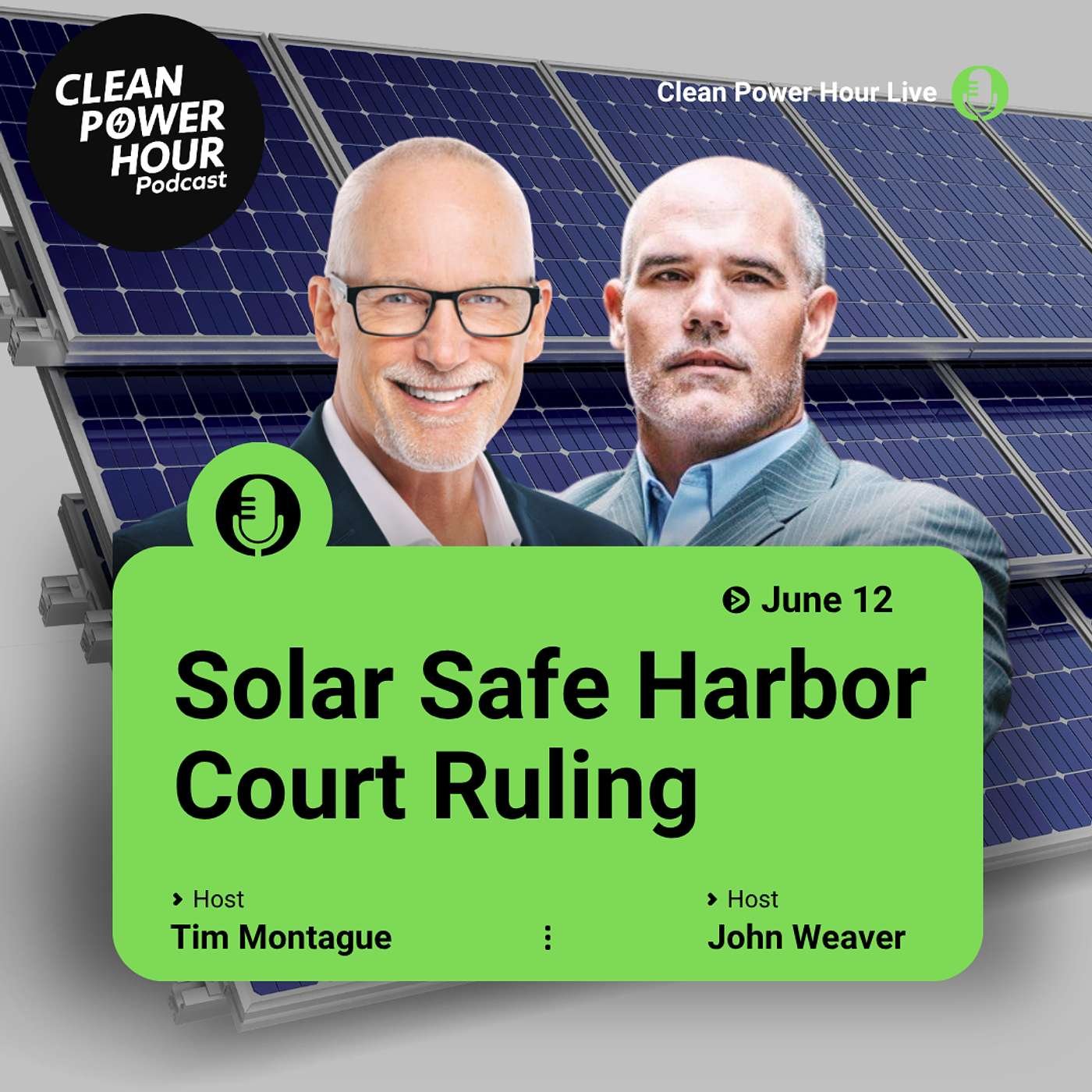
A US federal court just ruled the IRS acted in an “arbitrary and capricious” manner on solar and wind safe harbor rules, shaking up project timelines for developers racing toward the July 4, 2026 deadline.
Meanwhile, at the Shanghai Solar Show (SNEC), energy storage claimed more floor space than solar panels for the first time, signaling a major shift in where the industry is placing its bets.
Tim and John dig into safe harbor court rulings, vertical integration in US module manufacturing, battery technology milestones, and agrivoltaics at the Vatican. Viewers get first-hand reporting from the Shanghai Solar Show floor alongside detailed discussion of what these stories mean for developers, installers, and investors.
EPISODE HIGHLIGHTS
- IRS Safe Harbor Court Ruling (PV Magazine): A US federal court in DC ruled the IRS acted arbitrarily in requiring wind and solar projects above 1.5 MW AC to meet a continuous physical work test to qualify for safe harbor. The ruling opens a potential 5% spend pathway for developers who could not meet construction requirements.
- Shanghai Solar Show 2026(BSKY): John Weaver returned from his first visit to the Shanghai solar show and reported that battery storage occupied more floor space than solar panels. Module efficiencies of 25% were common across exhibitors, and one solar module clocked in at 27%.
- BYD’s 2,710 Amp-Hour Battery Cell: BYD showcased a single battery cell rated at 2,710 amp-hours, roughly double the largest cell previously available. BYD’s press materials claimed a levelized cost of storage of 1.4 cents per kilowatt-hour over 10,000 cycles, compared to the 3 to 4 cent range seen elsewhere.
- Q Cells Full Vertical Integration in Georgia: Q Cells announced a 3-gigawatt fully vertically integrated manufacturing facility in Georgia, covering polysilicon through module assembly. The announcement means US-made solar modules are now available from a single domestic supply chain.
- Australia’s First 8-Hour Battery, New South Wales (PV Magazine): Australia’s first 8-hour battery storage system reached full operations in New South Wales, using Tesla Megapack units configured to charge at 100 MW and discharge at 50 MW.
- C&I Battery Storage Playbook for 2026: Tim published a story in Solar Builder on the Earn, Save, Protect framework from Intelligent Generation, a three-part guide to battery value stacking for commercial and industrial installers. (Solar Builder)
- Vatican Agrivoltaic Project: Pope Leo XIV established the Fratello Sole Foundation to implement an agrivoltaic installation at the Vatican, aligned with Pope Francis’s 2024 sustainability directive. The project will supply power to Vatican Radio’s transmission center and Vatican City State. (Vatican News)
This episode is built for solar developers, commercial installers, battery storage professionals, and clean energy investors tracking policy and technology in 2026. The safe harbor ruling alone could affect capital decisions on projects above 1.5 MW AC before the July 3 deadline. Between the Shanghai show floor, the QCells factory update, and Australia’s 8-hour battery milestone, this episode covers the week’s most consequential moves in clean energy.
Connect with Tim
Clean Power Hour
Clean Power Hour on YouTube
Tim on Twitter
Tim on LinkedIn
Email tim@cleanpowerhour.com
Review Clean Power Hour on Apple Podcasts
The Clean Power Hour is produced by the Clean Power Consulting Group and created by Tim Montague. Contact us by email: CleanPowerHour@gmail.com
Corporate sponsors who share our mission to speed the energy transition are invited to check out https://www.cleanpowerhour.com/support/
The Clean Power Hour is brought to you by CPS America, maker of North America’s number one 3-phase string inverter, with over 6GW shipped in the US. With a focus on commercial and utility-scale solar and energy storage, the company partners with customers to provide unparalleled performance and service. The CPS America product lineup includes 3-phase string inverters from 25kW to 275kW, exceptional data communication and controls, and energy storage solutions designed for seamless integration with CPS America systems. Learn more at http://www.chintpowersystems.com
0:50
Tim, welcome to the Clean Power Hour Live. I'm Tim Montague, your host, bringing you the latest and greatest wind, solar, and battery news every other Friday with none other than the commercial solar guy, John Weaver. Welcome to the show, John.
John Weaver:
1:11
Hi, Tim. Tim, I just want everybody to know Tim was a good life right now. Tim is sitting, he's around his boating, there's birds and water around him, and people having nice conversations with probably shrimp cocktails. So, Tim, what is your hobby like? You are, you're really good at moving boats across water. This is part of your talents, right? Yeah,
Tim Montague:
1:36
you know, I'm a human being, and so boats are part of my DNA. They're so important. And I'm in Lake Saint Claire, near Detroit, Michigan. I'm looking out over the lake. There's a beautiful wind farm on the far side, which is Canada, the Canadian side. There's a big wind farm, and otherwise, yes, it's blue water, and lots of sailboats. And I'm here for the one design regatta at the Crescent Sail Yacht Club. I sail a Flying Scot, which is a One Design boat, but there's a bunch of One Design boats that I'll be racing with, and boats like the Lightning and the thistle, so it's a very storied place. This is old money, Detroit, old money. All
John Weaver:
2:21
right, so now we know about Tim a little bit more. Everybody, we just learned some stuff.
Tim Montague:
2:26
Yep, gotta go sailing, gotta go sailing. It's a great way to decompress from this ordinary life, but we have a lot of news, John. So, and more importantly, you are just fresh back from China. You made your first trip, I think, to China, is that right?
John Weaver:
2:46
No tech. No, I was.. China once, back in 2008 Okay, you know, I landed in the big city and bounced through it, and then I went to, like, Kashgar. I went to, like, the western portion of the country, crossed into.. it was.. it was a thing about the Silk Route back in the day. So we did, like, Western China, crossed over into Pakistan, went through some beautiful places, and we saw a solar eclipse on August 1, 2008 That was actually the driver of that trip, was to see a solar eclipse. I'd never seen one. Yeah, made it into a vacation, and so Shanghai was cool. Solar show was great. Downtown Shanghai, very big city, very big city, beautiful, lots of EVs and electric mopeds, and and they do well on the roads, driving, and so I have a question. Yeah, yeah, I
Tim Montague:
3:36
have a question. I'm famous for saying, if you want to see the future, go to China. It does that statement hold water?
John Weaver:
3:45
Certain things, definitely. Yeah, um, like EVs downtown in Shanghai, the quietness. I've heard about it before, like the quiet city. It's different. It's a, it's a quiet city, like you can talk to people right next to you. All the vehicles, like there's one or two vehicles that are allowed, and it's, it's that's it. And so that was one thing that was pretty cool. There was a lot of nice construction, tall buildings downtown, driving around town, the police officers were nice, because, like, two or three times I was riding my bicycle in the wrong place, so, like, dope, can't go there, that's because I missed a sign occasionally. So, well, I'm glad you
Tim Montague:
4:23
didn't get arrested, but tell us about the solar show, John. This is one of the largest solar wind battery was solar wind battery or solar battery,
John Weaver:
4:33
solar battery for me. I mean, there was so much, to be honest, I.. there's whole rooms I didn't find because it was just massive, and yeah, it was so.. I think it's the largest in terms of people, though I hear very strongly that this year there were a lot fewer spaces, and a lot less showing because the domestic Chinese market has tightened from its peak of two years ago, 23 when it was just pounding out hardware, then they really pulled back with manufacturing, so it was, but it was still a huge show, and and the gear that was on the ground was cool, modules were neat, there were batteries, apparently there were more batteries on the floor than solar, which was interesting. Machines, there's a lot fewer machines. People who manufacture machines on the show on the floor is what I heard. Oh, that's the opening morning. The day before that place was a mess, so this was like right as it opened. I was like, really good job to the construction crews that made this place look clean, because everybody was bang bang, it sounded like a proper wonderful construction site. People were just doing all kinds of cool stuff. And next day, boom, what was the
Tim Montague:
5:44
what was the most unusual thing, or the thing that you least anticipated about the show,
John Weaver:
5:50
least? Just anticipated, you know, what the salespeople there are very quick work hard, get you a business card, take a picture, your WhatsApp, ask you what your gear is. A lot of them knew about the complexities of selling into the US market. Some of them did it, but bam, bam, bam, get a picture of your business card into WhatsApp real fast. So I figure I'm gonna start getting a lot of WhatsApp messages that on the floor is your open target and you're at a show and you know that's your job to walk around the floor and buy stuff. So, so I get it, and but it was just like it, people were like good at showing you the gear. It's like I like it. Was hard. Was there a
Tim Montague:
6:37
technology that, that you know, really grabbed your attention or caught your eye?
John Weaver:
6:43
Hey, technology. Well, there's right now the broad infatuation with energy storage, which was supported in seeing it, but sodium was
Tim Montague:
6:53
sodium batteries thing,
John Weaver:
6:56
yeah, I mean people were talking about it, C A T L, but you know, I found that walking the floor it's easier to get whiz banged by a beautiful solar panel with a wattage and percentage efficiency than it is a battery, and so I think it's just easier to take pictures of panels and be entertained by it than it is the battery section yet, because I'm still learning about batteries. I don't know which stats are the coolest yet, so I think the modules everybody haven't, and I wrote a story about it. The thing that caught me the most was that so many solar panels were over 25% efficiency, and as I'm doing big roofs right now, I'm trying to maximize the DC to AC. Every extra roller panels cost like, I don't know, 60 cents, 80 cents a watt. That's worth it to build it, it pays for itself, you know. It gets clipped 20 30% but you got to do the math to figure it out. And so it's a, the efficiencies are the coolest thing. But energy storage, they've all the big players that do modules are like stressed financially, they're not making cash, they're not profitable right now, they're supported by state level structures, but you know, some states are allowing their solar companies go BK, some aren't, some are repurposing manufacturing lines, whatever it is. Module pricing is holding a penny or three below profit, it seems. So all these companies are the big ones, at least talking energy storage, and it was cool. I was able to have a conversation with a really smart guy from Longji. He was CFO, and it was just great to listen to perspective from a CFO of such a strong company, and they're looking at offering a platform for energy storage, so that developers can come and know that the system is, I guess, it gets rid of the integrator or crosses into the integrator space. They're bringing together technologies, they're bringing it into their own house. They have, they bought a battery-related company. I read the article, their name passed from me. They have a control system now. The conversation with the CFO included explicitly talking about being able to model and changing with the tariffs in every single region, so the value.. oh, you know what? Here's something I didn't anticipate Tim Perovskites are awesome, but the value of batteries is greater, because we already know how to make lots of solar electricity at high noon. Now we need to make our high noon worth more later in the day.
Tim Montague:
9:51
Yeah,
John Weaver:
9:51
and
Tim Montague:
9:52
totally,
John Weaver:
9:52
so, so, while Long G, they have the highest rated perovskite. This is the same conversation, Zhang, I think his name is John, because his name was close to being mine, but I'm terrible at pronouncing, but
Tim Montague:
10:05
yeah,
John Weaver:
10:07
I was saying, hey, what about perovskites? Because you know me, I'm just like, cat touch it, what's the most shiny thing you got, and that, of course, is it is the highest efficiency module on the floor. There weren't that many of the whiz bang ones. Everybody was talking about the stuff they're selling today, and I think it's because the value between a 25% module and a questionable 28
Tim Montague:
10:30
is it is
John Weaver:
10:32
awesome. but it's not like whiz bang right now. We have real projects, hundreds of gigawatts, they need to be put in in a more valuable manner, and value means catching all the excess and spinning it around the clock as far as you can, and so the the value. You of a perovskite is decreasing. I don't know, there's an equation there that's going to break open, but there's different pieces moving at this exact moment, and so right now Whiz Bang is making that battery listen to the grid and feed the machine and take care of those solar panels. That's that's, and it doesn't even have to be with the solar panels, co-located, of course, just close enough, so yeah,
Tim Montague:
11:16
it's like when you talk to Joel Jean at Swift Solar, who I think you're going to talk to soon, you know, he was on the show a couple weeks ago, he convinces you that they're going to get to a lower LCO, e, and you get excited about the props guides, but then you kind of fall back into, well, storage is so important, and if you have a 25 versus a 28 I don't know, but anyway, it's fine. And did you get this touch a props guy panel, though?
John Weaver:
11:49
Yeah, yeah, in fact, I'm going to start sharing my little, my little thing, my that story that's on our list. Let's see if I know the shares. I saw the
Tim Montague:
12:00
I do see the project of the week
John Weaver:
12:04
stream yard post by mr. So we'll do think I think I'm sharing a tab right here. Let's make sure I don't, okay? So I'm going to start from the bottom, you know, buzz through some stuff a little quick, but I'll go to the perovskite module first. I only took a picture of one. This is the only one where I was like, all right, because it's by.. I didn't really have anything else by this company. They're really Tong Wei is really a upstream. They make cells, they make wafers, they make polysilicon.
Tim Montague:
12:39
I've heard a tongue way.
John Weaver:
12:41
Yeah, they're actually, you know, who you should interview. He's cool, he knows everything. Finlay, I'm trying to even know his last name. Yes, you should. He's smart, so he has them, I believe, at the top of his list of most financially viable solar power companies.
Tim Montague:
13:00
Do you have some sway with Finley?
John Weaver:
13:02
Me, no, I don't know anybody, but
Tim Montague:
13:06
I've been trying to do an interview for a couple months.
John Weaver:
13:10
Well, get back to work. So he's cool, so that's the only perovskite module, but you know, if we start from the top, that you know it's just good crowd. This is where it started. I started seeing a lot of 25% modules, and ICO was one of the first. They were right next to the PV magazine thing, so it was easy. There are lots of 25% modules. There are also a few robots, different types picking up, moving stuff around, which is cool. Lots of 25% modules. This is a an AI DC one, you know, AI, and some level it's part of a DC system that is supposed to feed a feed a little differently. I don't know if that's just sales pitch or if there's a little bit of logic and how it's structured to try and support these higher voltage systems up here. I'd love to learn more about how they structure the micro grids that feed data centers. They're like 800 volts, because the architecture of the computer chips are different. I think that's what I've heard. Bottom
Tim Montague:
14:08
line, there, 7000 5000 What is that?
John Weaver:
14:11
I think that's Pascal's PA. Notice the PA there, like we could not stand on it, but you know, touch
Tim Montague:
14:17
it. Then
John Weaver:
14:18
there's just some cool colored modules, you know. These are always out there, more robots. There's my, oh my gosh, it's 27% I think that may have been the highest one on the floor. More cool colored modules a recycling manufacturing line? This was kind of neat, you know. Usually we see solar panel manufacturing lines. Well, here's the opposite. Now we're taking it apart, and I just thought it was kind of kind of neat that people are thinking on a systems level with modules, getting better at it, pushing on it, because everybody wants to talk about recycling, and if we, we start automating it like this, this is gonna, this will be like module, module recycling at 8995 98% redoing it, that's pretty solid stuff. More robots, lots of robots, or not too many robots, but enough that each one I saw that was cooler. I've never seen a robot
Tim Montague:
15:13
arm moving on an American trade show floor.
John Weaver:
15:17
Oh, really? Well, they're like six of them.
Tim Montague:
15:20
That's cool. I like it. Yeah,
John Weaver:
15:22
lots of robots.
Tim Montague:
15:26
So they're promoting a robot that installs modules, obviously. There looks like that, looks like the Lumi, almost
John Weaver:
15:40
got some good solid tracks, so machine that extends modules outward moves it nicely, I. This guy, I got to meet. This is a battery, 20 710 amps, made by BYD. It's about two and a half, it's not 3x the biggest out there, I think. The biggest is 13, so maybe just two, double the biggest cell out there, and that's multiple feet wide, that's big chunky piece of hardware. I'm really interested in it. They put out some press on it. I saw a press on it where the PR people said the battery with its 10,000 cycles would end up having a levelized cost of storage, LCOS of like 1.4 cents, and everything else I've seen about batteries has it on like four cents, so I wonder if they're not including other things, they're just going straight hardware, and this doesn't include management operations,
Tim Montague:
16:43
right?
John Weaver:
16:43
But I think 1.4 is like a step change number from like three to fours down to a third of that number, and I don't know, maybe we'll see. This is, I think, this is going to be an interesting technology, but I, I still, I'm just infatuated with it. That's really what it is. So, that,
Tim Montague:
17:03
that tech, when you say that technology, it's, it's a cell battery cell technology.
John Weaver:
17:08
Yeah, this is like a cell. This is, you know, how you got a little Darrell cell that's like nine volts x something. This is the equivalent. This is like a battery in and of itself, but this is just a single cell. You know how we had articles on here about a year ago where we talked about the big year, the big cell. Do you remember that?
Tim Montague:
17:25
Yeah,
John Weaver:
17:26
and we talked about 500 amp hour cells and 600 amp hour cells, and how we were leaving behind 314 which was the prior industry standard. These folks just jumped at 7x you know, they're they're playing the maximization game, trying to figure out what things are, and some scientists, like, oh, said, oh, look at that little batch of correlations off to the left of the graph, and then they said, well, if we build a cell like this, it'll consume those, and everybody was like, all right, that's what I guesstimate occurred. You know, somebody came up with a reason to go this big with a cell. When I was at a conference, a bunch of people were on stage, it was neat. They gave me a little headphone that translated to English, and there was a gentleman on the stage who said he doesn't see value beyond 300 kilowatt hour cells, so chew on that, and then tell me about everyone else doing stuff, and I don't truly get 300
Tim Montague:
18:27
amp hours, I don't know, amp hour,
John Weaver:
18:29
yes, amp hour, so he, he said on stage, he goes, listen, I don't know why we have these giant cells. He goes, '300 amp hours where the benefits cease to exist, cease to happen. And I was like, 'All right. And I didn't understand it, because I didn't hear the.. I don't think he said the explicit reasons he said he believed that. So, but nonetheless, he said it. So now it's in my head, thinking, what does this guy know? So that was pretty cool. This is Longy talking about their platform, and I'm going to try and write a few stories from this. One of them is going to be about my disappointment with perovskites, but my realization that I think energy storage really should trump everything relative to perovskites, in terms of just let's see, professional infatuation. Perovskites can stay my science fiction, and they're going to come, and they're going to roll out, but it's really, we need to, we need to fall in love with batteries, I think. Yeah,
Tim Montague:
19:31
we need to recognize that we have the technology, even with batteries, John, we have the technology truly to completely green the grid. Now we truly just have to deploy, deploy, deploy, as Jigger Shaw says, and of course the technology is going to get better. It's going to get better faster on the battery side than on the solar panel side, but because batteries are about 10 years behind solar panels, but they're coming, and
John Weaver:
19:56
I, here's a solar panel, 26% that this is going to be like, you know, standard in a couple years.
Tim Montague:
20:05
Yep,
John Weaver:
20:06
and, uh, wow, you know, that's pretty cool, man. When I started, it was like 13% I remember Maga. I had some Magay solar panels that a guy from named Wolf pitched them to me, and when I was at Leaf Solar Power, and he brought me some cool Maga panels. I was like, all right, I gotta try and sell some of these. I don't know what percentage they were, they were, they were like 14 or 13, maybe they were 15. It's 2008 2009 it's good stuff. So now it's 26% dude. It's coming. It's not today, but that's panel that exists when tested. The cells were 28.2% I think. I think somewhere in the low 20 nines, upper 28 Low 20 nines is like the true limit, like that 33.3 Shockley guestly limit, and then it translates down in reality to like 29 and change, is where you can actually get a sell, and we're like we're 28 too, I think we're within 1% of where we think we can go. That's kind of cool.
Tim Montague:
21:08
Should we talk about your project of the week?
John Weaver:
21:11
Yes, I like the project of the week. All
Tim Montague:
21:14
right, let's, let's move on to that. I'll get that on screen. You're building a large rooftop project.
John Weaver:
21:22
Yes,
Tim Montague:
21:24
what's the project?
John Weaver:
21:26
So, this is a 1.90 no, sorry, this is a seven 679 693 somewhere in that range. I can't remember the number right now. Yeah, just under 700 kw. Geez, of Helene 640s sun ballast racking solar edge optimizers being built downtown in Fall River, where you know roughly we're at like 98% of the AC work inverters are in place. I saw a wire, I have pictures of wire being pulled up to the inverters, so at that point, then the AC side is done. Yeah, they were working on this stuff all yesterday. Today, I think everything is getting at least pulled. I don't know where it's weather, how it's gonna land, but the weather's a lot nicer. And the customer, he owns the building, he's some nice images. That's me with my photography skills. Those are solar edge. You put them directly into the ballast.
Tim Montague:
22:40
Okay, so this
John Weaver:
22:41
is, and that that wire there, that's for the for grounding it. That's the bonding wire, I guess. We had to have a certain number of bonding items that we had to pads, because at first we were thinking 30, we kept talking about 3471 whatever ul, but then at some point we shifted to for domestic content, we were gonna have to use either Solar Edge or Enphase, we had no choice, and so for this one we went with Solar Edge, because the module we had already chosen the Helene module, it's a great module. I really wanted to use that product, and so this job, that's our AC work. Everything at this stage is super close to done. I, you know, again, they were pulling, they were pulling the red wire or the colored wire going into the conduit today, so I'm sure they haven't landed at all in the panels, but but it's moving, and some modules are going down. Yeah, we're like, I've
Tim Montague:
23:37
never heard of this racking system. It's quite a unique racking system, right? The ballast is like integral to the system, huh?
John Weaver:
23:47
There's so few components, it's just that the components are heavy. It's a 96 pound block, they have a smaller one, but with the way our, yeah, so that's why you did the first picture, remember the first picture with the big wheels, that's why we were showing our results, yeah,
Tim Montague:
24:54
but those is it, is it one panel per per ballast?
John Weaver:
25:02
Well, so that you have a ballast, and then you have a panel on each side of it, and then on the back side of it, you'll ass will also have two panels, so it's really sort of kind of close to that, maybe with an extra row, you know, I've never actually looked at the exact count, but I'll do that, and how does the
Tim Montague:
25:19
panel attach to the bow to the to the block?
John Weaver:
25:22
Oh, that's my face. The there's standard clamps, mid clamps, mid clips. You know what? I don't even know. You know what I owe this. Oh, that's a, that's our AC panel just landed yesterday, so I'm pretty certain we haven't put all the wires in it by today.
Tim Montague:
25:42
Yeah, I'm so curious about this ballast system, but the good news is it's super durable.
John Weaver:
25:50
Yes, it's made in New Hampshire.
Tim Montague:
25:52
There's nothing that can break virtually. I mean,
John Weaver:
25:55
so I went, we went to visit the shop in New Hampshire, and it was great. The project manager, she. we were researching product, and she said, "Hey, they're located here. And so we all hopped in a car, and we saw the factory, shook the dude's hand. The owner was on the ground working, and as you might expect, the owner of a cement factory, he looked like a strong person. So I was like, "This cool, I like, I like buying product from this dude, because he's here doing the work, and I don't know, it was just kind of cool. Yeah, so it's so it's obviously made in America, it's made in New Hampshire, it's made like right up the street, about four different streets to get to us, so kind of nice to see that,
Tim Montague:
26:41
cool. All right. Well, let's talk about safe harbor. We've got a big story. The US federal court in DC has ruled that the IRS acted in an arbitrary and capricious manner after more than a decade of precedent. It required wind and solar facilities alone to change how they establish safe harbor. Why is safe harbor? First, let's establish why is safe harbor important. John,
John Weaver:
27:08
the tax credit is going away in different dimensions. The 30% basic tax credit, if you want to have four years to construct, you need to safe harbor your project by July 3, fourth years of 20, yes, of two months out, no, of a month out, not even a month, not even a
Tim Montague:
27:29
month away. And if you don't get safe harbor, then you have until the end of 2027 So that's what sometimes people forget. We do have a little bit of room here, but a year and a half, we have 18 months, unless you save harbor, and that gives you another couple of years until the end of 29 I believe, right?
John Weaver:
27:49
No, it's into 20, it's into 30.
Tim Montague:
27:51
Oh, it is from,
John Weaver:
27:52
yeah, it's four years from july 3, essentially. So, if it's 3026 plus four, so it's July 3, 25 plus
Tim Montague:
28:01
four,
John Weaver:
28:02
no, it's 2626 26 plus four. It's from july 3. You have four years from that date going forward to complete.
Tim Montague:
28:11
And so there was there was a requirement on larger projects, I think above a megawatt and a half that you do that there be a physical work test, right? That's what the ruling specifically said. They're no longer going to require the physical work test, right?
John Weaver:
28:28
Is sense, well, it's not, it's continuous, it's more than just physical, it's continuous physical. So you have to show that something is happening indefinitely and moving. I see now they effectively
Tim Montague:
28:41
wanted the project to be under construction
John Weaver:
28:45
now. Yes, and then through the magic of magic, people figured out that you're allowed to have construction starting if you're making customized hardware within a warehouse and it's being tracked and modeled and shown as real work happening, and this customized hardware could be transformers, it can be switch gear, and you just start doing all your switch gear piece by piece, and or it could even be torque tubes, you can buy the rights to a torque tube line. These different ideas started to spring up, and these represented continuous construction as well. We actually wrote about this, and for PV Mac, Jenny Sparks, I think was her name. She's from a firm in Houston that does tax law, tax specialty law, and that's what I was. Another thing, so what this says is no, 5% If you have spent 5% of your project, you know, as of right now, this this motion, we overthrow it. Now, the reality is it's probably going to be really hard to get people to invest on 100 million dollar projects with this ruling, because unless they're just like on edge, they had no choice, and their project was dead otherwise, and, like, wow, we just got luck, lucky, because we had already spent 5% I don't know, I don't know how it could happen, but maybe somehow. And then, and then it works so great. Good for them. Maybe, maybe they don't. Maybe people who were safe harboring with modules prior are now going to start procuring safe harbored modules as investment partners to help move their projects forward and get rid of the continuous construction. I don't know, but
Tim Montague:
30:27
so the the end game here, well, for now, right? There could be the federal government could still win this push back. Yeah, absolutely. So, I guess you know, to be conservative, you, you probably should just keep rolling with whatever your safe harbor tactic was,
John Weaver:
30:50
but, but here's, here's the thing, that so I spoke with a lawyer from Norton, Norton Rose, David Burton, I think he's, he's quoted early on, he said, you know, there's going to be a class of developers who've been trying real hard to get certain things to happen, and they couldn't make it work, so this would be a tool, a backup tool to roll the dice with, because you know, people just above that one and a half AC value, you know, maybe community solar projects, and they're trying to figure out how to do things, and whatever, somebody's just figuring it out, this could be a tool to use an argument within a court case, and maybe they win, and maybe they win for long enough that it gets things going, maybe it releases some capital from a bank. He says, "You know what, it's going to work, we'll figure it out. Something, so who knows? It's.. it was a big thing to see it. Just really, really late in the game for big time developers, for a certain class, maybe it will make it, maybe it'll make something work, you know. Now you have a reason, now you have a reason to take a swing and believe you're going to get it, because the rule just changed. You still got to spend 5% of a project, and you know, for the people that are above one and a half megs, let's just say it's $1 a watt for the case of it, that's 50 gs, 70 gs, so it's not like don't change, you got to figure out how to spend$70,000 and invest as a starter for that game, so I think that's cool case to see, it was just neat to read about,
Tim Montague:
32:24
well, as we were saying earlier, battery storage is super important. I wrote a story for Solar Builder that just dropped yesterday. Cool, and it's titled CNI Installer's Battery Storage Playbook for 2026 I made a nice graphic using Notebook LLM. If you haven't tried notebook LLM, check it out. It'll take your transcript, it'll make an audio podcast out of it, if you want. It'll make graphics like this, but I built this story around the framework that Intelligent Generation created, called Earn Save Protect, and it's just a super easy way to remember the value of batteries. Okay, you can earn money with grid services like frequency regulation. You can save money doing energy arbitrage, right? You buy low, sell high, and you protect with resiliency, right, you, you can have ride-through if you're an industrial facility and there's a brown out, or you can have 24/7 power if you're a smaller facility and you have a big battery. So that is the moniker that every installer needs to know: earn, save, protect, and then whatever jurisdictions you're working in, you need to really dial in what is that value stack in your jurisdiction, right? Because it varies in New York ISO versus PJM, right? I work in PJM a lot, that's ComEd in Northern Illinois, but it goes all the way over to New Jersey and Pennsylvania, huge ISO, and they will pay you for frequency regulation in PJM, which is nice, it's not the bulk, the bulk of the savings from a battery in PJM are capacity and demand charge reductions, which can be 30% of a large customer's bill, and so when you're coming from Resi John into commercial, there's this whole other world in this value stack that you're, you haven't been thinking about, right, for the most part, unless you've been doing like VPP, and that's of course another thing that's coming on strong. There are VPP programs in Texas, in California, in Illinois, where else have you ever done a VPP, John?
John Weaver:
34:43
Residential projects, it's really not doing much. You check a box once the end phase battery is installed, it's.. and it's not even Massachusetts,
Tim Montague:
34:54
right? Massachusetts, you have a VPP program, I think
John Weaver:
34:57
it's called Connected Solutions. Yep, and it's really the customer who checks the box. You just tell them, hey, go talk to the app, and go here, and it takes you to the VPP enroll button, and boom, you're in it.
Tim Montague:
35:10
Yeah.
John Weaver:
35:10
So,
Tim Montague:
35:11
so I had a.. I had a guest. The interview hasn't dropped yet, but I interviewed Mike Nicholas from Hillary Companies, and Mike used to be a fire.. I think he was an assistant fire chief in a place called Kern County, California. There's a lot of, a lot of
John Weaver:
35:30
solar, lot of solar in Kern County. Yes, that's cool, man. They're always in the headlines for big old stuff.
Tim Montague:
35:36
And, and Mike has so many pearls of wisdom, though. So you can look forward to seeing that interview. I've also, well, I will be writing more about fire safety, but the big thing with fire departments is talk to them earlier in the process, right? Don't wait until you're down to the wire, talk to them early, get them familiar with your project, make sure they understand lithium iron phosphate is different than the historical NMC, right, nickel manganese cobalt, right, that people still remember the Moss Landing fire and have that stuck in their, their heads, but the technology with LFP is much less fire, much less fire prone, but you got to talk to these fire departments early, because this is new for them, right? And they have a big responsibility, right? Their job is to keep the community safe, and there's no reason we can't do batteries safely, but you got to talk to your a. HJS and fire departments, so let's move on. What's next?
John Weaver:
36:50
X is Australia. Y'all know, heck yeah, look at the pictures, show the pictures.
Tim Montague:
36:57
Yeah, so what's what's Q cells made an announcement this week,
John Weaver:
37:02
three games, so they had the full, full thing, man. Sorry, I'm excited.
Tim Montague:
37:07
Explain it. Explain what is it? What do you mean, the full Monty at Cue cell? What does that
John Weaver:
37:12
mean? So I think they go all the way from poly silicon through modules, three gigawatts capacity. I'm not exactly certain where the poly is coming from. It could be on site, but I think they're doing everything else on site and buying poly, I don't know, we could ask the machine, you know, the machine is usually close. Where does Q cell get its poly? Yeah, so Q
Tim Montague:
37:36
cells, you know, has been doing module assembly for a long time in Georgia, and now they're completely vertically integrating and making the poly the cells or the wafer the cell and the module, and so you can get a completely American-made solar module. Now coming out of Georgia, I'm pretty sure they're making the ingots in the US, but
John Weaver:
38:03
I mean it's the whole thing there, I haven't seen it, but I'm still working toward it. But they're, they, they, it's all in the US, so that's the pitch. And my knowledge is probably limited, because I don't know every little thing going on. It's turns out, but I think they're making the whole dang thing, and it's all down there in Georgia now. And I'm excited that they're doing it, and it's cool, I hope. Okay, just cool little cells moving through a machine that's really cool. How the video quality, it looks like a cartoon, almost, dude. Pretty cool.
Tim Montague:
38:36
Right now, I mean, for domestic content, of course, there's a trade off. You're getting the 10% adder currently, right, for the ITC, but the product is going to be more expensive because it's American labor, so you still got to do the math, it's, it's non-trivial, and this is why I promote Chris Letman so much, because he really knows his stuff, he's got great calculators, you know, and you can even do like a blend, right, of some modules with domestic content, some with just panel assembly, or some other mixture, right.
John Weaver:
39:19
Chris makes custom modules too, so if you need, if you actually need modules, Chris can, Chris and his company are making Imperial Star volumes. Yeah, I think if you have 1010, gigs of capacity, maybe not 10 gigs, maybe 10 megawatts, but some number, they're going to give, they'll give you a reasonable price to customize your product. So, so the Q cell factory in Georgia is going now, man, and I think it's full string. I think it's full vertical, and that's cool. I'm just.. I'm excited that they're doing it. It's been hard work. It's 26 It was almost halfway through 26 I don't know, not too long to build a new industry. Wonder, how many lead.. how many businesses that support little knickknacks surrounding the companies exist. I hope there's something. What do you mean by
Tim Montague:
40:08
knickknacks?
John Weaver:
40:10
You know, there's to manage these machines to take care of the robots to the trucks to drive in and out. Yeah, the mini supply chains, the supply chains of supporting the business, you know, how much more paper, how much more, how many more five gallon jugs of water will be delivered to the office space for people to talk around, you know, all of that's like a little bit of extra business, and so
Tim Montague:
40:35
sure,
John Weaver:
40:37
and I hope the modules are nice, so I want to put some on something, I hope somebody gives me a chance to buy, so yeah, they'll be around, you're
Tim Montague:
40:44
buying lean modules, which are also made America.
John Weaver:
40:49
I don't think they're as made America the ones I buy.
Tim Montague:
40:53
They're not making cells yet in the US. I don't think.
John Weaver:
40:57
I don't think so either. I don't think they're making wayforwards either. I don't know where the poly comes from. So, there's some work done in the US, but, but there's some people like Seneva who are making sales, who just backwards merged with a weird, with a Redsy company in a weird manner to suddenly be publicly traded. I think you can buy Seneva stock now if you wanted to, and solar. They did a
Tim Montague:
41:21
Smack.
John Weaver:
41:23
I'm not, I don't know this stuff. I'm making fun of myself, you know. I, I just know I saw it. I was like, oh man, look at that backward structure, like it was a resi company that went public. Yeah, so I now want to look at like companies that have gone public on these penny stock things and see how they earned his money, and be like, okay, that's cool, I'm learning. And say that work stuff works, so it's a good job to you, so, oh yeah, eight hour battery, we
Tim Montague:
41:48
got a store out of Australia in PB Magazine by EB Foley. Australia's first eight hour battery moves to full operations in New South Wales.
John Weaver:
41:59
There was a neat thing about this battery, I don't know why it was set up this way, but I can actually hypothesize that it might become a thing, and that it, if you scroll down to the story a bit, it says, yeah, that's beautiful. I don't know, is that actually the real system? Maybe limited solar
Tim Montague:
42:20
farm, the
John Weaver:
42:22
project has the ability to charge at 100 megawatts. You can see it in the first paragraph up there, but discharge at 50, and I, I, well, first off, the reason I really find it interesting, the most interesting thing is that for an eight hour battery, you can then have a four hour charge, eight hour discharge, doing that twice, that's that's two full cycles. Yeah, and that's, and that's not only the two cycles, it's two discharge heavy cycles, it's 16 hours of power output. So, if you can somehow figure out how to bridge those two four hour windows, you now have a 50 megawatt power plant, and that's kind of cool. Lot of solar panels to fill it up, manage it, but I just like that, and I don't know why they did it. I know sort of why they did it. They're using Tesla batteries, and the Tesla batteries, they just have four megawatt models. They don't have eight hour models, so they just use the charge capacity of the Tesla batteries to connect to the grid and output via a different set of grid control systems, I guess, for the eight hour version, or maybe they just cut the output to 50% I don't know the star software calculation exactly, but or the gear, but it's just, you know, they use standard four hour Tesla batteries using it, man as eight hour batteries, charging at 50% I wonder if it saves on interconnection costs. I wonder, because there's no output management, but they're taking such a heavy input, the utility wants that somehow, and so they're like, "All right, we'll do this. I wonder if they're charging heaviest during 11am to 3pm or 10am to 2pm like just like taking in all the solar they can, every bit of it, for four hours, like blasting 400 megawatt hours of solar into those batteries, or whatever it is that they're going to get in there during four hours, because they got to fill the whole thing up. So,
Tim Montague:
44:30
sounds like there's a program that incentivizes long duration storage.
John Weaver:
44:35
Yes. Well, there's also that model. But now, how do we use it? So, we have this program. People keep saying we need long duration to bridge the gap longer. Okay, I'll take it. How do we use it now? How do we value their pricing? Like, we have to give a pretty much a capacity payment in eight hour chunks at a price that supports long duration to see if it makes financial sense, to see if somebody like that BYD battery, which comes in an eight hour format. Oh, there we go, Tim. The BYD battery, that big 20 710 amp hour cell, it's standard four in eight hour versions, and I think eight hour output is its default output on that unit. So, so maybe there, so maybe there's something there. So, I don't know, eight hours batteries, batteries are doing a whole bunch of stuff, so I think it's cool that you put out a document, I guess, because you are paying attention to trends, and you're like, all right, I gotta tell people some stuff that I know, so they can do it too, because that's the biggest thing from the show, because batteries, man, there's more floor space dedicated to batteries than it was solar panels, absolutely
Tim Montague:
45:44
big
John Weaver:
45:45
business thing to know, and talk about, you know, generation. We're so good at it. That was very noticeable
Tim Montague:
45:51
at Inner Solar in San Diego, too, in February. More batteries than solar on the on the show floor. Alright, let's talk about the Pope. I think this will be our final story, John.
John Weaver:
46:03
It's a good, good thing to finish on.
Tim Montague:
46:05
We have an American pope now. I still can't wrap my head around that
John Weaver:
46:09
from Chicago.
Tim Montague:
46:10
Yeah, baby, Pope established his foundation to implement Vatican Agrivoltaic project.
John Weaver:
46:18
Just a very simple story there in the Vatican
Tim Montague:
46:21
News, nonetheless.
John Weaver:
46:23
Yeah, oh yeah, I wanted to, I wanted to make sure I went to the source on this one, because, yeah, this is a complex, but I just, I like the idea that the thought of agrivoltaics is really being spread around the world, and it just seems very fitting that you can make food and a. Electricity from the same plot, and they're actually pretty optimized. I bet you some people become agrivoltaic like gods, they're just going to see the proper lighting and know their sight, and say these 17 crops will coexist in this optimized lighting thing, because, because this is gonna.. I'm talking to some, some kids, says, geez, that's so disrespectful. Some students at a Swiss school with MIT roots who are helping us do a little agrivoltaic design. And now that I'm back in the States, I gotta connect with one of them. He's nudged me on LinkedIn again. I didn't respond. Sorry, no disrespect. But anyway,
Tim Montague:
47:23
so the Fratello Soul Foundation will promote, and as envisioned in Pope Francis's 2024 motu proprio proprio. Well, I can't say that I'm obviously no good at Latin. A transition toward a sustainable development model, the new installation will provide energy both to Vatican's radio transmission center and to Vatican City State. Okay, so the Vatican is going green, long and short, right?
John Weaver:
47:53
Well, yeah, you'd say going green. They're they're setting a good example, they're testing it, they're building a thing, they're going to make food from it. Yeah, going green, that's good. There's
Tim Montague:
48:05
one thing that I love about the war in the Straits of Hormuz right now, John, and that is that it is reminding people that when energy prices go up, there's only really one way to hedge against that, and that's with solar and batteries, and I'm driving an EV, and Americans are starting more and more to recognize this and think about it and take action on it, and we're just getting started, right. We're at maybe 10% solar grid right in the US, and we're going to go to 50% in the next 2530 years, and that's the only thing that I like about oil wars, but
John Weaver:
48:49
all right,
Tim Montague:
48:50
I truly think that's what we're doing in the Gulf is an oil war, but all right, John, is there, is there anything else we should do before we close out here,
John Weaver:
49:02
we should thank the Pope for giving Agrivoltaic some attention, and, and then, if anybody needs any help with the solar power, we can help you with that stuff too, because we love solar power.
Tim Montague:
49:14
Check out all of our content at Clean Power hour.com Tell a friend about the show. Check out my interview with Mike Nicholas, which is going to drop in the next couple of weeks, and John, how can our listeners find you?
John Weaver:
49:29
Commercial Solar guy.com clean up my website, but that's the best place. We have a nice contact us page, you can give us a ring. I'm around if you're in New Bedford or Boston or Cambridge, you know, I can be found. Yeah,
Tim Montague:
49:44
and if you check out Clean Power hour.com I would love it if you would test our chat bot. We have a chatbot there, which we trained on my book and some other things, so it should be pretty intelligent. It should be able to answer real solar questions for you. It will also encourage you to reach out to me, but I would love to hear some feedback on the chatbot. Is it worth having the chat bot or not? It's not free, it costs tokens, so I'm trying to get some more feedback on the chat bot. And with that, I'll say, let's go solar and storage. Thank you so much, John Weaver. We'll see you again in two weeks,
Unknown:
50:23
you.