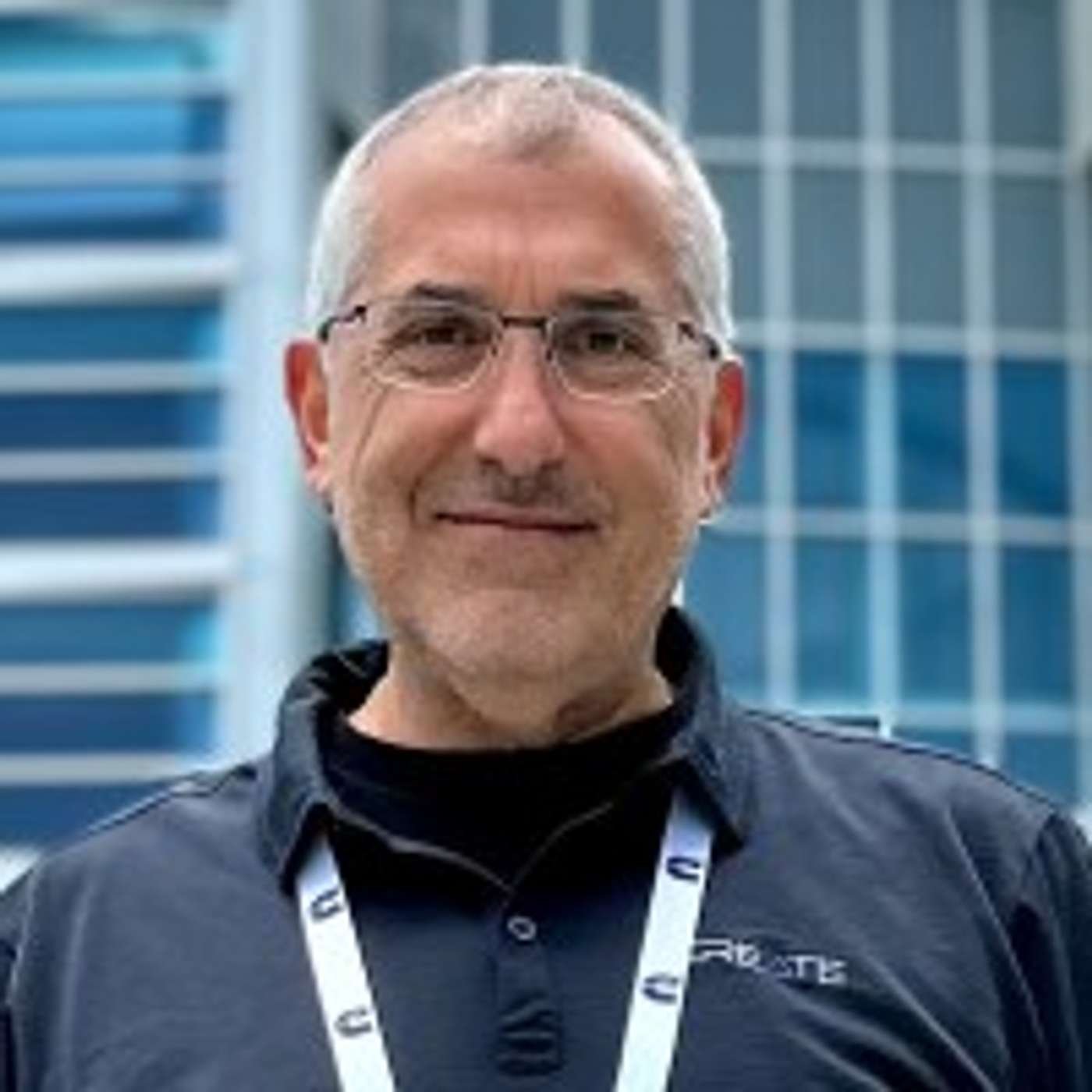
American solar manufacturing is getting a reboot. Dean Solon, founder of Create Energy and formerly of Shoals Technologies, sold 1 GW of product in Q1 of this year alone. In this episode, he walks Tim Montague through his vertically integrated factory in Portland, Tennessee, and names exactly why utility-scale solar equipment is quietly failing at scale.
American solar manufacturing has a reliability problem, and the utilities and independent power producers who own these fields for 30 to 50 years are the ones absorbing the cost. Dean Solon, founder of Create Energy and the man who built and took Shoals Technologies public on the NASDAQ in 2021, has spent three years building a vertically integrated solar manufacturing operation in Portland, Tennessee, to address this directly. Create sold 1 gigawatt of product in Q1 of this year, with Q2 expected to double that output. Host Tim Montague tours the Create Energy factory floor and draws out exactly what full-stack, American-made solar hardware looks like in practice.
Here is what you will learn from this conversation:
- You’ll hear Dean Solon explain why module warranties are misleading and why EPC economics push toward equipment designed to last only past the two-year mark, leaving utilities and IPPs exposed for the decades of ownership ahead.
- Find out how Create Energy’s OnTrack system uses one common control board across trackers, E-boss units, weather stations, and inverters, giving asset owners a single view of every row in a solar field with no separate pony panel required.
- Learn why Create offers a 10-year bumper-to-bumper warranty on its full product stack, and what Solon means when he says he eliminated failure modes rather than reduced them.
- Understand how automated, electric vegetation control cuts solar O&M costs in half, and why long-term asset owners should treat this as a budget line item, not a feature.
For any asset owner weighing supply chain decisions in 2025, this conversation is a direct look at what the American manufacturing alternative looks like on the ground.
Connect with Dean Solon and Create
LinkedIn: https://www.linkedin.com/in/dean-solon-b8876649/
Website: https://www.create.energy/
Connect with Tim
Clean Power Hour
Clean Power Hour on YouTube
Tim on Twitter
Tim on LinkedIn
Email tim@cleanpowerhour.com
Review Clean Power Hour on Apple Podcasts
The Clean Power Hour is produced by the Clean Power Consulting Group and created by Tim Montague. Contact us by email: CleanPowerHour@gmail.com
Corporate sponsors who share our mission to speed the energy transition are invited to check out https://www.cleanpowerhour.com/support/
The Clean Power Hour is brought to you by CPS America, maker of North America’s number one 3-phase string inverter, with over 6GW shipped in the US. With a focus on commercial and utility-scale solar and energy storage, the company partners with customers to provide unparalleled performance and service. The CPS America product lineup includes 3-phase string inverters from 25kW to 275kW, exceptional data communication and controls, and energy storage solutions designed for seamless integration with CPS America systems. Learn more at http://www.chintpowersystems.com
0:51
I trade on value, I'm giving you a massively better long term solution for a great price, and I'm gonna do this for the next 50 to 100 years with you. Let's face it, 99% of C suites at every solar company have never fucking walked on a solar field in their life, and they're designing systems. Module warranty is a scam. They're all full of shit. They all lie about their degradation.
Tim Montague:
1:16
The man you just heard is Dean Solon. If that name sounds familiar, it should. Dean founded shoals technologies in 1996 took it public on the NASDAQ in 2021 and walked away in 2022 as one of the very few self made billionaires the American solar industry has ever produced. Forbes ranked him number 152, on their self made list this year, most people would have stopped there. Dean spent about five minutes in the backyard before Nissan called and asked him to build them a micro grid. They gave him 18 months. He delivered in nine and create energy was born today on the Clean Power Hour. We take you on a factory tour, but it's much more than that. It's a manifesto. Dean Solon has a thesis about why utility scale solar is quietly burning down at the same time it's growing. He has names for the people he holds responsible, he has receipts, and he has spent the last three years building a vertically integrated American made solar manufacturing operation in Portland, Tennessee that he believes will make every other supplier in the industry quake in their boots in q1 of this year alone, Create sold a gigawatt of product. Dean expects to double that in q2 he just brought a second building online. 338,000 square feet, ramping towards 1000 jobs. He's building a ul 9540 Battery Test Lab, 12,000 amps of incoming power and 7000 rack spaces a finished product waiting to ship. This is what it looks like when somebody decides to build American Solar manufacturing for real. Buckle up. A quick disclaimer. The technology I'll be showing you today is currently patent pending. Create is excited to share their progress with you, but please respect that the designs and concepts are creates intellectual property.
intro:
3:17
The clean energy industry is moving fast. The deals are getting bigger, the technology is evolving, and the stakes have never been higher. Welcome to the Clean Power Hour, the podcast for solar, storage and micro grid professionals who want to stay ahead of it all each week, your host, Tim Montague, industry advisor and president of clean power consulting group brings you unfiltered conversations with the leaders actually building The energy transition. Now. Here's your host. Tim Montague, Tim
Tim Montague:
3:53
good. See you.
Dean Solon:
3:54
You too. Welcome to our Disney World. So what we have here is you, you've entered Disney World. You've entered the tickets. You're walking through the tunnel, which is above you. We got Walt sign. You're then walking on Main Street. And for Main Street, we switch into Space Mountain. And what Disney loves to do is do force perspective on you, so you you're walking into a ride, and they're mentally compressing you down. You think they are, but they're really not. And then they put you into a big, huge room. Yeah, we'll get to the big, huge room. But what we have is you come down our main street and we, we kind of, this is imaginary kind of castle area where we have our four parks. We got our tech, we got our Meet Greet and our toys. So over in our tech, original 1956 Astro Orbiter from Disneyland. We made Buzz Lightyear. That's a piece of white oak, Tennessee white oak, and we did it with chainsaw.
Tim Montague:
4:58
Wow.
Dean Solon:
5:01
We act like children. We'll head this way, and then we'll go out into the shop.
Tim Montague:
5:07
Before Dean tells you what he's building, you have to understand what he believes is broken. This part is uncomfortable. It is also in his telling exactly why create has to exist
Dean Solon:
5:20
off the Weatherhead to the tracker. They're putting Tycho amphanol, MC fours, and it's on the point of inflection with a piece of eight gage wire from from the Weatherhead point of inflection, up to the tracker. And now what the industry has done, because they're being cheap and stupid, is they're asking that MC for to now swing up to 100 some degrees every day, and and it's as it's swinging, it's. You're scraping and opening and closing
Tim Montague:
5:54
the electrical
Dean Solon:
5:55
connection inside that terminal, and you're scraping the contact surface,
Tim Montague:
6:00
sure,
Dean Solon:
6:01
and then what's happening is that plating gets oxidized. And what does DC love to do once it sees resistance, jump and catch on fire. This is the dumbest place in the world. Put MC forest tychos. It's not MC forest problem. It just is stupid. Installation errors that people have been doing for years. Module warranty is a scam. They're all full of shit. They all lie about their degradation, right? Micro cracking all over the place because these modules have gotten so big, so stupid, so heavy, and they reduced the frames. They reduced the glass from 2.3 millimeters to 1.9 millimeters. You're sticking this stuff out in Texas and this shit, it's not even lasting two years in Texas, right? But an EPC is worried about profit, so an EPC is going to buy everything for your field that gets him two years and one day, because at that next day, he don't give a fuck what happened to your solar field, right? I am selling to the utilities and the independent power producers, people who own this stuff for decades. Plus, I'm not looking for every Tom Dick and Harry stupid EPC that's buying once module torque tubes that are sagging, modules that are sagging because they just need two years in one day, and they've made your profit, right? But now, all of a sudden, all these utilities, drunk sailors at Port. They woke up the next day going, Where's my wallet? Where's my keys. They got glued, screwed and tattooed, buying all this cheap shit for the last three, four years, and they get what they deserve. All right? Everybody else is getting a board from China, bringing it over, scraping off the name of the Chinese guy on it, putting your sticker on and saying, Look, I have an American battery management system. No, you don't. There's this solar battery energy storage and battery energy storage are very similar. In oh nine, everybody had a good story and a good lie in oh nine, and you saw a lot of it just evaporate, right? Because eventually the truth comes out. AI best, and all these data center people installing stuff, there's a lot of bullshit out there, right? But these data centers need power, and everybody's making shit up on the fly. Eventually it's all going to wash out in the next year on what's real and what's not. And I love it. I thrive in chaos.
Tim Montague:
8:25
Hold on to that line. He thrives in chaos, because what he's about to show you is the order he's building inside it.
Dean Solon:
8:34
So we have our create McDowell's menu board. Kind of looks like 50s prime time. Pull up to the menu. You want modules. We have modules in inventory waiting to be delivered. You need mounts, fixed, Tracker, ballasted. We got four inch torque tubes. We got five inch torque tubes. We got rounds, we got squares. We have all kinds of mounts. You need, e boss. We have load brake disconnects, combiners, harnesses in line, fuses sitting waiting in racks. You need a power station. Oh, well, we're building string inverters in the back you need, essential. We come on up a central on a skid for you best. We're building battery energy storage. And right now we're concentrating on CNI getting into the utility space, and that's happening very quickly. So what I'm doing here is, you have a McDonald's menu board of sorts. You want a hamburger, you want a cheeseburger, you want a combo meal. You want a happy meal. We don't give a crap. You just take what you want from us.
Tim Montague:
9:38
I want a happy micro grid. There
Dean Solon:
9:39
you go, and we'll deliver you on and days later, it ships to you. So it's it's fast food menu runs into an Amazon Prime delivery system. So you call us and say, Hey, how fast can you deliver 1000 load, brake disconnects? We're saying 10 days. 15 days. How fast do you want
Tim Montague:
10:04
them?
Dean Solon:
10:05
Because I'm not waiting for orders to come in and then go buy raw materials and then try to build it. This stuff is residing on racks finished goods. And the only thing you have to do is give us where your knockouts are, where's your conduit holes are going to be, and then we'll just deliver. Days later, we'll put the holes in and ship to your site. I'm making it where on every single site you have. It's the same tracker, it's the same E, boss, it's the same in line fuses, it's the same inverter stations. It's identical from Florida to Massachusetts to Timbuktu. And by the way, we give you a 10 year warranty, bumper to bumper on everything, 10 years bumper to bumper. Not two years on the disconnect and five years on craftsmanship, you got 10 years bumper to bumper. Show me somebody else doing that.
Tim Montague:
11:52
Here's the part where most company tours fall apart. The CEO talks vision and the products on the floor don't back it up with Dean. The products are the argument.
Dean Solon:
12:04
So what we have is called on track. On Track is our suite of products that is a complete solution to control a power plant, solar power plant, including battery, energy storage. So we have, we have our plant wide controller board, three inputs. It's a common board, and this board resides on the module in the tracker. It resides in the E boss, in the mower, in the weather stations. It's a common platform board. It's got five different communication pathways, five. It's got five gig, 2.4 sub, some phi, Bluetooth, blah, blah, Rs, 485, you name it. All built in one board. If you notice on the board, we got a slot one, two and three. So when we need to be the tracker motor. We drop on the tracker motor board, and it's running the tracker. While it's running the tracker. It's also IV curve tracing the module. So we don't have a pony panel anywhere in our system. There's no There's no bearing gaps anywhere. It's continuous, except for the slew drive. But what we're doing is we're moving the tracker based off of IV curve and astronomical data, and then we're adjusting the inverters so on track is powered by this plant wide control,
Tim Montague:
13:38
every row is independent,
Dean Solon:
13:40
yes, completely independent, and then tied to whatever size inverter it has. So let's just say it has 150 kW string inverter, single MPPT, roughly five tracker rows, is tied to that one inverter.
Tim Montague:
13:55
Okay,
Dean Solon:
13:56
and I'm manufacturing the inverters, so I have access to the mppts, so I'm completely rewriting how the module interacts with the tracker and the torque tube, the E boss, the weather station and the inverter and then the battery. Battery the best cabinet, because, again, we have our own battery management system residing in our cabinets. So we have one pane of glass that shows you what the tracker is doing, what the E boss is doing, what the weather stations are telling you, and we got one simple system that's completely automated that takes care of all this and tracks it row by row, and a full suite of SPC programs looking for standard deviations of things falling out of six sigma. So once you use our system and install it, once you close our E boss, you never open it again. If you open it in the next 10 years, my warranty is gone. It's not your problem. So either we're crazy or we've done a whole lot of engineering, but once we commission that box together, never open it again. One of the things we've done is came up with the next generation inline fuse, and in this fuse, it's been underwater 14 months straight, and it's just now got to one nano amps of leakage current 14 months later, the UL requirement is, put it in a wet high put it in a tank. Do wet hypot leakage current, 50 micro for two minutes or three minutes.
Tim Montague:
15:46
Yeah,
Dean Solon:
15:46
you get a listing. I've been underwater 14 months straight. It just got to one nano. So the industry wants five times 10 to the minus six. I'm at one times 10 to the minus ninth or 12th. Ninth. We started in femtose. Then I went to picos, and now it's at one nano magnitudes away from industry requirement. So what we got here is a mower. This is the first generation of mower. It's a little tall, but guess what? When the mower is done cutting parallel pass, we have a system where it says to tracker 1249 and 1250 go flat for me. Yeah, I'm now cut underneath the modules and go back into production all day long
Tim Montague:
16:34
you talk to asset owners. Vegetation control is one of the biggest headaches, one of the biggest cost centers
Dean Solon:
16:41
still is.
Tim Montague:
16:42
And by in by automating vegetation control and electrifying it, it's electric, right? Yes, 100%
Dean Solon:
16:50
electric.
Tim Montague:
16:50
So you're automating it, electrifying it. How much can an acid owner reduce their own M costs?
Dean Solon:
16:58
Half?
Tim Montague:
16:59
Wow, that number is the one to write down, half, not a percentage point half. And vegetation control is just one piece of the stack.
Dean Solon:
17:10
Probably the only player in the United States has a real, legitimate American battery management system. Everybody else is getting a board from China, bringing it over, scraping off the name of the Chinese guy on it, putting your sticker on and saying, Look, I have an American battery management system. No, you don't. We're putting in an ul 9540 Battery Test Facility. I don't know if there's anybody else in the US that even has that listing for battery energy storage. I just put in 12,000 amps of power right behind this building. They just trench the roads up, laid 12,000 amps. I've got eight amp, eight inch water line coming in. We will design, build, test and deliver battery energy storage solutions that have been factory accepted here, delivering pre commissioned, so now you're just plugging playing that stuff together and hitting the on switch.
Tim Montague:
18:09
Yeah. Up to this point, Dean has been talking like a competitor. Now he starts talking like something closer to a moralist, and this is where the conversation gets most interesting.
Dean Solon:
18:21
The labor pool available in solar is in every high rise, doing electrical work, mechanical work, HVAC, tile, you pick it every city that's going through growth curve, like Nashville, all the craftsmen and high end tradesmen are working in high rises,
Tim Montague:
18:43
yeah, in built in, built, controlled environments, versus out in the elements, out in the hot, out in the cold, out in the rain,
Dean Solon:
18:50
that little Montague when to come and say hello to you, or that spider jumping on you. And you got to make it where they can on Monday at 8am and Friday at 5pm how I feel on Monday, 8am is nearly how I want you to feel on Friday when you're going home. So you got to give them tools, processes and procedures that engage them. They want to go and they want to come to work every day for the next 10 years, because they have a growth model of growing within an EPC, or whatever the company it is in renewables. But when you put them on a solar field and you have them lifting 85 pound modules, 10 hours a day, say, take the white collar idiots who went to solar fields and let them go try to lift that shit for 40, 5060, hours a day,
Tim Montague:
19:41
take
Dean Solon:
19:41
this stupid out of solar and replace it with robotics, smart manufactured systems, pre manufactured systems, where it just plug and plays. I
Tim Montague:
19:52
mean, you look at these solar modules, they are ginormous
Dean Solon:
19:56
and they're heavy as hell.
Tim Montague:
19:58
I want the robot doing the heavy lifting.
Dean Solon:
20:01
Amen, all day long.
Tim Montague:
20:02
I envision a day when solar construction can happen. 24/7,
Dean Solon:
20:07
yes, where
Tim Montague:
20:07
you don't need daytime field crews, right? Of course, humans are going to be necessary for quite a while. I don't know. Do you have any thoughts about that? Because there is a robotics revolution happening now with humanoid robots. Yes. When will humanoid robots replace humans. Do you think in construction?
Dean Solon:
20:25
What I want is we want humans on these solar fields. Because guess what? We need the people to wake up in the morning, go to work, earn a great income, come home, feed your children, have a life. Don't wait for your check to come from Uncle Sam,
Tim Montague:
20:44
yeah, because
Dean Solon:
20:44
you're sitting at home because AI or robotics is taking your job over. And what if
Tim Montague:
20:49
that happens?
Dean Solon:
20:50
Okay, this is the way I'm looking at it. I want humans building solar fields forever, but when they don't show up, hit the play button and then the robots will take over. Do
Tim Montague:
21:03
you want to talk about the Forbes thing?
Dean Solon:
21:05
Sure, we
Tim Montague:
21:06
haven't talked about that yet. Congratulations on making the Forbes list of self made millionaires and billionaires,
Dean Solon:
21:13
number 152, in that special
Tim Montague:
21:17
I know you don't really care about money. Dean, that's not what motivates you. It is fascinating that you are so driven. Do you know where that comes from?
Dean Solon:
21:28
From a broke little kid in Gary working hard, I went to college, tried to pay my way through, didn't have the money dropped out and put a fire in my gut to succeed. But more importantly, I was. Working with my dad from eight years old, and we were doing doing heating, air conditioning, walk in coolers and freezers in Gary, Indiana, at the Greek restaurants were Greek, so we were I was always having to debug why a compressor wasn't working, why an air conditioner wouldn't start learning debugging very early on in my career, and that skill is way more important than any engineering degree. It's nice to have an engineering degree, but if you can't problem solve and debug, you can have the PhDs of the world. They can't work their self out of a wet paper bag because they over analyze and overthink versus I come from a gearhead 70s. Loved 70s cars working on. Why the hell isn't this car starting again? Why isn't this motorcycle starting? Why isn't this lawnmower starting?
Tim Montague:
22:31
So how do you go from cars to solar
Dean Solon:
22:35
problem solve, look at problems that's going on and come up with different solutions.
Tim Montague:
22:41
And I mean, you've definitely done a good job drilling into me how fragile a lot of equipment is, you know, in in the solar industry, but when you think about the industry, it's a fast, growing industry. It is a rocket ship. I love the rocketry metaphor around create here,
Dean Solon:
23:02
yeah,
Tim Montague:
23:04
but that's a double edge. There's a tremendous downward pressure on price to make stuff cheaper, and we're growing fast, and that is an explosion of inadequacy. I call it,
Dean Solon:
23:23
yeah,
Tim Montague:
23:23
what is, what is it when you think about, you know, in five years, when you're looking back at what you've built, you're talking now gigawatts and gigawatts of solar fields that have your fingerprints all over them,
Dean Solon:
23:38
yes.
Tim Montague:
23:40
What does that? What does that mean for you and for the industry,
Dean Solon:
23:44
reliability, total reliability. It was installed. There's no warranty claims. There's no issues. Things aren't failing. It just works. It was installed easily. You got a 10 year warranty. More importantly, we designed out the failure modes. So I come from automotive I was building blower motors for Ford. And in automotive engineering, you look at potential failure modes, and you try to reduce them as much as possible. I said, Screw reducing them. I eliminated them. No more bolts, nuts, washers, bellevilles, people having to bring daddy's Tyco crimper from 1950 to make connections. Don't bring your side cutters. Don't bring your pocket knives, because you're going to hurt yourself or you don't know the difference between 30 inch pounds and 14 Newton meters, right? So you don't want anybody having to use the brain in the solar field.
Tim Montague:
24:37
Dean Solon does not need to do any of this. He could be on a sailboat instead. He's in Portland, Tennessee at 6am arguing about the 1.9 millimeter glass on a Chinese module that's going to fail in two years in Texas. He's doing it because he believes American Solar manufacturing is worth doing, right? He believes the people who own these assets for 30 and 50 Years deserve a better partner than what the industry has given them. If you're an IPP, a utility, a developer or a long term asset owner, create is worth a phone call. If you're an EPC running on 24 month and one day economics dean would tell you he's not your guy, and I would tell you to listen to him anyway, because the customer behind you might not stay your customer for long. This has been the Clean Power Hour thanks to Dean soleyn and the entire team at create energy for opening their doors. If you got something out of this conversation, share it with a colleague. Subscribe wherever you listen. Follow the Clean Power Hour on YouTube, and most of all, let's grow solar. I'm Tim Montague. You.