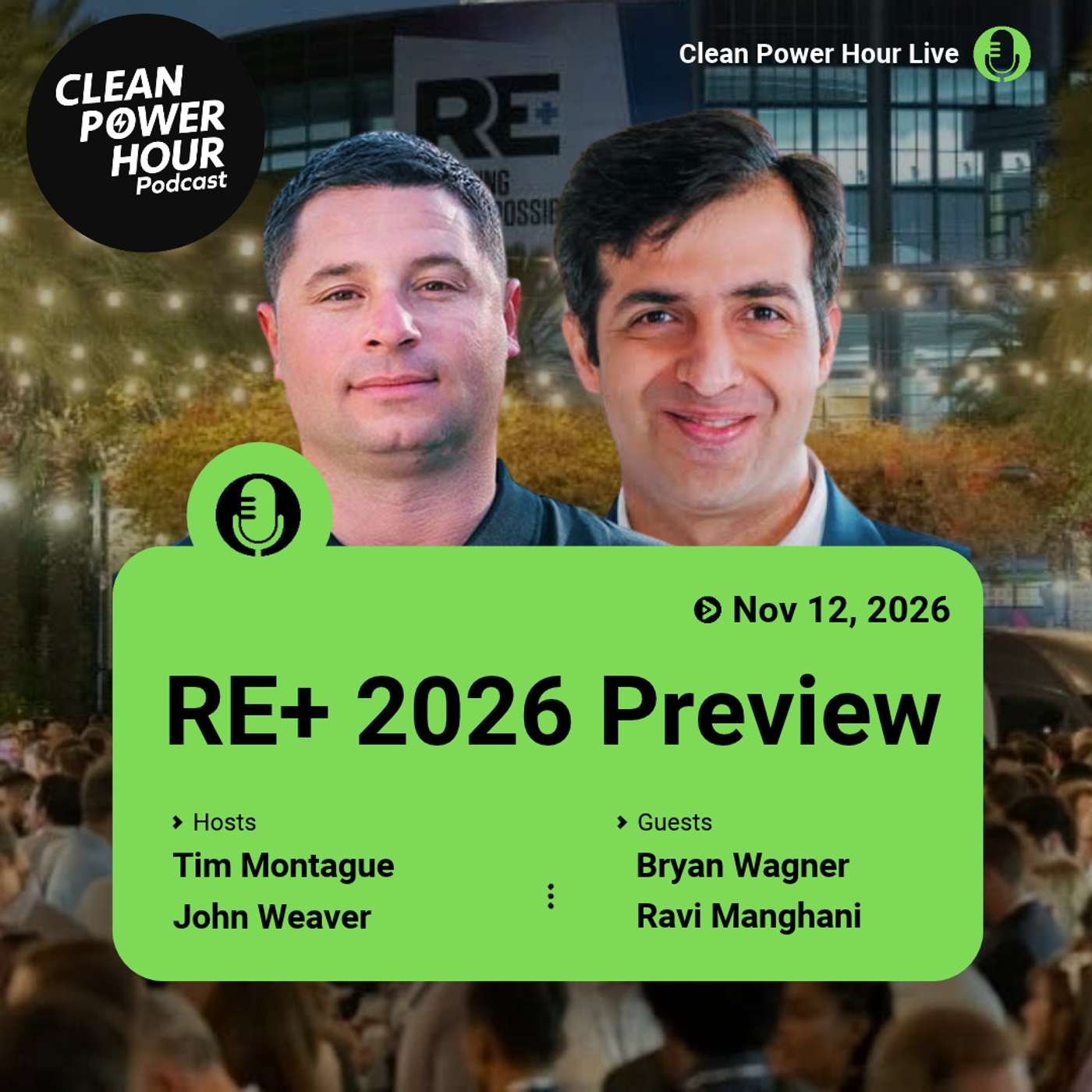
RE+ Las Vegas 2026 is here! What should solar and storage professionals be watching as the industry navigates new technologies, changing federal policies, and growing demand for energy storage?
In this episode of Clean Power Hour Live, Tim Montague and co-host John Weaver welcome Bryan Wagner, President and GM of CPS America, and Ravi Manghani, Senior Director of Policy, Trade, and Markets at Anza, for an industry preview of RE+ Las Vegas, November 16–19, 2026.
The conversation explores the latest developments in commercial battery storage, grid-forming inverters, solar and storage procurement, and the future of federal clean energy tax credits. The panel also discusses emerging technologies to watch at RE+, including higher-density batteries, solid-state transformers, perovskite solar modules, and balcony solar.
Plus, the team examines how solar and battery storage are helping stabilize electricity prices in ERCOT, what changing market conditions mean for battery developers, and why long-term manufacturer support matters when selecting energy storage equipment.
Whether you’re attending RE+ or following developments from afar, this conversation offers insights into the opportunities and challenges shaping the solar and storage industry.
In This Episode:
- What to expect at RE+ Las Vegas 2026
- CPS America’s expanding commercial energy storage business
- Anza’s solar, battery storage, and transformer procurement platform
- Why grid-forming inverters are becoming increasingly important
- How to evaluate battery technology, suppliers, and long-term service support
- Emerging innovations in batteries, power electronics, and solar modules
- The outlook for ITC and 45X tax credits following the midterm elections
- How solar and storage are reshaping ERCOT electricity markets
- Practical advice for making the most of RE+ 2026
Connect with our guests:
Bryan Wagner, President and GM, CPS America
https://www.chintpowersystems.com/
Ravi Manghani, Senior Director of Policy, Trade, and Markets, Anza
https://www.anzarenewables.com/
John Weaver, The Commercial Solar Guy
https://commercialsolarguy.com/
Explore more Clean Power Hour episodes:
https://cleanpowerhour.com/
Subscribe to Clean Power Hour for conversations with the people building the future of solar, energy storage, and the electric grid.
#CleanPowerHour #REPlus2026 #SolarEnergy #EnergyStorage #BatteryStorage
Connect with Tim
Clean Power Hour
Clean Power Hour on YouTube
Tim on Twitter
Tim on LinkedIn
Email tim@cleanpowerhour.com
Review Clean Power Hour on Apple Podcasts
The Clean Power Hour is produced by the Clean Power Consulting Group and created by Tim Montague. Contact us by email: CleanPowerHour@gmail.com
Corporate sponsors who share our mission to speed the energy transition are invited to check out https://www.cleanpowerhour.com/support/
The Clean Power Hour is brought to you by CPS America, maker of North America’s number one 3-phase string inverter, with over 6GW shipped in the US. With a focus on commercial and utility-scale solar and energy storage, the company partners with customers to provide unparalleled performance and service. The CPS America product lineup includes 3-phase string inverters from 25kW to 275kW, exceptional data communication and controls, and energy storage solutions designed for seamless integration with CPS America systems. Learn more at http://www.chintpowersystems.com
0:53
There you go, Ravi. It's in the room chat. I don't know if you can see the private chat.
Tim Montague:
0:58
Welcome to the Clean Power Hour Live. I'm Tim Montague, your host, joined by my co-host John Weaver, the commercial solar guy. Great to see you, John.
John Weaver:
1:06
Hey, Tim. I'm here in black and white because I am speaking from the afterlife, apparently. But very nice to see you, and absolutely turned
Tim Montague:
1:15
into a ghost. It's true.
John Weaver:
1:17
Yes, I need to get a tan. It's this New England living. So yes, I'm working from home today and packing for headed out to RE Plus. So yeah,
Tim Montague:
1:29
well today we're getting you ready for RE Plus Las Vegas next week, November 16 to 19, we're going to talk about what to watch for in solar and storage, who to connect with, and how to turn your time at the show into real opportunities for your business. Joining us is Brian Wagner, President and GM of CPS America, a longtime friend of the show, bringing the solar inverter and energy storage manufacturers' perspective, and Ravi Mangani, senior director of policy, trade, and markets at ANZA, a solar and storage data procurement data and procurement advisory company with more than 20 years of industry experience. Welcome, gentlemen.
Ravi Manghani:
2:12
Good afternoon.
Bryan Wagner:
2:12
Thank you, Tim. Thank you, John. Great to be on.
John Weaver:
2:16
And and Robbie, he gets special status because he used to write for Green Tech Media, and anybody that wrote for Green Tech Media, they're automatically kind of cool. So, Brian, nothing taken against you. That's where
Bryan Wagner:
2:27
I recognize Robbie's name from. Here's meeting now, so that yeah, well,
Tim Montague:
2:32
Ravi's been around. Ravi's been around. Well, I'd love to get some introductory thoughts from all three of you. Like when you think about going to Vegas, it's it's a exciting, somewhat intimidating time. Honestly, there's a lot to chew on. But how do you approach going to RE Plus, John Weaver?
John Weaver:
2:55
Me, I get exhausted there because I'm there writing for PV Mag, and I'm trying my best to learn knowledge for my small business. I try to schedule out meetings, but not too many meetings. I try to go out a day or two early so I can get some sleep, and then. then I, yeah, I I just I try to coordinate a little bit, and I have to plan some. It's in a new floor, new building, so again, I'm going to be learning a new map. I hope it's not nutty like the last couple of years where we had to go to different buildings, but we'll see. But I try to read all the press releases and emails that hit my inbox from all the manufacturers, so I get an idea of whose sales pitching. And but I can't schedule all the time because you got to walk the floor and just talk to people. So drink lots of water too, and and wear soft sneakers. I got my New Balance. I got new New Balance sneakers that are sitting right there on the floor. They're about two weeks in, so that's going to help my back.
Tim Montague:
3:55
Good advice, though. I don't think getting to Vegas early helps you sleep. What about you, Brian Wagner? What are your thoughts about going to Vegas?
Bryan Wagner:
4:03
Similar to John, I think that's the similar routine I've had every year. This one's been, I'd say, a lot more going on prior to the event and after the event, I've been, as you know, Tim. We have manufacturing in Thailand today, so I've been there recently. You know, several locations overseas the last you know 468 weeks. So I'm I'm here in New Jersey today in our in our business headquarters, but I I wish I was going to say I'll be I'll be kind of resting until next week. I also get get there a little early, get things mapped out, like John said. This is the exception, though. I have to give kudos to my wife and a 10 or 10 or 10 or 12 girls of like our 12-year-old is we're going to Hershey Park, so I'm a driver this weekend for that, and so I guess big kudos to her for planning that right around our biggest event all year. So it'll be a it'll be a little bit more I think things going on ahead of RE Plus than I would normally be used to, so maybe when I get there I'll be have a chance to relax and and take everything in. But yeah, I'm I'm excited nonetheless. You know, obviously the last few years it's grown from 30,000, 40,000, even 50,000 people, and so I think we're expecting you know a really good turnout. And there's just so much going on, as you know, in in policy and and you know in the inside the industry, even outside the industry. But but you know, good chance to kind of connect with everyone again.
Tim Montague:
5:44
Great. How about you, Robbie? What are you looking forward to?
Ravi Manghani:
5:47
Yeah, absolutely. First of all, John stole my thunder. I was going to. Make the same comment. Make sure you wear comfy shoes, whichever brand you prefer. That's one lesson I've I've learned over the years. But in terms of you know what I'm looking forward to next week, obviously the recent elections have put you know some buzz back into the industry with respect to you know potential upsides that that we could see in in the in the coming with the coming Congress. So we'll be keeping my ears open to see you know what the industry folks are are are thinking about in in terms of trade and policy and everything else. But otherwise, you know, obviously it's a great opportunity to meet all the folks have been in the industry long enough. I think it's it's it's a more more spread out event this year, so it will be wonky to make sure that you you know all of all the folks who plan to attend give yourself an extra five to 10 minutes to get from one hall to the other. But other than that, yeah, looking forward to the show.
Tim Montague:
6:51
Yeah, the the scale of the facility is a little intimidating, I have to say, and so your meetings will be running late. But and and like you, John, I I try to do a mix of scheduling myself, but also finding time to just walk the show and meet and greet both existing known companies and looking for new technologies. You know, it was a major shift. I thought in February of this year, going to Intersolar to see how many battery storage companies were on the floor. It was it was quite dramatic, so I wonder though, Brian and Brian and Robbie, from a technology side, what is it that what is it that CPS is showcasing this year, and and likewise when it comes to Anza Services, what is it that you're really trying to get the word out about,
Bryan Wagner:
7:58
Ravi? You want to take that?
Ravi Manghani:
8:01
I'll start from Anza's perspective. So, in terms of what we expect or would love to see in meetings with the customers and our demos on at the booth is just showing your customers the the the depth and breadth of the solar battery storage and transformer market coverage we have on the platform today. We in fact very recently launched a transformer data platform too. We've always had solar for the last three years and storage data platform about a couple of years back now. So Transformers is the new kid in in town for us. So looking forward to you know showing our customers and and prospects as well what what the features and and various technologies that we track. Beyond that, of course, you know obviously our advisory services are growing as well. A lot of our customers that we work with are looking for our advice on what what the heck is going on with FIAC and ITC and Section 232 and all the various other tariffs that we currently have to deal with. So there'll be some, you know, hopefully some productive conversations there,
Tim Montague:
9:15
Ryan.
Bryan Wagner:
9:16
Yeah, I would say the same. Really, as Robbie, all the categories you mentioned, we'll be connecting with our customers directly. About, I think we've built a really strong relationship business that is very focused on, you know, trust and years of like loyalty to one another, and working through hard times and challenging times. And this is just another example of you know, almost every year I feel like we when we see these periods of time for two or three times in a year that are really a big challenge. And we've looked at it now and this year is, you know, as we ride through this, it'll become we feel a really big opportunity ahead, and maybe that doesn't mean the next three months, but the next probably more, you know, three years. You know, how do we retool and revamp who we are to recharge the industry? And that's that's really what we're focused on going into next week, and you know the 1500 or so direct customer relationships that we have, connecting with with as many of those as we can, and continuing to give them the insights that we're working on and that they want us working on, so we can stay ahead, you know, inside the industry.
John Weaver:
11:26
So I was going to bring up a thing about batteries, and I'm wondering if you guys know about this. You know, we're going into RE Plus. You know, the politics is, you know, of course, a big thing, but this is more of a tech question. I know CPS has a large has. Ability to offer grid-forming batteries, and Ravi, I know you are conscious of this. Like Brian, are you guys seeing in the United States grid-forming battery demand yet? I see it. Like I'm going to share an article in the second half of the show talking about how Portugal requires it, but just you know, I've seen you guys and your products out there. I want to stop by the booth and be like, "Hey, this is a grid-forming battery." I don't think they're very different physically. There's like a couple little trivial things inside physically, but I don't know. I just want to touch one, and you're a battery, or you're an inverter and a battery guy. So technically, we're talking grid forming inverter, not grid forming battery. But it's within the inverter that's that both components have it. So that's just one thing I've been wondering. I wanted to ask you
guys:
12:33
Is that
Bryan Wagner:
12:36
yeah? So sorry, the question: Do you guys
John Weaver:
12:40
are you guys have one for sale? Yeah, I just kind of rambled there talking about batteries, grid forming stuff, but I want to go touch one at your booth at the show. Is my you know aspiration for this week?
Bryan Wagner:
12:51
Yeah, so I would say the answer to that is we look at our battery business as really the next leg up in what we're doing. It's it hasn't been what's brought us to this point in time, John. So I think that you know grabbing time with our engineering team, our product team, you know talking through the different applications, microgrid. You know obviously there's depending on the different regions, there's the different revenue models that that exist out there, and so I think we're open to all. You know, obviously, what we're working on next, the next two or three product iterations, we have our our battery storage product called Gonzo is kind of the main focus for us right now in commercial energy storage, and you know we offer other products, but I'd say that's become our our main focus is to really you know work work with that product and and you know try and like like the push to solar plus storage is really big right now. So if we have you know call it 3040 50,000 solar projects, we're trying to identify really what and why would those existing solar projects be adding storage? And so I think I'd like to learn again with you, John, inside of our team. I'd love to to have that meeting with you and and truly understand kind of how you're looking at from a developer perspective or in what markets, you know, which applications would make sense? Because my understanding is, you know, with with our battery structure today, we can we can we can go, you know, 456 different ways with the battery. Yep.
John Weaver:
14:42
Yeah, the the grid forming stuff doesn't need the battery. When it has it, it's even better. It's it's just kind of a big thing. Abby Ravi, sorry, I mixed Anza and Ravi there. So as Abby, that's your new name. Yeah, but are you is that a variable in your database. Do people care about grid forming yet? It feels early-ish.
Ravi Manghani:
15:09
Yeah, yeah, it's it's certainly early-ish, right? Although we we starting to see certain markets like Texas or ERCOT and and MISO start to look at sort of early you know proposals on how to force the issue in some ways, obviously. But as the grid has, you know, more IBRs or inverter-based resources on the grid, a lot of the inertia that you lose with all the rotating, you know, mass going away from the grid certainly makes the need for grid forming capabilities, you know, a question of reliability. And and we, you know, yes, we should expect more grid forming requirements going forward. Secondly, you know, even once you sort of zoom one step below the various ISOs and RTOs and what they're working on, or even NERC for that matter, there are you know increasing number of state you know state level jurisdictions you know electric utilities load serving entities etc. That even for distributed energy resources that are being deployed in their jurisdictions are increasingly requiring or asking for grid forming capabilities you know, as part of you know any kind of bringing new assets to their to their jurisdiction, and that kind of becomes a precursor for them to you know provide interconnection permitting approvals. So yeah, certainly expect grid forming to become. A major factor in in equipment selection going forward, and I know we we we haven't touched upon data centers. It's probably too early during this this webinar to talk about data centers. But generally speaking, you know, as we start to see more data center and large loads come in, again, those in theory would would would want to be in a position where they can disconnect from the grid and and get back you know connect back to the grid as and when their you know load requires so that there's a chance that you know grid farming would become a bigger requirement even amongst a large load a large load Yeah, customers.
Bryan Wagner:
17:26
John, I mean, just just just to add to what Robbie's saying, John. You know, the answer is yes. Our product can grid form. Arganzo can can can can help with. Again, it depends on what you're trying to achieve, and I think how. Like you know, I think we even will take you through. We have some unique, you know, advantages in the market with our particular product versus others with this topic, grid forming. I know that's not the point of the call, but yeah, we can definitely walk you and other customers through that.
Tim Montague:
18:00
I would say I would say your point of contact, one of your key points of contact is John Drummond at CPS. And while you guys were talking, I just googled that question: grid forming CPS EMS PCS, and the and a slide that came up with John Drummond from 2022. So yeah, there's no doubt that grid forming is part of the CPS offering, and I would just say that the future of the grid is a grid of microgrids, and this is a mantra you're going to hear on this show more and more in 2027. Microgridding is super powerful. Of course, the battery is you know has when it's attached to the grid, it can create a value stack that is unique, and you want the grid to be on the you you want the battery to be on the grid to provide those services. But then it's beautiful when the grid goes down if your battery can support a micro grid, so you have resilience. And everybody wants resilience. It's just a question of can they afford it, and do they have a need for it? But
Bryan Wagner:
19:07
yeah, I'd say like in the especially in the islands where there's no grid, you know, I think we can help a lot with the microgrid side. We're seeing a lot of those demand that a lot of that demand grow. Certainly, backup for critical applications. There's there's a number of reasons that I think the demand is growing in energy storage, and yeah, we're excited about that. I think what I was trying to say earlier, John, maybe not didn't say it so well, is that we are still new to the game. We launched our first products in 2017, and it was we were way too early with a small AC coupled battery. A lot of the players did the large DC couple, which had a lot of incentive structures that we didn't participate in, and so we really didn't launch our our large utility scale five megawatt hour best until 2024. So we were really late to the game in that from that standpoint, and you know where I think we've seen success and growth, you know maybe it's going to end up, you know probably at least seven to maybe 10 times higher this year for our business is in commercial storage. So, you know, we do expect in the coming years that that will be, you know, even 20, 3050 times growth. And so that's why I think we're a little new to, you know, most of our business on the incumbent side is the PV and all the things that we can do with that product. But we feel our our Gonzo product can can have even more benefits that I think are untapped so far. And and it becomes a little bit of a marketing challenge. How do you how do you market all these things that the product can do is which is much different than we you know, in our traditional PV business, it's much different applications, and I think we're going through this even like leveling process of how the engineers and the designers and the you know the project managers and everybody understand the product and what can can happen. That's why we've taken real direct aim at our existing PV projects to attach storage to, and and why do those customers in the different regions want to do that?
John Weaver:
21:11
You know, you just said something, Brian, that has been an issue for me. You talked about how to educate people on batteries and the many features, and
Bryan Wagner:
21:23
yeah,
John Weaver:
21:23
I think what I was you were saying that I wanted to say, Ravi, how the heck do you talk about? Because you know we're talking about CPS, but you guys have a bunch of different products that you work with. But you know how would you talk up like a CPS or any other inverter battery combo? Because there are so many features, but on so many levels, they're like they're similar but different. Like solar panels, you got a solar panel; it just blasts juice, and there's a lot of different features on it. Inverter starts getting a little more complex. You know, it's more complex than our solar panel. Now you're throwing on a battery, and when I walked the first time I went through Inner Solar in Munich, they had a whole. They have like 12 halls there, and four or five of them were solar panels. One or two carports, and then like six were consumer level batteries, car chargers. And as I walked through there, and I saw 1020, 30 different consumer batteries. I got overwhelmed, and so how the heck do I like? I guess Robbie, how do you differentiate them? And then Brian, when some dude like me who knows some stuff about solar comes up and says, "Tell me the difference," like I, I don't know where to go. I couldn't do your sales job at this. I don't know how to sell your products yet. To be honest, good
Bryan Wagner:
22:44
us either.
Ravi Manghani:
22:48
Yeah, no. So I think you know. First of all, it ends up at least on the battery storage side, we typically are working with utility scale customers. So we don't, fortunately or unfortunately, do not come across a lot of the consume, you know, B 2c markets per se, but the question still is valid, right? How how how does a buyer that has is looking at a bunch of different products in the in the market, and to your point, if they're looking to self integrate, you know, which DC block can or cabinet can work with which BCS? That always is a question that that we get right. So generally speaking, you know, the the starting point for any of those discussions is understanding what the customer is looking for, right? So we go through a full discovery process in terms of what's the use case. If there are multiple use cases, how do you expect to you know you know compartmentalizing different portions of your SOC or state of charge for for the various use cases. You know what portion of your of your value stream is contracted versus non contracted? Do you expect to operate the system for five years, 10 years, 15, or 20? Do you expect to maintain the same capacity? Is there a minimum capacity that you're obligated to to provide to your off taker for that period of operation? Are you are you planning to do rapid cycling for anthropy services versus also trying to tap into the energy markets, or or are you are you just going to be providing energy shifting, time shifting applications? So there are all these various questions tied to use case, your operating profile. Once you get to a point where the customer has given us enough information about the operating profile, then we go back to our our platform and their data set and and look at what products are out there that would meet those requirements. I mean, to be very honest, a lot of the five megawatt hour building blocks today in the storage market and Ryan, feel free to chime in there. Look and feel very similar, right? In terms of they all have 300 amp hour cell, you know, family cell, family of cells in there. We are seeing, you know, some products moving towards, you know, six, seven megawatt hours as well as as they start to use 500 plus amp hour, 600 plus amp hour cells. But generally speaking, the market today is pretty much aligned with with the five megawatt tower container building block. So at that point, you you then start to look at you know obviously go past the technical characteristics to think about what kind of counterparty risks is the buyer willing to take, right? So that's where some of the true distinction starts to happen, and and we start to see different tiers of products that can meet certain fiat compliance requirements versus some others that cannot. Whether you you need a domestic content you know product to to to get tap into the extra 10% ITC, or or you or you you want to go with the cheaper option if even if that's imported, what kind of tariff risk are willing to take? So there are all these various factors that now get into more of the supply chain issues, and and and then you know we eventually start with the list of 30 to 40 products at the at the top of the funnel. But once we go to the technical due diligence, then the commercial or or supply chain and counterparty due diligence, we get to a point where we're down to like eight or 10 suppliers, and and then from that point on, it's just you know fine tuning what what the customer is looking for.
Tim Montague:
26:05
I love this topic, and you know technology is a wonderful thing, but we have to remember that people are what make the world go round. And you know I'm curious, especially the audience, but but you guys here, there's there's issues of quality, capability, price, and then longevity, and who is the team behind supporting the product? And I find that I love chasing shiny objects, and I love new technology. But I also see a trail of tears behind so many new innovations and new manufacturers that don't have staying power and the ability to support a market. And here we are, really at a major. I think we're at an inflection point in the solar and battery industry in the United States, where you know, we're we're approaching, you know, say 20% clean energy in in many markets now in the U.S. Some are already past that. California and Texas, we're chasing that in New York, in Illinois, in New Jersey, in Massachusetts. But what do you guys say to our audience about how to properly vet technology?
Bryan Wagner:
27:31
Probably better for Robbie.
Tim Montague:
27:33
I think it's. I think all of you have have an opinion about this because you're all in different different boats.
John Weaver:
27:39
Robbie got the last one. It's your turn, Brian. You got to give us some time. All
Bryan Wagner:
27:43
right. I mean, I guess I can relate it to our subcomponent suppliers, where we've had a lot of technology. We we obviously like to say you're buying a CPS product, but we have a lot of partners behind the scenes. Probably 1000 components going to the the PV side, PV inverter. Whereas I'm not 100 on the battery side, but you have obviously key features like a PCS and like a you know the cells and the packs and the racks and all the like. So I think you know relying on subcomponent suppliers and doing your due diligence and ensuring that you have you know very sophisticated we have very sophisticated supply chain, ensuring that we are aware. Again, to use a PV reference, if there's a challenge in say the 1000 units in a batch, we have to be able to identify that challenge really quickly through both our U.S. teams and our overseas teams. If you say both the R and D side and the and the product development side or the or the engineering sides. I think to both John and and you, Tim, of what you were saying, or maybe John saying more so on the last question around how do you make the complex really simple. That's what I would say. CPS has done a really good job in the last decade of leading in the PV space, in the really I'd say string space, string string technology space, to make that really more simple, to help expedite solar projects and development and and the like. And obviously, we always feel strongly that we've helped create 1000s of jobs inside of the U.S. You know, solar industry. I think we're being challenged right now, John. That that's being much harder and longer in storage. And so I think what I would do in the past with our team, again being very simple in how we approach our market, you have to have a focus. And so I always use the analogy of you know being a former many years ago, but former athlete is like you know I was baseball, football, wrestling. If if I was trying to do all three in the same season, it would have been impossible. And nowadays, you see all the year-long sports, and it depends on which you know if you do hockey, if you do soccer, if you do wrestling, you do whatever sport it is. They all say they all encourage you. You must do it year round if you're going to be successful. Well, then you're not taking into account that if you if you train in basketball may help you in this other thing. So I think we're using the same example of solar and storage, and I think standing here today, I can say confidently we are likely moving into the EV space in some capacity, and so we are saying solar and storage. While we're finishing storage with what we feel is the finishing touches on what we feel the next decade will be success in commercial energy storage, we're we're working on our third leg of our of our business, which will be EV side, and we feel confidently in all three of those buckets, we can do them really well in the future, but not right now, time together. And so PV, what I'd say is where we've where we've gotten where we've had challenges in PV is because of all the distractions that's come from storage over the last 12 months, 18 months, even three years, five years, and so it's been really hard running a business when you know 90% of your effort or investment in that space has been a total flop and a total like time suck and and even loss of of revenue, and so I'm standing here today. I have in about an hour. I have a company call with all the team to go over, you know, kind of Q3 side and how we're doing and what's Q4 outlook and all this. And I can say we're year to date about 8% of our revenue comes from energy storage, and in Q3 it was about 10%. So, meaning that we're trending towards more energy storage. If you talked to it just a year ago, it would have been under 1%. And so, I think as both the PV side continues to, I don't want to say stays healthy or flat, but you know, stays healthy, right? For us, we know that's been a big business. We only will grow through our energy storage efforts and our and our focus in that space. So maybe John, to answer your question from prior about grid forming or some of these you know details with respect to how does the battery interact with even a gen gen set, like we're not exactly going to give away too much in those wall you know in this form, but but you'll come over to our booth to to hear more from our experts. Like Tim was saying, we've really created a business where there's you know 15 experts that can help walk you through how you do that for your specific market and and your specific business.
John Weaver:
32:38
And just a quick point first, Brian. Great answer. It's it's it's interesting under 1% to approaching 10%. That's significant. That's division that didn't exist and generate revenue. Now you have to deal with it. And but just a quick point to put out there. CPS is a solar panel company under its broader group in terms of astro energy, which I don't know if you have to deal with on a day-to-day basis, but I'm sure you see their projects and you have to be next to them. So I just want to make sure everybody knows this. That so Wagner comes from a crew that has one of the world's largest module manufacturing arms and one of the world's largest inverter arms, and now they're coupling in batteries. And you heard it first, EV stuff is coming here. So now everybody knows Brian. So it's good for you to keep some stuff quiet because there's millions of people listening to us right now. So be careful. Yeah, I
Bryan Wagner:
33:40
love that. It's millions. So that so then I would say on the question or the part about the panels, we did a really good job, in my opinion, staying focused on our core business. We've we've we've participated some in that more commodity market, and if you really look at a lot of the the overseas suppliers that have formed different looks or feels to their companies today, I think it started in modules, and because of where some of the margins are in the business today, but whether it's U.S., whether it's anywhere overseas, it's been a challenge. So I think you know Chin did a good job, obviously diversifying how we go to market and what we're working on, and that's really how truly CPS is thinking about it. Is we now got to go dominate this commercial energy storage segment? You know, I say for the next decade that'd be fantastic. We're really thinking about the next three to five years, and we're really well positioned to do that. And for the first time in first year, in fact, last year we had to I don't want to say halt sales, but we halted the conversations because of all the things that were happening in the beautiful bill, and the tariffs that were announced in in April, and luckily in that period of time, our energy storage was just starting to take off. So we could have been a little bit bigger, if not a lot bigger, today. It could have been closer to 15 or 20% of our business in storage if we didn't decide to make those strategic decisions last year, but I think sometimes taking a sidestep or even a step back helps you really move forward quickly. So next week for us is is is so critical, so important to you know get the attachment rate inside of our brand much higher. The CPS brand is really well known in PV. How do we attach the storage brand to the PV brand, so that in the in the recognition, a lot of folks don't don't know us in batteries. Like you said, it's very crowded, and that's the approach we took. We looked at the top 10 projects in the world for utility best, and not one brand was the same in the top 10 projects last year in the world. So we said, okay, that's a good example of what happened 1520 years ago in PV market, and we said we don't want to participate there. We're actually focusing on commercial energy storage, and I think you'll see a year from now or two years from now with market share, we'll be right there on those top three.
Ravi Manghani:
36:02
Brian, Brian, a question for you, if you don't mind, right? The you know obviously in the commercial space, we we work with a lot of customers. The challenge that we've seen some of our customers have on the CNI side is not so much the product. You know, again, you know, all products have their own value proposition and and and
Bryan Wagner:
36:20
the economics, right? Missiles,
Ravi Manghani:
36:21
right? The economics, right? But I think a lot of them are are struggling to find partners that can provide you know long term service you know contracts and and and be there to to support those projects because like I said a lot of these projects are you know going to last 510 1520 years. Any any thoughts around you know how you're thinking about your service organization to to support the. Nice piece.
Bryan Wagner:
36:44
I worked. I mean, I've been traveling all week. Like I said, even probably the last eight weeks working on that. And one of the things that you know we have going on today is probably across many states the PV commissionings are happening across now many states the battery startups are happening, so I think we're getting more firsthand knowledge of how we're going to staff that and really invest in that future. But we've always said, you know, kind of our business is service, and so you know, I I tend to say like the things I focus on would be sales, marketing, operations, but we really don't sell through the traditional sense. We sell really through thinking about the operations, and then that you know kind of leads to you know more success and and and and revenue and and and customers. But right now we have a particular site this week, last week that is really challenged with our Gonzo product. It's a new application, right? Like I said, there's many applications in the battery side that we have to be prepared and ready for, and so we've staffed our battery side like slightly different than we staffed our PV technician side, and we're at a position now where do we invest more before the projects are here, and so we're trying to balance that. And the answer is yes, we are, and we really need those projects to follow. So, Robbie, the economics of having ITC in batteries or non-ITC is, you know, one thing we're doing consistently is driving down the lowest overall install cost. You know, used to be two boxes. You know, PCS cabinet, battery cabinet. Now we've combined into one. And you know, think about logistics and and you know all the freight savings, but all the install savings. So we're always thinking that way. And I think following closely what's happening in policy, so we can also, you know, maybe make some upgrades to to our go-to-market strategy with respect to the the policy side as well.
John Weaver:
38:53
Yeah, that one particular reason I brought up Brian, you guys's connection with Astro Energy is, you know, if I'm like, for instance, myself, I'm trying to buy my first battery. I'm actually going to be asking Ravi for advice and help for a project we're going to own. And by the way, Ravi, your screen is backwards, so your Anza label is backwards. Sorry to call that out. I just thought it was funny. But one of the things that I have a worry about is how we, because there's a control system in this battery, and the control system is run by software, and software is run by human beings who have to program in the back end, and software always needs to be updated, and that's scary when you think about a small manufacturer who may or may not be here for a 20-year contract that I need to pay in order to keep my battery running. But the reason I brought up CPS is that Anza and CPS. That means you have multiple revenue streams. Now you got a battery company, you got an inverter company, and you got a solar module company, and all three of them are generating revenue and kind of giving back end support. So you got multiple crews of engineers, multiple crews of financiers, and this and that, and so I'm not trying to toot your horn, but it was just it's the reason I brought that up, Ryan. Is that your company's brand name, in my mind, has a couple of layers to it. It's not just an incubator company. It's not just a battery company. One of my favorite companies in the industry is QCell because Q Cell isn't Q Cell. Q Cell is Hanwa, and unfortunately they make weapons and stuff. But they're one of the largest industrial conglomerates on Earth. So I don't think Q Cell is going anywhere anytime soon. And I don't. And so I get vibes of that nature, and it lines up with the question you just asked, Ravi, about support over the long game, it's a thing I'm worrying about because it's I'm new to this. We're a small fry. I can't go in there and buy utility scale stuff and sign custom contracts. It's I got to sign what's in front of me because we buy one battery, and and that matters. So those layers, it's what
Bryan Wagner:
41:02
I was going to comment was one thing in my old inverter days. Like again, I was with a large central inverter brand, you know, public U.S. company that then went offshore with the manufacturing. Even though still today U.S. public stock company, very strong company. But one thing that we were challenged with back then was the service cost as a percentage of revenue, so I think John, you know, you and Tim on your your side of the business, you've probably always thought about that as your, you know, cost of after sales on anything you're doing, and right now where we're unique is we kind of have I don't want to call it the cash cow. But we kind of have this very healthy business that we've created. You know, in 2025 we were 43% market share for string, and so even if we drop 10%, we're still a third of the market this year. So we've created this really healthy side on the PV side. That's like you know multiple years out we can predict, even with some catastrophic things that you know you can name a lot
of these things:
42:06
FIAC, FCC, you know all kinds of things that's happened. Executive order that's out, all kinds of things that are out there right now. You know we're still weathering all of these while we're building, if you will, this new business that is is kind of almost like a startup within our business, and it's starting to take off. Where finally, for the first year, we're going to be profitable in that business, and we're going to be, you know, positioning ourselves to invest in the service. You know, it's really hard to invest in the service because you know, if we say maybe 10 or 20% of our our staff today, we're still under 100 people at CPS. 10 or 20% of our staffers in battery side. Well, I think that'll as we become approach 50%, you know, batteries and PV, then you'll see this the the organization follow. But you can't you can't wait until you can't hire after you have the projects, and so we've been really trying to balance that, and I think now for one of the first years going into 27, and watching where we are as a company and where the industry is going, we're really going to be start making significant investments into the future of what battery service will look like for us.
Tim Montague:
43:19
So, on the service discussion, I think it's important that our listeners ask this question: When you're talking to OEMs, who picks up the phone? Does a human in North America pick up the phone? And how quickly can a service technician be at your site? Because there's a huge spectrum in what OEMs offer, whether they offer anything directly, right? And many are relying on third parties, so just be very careful about that. It's a it's a very important topic. And then, I you know one of the things, Brian, that I love about CPS is your culture of service internally. You see yourselves as customers, and you're always focused on supporting each other and taking a team approach, and that that culture that CPS has created is like none other that I've experienced in in any company, bar none. So, kudos to the team at CPS and for your leadership there. In our last couple of minutes, we do want to get to some news stories, and we're going to let Brian Wagner jump because he's got to get ready for this company meeting. But I would love to do just a quick lightning round on what are two or three things that you recommend our listeners check out at the show, like just could be anything, but or check out or focus on.
John Weaver:
44:50
Check out the Helene solar panel that they just put a press release out on. That's so Helene manufacturer that has a perovskite glass layer and a standard solar panel under it that's up to 27% efficient. Helene says it's under commercial manufacturing right now in their press release. I'm going to be barking at the their booth to find out. That's my number one thing.
Bryan Wagner:
45:21
Nice. Number two for you, John, is CPS booth, of course. Yeah,
John Weaver:
45:26
absolutely, absolutely.
Bryan Wagner:
45:27
Yeah, yeah, and we can walk you through, like Ravi said, but we can walk you through that whole battery process in terms of, I think, some of the pre-development.
John Weaver:
45:40
Well, you got to give us the cool thing. You're not allowed to be in sales pitch territory now. This is this is cool re plus visit item. Come on, Brian, you're working too hard.
Bryan Wagner:
45:49
Well, I was saying I was saying you can find the coolest swag at CPS. So no, yeah, I guess what I'm thinking about is if you were to take CPS out of it for a minute, maybe that make that your last stop or or on your tour is the the battery side of the business. Just look at how many players are. You know, look at how many companies are going public with maybe even very little revenue right now. It's like you know, it's kind of like the AI space and and and battery space. And there's just a lot of things happening, you know. Try to figure out what companies are really doing behind those products they're representing. I think that's kind of what's most interesting for us right now as a company, and and for listeners is is look at the battery business in this small, medium, large. Basic, you know, make it that basic. Small, medium, large. Who's really involved in doing what, and and how can that help you,
Tim Montague:
46:52
Robbie?
Ravi Manghani:
46:53
Yeah, sort of talking about cool tech and and not necessarily wanting to name any vendor names here, but I definitely want to visit some of the booths that are bringing sort of some of the higher energy density battery products. You know, six seven megawatt products. Like I said, one other area that I would be keen on is seeing you know how many innovations that we see, innovative products we see on on the power electronics side. And by that I'm not just documenting motors or PCs, but you know there are some products that are going to be focused on solid state transformers, for instance, or thinking about how to optimize some of the non-battery BOS portion of the of the cost stack. So those are some of the technologies that we're considering for sure.
John Weaver:
47:44
Solid state transformers sound interesting to me. I don't understand it. I mean, I sort of do, but it just sounds super interesting. Solid state rolling through lots of stuff. What about you, Tim? What's cool thing you're going to check out?
Tim Montague:
47:58
Well, you know, on my mind is balcony solar. I'm curious to see if anybody is hocking a solar module, for example, that has an integrated hinge and hook. I saw something when I was in Australia two weeks ago that was just that a solar module that has a hinge built into it, so it's designed to go on a balcony. So that's a hot topic, I think. And solid state everything. I love solid state. I got the question from the electric Viking. You know, are we going to see solid state EV batteries? And the answer is yes in two years. But anyway, all right. Well, I wonder if we should transition to cover some news stories, John.
John Weaver:
48:46
Sure, sure. We got 13 minutes, so absolutely. If you want to blast through some, Brian, you can hang out and listen to us talk about news. Won't necessarily be about CPS though. So
Bryan Wagner:
48:56
the big boss might take advantage. I'll be here.
John Weaver:
48:59
All right. Sure. So you know, I guess for me the number one news item of the last two weeks is probably just the election. I mean, you could probably share my article that I wrote there, Tim. I, you know, my opinion on the election. I'm a little more bullish on the ITC than a lot of others. I'm also very strong in that we need it. Some people push back on it for you know economic purity reasons. We shouldn't have incentives. I could go on a soliloquy and write some articles on it because I already have. But what I'm showing off in this particular article is that constantly since the OBB was signed about a year plus ago, we've had submissions from various politicians looking to revert various aspects of it to get the solar tax credit for residential back to extend the commercial one beyond 27. And some people are just going so far as to just get rid. Like one submission from a senator simply said revert all changes in the OBB. That's that's the language of the law, and it just it chops back out all the red lines. So the purpose of this article was first to show off that big thing. You know, in September we had politicians. This is before the election. We're moving into a positive political environment for solar. This was being reported by Roth Capital. They're always on the ground. So in September that happened. Now we had our election. The election obviously has an effect. These articles are just different things. These links are just different pieces of legislation that were submitted. Different ways that people were looking at it, and how you might see people looking at it after january 3. Every one of these, none of them are going to be useful after january 3. Any legislation that's submitted gets killed at the end of the year and has to be re-upped. So none of these can get signed explicitly, but they might. And I'm just putting out there my opinion and my desire both are that the ITC will get extended and that it should be extended.
Ravi Manghani:
51:12
If I may chime in here very quickly, right? I think John, I I kind of agree with your hypothesis here that you know we potentially do see some modification to ITC and tax credits at large, right? We we didn't talk about 45x, but ITC and 45x potentially go hand in hand. It does seem like, based on some of the buzz I've been hearing in the market, that 45x apparently has a much better shot at an extension compared to ITC. We'll see. I do want to sort of also temper the the enthusiasm just a little bit, right? We we're still going to have Donald Trump in the office for the next two years, and while Congress can go about doing their legislative sort of you know actions, there is still a lot sitting with the executive branch, the FCC inverter ban that we touched upon, the executive order on the bulk power grid, all the tariff action that we we we already have seen and potentially expect to see more of, you know, Section 232 impact a minimum import price. How that changes in the next you know six six to eight months. So all to say that it's it's a bit of yin and yang that we'll have to sort of balance through for the next couple of years.
John Weaver:
52:27
Brian, what do you think about 45x? I mean, I know you guys it'll help, but do you have any internal insight about what's happening your your people?
Bryan Wagner:
52:39
Yeah, I mean, here today and even next week at the event, our messaging is we're working on that in terms of what we're going to be exactly messaging outward. I will tell you inside the walls, even well before the beautiful bill was signed. There's you know going back to two or three years of the different strategy and options available to us. So both of those matter dearly. Yeah, the ITC and the 45x matter dearly. We're seeing the 45x this year in particular really affect some of our rooftop business. You know, with some of the domestic content, you know, adders that obviously we're not participating in. And so I think once things start to impact your business, then you take them a lot more serious than when they're proposed legislation or or even passed. And certainly, that's how I've seen you know our group here look at is like what's the real business impact here today, and what do we see these next couple quarters? And I think you know maybe we've been, I would say, not a little slow to respond, but just a little methodical in the way we're going to respond, and and then obviously watching the the midterms was was interesting. And you know, does that change any of our approach? I think the answer is we aren't waiting to see, but we're we're weighing every one of those options. You know, call it three to five options right now. That what we'll end up doing as we head into you know the first of the year, and you know I'd say really all of 27. I think I've also seen I've I've been really in energy since 2008, but I've seen you know one time I stepped outside of solar was I was in more an LED manufacturing side for almost a couple years that that side of the business I saw firsthand that even with 70 80% electrical savings some weren't willing to put forth the investment into the capital equipment because of the lack of the tax equity and and things that have driven our industry to date so I definitely feel strongly that the ITC getting extended is an important piece of the equation right now, and I'm obviously a little bit, you know, optimistic that that is going to be more closely looked at right now.
Tim Montague:
54:59
Everybody wants to save money. The ITC is good for helping consumers save money, and I think America spoke loud and clear that saving money is a top priority for us. That Congress was not paying enough attention to, so that does bode well for the ITC. But I do not have a crystal ball. I also take a stand for a ITC free solar industry at some point, but every industry needs subsidies, and solar and batteries is no different.
Bryan Wagner:
55:29
Jobs, it's all about jobs. That's what we look at inside of our company, and how many jobs can we create inside the company, but also you know our customers and our you know like if you think about a utility, well, at a individual utility, how many jobs are at that utility for the renewable side? I think the more we incentivize that direction over these next three to five years, to me, is still very critical, and it's not the time really to pause the or cancel the ITC. Is my take, John? I wonder if
Tim Montague:
56:08
we should if we should talk about the story on ERCOT. Despite record summer demand, solar storage kept ERCOT prices low.
John Weaver:
56:16
It's fitting, and this is the one. So the story that's right above this ERCOT one is that Portugal, and this is what drove me to start poking you, Brian. Is that Portugal recently made it the legal requirement that all inverters, I believe, above 45 megawatts, all solar inverters and battery, have the ability to offer grid-forming services, and these are places. That have massive solar penetration, so these places need it. Like Spain had an issue a year or two ago where they had some challenges with their services. At first, solar was blamed for being too much. It's a more complex thing. It's really about the coal and the gas that weren't running properly and not connected. But it's a bigger discussion that Sol is involved in, and that's why this matters. So, and and then it connected to this story. If you don't mind sharing it, Tim. But it should be on
Tim Montague:
57:13
screen. Oh,
John Weaver:
57:14
oh, I got to
Tim Montague:
57:16
add it to stage. There we go.
John Weaver:
57:19
So, well, that's the Portugal one. So we like this. So everything for large scale, but the in Texas, the reason I think it's even more is that over the past couple of years, you know, Texas used to make its money on, or Texas power plants used to make money on the spikes. They used to cover their bills. Yeah, this is the one we would need to see. They used to cover their bills with their nine to five money, you know. Just if you scroll down a little bit, Tim, there's a really nice chart, and and these spikes, yeah. So there it is. Those spikes are where your profits was made, where where people were made happy, vacations. But energy storage, this is you're doing, Brian. Good job. Energy storage and solar are making the red line happen now, and the red line represents the current wholesale electricity price in ERCOT. This is the day ahead market, so it's looking at predictions and saying, "Hey, what's going to happen?" Solar and storage are driving the grid and doing this. They're going to lead to peaker plants go away. They're going to lead to coal plants going away. We will be the grid. Solar and storage will be the base of the grid, and we will fundamentally have to offer these services. So that's that's why this combo of two articles were on the document because this is your doing, Brian. Good job.
Tim Montague:
58:38
Oh yeah, just to be clear, the blue line is 2023. The red line is 2026. May not be easy for viewers and listeners to see that, but so there's a dramatic change though. The extreme weather continued in Texas, but it's been the the cost to consumers has been controlled because of solar and batteries, or
John Weaver:
59:05
it's solar, man. It's solar and batteries in the daytime. Yeah,
Ravi Manghani:
59:09
I I think a couple of things to to point out, right? I think yes, the the prices have been kept low, but more importantly, the grid was kept running, right? So reliability is just as important, probably more important for customers than than the electricity prices. The the second point, however, worth mentioning is that you know as the the red line starts to get less volatile, that arguably also reduces the energy storage economics, right? Or or or makes it worse because now you know as as you as our audiences is aware, energy storage makes money through arbitrage, and as there are fewer peaky days, you're you're likely to see that the the cost of charging versus discharging that that delta shrinks. However, one on the positive side, though, I think what we are also seeing in Texas is you know the battery storage duration hours are are increasing. You know, back in the day, Texas was only a you know 30 minute an hour long market, but today a lot of our battery storage products that projects that we are supporting are 345 hour duration projects. What that implies is, in addition to participating in the in these markets, a lot of these projects are going to be also getting into offtake agreements, so there are new revenue streams that are certainly available to energy storage developers and IPPs, even as the that red curve is is getting less volatile.
Tim Montague:
1:00:41
Unfortunately, we're out of time, gentlemen. I'd love to hear from you, though. How can our listeners find you in Vegas next week at RE Plus?
John Weaver:
1:00:51
I'm going to be walking around the floor harassing people, so you'll probably have to avoid me. But Brian, what's your booth number, or do you know your booth number?
Bryan Wagner:
1:00:59
Yeah, you got to give me a minute on that.
Tim Montague:
1:01:02
Oh, I know I know the CPS booth number. It's n 1n 136 3n is for North. So check that out. I will also be in the CPS booth most of Tuesday and some of Wednesday. So please come find us at n1 363. Bobby.
Ravi Manghani:
1:01:24
Yeah, we are going to be not far from CPS's booth. I think we are also in the North Hall booth number N 226. I get it right, N triple two six.
Tim Montague:
1:01:37
Wonderful. Check out all of our content@cleanpowerhour.com. Tele. About the show, that's the best thing you can do to help others find this content. And with that, I'll say I'm Tim Montague. Let's grow solar and storage. Thank you so much, Ravi Mangani and Brian Wagner, and none other than the Commercial Solar Guy. Thank you, gentlemen.
Bryan Wagner:
1:01:59
Thank you, guys. Have a have a good one.