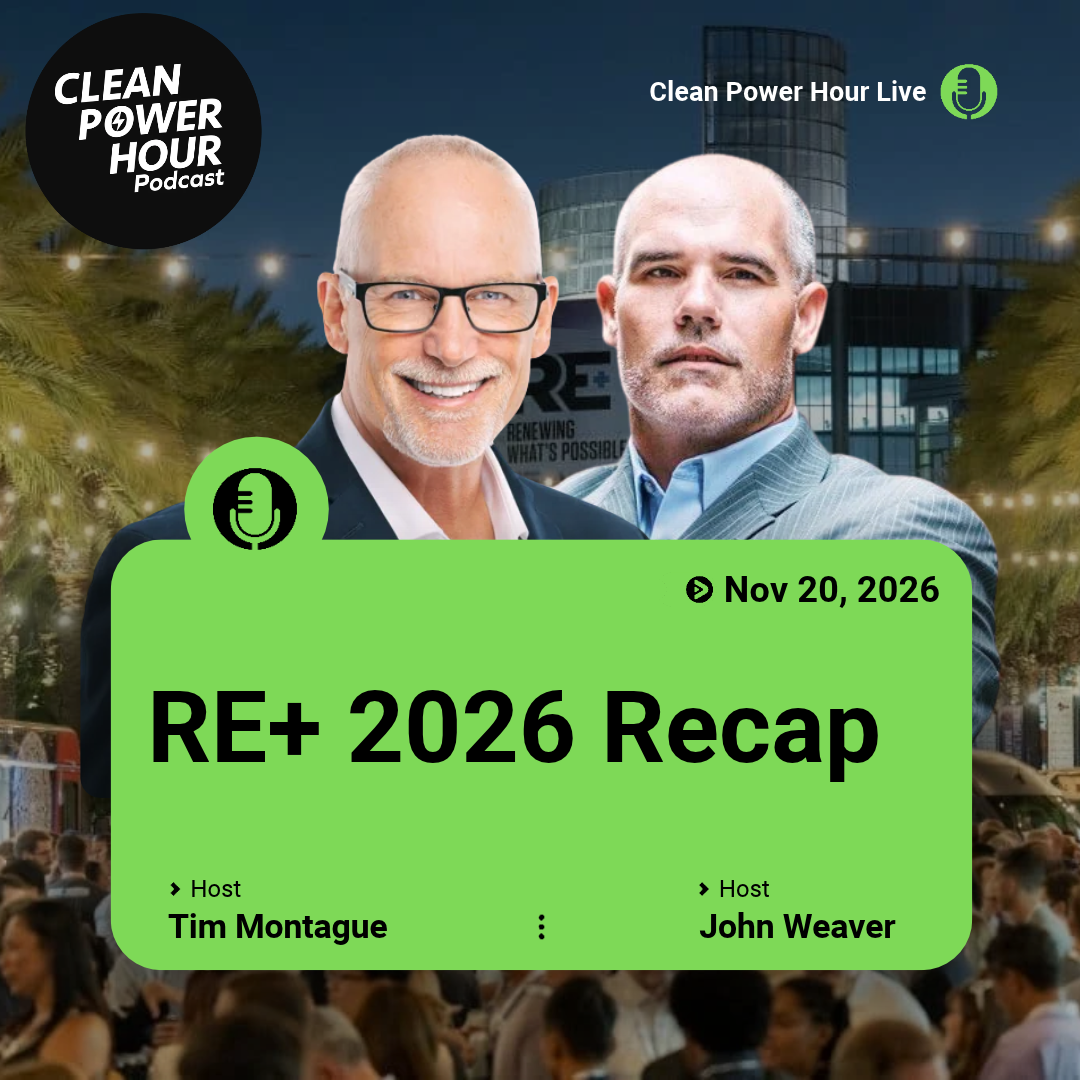
RE+ Vegas 2026 delivered a glimpse into the future of solar and energy storage. From next-generation perovskite solar panels to advances in battery technology, the industry is evolving fast.
In this episode of Clean Power Hour Live, Tim Montague and John Weaver recap their biggest takeaways from RE+ 2026 and explore the technologies, companies, and market trends shaping the future of clean energy.
They discuss Heliene’s new 27% efficient perovskite tandem module, emerging battery chemistries, the growing importance of energy management software, and how companies like Nextpower are expanding beyond traditional solar hardware.
Tim and John also examine BloombergNEF’s battery storage forecasts, declining coal generation in China, and the economics of single-axis trackers versus fixed-tilt solar systems.
Episode Highlights
- Battery storage and energy management: Tim and John share their biggest takeaways from RE+ 2026.
- Perovskite solar breakthroughs: Heliene showcased a hybrid tandem solar module with 27% efficiency, while other manufacturers explored ways to bring perovskite technology to market.
- China’s declining coal generation: New data shows China’s thermal power generation falling compared with the previous year. (Bloomberg)
- Global battery storage growth: BloombergNEF forecasts 188 GW of new battery capacity in 2026 and 209 GW in 2027. (ESS News)
- Solar industry’s growing political influence: A clean energy political action committee reported an 83% success rate in the elections it supported. (Canary Media)
- Electrification and energy efficiency: Electrifying transportation and other energy uses could significantly reduce wasted energy.
- Solar trackers vs. fixed-tilt systems: Tim and John answer a viewer’s question about choosing between tracking and fixed-tilt racking.
Whether you’re a solar installer, developer, EPC, or energy storage professional, this conversation offers insights into where solar and storage technology is headed.
Connect with Tim
Clean Power Hour
Clean Power Hour on YouTube
Tim on Twitter
Tim on LinkedIn
Email tim@cleanpowerhour.com
Review Clean Power Hour on Apple Podcasts
The Clean Power Hour is produced by the Clean Power Consulting Group and created by Tim Montague. Contact us by email: CleanPowerHour@gmail.com
Corporate sponsors who share our mission to speed the energy transition are invited to check out https://www.cleanpowerhour.com/support/
The Clean Power Hour is brought to you by CPS America, maker of North America’s number one 3-phase string inverter, with over 6GW shipped in the US. With a focus on commercial and utility-scale solar and energy storage, the company partners with customers to provide unparalleled performance and service. The CPS America product lineup includes 3-phase string inverters from 25kW to 275kW, exceptional data communication and controls, and energy storage solutions designed for seamless integration with CPS America systems. Learn more at http://www.chintpowersystems.com
0:53
Welcome to the Clean Power Hour Live. I'm Tim Montague, your co-host, bringing you the latest and greatest solar storage and everything renewable energy. Welcome to the show, my co-host, John Weaver, commercial solar guy.
John Weaver:
1:06
Tim Montague, I'm back in back in sanity after a week at RE Plus, I got some sleep last night. I slept yesterday when I got home on the red eye for about six hours. I did sleep on the plane too. It was cool going out west. I hope you enjoyed yourself talking with folks, talking with things. It was neat. I saw sheep.
Tim Montague:
1:30
Yeah, they had a display of agrivoltaics in the parking lot. That was pretty cool.
John Weaver:
1:35
Yep. Yep.
Tim Montague:
1:39
Yeah, I had a really good trip. It's it's always a double edge, but basically, really good trip. I saw lots of cool stuff, some of which we'll Talk about robotic construction, perovskites, the Gonzo battery flying off the shelf for CPS America. Shout out to CPS. Thank you so much for your ongoing sponsorship, and thank you, John Weaver, for your ongoing sponsorship.
John Weaver:
2:10
More than happy.
Tim Montague:
2:11
All right. So, what should we get into first, John?
John Weaver:
2:15
What was the coolest thing you saw, felt, thought, etc. At RE Plus, I guess that's that's my logic. That's what I put at the top of the document.
Tim Montague:
2:26
Yeah, you know, I'm I'm totally geeking out on batteries, and so for me, the coolest thing is learning about the software stack and how to more effectively control the battery. And this is just one platform. I went to an event for Wattmore, just like it sounds. W A T T M O R E, company out of Colorado. Shout out to J.W. who will be bringing a full interview to the show here soon. But it was especially cool because there's just a lot of other battery geeks like Sean Shaw, who you definitely need to meet because he's he's right there In Massachusetts or New Hampshire, so yeah, what more is an EMS energy management system? You know the you have the battery, you have the PCS or the inverter, and then you have the EMS. And some battery makers make their own EMS, like Tesla, but many do not, and so it's it's good for us to become versed in all these parts and pieces because you got to know what you're getting into, and it's pretty deep water. And then and then you know related to that is Gridvest, which is a value-added reseller of storage. So if you're doing some of your first battery projects in the CNI space, let's say a megawatt to 10 megawatts, check out Gridvest. Also bringing an interview with their CEO and co-founder Alex Shore to the show here in the coming weeks. But yeah, that's those were my two favorite things, and I know those are pretty wonky. But what about you, John?
John Weaver:
4:16
That's cool. Red rocks.
Tim Montague:
4:17
I saw you saw red rocks.
John Weaver:
4:20
Yes, I climbed some things. It was pretty cool. I was out there with my coworker, her husband, and an industry fellow, and his girlfriend, and we did some canyoneering. It was beautiful out there. There was some bouldering. I didn't do the bouldering because I'm not a boulderer, but I hung out with boulders and then just kind of climbed the canyon walls around them. I'm okay at scooching around some rocks. Yeah, it was great out there. So I think one positive of the show being in Vegas is how close it is to some pretty neat. Oh yes, there we go. Look at me. Too many blue sky
Tim Montague:
4:59
windows open, and I couldn't tell which one to put on screen.
John Weaver:
5:03
Oh, that's me. Oh, that's that's that was a cool little place. Yeah, look at this. This is beautiful. Come on, man. How gorgeous this stuff is! Yeah, I want to go. I just want we. I wanted the tent, but it it been raining a lot, so we really couldn't do that optimally. But it was pretty nice out there. Yeah, it's million pictures. It's so hard to capture what you see out there. It's just gorgeous. The land just beautiful. So yeah, so Ari Plus, you know, first I'll couple with you and say I um I agree with batteries. Um, I actually, as part of my work at PV Magazine, my new beat is sort of to cover batteries because PV Magazine has a lot of writers now, and I only do about four articles a month, and so I'm kind of trying to focus to help my boss at PV Mag, which. Ryan Kennedy help you know guide me on stuff. So my focus, and this is strategically, and I picked this Tim. My focus was chasing battery people. I did talk to a battery software person, Twain, and I'll be writing an article on that. We'll probably talk about it here.
Tim Montague:
6:07
How do you spell that? To
John Weaver:
6:10
T W twice? Actually, no, it's twice, not Twain. Twice, T W A I C E. Let me double check because I have a PV interview with. See, is this his name? This Graham? Nope, that's Ellisum. That's a different company. So we have a few that I'm that I met with that are great. But twice, yes, T W A I C E. I spoke with the boss there. He was great, and I just I just enjoyed it.
Tim Montague:
6:40
Looks like a German company because it said GmbH.
John Weaver:
6:44
Yes, Germany German company, but with a crew in I think Chicago, but somewhere in the U.S. And I spoke with one of the gentlemen who was German, one of the founders, and he he he hooked up with the two coders designers who came up who saw the project saw the challenge first. So they wrote some software. It was a cool interview. I also met with Graham Grant of Elizum, which is a aiming to do, geez, sodium cells for energy storage by the end of next year with contract manufacturing in the United States. They have the cell, they have the tech, and they're going to deliver that. So that's a cool interview. Then I had a battery interview with another gentleman. Enter venue. They have a. I'm gonna. I'm gonna name the article the Forever Battery, the Industrial Forever Battery. It's gonna be my headline because they got like 30,000 cycles in their battery, and it was it's just pretty cool. And he thinks he's within spitting distance from an LCOS capex. So the guy's realistic. He doesn't think he's going to get pie in the sky cost, you know, purchases. So I I really like battery talks. Yeah, I spoke to Enerver
Tim Montague:
8:07
New a couple weeks ago. I didn't see him at the show, but they're trying to go mainstream. They've been working with NASA for many years. They have a very unique hydrogen metal technology. I don't fully understand it, but now they're they're really trying to go head to head with LFP. It looks like.
John Weaver:
8:32
Yeah. So again, that's what they they decided as their focus is. So those were just some of the interviews that I had with PV Mag and talking energy storage. I spoke with Enphase and Solar Edge for my own business and for PV Mag stuff, and they both have energy storage things going on in those shops. So batteries were everywhere, man. I did speak with module manufacturers too, including Illuminate, who is a an existing. They they used to only work with Invenergy. Well, I thought that that's not the case, but they're Invenergy's number one. But then they are a you know they're coming out. We're going to be able to buy from them as private folks next summer. They have about two and a half gigs of capacity that's going to be available. What's the name again next summer? Illuminate. I L L E M I N A T E. Yep, Illuminate USA. They're based in Ohio. They were founded as a partnership between Long G and Invenergy, who is like, if not the largest, no, they can't be the largest, but top 123, somewhere in that range, and maybe one, two. I don't know. I don't know that side size well enough, but but they have a five gigawatt facility that's been doing modules. They just did some changes with solar cells, so they were talking about how their lines are evolving. 98 and a half percent yield rate. I thought that was a cool number. That's their factory's goal for first round, ready to go grade A modules. So it's just kind of neat. Yeah, listen to some of the stuff going on there.
Tim Montague:
10:08
Yeah, I met I met their CEO Art Fletcher a couple years ago, I moderated a panel with him when he was still just purely Invenergy, but now he's the CEO of this spinoff Illuminate. And I don't know a whole lot about their technology, but you said it's a Longi partnership, huh?
John Weaver:
10:29
Well, initially, yes, it was between Invenergy and Longi, now it's really Illuminate who they still have a big contract with Invenergy, but they are separate entity. They always were a separate entity, but you know because of the dynamics of where we're at in the world, Longi's partnership percentages is probably. Lowered itself. Illuminate is now a larger independent company, and and they're going to have two and a half gigs of capacity next summer. Well, they're already selling it. So if you want to buy some modules for next summer, you need to call them today. I don't know who to call, but I'm sure I'm sure you can figure it out if you're a developer.
Tim Montague:
12:03
Well, I have I have Art's phone number, so just let me know if you want to talk to Illuminate.
John Weaver:
12:09
There you go, Tim. Tim, look at that! Look at that, everybody! Tim's got him in his phone book, so if you need to know how to find somebody, you just call Tim. Apparently,
Tim Montague:
12:20
yeah, I'm really glad that Illuminate has a is going public, so to speak. Right? They were only servicing Invenergy heretofore, and I didn't I didn't realize they were gonna go wider. So that's cool.
John Weaver:
12:39
Um, and you know, then I met a bunch of people. It was just great. It's just great walking around the floor, it's really nice seeing random people. I do actually. I'll give a shout out to Cole. The last in the evening on the second day for me, because I stayed two full days. I was walking back, talking with somebody on the phone. Someone comes up, smacks me on the back, says, "Hey man, I love watching you guys on the Clean Power Hour." I put it up in the office, and I work it on the left one, and I'm listening to you guys on the right one, and it's just a great time. And I thought that was so cool. So Tim, thanks for having the show. It's kind of neat. And couldn't do it without you, brother. Yes, and Cole, very nice to meet you. Thank you for running up and saying hi. It makes me want to do this a little better and work harder because there's actual human beings paying attention and watching this show. So very nice to meet you, sir. And so back to work, Tim.
Tim Montague:
13:33
And there's the sheep. I didn't get this on screen earlier, but they had they had some small arrays up, and you see how the sheep like the shade. So
John Weaver:
13:44
yeah, that's that. That's exactly where they were. They did move around a little because I was hanging out around there looking at the other booths, but they did mostly stay in the shade. It was cool. It was cool just seeing some sheep. I know it's nerdy, but hanging out in the parking lot. I got plenty of cold water.
Tim Montague:
14:00
Yeah, shout out to ASGA, American Solar Grazing Association. They're fighting the fight, educating, you know, grazers and landowners and solar developers on how to make agrivoltaics work in various business models. So very important work they do, and I greatly appreciate that.
John Weaver:
14:24
I'll say another thing about being on the floor. The vibes were different. There was just a different focus, a different thought process. You know, I'd love to get on the show. Is next. You see, it's no longer. It's next power.
Tim Montague:
14:40
Sure.
John Weaver:
14:41
I'm gonna write an article. I went to their capital markets presentation, and watching how they're growing as a company, not just you know getting bigger as a racking company, but their breadth. You know they're they're a power plant company now, man.
Tim Montague:
14:58
Yep, power plant in a box.
John Weaver:
15:01
Yeah, yeah, a lot of boxes. They bought a central inverter
Tim Montague:
15:04
company. Yeah, that was Next Tracker, right? The world's number one tracker manufacturer. They until last year, maybe or so, they were just trackers. But now they've acquired. I heard they acquired 15 companies. I don't know if that number is accurate, but
John Weaver:
15:24
Well, I'll tell you that they offer a suite, a full suite of products for the utility scale.
Tim Montague:
15:31
Yeah,
John Weaver:
15:31
and I saw one of the stats that they had up at the show, and I bet I could probably, you know, I could. So it's trackers,
Tim Montague:
15:38
inverters, batteries. I don't know about I don't know about balance of system, but
John Weaver:
15:44
no, absolutely, absolutely balance. Oh, so they're taking on shoals and
Tim Montague:
15:48
shoals and array. Yeah,
John Weaver:
15:50
it's yeah, it's part of. I bet you shoals and arrow array did the opposite. They were like, holy crap, we need to become really close and friendly because next power is about to eat our eat our junk. I mean, because holy crap! Like listening to them speak on the stage, it it you can hear the vertical integration just just making for value. It's just like ah, the engineers talking to each other live through projects and changing product as it goes and data. It just it was compelling. It was compelling. So there was this stat that they put on their stage. They said, you know, they were looking at the EIA data, Energy Information Administration of the United States, and they said, looking at the capacity of all energy deployed over the last X number of years. And it's like 1234. I'm gonna see if I can bring it up on my Google Photos here. And they said, looking at all these things, we have been part of 33 ish percent. Here it is. I think I found the slide. We've been a part of 33 percent of like all energy being installed in the United States, and when you think about that, it's it's not 33% of clean energy, Timothy. It's 33% of all capacity, and that I was like, ooh, because in the U.S. the majority of capacity here it is just found it. It's 30%. See, I was saying things wrong of all capacity
Tim Montague:
17:24
on the grid,
John Weaver:
17:26
yes, sir.
Tim Montague:
17:27
All like new capacity in the last so many years.
John Weaver:
17:30
New capacity, new capacity. Yes, 2025 specifically is is the picture I have here. Allow.
Tim Montague:
17:36
Oh, okay.
John Weaver:
17:37
Next power deployed 30% of new U.S. power generation in 2025. 2025, and this is based on an AC level. So people like you and I generally think on the DC level module.
Tim Montague:
17:53
Yep.
John Weaver:
17:53
But you know this is kWAC, but that's 30% of the grid. Was it solar? Because solar is like 75, dude. Maybe no, not 70. More like 70, but 30% was Next Power. That's like a, that's an interesting entity there. That's awesome. That's they're a power company, dude. And they say it now, Next Power. That's good branding. Somebody thought about that. So hi Brandy, I know Brandy in the marketing department. Brandy, we're gonna give you a call because I'm gonna wanna ask you questions and stuff because you guys are cool. So that was it. It was cool to see them. I like that capital markets thing. Felt very professional. All the words were very well written, rehearsed. Nobody made mistakes in their presentations. You don't mess up at those conversations when you're like,"Hey guys, we need we need to sell a billion dollars every I don't know month." They have a they have a revenue target of 4.5 billion just for trackers. In 2030, I got to see all their goals, and it was like, wow, you guys pretty cool. Oh, I learned a new word, TAM. Now I'm a I'm a Wall Streeter now, Tim.
Tim Montague:
19:12
Okay, TAM,
John Weaver:
19:13
total addressable market.
Tim Montague:
19:16
Yep.
John Weaver:
19:16
Yes. So they were talking about part of driving their growth is, you know, right now, utility scale on a global scale is going to grow out flat, maybe up a tiny bit, but flattish in China because it's subtracting, and globally it's growing. There's just kind of a net utility scaleish. It's still growing a tiny bit, but distributed is growing a little bit more right now. And so you would think, man, next power you're going to have to take over in order to grow. You're going to have to grow bigger while your market is kind of you're going to have to grow faster than your market is. That means you have to take market share from people. That's hard. You could do it because you're awesome. I mean, that's they're a good company. But another way to grow is to do more things, and they're doing things that are fundamentally important: energy storage. But you know what is growing? Energy storage is growing, so they're going into a market of energy storage that's without a doubt growing. So it's just kind of cool. So now, like they have this total addressable market on the power generation side. It was solar stuff like I'm looking at the slide right now 33 billion on the battery side it was 36 billion so by 2030 they think batteries might be more as a potential as a bigger addressable market than solar and I totally
Tim Montague:
20:45
believe that batteries are a bigger capex, and there's just more runway there, right? We we only have batteries on a small number of solar projects. There's going to be a huge retrofit market, retrofitting batteries into solar projects, and then installing battery alone projects and new solar plus battery projects, like huge huge opportunity. So, got to be fluent in batteries. Should we talk about perovskites?
John Weaver:
21:18
Yes, I had one perovskite interaction. I heard you had one as well. Is that the case?
Tim Montague:
21:24
Yeah, I talked to Sirius S I R I U S, not to be confused with the satellite radio company, but and they are a so they were displaying in the Iron Ridge booth a. Product that we're going to show a different version of made by Helene, but they're also working with Kalux. So it was interesting to see Kalux now working with you know a handful of manufacturers on perovskite modules. Can put this on screen, maybe,
John Weaver:
22:05
Maybe,
Tim Montague:
22:08
but Sirius. So Sirius is tackling the residential market, and they have come out with a, I believe, 550 watt residential module that was same footprint as a previous 450 watt module,
John Weaver:
22:25
550 versus 450 because they're going with a Salex layer.
Tim Montague:
22:29
Pretty cool! Wow,
John Weaver:
22:30
that's awesome. 100 kW. What? I have the Helene one. Do you want me to share the Helene one?
Tim Montague:
22:37
Yeah, if you can put that on screen, do that.
John Weaver:
22:41
I was waiting for you to say that. The
Tim Montague:
22:42
Helene Hybrid Tandem Module, 27% efficiency,
John Weaver:
22:50
and you know what? You can tell I didn't do this with AI or something because you can see that I was actually there at the show, right there, taking a picture, wearing the exact same hat.
Tim Montague:
23:02
We probably could make that photo with AI, but you were actually there because I saw you.
John Weaver:
23:08
That's true. Yeah, it was. This is neat. Calix, their path to market. Sorry, I got tongue tied there. Kalix, I have no idea. Yeah, I think it's a hard C. Kalux, cool. So Kalux, their path to marketplace is different than Tandem PV, who is launching, who's working on seemingly a very similar product type, 4T perovskite tandem, you know, perovskite in the actual outer glass versus on the module.
Tim Montague:
23:41
Yeah.
John Weaver:
23:41
And Tandem PV is working directly with developers on modules of their choice, which is very interesting, very cool. But they're picking a module, whereas Kalux is going to module manufacturers because they've also signed with some Indian manufacturers, at least one or two, to have capacity. So speaking with Helene in the booth, you know they say these are in commercial something right now. I actually met the CEO Martin. He happened to be there, headed to a meeting. I was actually there with my sales guy, Jim, who's really great. Jim from Helene, Jim Sekord. He also bought me a sandwich in nearby, so I got to like be really nice to anybody who buys me food, so thanks, Jim. But so talking with them, it was just cool to listen to them. They're ready to do some pilots. They want to do some pilots. They actually mentioned to me 50 to or 100 to 150 modules would be a good pilot. So I'm now going to see if I can find, and if you think 50 to 100, and this is a 500, I think it was like a 50 to 75 kW system. So I gotta find a 50 to 75 kW system, which who wants some 27% modules? I'm gonna try to get a pilot, man. I was just excited to see it, just kind of like nerded out. There were people asking questions. They had very technical conversation going on, and I was just listening, and it was good. I can I can tell that they're amping up their knowledge on this product right now. So that that was my that was my most exciting whiz bang thing for a module. You know, I had a great module conversation with Canadian Solar, learning some of the cutting edge stuff they're doing, which is great. But this was just cool seeing it. But it's still, again, Tim, it's not till the end of next year for official launch. Maybe pilots beforehand, though. But I'm probably gonna have to sign an NDA and shut my mouth, which will be really hard.
Tim Montague:
25:44
Yeah, I didn't ask serious when they're quote unquote going to be available in the market, and that their roots are in Turkey, but they have a factory in Houston, Texas. So I think we will. I think we'll see eventually all the module makers, at least dabbling in perovskites, it seems to be taking off. So
John Weaver:
26:14
good to hear. Yeah,
Tim Montague:
26:17
I mean, we'll see. It's like anything; these new technologies, there, it could be like a fly and die if they don't work, right? It's no good if it only works in the lab, not on the roof. But we'll see, we'll see. I'm cautiously optimistic. All right, are we done talking about R D Plus or
John Weaver:
26:42
no?
Tim Montague:
26:42
No,
John Weaver:
26:43
no, we got two more items.
Tim Montague:
26:44
What's next?
John Weaver:
26:46
Waymo. Can I just show a picture of the inside of a Waymo? I rode a Waymo for the first time. It was pretty neat. Drove on its own. Did everything. It took corners well. It was within within a very limited region. And here, let me share the picture real quick. And nothing too nothing too magical. It was just a car, you know, just a normal car, and it was Waymo. I mean,
Tim Montague:
27:09
it's a it's a pretty different looking car. It it's basically a small minivan with a very snub nose. I don't know who makes. Do you know who makes that car?
John Weaver:
27:21
It's a Chinese car, actually. It's a Chinese manufactured car that Google imports and pays a big old tariff on it.
Tim Montague:
27:28
Wow!
John Weaver:
27:29
And if they if they ban it, which the Senate might do, I don't know what's how's that going to have effect. It might not.
Tim Montague:
27:36
Yeah.
John Weaver:
27:36
I don't know what's going to happen. These are like since these are privately imported. Did you take more than one photo
Tim Montague:
27:41
of the the Waymo?
John Weaver:
27:43
I did, but no, this is the only inside one. That's all that matters. I have some outside photos if you want me to find one. It's a Waymo. Google it. Yeah,
Tim Montague:
27:50
I think the the outside is pretty interesting because I'd never seen one so up close. There were there were several radars or lidars, like every corner of the car had lidar, and then there was one also in the middle on the roof, but and and it's got that little spinning disc.
John Weaver:
28:08
I'm gonna get some of the pictures. I have taken some recently because they're charging at the local EV charger that I most often have. They're not allowed to drive alone yet in Massachusetts, so I guess they're just doing training. But I I've definitely taken pictures of them. So I'll see if I can find us one here in the next.
Tim Montague:
28:28
Do these Waymo's in in Vegas? I mean, they have Waymo in California also. I think
John Weaver:
28:34
San
Tim Montague:
28:34
Francisco, right? But do they do they charge autonomously too, or is that semi autonomous?
John Weaver:
28:41
I don't have an answer. They're definitely not. I mean, I wasn't there in Vegas. I definitely they weren't autonomous when they were hanging out next to me in Cambridge because I've spoken with the guy and asked questions and stuff. Oh yeah,
Tim Montague:
28:55
if there's a driver, right?
John Weaver:
28:57
Yeah,
Tim Montague:
28:58
but the car here was driverless, right?
John Weaver:
29:01
This one was definitely driverless. Yeah, yeah, definitely, and it and I was in it twice. We had two different rides. All right, so the picture is further back than I thought, and I'm done looking for it. But they do exist. They're real. It is official, Tim. You can get a car, drive you, and and that. So I can verify it without doubt. So here's my last thing that I want to share about RE Plus, and then I'll, you know, probably still talk about, you know, the best part about RE Plus was the people. But driving north from Vegas, I just kept seeing solar power plants, and I left, right, left, right. We were going north, northwest towards Zion National Park to do that canyoneering and to just relax and see pretty stuff. And you know, driving through the mountains, through the valleys, and there's just solar surrounding it. And this is Google, just me taking a Google Earth from wherever we were, and after seeing them over and over and over, and a little work, a little well, not me doing a little work, but the machine suggests at least tenish solar power plants that are nearing around two gigawatts AC of capacity, and one of them is the the Gemini Solar Project, which is a gigawatt DC about just short of 700 AC. It's like 690 or something, and it's got a big old four-hour battery, which is cool. So it was just neat to see all of that solar over and over because I don't see large ground mounts on my day to day in Massachusetts. We don't have any large ground mounts. I don't. I mean, not like this.
Tim Montague:
30:44
Yeah. Multi-100 megawatt projects.
John Weaver:
30:48
Yeah, and I was surrounded by them, and they were everywhere. And it's just like, there's another one. There's another one. There's another one. It's like, holy crap, man! It was just cool. So that that was a highlight of the drive out as we headed to. And I I flew out the weekend before, so I could acclimate myself and be relaxed, and yeah, that sort of worked, but sort of didn't. All
Tim Montague:
31:11
right, should we talk about coal? You found a story on Blue Sky.
John Weaver:
31:16
So I don't understand this
Tim Montague:
31:18
at all. By the way,
John Weaver:
31:20
yeah. So this is Bloomberg, and this is the year-over-year use of thermal power output. This is coal. So what this chart is showing in January, they use more coal than the prior year. Looks like about 3%. So 333. Then they were up in March, April. They, you know, a little bit lower, and then something started happening. There's new rules. There's new things going on. The price, the use of coal, has now started falling in China. And right now, month over month,
Tim Montague:
31:55
this is just one year, right? Aren't we just seeing the impact of increased radiation, like coming on in the in the summer.
John Weaver:
32:07
Um, no, this is month over month use. So this has nothing to do with this is comparing last year's use versus this year. Year
Tim Montague:
32:16
over year, yeah, yeah, yeah.
John Weaver:
32:17
Yes, yes, year over year. So the last, so right now, and based on next month's and other policy analysis, it's looking like this year we're going to see China use less coal. This aligns with China using a whole bunch less emissions as well. Like maybe I saw a headline that said China will emit less emissions this year than all of the emissions of Great Britain, which says two things: one, China is dropping its emissions right now a whole bunch; two, China is the world's largest emitting country by like 3x right now. You know their growth and taking over industrialization has made them, you know, bar none. They're like three times the U.S., two times on a per capita basis. They're a third, a fourth, whatever. But you know, so they got a lot of work to do, but they're doing it at least some. I don't know if they're doing enough, but so like it's just big. It's something's going on there, and it's great. So hopefully China. Well, not hopefully China is leading, and hopefully their leadership keeps doing stuff. So far, it's helped drop the price. They're putting their money where the mouth is. It matters, and we're starting to see it.
Tim Montague:
33:37
But so you think it's a signal that China is investing less in coal energy because they're still building coal plants.
John Weaver:
33:47
Absolutely, no. I don't say it's a single. They're investing less. I'm saying it's a single. They're burning less because they're going to get rid of old coal, which they've been doing for years, because they've been building coal that has lower capacity factors for years, so they're going to keep getting rid of old, inefficient coal plants and building new ones for multiple reasons. One, for political stability, but two, also to upgrade old stuff that needs to be gotten rid of, and they're going to keep doing that. So they're going to, but they're probably also investing less in power plants. I don't know that explicitly, so I'm not going to say it out loud, but I do know they're burning less coal. So that is what this chart says, and that's in the end that's what matters. If they build a new coal coal coal plant, who cares? Yay! Build coal plant. It's what comes out of it that I care about.
Tim Montague:
34:41
Gotcha. Okay, you have a note about battery storage, but there's no link.
John Weaver:
34:48
Yeah, there is. You just got to look a little bit lower down. I space it out because there's two separate notes there. Oh, it's the China story. Yes, sir.
Tim Montague:
34:58
Okay, sharing that tab.
John Weaver:
34:59
Bam! Look at that.
Tim Montague:
35:02
So there's a story in ESS News. BNF forecasts 209 gigawatts of new batteries in 2027, and that is a delta of what 209 versus.
John Weaver:
35:16
Actually, that's the note I put. So this year, they think we're going to install 188 gigawatts, which is a 45% growth versus 2025. Tim, 45. Next year, they're predicting 209 gigawatts, which is an 11% increase in capacity. Tim, what do you think about 45% this year versus 11 next year? What's that emotionally do to you?
Tim Montague:
35:51
I don't really know, because you know, 45 is more vertical than 11. Are we past? Are we past the inflection point on the S curve, I don't know.
John Weaver:
36:05
So I think it's I think it's
Tim Montague:
36:06
a I think it's a just a blip maybe.
John Weaver:
36:10
Well, I mean, we should reach out to BNEF and see if we can get one of their techs on here and talk to us about this stuff. They're good people there. So so here's your chart. Scroll down a bit, and you can visually show what you were just questioning what you were just thinking about. Look at that. Look at 2423, chunk, chunk, chunk, 2526. Look at those jumps right there, and then 27. Nice and slow and logical, and that's the way you have to get this done by people like BNEF. They have to Bloomberg, because they have to be. Responsible adults, and they have to guide investment money and how people do stuff, and so that's what they, that's how they predict them. But look at those, look at that growth, look at next year breaking two. You know, pretty cool. If we look at it, it's about a three-hour extension, so it's 209 gigawatts over 638 gigawatt hours, so just over three. If you look at that last one, it's just over 300. So that means by 2036, we're nearing a terawatt hour of capacity that could be getting deployed, which would be kind of neat. I think it's all going to happen sooner. I think we're going to see additional growth years early on. We do have the capacity in the factories, but we do also have China trying to rein in things. But I think every place is going to grow faster. Think, think we're too early for that curve to chop off that greatly. I think it'll chop off, but I don't know. We'll see.
Tim Montague:
37:45
Yeah, it looks like the U.S. is actually fairly flat. That big blue bar got a lot bigger in 26, right? But it's not getting a lot bigger year over year from 26 to 2036. Honestly, getting a little bigger, but it's a good nut. It's a good. It's a good number. It's 50 gigawatts, right?
John Weaver:
38:13
You know, as always, it looks like China is. Let's see, China is at about 75-ish there. So 75-ish out of 188, 150. It's probably like 45%. They note that China, the U.S., and Australia will be 62% of total capacity. So that's three countries, and it's so great. Australia is like, you know, China 1.3 billion, the U.S. 350 million, Australia 34 million, but bringing it, bringing it. And you went to Australia recently. Eckert Gross, the owner of PV Magazine, said he was at the same press event as you, Tim, and he didn't see you. He wished I would have told him prior. So I said, "Oh, I'm so sorry." He was in Melbourne with you at the show. So next time you go to a show, let me know so I can make sure you and him get to shake a hand. He he spoke highly of you. We talked about your show. You
Tim Montague:
39:13
knew I was going.
John Weaver:
39:15
I know that's my fault. I said it's my fault. I blame me. So next time you go, tell me again. This time I'll remember. Sorry.
Tim Montague:
39:22
It's all good. I haven't seen Eckhart. I don't think I've ever met Eckhart.
John Weaver:
39:28
Oh, well, you got to meet Eckhart. We've talked,
Tim Montague:
39:30
we've talked on the phone or on Zoom, but never met face to face. Despite my many attempts.
John Weaver:
39:40
Oh, sorry.
Tim Montague:
39:43
All right. What's next?
John Weaver:
39:46
I wanted to talk tim a bit about politics. This is sort of related to RE Plus because this is the Baugher
Tim Montague:
39:52
story.
John Weaver:
39:54
Well, technically, no. Actually, we could talk about Baugh if you wanted, and I could talk about having conversations with CIA at their booth about it. But this was just more about the elections and the solar pack, and that they're loud talking and fun. And I just wanted to bring them up because I saw an article in Canary Media, and there were lots of talks about politics. I wanted to stop by and see them at the show, but I just got really busy, and so this is just solar pack. And
Tim Montague:
40:29
yeah, shout out to Julian Spector. I saw him in the distance one time, but didn't get to talk to him. I hung out with
John Weaver:
40:36
Julian. We were at the solar fight night, and he came up and patted me on the back when I was hanging out by the pool, and then him and I talked a bunch. And I bought Julian a drink.
Tim Montague:
40:48
That's very nice of you. Solar Pack got revenge on clean energy's enemies in Congress. Yeah, we're starting. We're starting to flex our muscles a little bit. Um. So so Julian thinks the the pack actually made a difference.
John Weaver:
41:06
I mean, there's a few things in here, yes, where you could think that they made a difference. Of course, we saw nationwide that it was a hard shift from the in the a general election.
Tim Montague:
41:19
It was a blue tsunami for sure.
John Weaver:
41:22
Yeah, across every nation, there were there were like two, you know. I saw this map of directionally how every state went, and almost every place shifted one direction. So it's hard to fully tease that out, but it does look like where they put their money, people won, and it does look like. When they put their money into the primaries and went after certain people on the Republican side, they every primary they put their money in happened to win. So I don't know. I don't know if they're. I can't tell that. You know, politics is challenging, but I do like that they're doing it because we know that money has an effect, and then it was great that two things occurred. One, they got called out. The solar pack got called out by somebody who lost and said,"Hey, this group is doing stuff and it's hurting me multiple times." So at minimum, the politicians felt the sting and adjusted themselves in some way based on the solar pack. So I thought that was cool. Multi multiple people did that. Lauren Boebert, that crazy person, who never mind, keep my mouth shut from Colorado. But and then there was another one, and it's somewhere in here. They say it. So if you scroll down in the article, you might be able to see it. Let's see. Keep scrolling. I want you. An 83%
Tim Montague:
42:47
success rate is pretty impressive, and they only spent $17 million. That's that's 4% of what Elon Musk spent. So,
John Weaver:
42:58
all right, here it is. Tell Victoria Sparks second paragraph. So the second paragraph is great. After the Republican lost, the group released a statement to the press. Tell Victoria it was us. It was great, and you know they wanna they they did something in Indiana. They went after a place where the Democrats didn't even fund, and again, this was a thing to the left, the whole state, the whole nation. But nonetheless, they were there, and it's good to have somebody. It's just I what you started to say, Tim. We're flexing our muscles. I thought that was something. It's an organization of us. You know we have CIA, we have other groups, we have Nextera, who I don't know how they do stuff, but they make a lot of money from renewables. So that company helps these big development firms. They do stuff, but yeah, I mean historically the number
Tim Montague:
43:58
the number that really stuck in my mind was that the fossil industry, so oil and gas funds politics by a factor of 6x what clean energy does.
John Weaver:
44:11
It's true.
Tim Montague:
44:12
So it's a very big, it's a very big lobby.
John Weaver:
44:15
But they got to pay a lot because they suck. We're gonna have to pay less because we don't suck. Well,
Tim Montague:
44:25
we're we're for a cleaner, healthier future, right? Where our energy system doesn't have to kill people from air pollution, and it doesn't have to cause runaway climate change, which is going to disrupt everybody's life on Earth. Those two things alone, right, are just no-brainers. Everybody wants a safer, healthier future. So
John Weaver:
44:46
not everybody. We should have a more. Apparently,
Tim Montague:
44:48
Elon Musk does not want a safer, healthy, healthier future, which is bizarre. But
John Weaver:
44:55
a depressing thing that's in the news right now is the capacity of new fossil fuels that is in the interconnection queues going forward. It uh, it's it's sad. It used to be just massively wind and solar and storage, but now it's changing. So, all right, last story, and then gotta get back to work, Tim.
Tim Montague:
45:18
Okay, what's the story?
John Weaver:
45:20
Did you know that electrification, in and of itself will mean we use a whole bunch less energy. I'm sure you've seen this. I did know that. Yes, and I just wanted to point it out because I have found a new version that was put out into the world. Oh, there you go. We're both sharing it. Well, I can stop sharing it because you're on it, so that this is this chart's been out there a few times. Oh, stop sharing now. And it's just cool. I just wanted to bring it up again because there's two things that actually occur. So, you know, just moving to an EV, even if your grid is exactly the same will save you like 10 20% on emissions. So the argument that hey I got a lot of coal here, it's like all right that's cool because coal in a power plant is cleaner than gasoline in a car, and it probably has mostly to do with the scale of the power plant and the the efficiency that a bigger engine that runs hotter, etc., with professionals managing it can do. But in and of itself. But another thing, can you scroll down on this image a little bit? Can you show the bottom half?
Tim Montague:
46:34
Sure. Yeah,
John Weaver:
46:35
there we go. So no, no, you got to scroll up. You got to show the the two red portions. Yeah, the rejected portion, the 383 versus one. So the amount of rejected energy that's kind of wasted, that's not fully captured and used, will fall by I think 62% is the number 61%. So waste will decrease by, and what's amazing is that the value. So that's 150 plus another 88. So we're talking 238, 238 of rejected energy is larger than what we use. So we're throwing away more than we we're throwing away twice as much as what we use. But the amount that we're going to save when we go from to electrify,
Tim Montague:
47:21
yeah,
John Weaver:
47:22
just in rejected energy, will be still more than what we use. It's just immense. That's I don't even know how to properly come up with analogy on the spot. How about this? It's a lot that we're just pouring into the atmosphere that we're gonna
save. And here's a stat:
47:36
some stat that's close, but like 5060, 70%. I think it's lower than 70, more than 40. How's that? Of ships on the ocean are just to move fossil fuels. I think it's like 60%. So think of the inefficiency of that. Once we start doing wind and solar, the shipping industry is gonna fight back a little bit. And these people making these big boats, they're gonna have some challenges. Sorry, guys. Maersk is a pretty cool company. Maybe they'll start shipping hydrogen and methane and stuff. Well, they could start
Tim Montague:
48:07
putting sails on their on their boats, right? You can put sails that which are like airplane wings, right? Just very large airplane wings, hard surface, hard but modifiable surface wings.
John Weaver:
48:24
Maybe I don't think they're going to do it. That's that's not really cost effective on these big boats, but it is pretty cool. They've done it.
Tim Montague:
48:31
I think it's I think it's being done in at a very small scale. But anyway, yes, yeah. The EV the EV alone is a great model for this, right? Because an ice engine car uses only about 20% of the energy in the gasoline to actually move the car forward, and most of the energy is going out the tailpipe, and then the EV is is I think it's pretty much the inverse. It's using a lot more of the energy to move the car, so it's a good thing. Now I just need a ultra long range EV, and I might be able to tow my 19 foot sailing dinghy known as a Flying Scott with an EV. That's my dream, John, to get back to the EV. I had a Model Y, but I got rid of it because I had range anxiety.
John Weaver:
49:23
Well, because of towing, a lot of people's, a lot of people's dream. I'll support it, Tim. I'll support
Tim Montague:
49:30
it. My my other dream is to own a Chinese EV because I want to be on the I want to be on the bleeding edge, man. China is now on the bleeding edge of the EV technology.
John Weaver:
49:40
I don't know if you know this, but right now in Congress, they're considering banning the import of Chinese cars.
Tim Montague:
49:46
Oh, I don't doubt it.
John Weaver:
49:47
Straight up banning, not even 100% tariff, because there's 100% tariff right now. Right. I'm just talking at the neck. Ban.
Tim Montague:
49:55
Well, they, yeah, I'm sure that our our native car companies understand that they're they're toast if the Chinese CVs come to America, but we'll see.
John Weaver:
50:07
Either that, or they better evolve real fast, buddy.
Tim Montague:
50:10
Oh, we had Kyle Sinclair on here ask a question, and I didn't see that.
John Weaver:
50:15
Oh man, I missed a comment.
Tim Montague:
50:16
Kyle says, "John, my question is a little outside of the scope of today's discussion, but I appreciate your perspective when evaluating single-axis trackers versus fixed tilt ground mount systems. What are the primary factors driving your decision? Is project scale the determining factor, or do you place equal weight on upfront capital costs, long-term O and M reliability, and overall life cycle economics? Well, this is a very sophisticated question from another sponsor of the show. Shout out to Kyle Sinclair at Sinclair Designs and Engineering. They make fixed tilt racking and carport racking. Wonderful to see you, Kyle and company in Vegas. I'll let you answer the question first, John.
John Weaver:
51:02
Oh, first I don't feel too guilty, Tim, because he asked it at 1247. That was like two minutes ago. So you know he was hanging out for a while before he asked. That's all right. Thanks, Kyle. So, so I guess ultimately it is always ROI and how we take care of the customer, but the project drives that. The project makes the decisions about what it can handle, and scale is a thing that drives that because you know installing a tracker costs more. Installing a tracker takes a little more technical skill. The hardware costs a little more, and it needs more O and M. But and it also needs. A big enough size, like for instance, in order to maximize the value of installing a tracker, tracker you want tables, and a table has a certain number of modules, and a tracker, a spinny guy, can run a certain number of tables, and if you don't have a big enough, large enough square that can handle these tables going north and south, like 456 of them for a single motor. Every one you take off, you're paying a higher cost per watt for that one because your cost around this motor and all that extra hardware and everything, you need to scale it just like everything. So that's one thing. Then, so where do the well, the
Tim Montague:
52:19
question I think he's really asking is where do the lines cross for developers, and it depends on the latitude of the project, but it and and then it depends on the size of the project. If you're doing a one megawatt solar farm, pretty much anywhere, you will often just go to fixed tilt racking. If you're doing 100 megawatt project, which will produce 10 to 15%. Some would say 20, but in in my world, I would say 10 to 15% more energy by using a tracker. Let's just say here in Central Illinois, okay, you would 95% of the time do a tracker on a large scale solar project today, and the the uncertainty he's he's asking some questions we don't really know the answer to. The uncertainty is what is the opex of that project, right? Because the capex and the and the short term LCOE, the amount of energy and revenue that you're going to generate, do make financial sense. Otherwise, nobody would be installing trackers.
John Weaver:
53:27
Well, but it doesn't when you start scaling downward too far. If a car or single tracking units start to make more sense in certain sizes, like a site that's really wide but doesn't have a lot of depth north and South, you can't do trackers there. I've had one of those sites. My Beagle Club project is really, really wide, so we couldn't go deep. So that's a technical. But I do place things like O and M requirements. If this project's, you know, if you think you're going to have a loving person who's going to take care of it, then yeah, O and M matters. The cost of O and M costs more. Reliability does matter, so I try to do life cycle stuff. It's hard. We're not that sophisticated, but it really comes down to can the project handle it, and can we, as a small company, install it?
Tim Montague:
54:16
And we don't truly know. We don't truly know what the O and M cost of these projects is because they've only been in the ground now for going on 10 years, trackers. I
John Weaver:
54:27
think tracking people know some stuff about trackers. Kind
Tim Montague:
54:30
of swept the the field, starting in in in my world anyway. In Illinois, in the community solar market, starting in 2018, I saw a lot of designs with fixed tilt in 2017, and then in 2018, a lot I started seeing trackers. But trackers have been around 40 years, I think. But but we didn't, you know, the modern era is 2010 and forward. So we really need to get to some asset owners who have older assets in California and maybe Hawaii to get to the bottom of that. But the other thing is the other, you know, I had a very interesting conversation a couple years ago with Helga Biernath of Sunstall. Shout out to Helga, he's a mechanical installer, and you know, one to 20 megawatt projects. And he said, and this is a couple years ago that eventually, as the price of of solar panels comes down, the advantage of trackers goes away because you can just do greater density like an Earthos style system. We did see multiple Earthos style systems at RE Plus this year, except they're they're jacking them off the ground, say three feet, but they're flat to earth, so they're super high density. And Peg is in this zone. They have an east-west system and planted. I didn't get to talk to any of the racking companies, unfortunately, because I'm spending too much time with Karl Sinclair at SDE and my friends at CPS, but and not enough time with you either, John Weaver. We didn't even get to have a beer, brother.
John Weaver:
56:08
We saw each other for like 45 seconds. Oh man! And I want to meet that. I want to write about the person you met. There's somebody doing Lori Gutierrez. What's her name again? Say
Tim Montague:
56:18
it. Oh, you can't say what she's doing though.
John Weaver:
56:20
No, okay, I won't say it. Miss Gutierrez, you have a great great thing. Keep working at it. Good luck. If you wanna, if you wanna talk about it, let us know when you're ready.
Tim Montague:
56:29
Yeah.
John Weaver:
56:29
All right. All right. So we're back. We're back
Tim Montague:
56:33
on december 4. The Thursday, december 4 is our next broadcast, right, John?
John Weaver:
56:39
I think that's what the date is. Yep. Sounds like it.
Tim Montague:
56:41
All right. So mark your count. And thank you for being here. Check out all of our content at CleanPowerHour.com. Tell a friend about the show. Do it today. CleanPowerHour.com. So many people still do not know. I know it's hard to believe, John, but still, there's many people that don't know we exist. Where can our listeners find you, John?
John Weaver:
57:04
Cambridge for this next three days, and I'm going to my aunt's for Thanksgiving. I'll be in D.C. or LinkedIn, Commercial Solar Guy or CommercialSolar guy.com. We mostly construct solar plants in Eastern New England. We're trying to squeeze our way into New York and Pennsylvania, maybe even New Jersey. We're doing some projects out in Illinois. Tim as well, trying to trying to get some stuff done. So we're we're we're trying to build. So you can find us outside building stuff in some large open areas. CommercialSolarGuy.com as well.
Tim Montague:
57:38
And now you just need to do a Sinclair carport. I know you've done some carports with other manufacturers, but you got to try the Sinclair carport.
John Weaver:
57:48
All right,
Tim Montague:
57:49
and with that, we'll see you. Thanks for being here, and see you in two weeks.