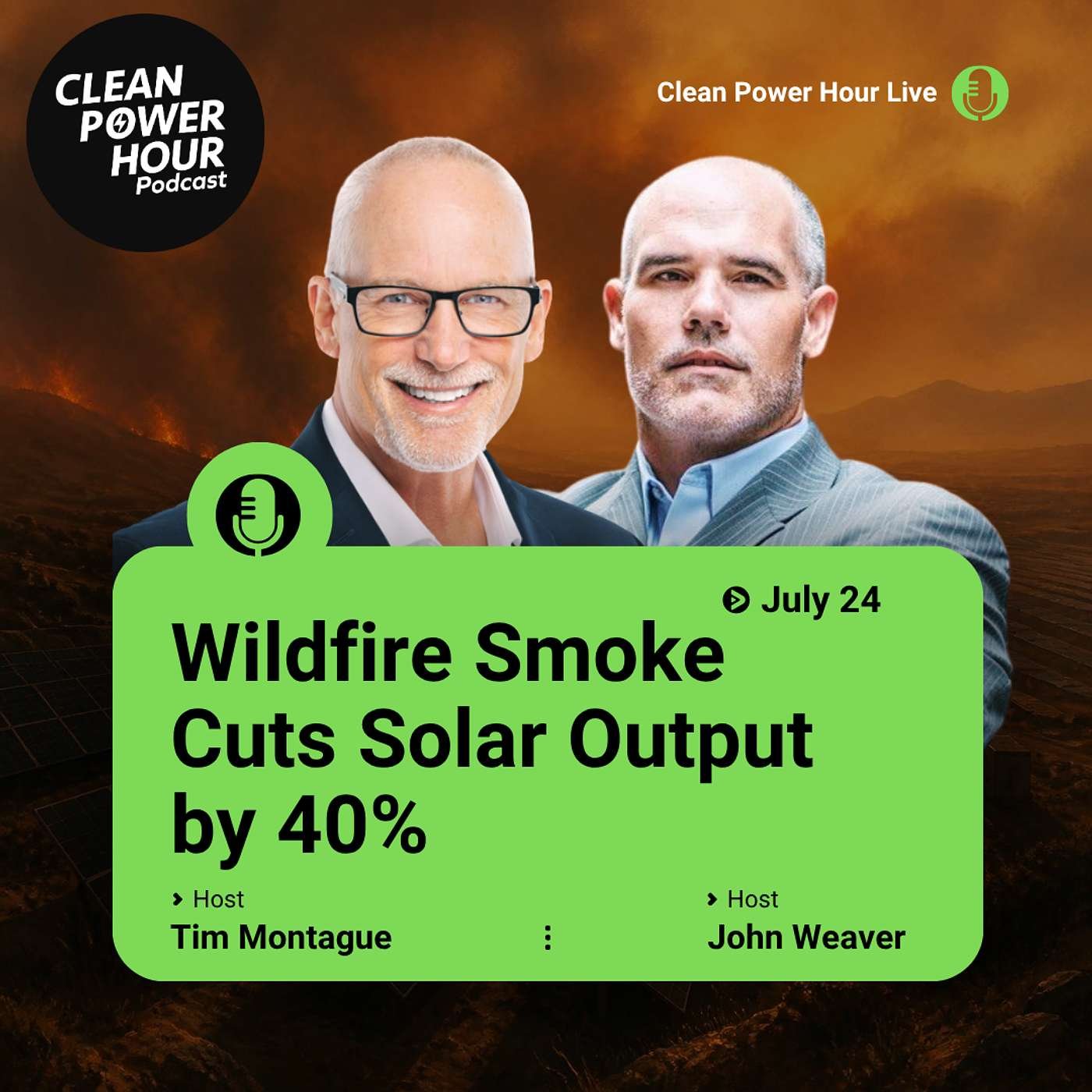
Wildfire smoke from Canada cut solar production across New England by as much as 40 percent, according to ISO New England, a loss of 2,500 megawatts at peak hours compared to the forecast.
Tim Montague and John Weaver dig into that data, including John’s own project numbers, on the Clean Power Hour Live. They also cover a massive BYD battery storage deal in Abu Dhabi, a new gas car ban in China, rising copper prices, and a wave of new battery products hitting the market.
Whether you’re an installer, developer, investor, or simply following the clean energy transition, this episode covers the trends you need to know.
In this episode:
- BYD secures an 11.275 GWh battery storage contract for one of the world’s largest clean energy projects. (BYD Energy press release)
- Wildfire smoke cuts solar production by up to 40% in parts of New England. (WBUR)
- China’s Hainan province set a 2030 deadline to ban new combustion engine car sales, with plans for new energy vehicles to reach 45 percent of the province’s fleet. (Dialogue Earth)
- Massachusetts expanded its vehicle-to-grid and virtual power plant programs through the ConnectedSolutions initiative (regional VPP program).
- SEIA data shows utility-scale solar occupies just 0.07% of America’s prime farmland. John Weaver corrects the math live, and SEIA’s own figures show roughly 43 acres of abandoned prime farmland for every acre solar currently occupies. Tim and John debate the politics behind the farmland argument. (PV Magazine)
- Octopus Energy launches the Nook Cube smart battery for renters. (Renewable Energy Magazine)
- Copper prices continue climbing and what that means for future solar project costs. (BlueSky)
This episode fits solar developers, battery storage professionals, EPCs, and clean energy investors tracking both hardware innovation and real-world grid risk. The BYD deal and Octopus battery launch show where storage economics are heading, while the wildfire smoke data is a preview of a grid challenge more regions will face. Anyone pricing projects around copper costs or watching global EV policy will find useful detail here.
Connect with Tim
Clean Power Hour
Clean Power Hour on YouTube
Tim on Twitter
Tim on LinkedIn
Email tim@cleanpowerhour.com
Review Clean Power Hour on Apple Podcasts
The Clean Power Hour is produced by the Clean Power Consulting Group and created by Tim Montague. Contact us by email: CleanPowerHour@gmail.com
Corporate sponsors who share our mission to speed the energy transition are invited to check out https://www.cleanpowerhour.com/support/
The Clean Power Hour is brought to you by CPS America, maker of North America’s number one 3-phase string inverter, with over 6GW shipped in the US. With a focus on commercial and utility-scale solar and energy storage, the company partners with customers to provide unparalleled performance and service. The CPS America product lineup includes 3-phase string inverters from 25kW to 275kW, exceptional data communication and controls, and energy storage solutions designed for seamless integration with CPS America systems. Learn more at http://www.chintpowersystems.com
0:53
Welcome to the Clean Power Hour live. Today is july 24, 2026. I'm Tim Montague, your co-host, bringing you the latest and greatest solar, wind, and battery news. Welcome to the show, John Weber, commercial solar guy.
John Weaver:
1:07
Hello, Tim. Hello, Tim. I hope you're doing well. A nice summer. We're building solar, very busy, and and oh my gosh, there's just constant solar stuff going on. I hear that you're visiting with Chint at Family Day in Maryland. No, Jersey. The
Tim Montague:
1:28
life of a podcaster. I am traveling almost constantly this summer, for better or worse, I was in Maryland doing some on-site recording with Sunrise Solar on the Eastern Shore, and then I visited Standard Solar in the D.C. area in Rockville, Maryland, and then this week I was visiting with my friends at Chint Power Systems. They host a social event for their partners and staff every year called Family Day. There were lots of children. There was ice cream, and there was a beautiful view of a river. I can't remember the name of the river. We were in Red Hook, New Jersey, and there were sailboats, and it was beautiful.
John Weaver:
2:08
Well, you like sailboats, so so TPS. What's just for because they're a sponsor, you know I sponsor this portion of the shows, but I don't care. I like talking about CPS. But what's their coolest, latest, greatest inverter that's currently on the market? I know there's always cool news to talk about that you're not allowed to release, so we won't ask you about that. But I don't know, just for the sake of showing off. Well, they have a
Tim Montague:
2:32
they have a 350 kilowatt inverter on the market. Yeah, and they will be releasing a 500 kilowatt inverter next year sometime.
John Weaver:
2:45
Okay.
Tim Montague:
2:46
Now that's you're going to see a slew of 500 kilowatt inverters coming out from other manufacturers as well, so they don't they don't corner the market on the 500 kW inverter. But for utility scale, it makes a lot of sense, right? If you're building a 100 megawatt site, a half a half a megawatt spring inverter makes a lot of sense, and so yeah, that is the latest and greatest though a 350, and I'm going to be traveling around the the the the news story really about Chint is that I'm going to be doing more on site filming, making short videos about projects that involve Chint technology, highlighting the contractors, the installers that are doing those projects. So, if you're a Chint customer, reach out to me. I love hearing from Chint customers, and we also have a new sponsor, John. That's Sinclair Designs and Engineering.
John Weaver:
3:46
Who is this?
Tim Montague:
3:48
Sinclair Designs and Engineering. They're a ground mount racking company in Michigan. Ground mount
John Weaver:
3:56
racking Sinclair. Okay, so this is new for me. So everybody, where we gotta make sure we show off the sponsors so Tim can feed his kids. He's got 14 kids. That's right. And so Sinclair. So they do. They're ground mount rack. So they're a civil engineer. I guess that means if they're doing ground now.
Tim Montague:
4:14
Well, they're a manufacturer. Bolt manufacturer. Ooh, yes, yeah. They are stamping, rolling, cutting steel, and I visited the factory. We're going to be releasing a factory tour video in a couple of weeks, so stay tuned, but yeah, for small utility like I'd say half a megawatt to 10 to 20 megawatt projects, they make fixed tilt down mount and carport racking products, and they're no they're no stranger to the show. We we hosted a webinar and an interview with Kyle Sinclair earlier this year, and I just wrote a story a couple weeks ago about carports that you contributed to, John, for TV magazine.
John Weaver:
5:03
I was surprised with how much you quoted me in that story, but but yes, like I was. I got to take care of my
Tim Montague:
5:08
partners. Take care of my partners. Yeah,
John Weaver:
5:11
yeah. Okay, cool. So car wrecking. Maybe I'll actually send them a quote because I have two projects we're working on right now, and we have to get at least a second quote, and we've only got one so far. So I wonder if they're interested. But 500-that's a bit. We might be underneath their line though. If it's 500 for a carport, that's what happens. Those are a lot of carports. Very small.
Tim Montague:
5:32
They um they will they will look at any size project truly.
John Weaver:
5:37
Oh, like so our carport's about 100 kW. The first one and our second one's maybe 200. So those are the two carports that we have for a for a quote pretty soon.
Tim Montague:
5:48
Yeah, the cool thing the the. Thing that I think is really cool about Sinclair. I mean, I've known these guys for almost 10 years, and their turnaround is amazing. So you can get engineering in 48 to 72 hours. You could have product on site literally in two weeks from the time you order. So they're very fleet of foot, and right here in the middle of the country, right. So you can they can easily get product out to the East Coast or the West Coast in a very timely manner. Go
John Weaver:
6:26
ahead. So do you want to talk about you want to talk you want to talk about the story of me getting onto NPR?
Tim Montague:
6:31
Yeah, for sure.
John Weaver:
6:33
I I wasn't actually on the radio. I wasn't on the radio, but I was in one of their articles.
Tim Montague:
6:39
This is the all the wildfire smoke.
John Weaver:
6:41
Yes, sir.
Tim Montague:
6:43
Okay.
John Weaver:
6:44
Yeah, all the wildfire
Tim Montague:
6:45
smoke. Yeah, we've been dealing with a lot of wildfire smoke, John.
John Weaver:
6:49
We had a lot. We had two days, and you're going to see some data here. I'm sharing it in these two two sources. Our first article of the day. So W B U R, they're an NPR show that's or an NPR branch that's located in Massachusetts, and I follow on Blue Sky one of their reporters who covers a lot of green stuff who covers electricity billing and a lot of other things, and during the midst of or the day after the first, which was last Wednesday, the first smoke event coming from solar, she asked for feedback from people who might have data on solar, and I was there paying attention on Blue Sky because I'm on the internet all day long, like a little kid. And so this isn't my system, but this is another one that's in the article. And you know, you can see, look at production in Massachusetts. It was down. This dude's down was down like two thirds, half, more than half in the prior day. And we had the same. This is an individual
Tim Montague:
7:51
project.
John Weaver:
7:53
Yeah. Well, this isn't ours. Ours is a different one. Ours is right below this. But this is for some residential guys. End phase enlightened. A name, Stephen Gordon. So that's his individual residential project. Down a whole bunch. That's a that's a big drop. Our system. More than 60%
Tim Montague:
8:10
drop.
John Weaver:
8:11
Yes, absolutely. Our systems showed something similar. So here's so we don't have a chart in ours, but you can see where I'm quoted right there in the middle. That's a picture of our system we recently installed. But peak generation value. So the this project prior day hit 200, but this day it was only hitting in the 80s and 90s, and it's a 200 kW AC project, so it maxed out the prior day, and total generation was 40% of normal generation at this site. And this was down in Warwick, Rhode Island. This is a brand new system. It's been up since like December. You know, it turned on in December. It was completed last November. Everything is perfect on it, and it took a nice hit, and it took a big chunky hit. And so, you know, all across New England, Massachusetts particular, NP ISO New England, so they see a 40% drop across the whole region for behind the meter, and that's that's for the the entire ISO looking at all of New England. So they saw like, and I think that's two and a half gigawatts. If you scroll down a little further, they talk about it, but it's a two and a half gigawatt drop that was across the. They said like losing greater than millstone, so somewhere in here they actually talk about the number. Oh, there it is. At peak hours, at the very top line, you got to scroll up just a little bit. At peak hours, the solar fleet in the region produced 2500 megawatts, 2500 less than had been forecasted, so if it was 40% off, that means we have like six gigs ish of behind the meter solar. So that's that was pretty interesting. It was pretty interesting to watch on all the systems. And I have a link. So if you want to go to the next link real quick, I got something interesting to show you. Actual output from commercial systems from our portfolio of projects that we were looking at the
Tim Montague:
10:17
blue sky.
John Weaver:
10:18
Yes, sir. Yes, sir.
Tim Montague:
10:24
Okay, I'm getting that on screen.
John Weaver:
10:28
And you know, it's interesting. A couple years ago, we had a customer worried about output, and after storms, and he actually asked us to clean. So, if you click on any of these images, you can see the output much sharper. But he actually asked us if we wanted to clean the solar panels, and and we did clean them for him, and we found that there was very. Little smoke residue, no ash. A couple of months later, and because there was, so there was nothing. So I, I think the rain should clean anything if there was anything deposited. But you can see across multiple systems. You know, these are four different monitoring systems. You can see that second to last day where it just got wrecked. You know, output was rough. The things that
Tim Montague:
11:14
I worry about more than the loss of solar productivity, which is significant and a concern, is the effect on human health. Of
John Weaver:
11:23
course,
Tim Montague:
11:24
I was sailing in Wisconsin last weekend, and the first day wasn't bad, but the second day the smoke was really bad, and you know I'm not a particularly at risk individual, but there were many sailors who were quite concerned and wearing masks, and you know breathing that stuff is hazardous to your health, and it does increase your risk of heart attack, especially for elderly individuals. I do count as a senior now. I'm 60 years old, but luckily I'm in pretty good health thanks to all the pickleballing I do.
John Weaver:
12:00
I like it. I like it.
Tim Montague:
12:02
But climate change has real, real impacts, and like I don't remember so many wildfires when I was younger. Now maybe I wasn't paying attention as much to the news, but I think things have changed, and this is just one of the many changes. Ultimately, the biggest change that I'm concerned about, John, is disruption of food systems in low-income communities and countries, which will cause human migration. And when 1000s of strangers show up on your door because they're starving, that's a challenging situation. So we need to tackle climate change. We're not really serious about that. As a species, we're still very busy poking each other in the eye and worrying about the oil, Like, truly, the war the war in the Gulf with Iran is is about is about oil. I am 100% convinced that is really not about nuclear weapons. It's about oil.
John Weaver:
14:01
Well, you know, we'll we'll do a slight off to the side here. Price of oil has gone back up again with this war. It had fallen as there was a truce of sorts, and it had fallen down and almost touched 60 bucks a barrel, and or up upper 60s, almost broke through 70 going downward, and now it's back up to upper 90s. It even touched 100. At least the Brent, the international product. So oil is now rebounding again, and national averages pushed back over four bucks a barrel. So you know, at this point, we could, you know, we here look. I'm going to manipulate the story order. We're going to go to a different story. Now that we're talking about oil, we're gonna come down here. I'm gonna move this one up to the top real quick, and we're gonna talk before we talk about balcony solar, which is cool. We're gonna talk about Hainan , a Chinese province, has said they're gonna ban new combustion car sales by 2030. That's only like three years away, dude.
Tim Montague:
15:05
Okay, this is a story in Dialog Earth, which I've never heard of.
John Weaver:
15:09
Neither of South China
Tim Montague:
15:11
province to ban new combustion car sales by 2030.
John Weaver:
15:16
Yes, which
Tim Montague:
15:16
is right around the corner, of course.
John Weaver:
15:18
Right, yeah, dude, like right now. I mean, it's it's close.
Tim Montague:
15:22
I mean, I was looking, John, because of the one of those big. I think it was Lazar's report on energy that came out recently. China still gets 40% of their grid power from coal, so their carbon footprint is significant. They're getting 20% of their power from wind and solar now.
John Weaver:
15:44
Yes,
Tim Montague:
15:46
and do get a lot from they
John Weaver:
15:47
do get a lot from coal. Yes,
Tim Montague:
15:49
but you know many northern European countries have also set goals for phasing out combustion. You know, internal combustion engine cars. California has set a goal, right? Have they not?
John Weaver:
16:03
I mean, California has a zero. Okay, let's look it up. California, all EVs by what year? Let's see what the internet says. 100% zero emission vehicles by 2035. Maybe is what their target is. 100. Oh, 100% zero emission vehicle sales by 2035. So, so that they're a little further. They're they're another half a decade beyond this group. I mean, that's
Tim Montague:
16:32
our that's our most ambitious state in the U.S. when it comes to air quality, right?
John Weaver:
16:38
Yeah, yeah, they need it. So this is interesting. You know, as we're talking about oil. Geopolitics and global stuff. China and we talked about this a few shows ago. They cut back oil imports by 2030, 40% They're the world's largest import-1012, 13 million barrels a day, maybe more. The largest user of oil, and they cut back in different ways. One of the ways they did was by pushing the purchase of EVs, and I do have another article somewhere that shows China's exports of EVs are just going through the roof. We weren't going to talk about it on the show, but this just talks internally. They're sending more EVs, so this is it's just pretty interesting, man. They're they're doing they're doing a lot of things with EVs, and and within this article, I'm actually writing an article this morning for PV Magazine USA. There was a local announcement in Massachusetts where the local utility is doing vehicle to grid within our what's called connected solutions program. So you can do vehicle to grid within the VPP peak demand. So we got all the words here. So we got a V to G VPP peak demand program, Tim. That was fun. So we have a vehicle to grid virtual power plant peak demand offset program. So in in Massachusetts, Rhode Island, and Connecticut, we have something called connected solutions, and that's where the local utility will tap into thermostats, hot water tanks, and batteries. And when the grid has 26 to 30 peaking periods within the course of the year, the utility will will turn up or turn down different pieces of hardware, and I was just reading that last year, the people that own batteries, and you're going to we're going to talk about this next show. I think it's August 5, a Wednesday. The people that own batteries were paid $5.4 million, Tim, for allowing their batteries to be used in the VPP program. It's about 5100, 5400s. That's like 1000 bucks per person. So people for their residential batteries got paid on average about 1000 bucks for the year, so five years. It's a five-year program, so you roughly get paid the same amount for five years, and then they think you're going to be able to re-up. But that means half the batteries cost, if not more, is covered in the VPP program on its own. So Hanan is talking about doing it vehicle to grid. Massachusetts is now adding car batteries. Now, of course, I'm in my apartment, so I can't really participate in any of that stuff. But that's pretty cool. Maybe I'll rent my car out, let somebody plug my car into their house in exchange for charging it. They'll make the 1000 bucks. I'll get a highly charged car. I don't know. Yeah,
Tim Montague:
19:43
and I and I did see a story. I can't remember the publication now about allowing EV owners to plug in to remote chargers and access VPP programs. So we're going to start seeing mobile monetization of your EV battery as well, which makes sense,
John Weaver:
20:08
right? You know, one time a long time ago, I said that it should be social etiquette that when you show up at a place, you plug your car in. You need to show up with electricity. That's your job. That seems kind of interesting. Like it's if you have electricity, if you're traveling with a 70 kilowatt hour battery, show up, join the show, offer some demand charge. Maybe you'll charge. Maybe the grid needs some help there. But you're showing up with electricity demand. It'd be kind of neat if you showed up with a battery. You could support the local grid.
Tim Montague:
20:41
Yeah, if you have the luxury of not needing your battery for all of its range, then you could do that.
John Weaver:
20:48
Yeah.
Tim Montague:
20:48
Well, let's talk about Octopus Energy. I'm going to put this tab on screen. Octopus Energy launches the Nook battery range to unlock lower bills for millions of households. Octopus Energy is a very interesting company.
John Weaver:
21:02
Yeah.
Tim Montague:
21:03
And I have not been able to secure an interview with them, but it's on my to-do list. But tell us about the story.
John Weaver:
21:12
So technically, I think this is your story, Tim. But it's just they have a new battery that they've programmed, and it lines up because Octopus is a a retail electricity provider who is super interesting, and you could probably add some to this. But from my perspective, I love how they interact with their users to get them to save energy and to use energy. Like they actually tell their users, "Hey, at this time, turn on all your wash." Driver and use all the electricity you can because electricity is free right now, and so they push different gear. And they're in Texas, at least in Texas. Yeah, but they push different gear to their people. And now, for renters, they're putting out a battery that they've programmed that taps into their software network and understands what's going on, and so it knows when to save the renter some electricity, when to pull electricity from the grid, when to charge itself, and it's you know it's just a cool little thing. And because now, I think in August officially August 7, I don't know. Let's double check the internet. When is balcony solar legal in the UK? It's like in three weeks, end of August maybe, august 27. There we go. So plug in solar per solar UK on Reddit. Plug in solar is legal from August 27, and so they're getting some batteries out.
Tim Montague:
22:47
Well, and this story is about a product called the Nook Cube, which is a plug-in, a battery that you plug into the wall.
Unknown:
22:55
Yep.
Tim Montague:
22:56
So, so Octopus is not the only company doing this. There's a company called David Energy, which has made some waves recently with this same kind of a product, I believe, in New York State initially, and just like Balcony Solar, right? It's it's a battery that you plug into your existing infrastructure. It charges or discharges according to what the operator you know says, and it monetizes the battery and then reduces your energy bill, and so it's a win-win, right? Octopus is going to earn revenue from the battery, and the consumer can earn savings from the battery.
John Weaver:
23:37
Yep, and the the key thing is that it can work in a residential apartment setting, which means they're not calling me, the general contractor, master electrician with a big old crew to open up a wall. They're just buying a box and plugging it in, and that's pretty neat. That's that's and it's and it's pre-solved and it's pre-programmed. That's the key. Well, not pre-programmed, but it hooks Into the the Nook environment, I guess I don't know what the word is ecosystem, because Nook manages electricity usage. They want to make sure, or not Nook. I mean, Nook manages it too, but Octopus helps you manage your electricity usage. That's a big goal of theirs. So I think,
Tim Montague:
24:22
yeah. So Octopus is is a UK company. They now operate in the U.S. but they have 26,000 solar and battery installations in the UK, Spain, and France. So their footprint is significant in Europe and coming to the to the U.S.
John Weaver:
24:40
And so, speaking of balcony in the U.S. there's a new little kit you can buy from. Have you ever interviewed the people from Bright Saber Tim?
Tim Montague:
24:51
I don't think so. No.
John Weaver:
24:53
All right. Well, they're a group who's pushing balcony solar in the U.S. They just they came up with a neat little kit, and this is just them pushing a product was shared on PV Mag. The pricing is okay, you know. Of course, U.S. pricing is a little strong. They have a membership program, which is weird. 29 bucks. I don't. I don't fully grasp. I guess it's to support the system. So they have a membership at 30 bucks a year that would, I don't know, after one year, cost the same your savings. But you can buy a little kit. So if you scroll down a tiny bit, they show a couple of systems. We don't have to get into it. I just, it's nothing magical. They just have a couple of neat little documents. Yeah,
Tim Montague:
25:43
let's give credit to Ben Ziantera, our friend at PB Magazine,
John Weaver:
25:47
who
Tim Montague:
25:48
wrote the story. Shout out to Ben. Look forward to seeing you in Chicago, probably at RE Plus Midwest, Ben. And so this this California-based nonprofit called Bright Saver, okay, is accepting pre-orders. Okay, right on. So yeah, it's getting real. The balcony solar space is getting real. All
John Weaver:
26:11
right. So here's their little kit. It just has a two-module kit. That's their price. The price. Let's see. Is this the price? They're not doing a markup, but if you do join, you get the wholesale price straight if you pay 29 bucks as a membership, which is I don't know. But otherwise, there is a big price markup if you if you don't join the membership. So it's just a it's just a balcony. Solar kit that you can buy now. That's it. So rock on. If you want to find Bright saver, there's a kit out there that somebody did a little time and put together. That's it. Yeah. Oh, and I could. We got to tell Ben he needs to edit the article. There's an extra period that was sitting in there in the middle of the article. I just saw it. Picky
Tim Montague:
27:01
picky. Is there is there a balcony on your apartment?
John Weaver:
27:06
Absolutely. I've already been checking out. I've been shaking it. I'm totally going to put a balcony system up as soon as I can. No questions asked. Yes, and I got a nice south facing chunk. I'm going to put it out there at like 25 degrees. I might get a battery too because I don't use a lot of electricity, but we'll see. I mean, one panel it will do it for me with the amount of electricity I use. Maybe two.
Tim Montague:
27:30
Yeah. All right. Price of copper going through the roof.
John Weaver:
27:37
Oh, Tim, why'd you bring this up? Well, talking about this topic, you're you're stressing me out, Tim. Christopher Cobb. It
Tim Montague:
27:48
wants me to sign in to Blue Sky to show this for some reason. Oh well, let me share
John Weaver:
27:53
it then. Let me share it. Let me share it. Yes. So it wasn't even you that brought it up, of course, Tim. So I guess I I can't blame it. I'm the one that brought up this horrible topic, but I just, you know.
Tim Montague:
28:05
Well, why is the price of copper going up? Do you think?
John Weaver:
28:09
Well, actually, I follow this guy. He's pretty smart. So, in general, there's a lot of inflationary pressure on copper. There's a lot of heavy demand in copper because of EVs. There's a lot of copper price in the U.S. This most recent, there've been there's been a copper mine or two that has been down, and then it fell off this peak. So this was a couple of days ago, but it is still up in general from way high rates. I mean, you can we're looking
Tim Montague:
28:42
at a how many year chart here? Like
John Weaver:
28:45
this is like 30 years.
Tim Montague:
28:47
Yeah,
John Weaver:
28:48
and then if you look in the last five, I mean, you start in like 2020, you can see that big COVID bump that where it went up in 2021 and then it came back down a whole bunch in like 22, but then it's just been marching, man. And so copper is significant. I, you know, I just spent 10,000 bucks on copper for a project. It's not, you know, it's it's a lot. So I just, you know, I've been paying attention to copper. It's up, price is up, and so and I buy it regularly. I'm lucky right now. I have a solid source that gives us a fair price. We pre-purchase sometimes for projects so that we can. Because I've been watching this and being nervous about it, but but this is happening. And and there's a big copper company. This guy Andrew, he's a he's he's somebody who I know in the world. Andrew Gilston. He he likes to pay attention to rocks and investing and stuff. He's crazy on blue sky, so don't don't listen to anything he says. But every once in a while, you get to see cool charts like copper going through the roof, and you get stressed out. So, so just you know, as you're buying your copper and you're pricing stuff for next year, this is really for developers. You know, as your and and EPCs as your pricing projects, you got that little box. You have your price. You know, you have your number eight copper. You have your bigger copper. You have your ground wires. You know, there's there's like 678, different copper items we buy, and we have certain number of feet. And each foot, you know, it's 30 cents. It's 60 cents. It's four bucks per foot for the big stuff. You know all that stuff's going up, man. So, so just be conscious. Be conscious of your spreadsheets is is where I'd put you.
Tim Montague:
30:36
And we have another story from Benzie and Tara in PV Magazine on utility scale solar uses only 0.07% of U.S. prime farmland, says SEIA.
John Weaver:
30:52
That's not a percent, Tim. That's not a 10th of a percent, Tim.
Tim Montague:
30:56
It's not a 10th of a percent.
John Weaver:
30:58
It's seven hundredths of a percent, and a percent, Tim, is 100th of everything, so this is seven, not thousandths. This is 710 thousandths of all of the prime farmland in the U.S. And to be fair, there's about 345, x of prime farmland in volume that is abandoned. So we have two or three times the amount of prime farmland we need. Some of it's not as prime. Some of it's you know not Illinois prime farmland. But there's more. There's like 3x. Abandoned prime farmland around the country. So the purpose of this is to so the people that are saying ah you're you're using the farms really just to tell them to shut up, get a little perspective. Here's what reality is. You want to talk about farmland being destroyed? Talk about parking lots. Talk about roads. Yeah, suburban
Tim Montague:
32:05
sprawl. Suburban sprawl is really a big enemy of farmland in America, and solar is going to take 1% when we're all done, right? We need about 2% total. We'll put 1% on the built environment, which is about 6% of the land use already in the U.S. and then we'll put another 1% on undeveloped land or brownfield or whatever. So it's really trivial relative to things like golf courses and homes. So yeah, we got to keep it in perspective. We're not going to pave over the breadbasket. We should also worry about how we're using other ways we're using our farmland, like growing corn for ethanol. You know, 40% of the corn crop is used to grow corn for ethanol, which is hugely inefficient by at least a factor of 10 compared to PV, and that's a very conservative figure.
John Weaver:
33:11
That's yeah, I mean the amount, yeah, it's just huge amounts, huge amounts of electricity, huge amounts of land from not huge amounts of solar taking it out. I mean, the U.S. is huge, hundreds of millions of acres. I'm, I, you know, even the biggest state is California. I think with the highest, or was it Rhode Island? Um, you know, Cal, you know, California. There it is, point four three, and we're, and this is California and California is already at I don't know 3040 50% clean energy, you know their you know gas natural gas is under 30% now, and California is oh and it's California man, and they're at point four three, so if you know the only places I'm worried about is like Hawaii, how the heck are we going to take care of those people? We got to figure that one out. Some floating offshore wind in the middle of the ocean or something, you know. Rhode Island, I'm not worried about. You know, they're surrounded. There's plenty of land up here in New England. Offshore wind. I got nukes nearby. So I just the people that talk about the farmland stuff. There's a lot of politics that's not real. It's not honest. It's oil companies pushing propaganda. So anyway, that's enough. And I'm
Tim Montague:
34:35
also I'm also a supporter of landowner rights. Like a farmer should be able to decide what he or she wants to do with his land,
John Weaver:
34:44
yes, and
Tim Montague:
34:45
solar being one of them. And we have dual use solar. That's a growing phenomenon. And I'm cool with states like New Jersey requiring, you know, ground mounted greenfield solar to be dual use. I think that's appropriate in a in a state that is very has very limited land resources, and we want to protect the agricultural land. Do dual use-that's great. You can grow crops under a solar array, and sheep, of course. So,
John Weaver:
35:16
yeah. All
Tim Montague:
35:17
right, we got time for a couple more stories. I do have a hard stop at 140. Yes. So we'll do one bad luck.
John Weaver:
35:27
We'll be fast. We'll do a bad luck story, and then we're going to talk about batteries because you know because I like batteries. But let's do a bad luck. Freak storm forces
Tim Montague:
35:37
Arizona. Freak storm forces forces Arizona contractor to rebuild just completed carport. Ouch.
John Weaver:
35:43
Yeah. Yeah, man. Look at the pictures. Oh, what was the freak event? It was, you know, is maybe, but what do they call them? They in Arizona they call derecho. They could be derechos, but they also have micro bursts. There's another term I've heard: 100 mile an hour
Tim Montague:
36:01
winds in
Unknown:
36:02
a five mile
Tim Montague:
36:03
wide path.
John Weaver:
36:04
Yep, so. here they call it a microburst.
Tim Montague:
36:07
Yeah,
John Weaver:
36:08
microburst is rough, and man, look at that carport just ripped. It's just like oh, just just sad. So so that that yeah, they Ob odo Energy.
Tim Montague:
36:20
They had we did a webinar with the Boto a couple years ago,
John Weaver:
36:25
you know, you can tell from this conversation there with this guy. He's talking with his partner. Like, look at that! They just ripped up half the thing. Man, how sad is that? Obodo Energy , it seems like they're a good developer, a good contractor, because he said, you know what? We talked to our customer. We're building a multiple number of carports with them, and we said we're going to figure out how to split the hurt cost on this one. That's going to and so if you have a customer that's willing to take on that with you, work through it and and be comfortable, and then you know these guys they you know I share a lot of stuff getting broken and beat up and stuff on LinkedIn because I think that's important. These guys shared the bad news. I think that's great, man. This shows the reality of our industry. I mean, the the cool roof solar panels everywhere are awesome, Tim. I love it. But we gotta see real stuff. We gotta see damage. We gotta see fires. And I thought it was cool that these guys shared a fire, or maybe not a fire, but a tornado. So that just neat. All right, we got one more story, Tim. I guess we're gonna talk about battery, and it can be BYD's big battery that won the 24 hour bid. That's what I like. I'm down to two minutes with you, Tim, before you jet jet set somewhere cool, man.
Tim Montague:
37:43
I'm going home to Champaign, Illinois. That is someplace cool for sure.
John Weaver:
37:47
I like I like
Tim Montague:
37:48
it. Okay, BYD Energy Storage signs a 11.275 gigawatt hour contract with Masdar for Abu Dhabi's world's first RTC project story in BYD Energy press release. Not really a.
John Weaver:
38:06
It's real more of a press release. But they they want a big old contract. You know, 11.2 gigawatt hours, and it's their Haohan battery cell. I don't know how to say that properly, but oh, here it is. Oh, sweet! They got the data thing right there. No, you were in the right place. Actually,
Tim Montague:
38:24
I don't know what I'm going to go back there
John Weaver:
38:25
in a second. Oh man, you're gonna have to figure it
Tim Montague:
38:28
out. It was a rollover.
John Weaver:
38:30
We'll get there. So this is the battery that I brought up. That's a 2,700 amp hour cell. The battery cell is like five feet long, and they said it has, and we covered this a couple weeks ago, and that's why we're covering this story now. They said this battery has a 1.4 cent levelized cost of electricity. So that is the lowest I've ever seen for a battery. Everything I've seen is in the four cents. That might include finance and other stuff. So I don't fully understand bank. I don't fully grasp battery financing yet. Intuitively, got to do more work. But this is the coolest battery cell, in my opinion, inside of the coolest product. And there it is. They're talking about it down there. The Haohan is is equipped with a 2710 amp hour battery cell. I mean, that's the size of a battery. That's just a battery on its own. I don't know how big that is. Somebody said this is like a horsepower. It's bigger than a horse horsepower. I think a horsepower. No, a solar panel at 900 watts is bigger than a horsepower. Never mind. Something comparable. But this is a really big battery cell. This is more than a kilowatt hour of electricity in there, I believe. So it's a huge cell. It's different, and I'm just interested in it. And of course, it's in this power plant. That's a 24 hour. It's a one gigawatt, 24/7 solar plus storage power plant. So it's five gigs of solar and like 19 gigawatt hours of batteries, right? And then, and then solar. So it's a 24-hour. The sun will shine 24/7 here. So that's my favorite battery story, or battery sale, sale of the week. That's a nice commission, dude. You want to get a commission on 11.2 gigawatt hours, Tim.
Tim Montague:
40:29
Did they say what the capex of the project is?
John Weaver:
40:32
Uh, no, but let's. It's it's it's not. Ooh, you got to oh go over solutions and products up at the top. Okay, now no, go back to products. Now go down to the Haohan at the bottom. Click that guy. Yeah, that's what we're talking about. This is what you people are going to be buying soon. This is a 14.5 meg. And by the way, Tim, it's now 141, so you got to leave. But it's a 14.5 megawatt hour shipping container with that cool, cool battery cell. Scroll down, see if they show a picture of it. They better, yeah. There it is. Look at that thing. You could you could break a window with that or something. I don't know. You could cause havoc with a battery cell that big. I'm not sure what to do, but it looks cool. So yes. So that's that's my battery. That's my current fascination of hardware. Yeah, the battery cell from BYD. All
Tim Montague:
41:35
right. Well, we'll be back on Wednesday, august 5, because I am going on vacation on august 6. So we're having the live two days prior to the scheduled date, but we'll see you on Wednesday, august 5. And with that, check out all of our content at CleanPowerHour.com. Please tell a friend about the show. That's the best thing you can do to help others find this content. How can our listeners find you, mr. Weaver?
John Weaver:
42:02
CommercialSolarGuy.com. That's our website. LinkedIn, I'm on LinkedIn 24/7, and and Blue Sky Commercial Solar Guy is on Blue Sky. All
Tim Montague:
42:13
right, I'm Tim Montague. Let's grow solar and storage. Thanks so much, John.