Illinois Renewable Energy Conference 2026: The Conversations I’m Watching
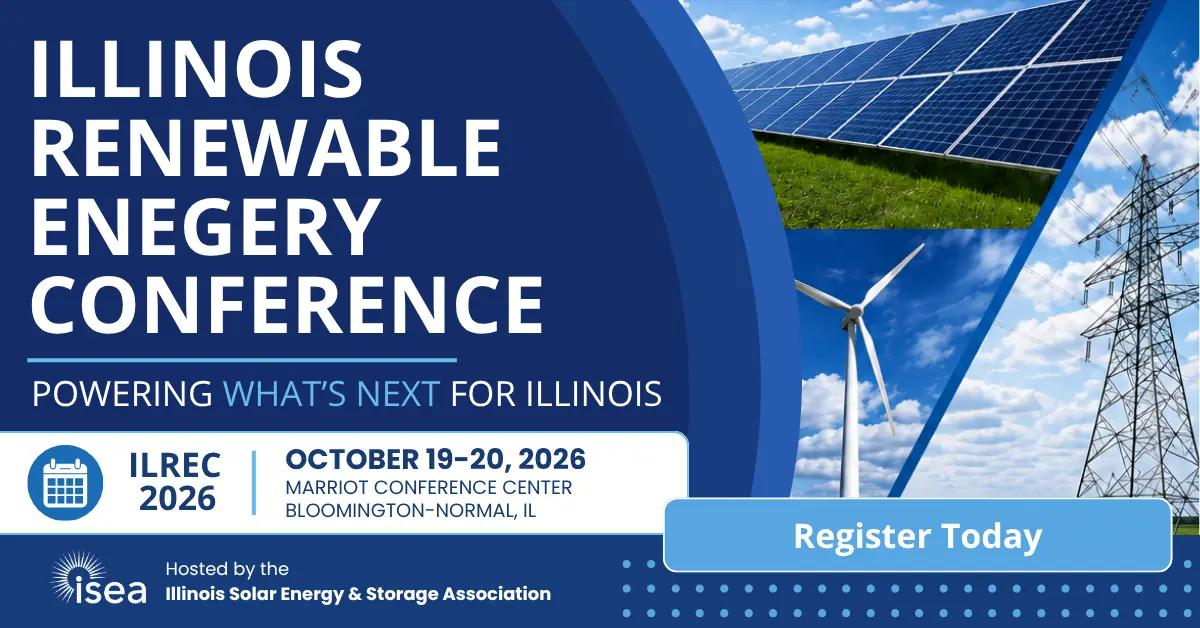
The Illinois Renewable Energy Conference (ILREC) returns October 19–20 in Bloomington-Normal, and this year’s agenda reflects just how quickly the energy conversation in Illinois is changing.
We’re no longer talking primarily about deploying more solar and wind.
We’re talking about whether the grid can keep up with rapidly changing demand. How we interconnect the next wave of distributed resources. What role batteries, microgrids and virtual power plants can play. How Illinois policy translates into projects on the ground. And how we build the workforce required to do all of it.
That makes this year’s ILREC particularly timely.
Hosted by the Illinois Solar Energy Association (ISEA), the conference brings together developers, utilities, contractors, policymakers, regulators, local governments, educators and clean-energy businesses from across the state.
I’ll be there, and this year I’m especially excited to be moderating the Grid Resiliency & VPPs panel on October 20.
The conversation I’m most excited about: Grid Resiliency & VPPs
Anyone who follows my work knows that I’ve become increasingly focused on the intersection of solar, battery storage, microgrids and grid flexibility.
That’s why I’m looking forward to moderating the Grid Resiliency & VPPs session in the Distributed Generation track.
The basic question is becoming increasingly important:
What if distributed energy resources aren’t simply loads and generators connected to the grid—but become part of the infrastructure that helps operate it?
A commercial battery can reduce demand charges for its owner. A solar-plus-storage microgrid can provide resilience when the grid goes down. But aggregate hundreds or thousands of flexible distributed assets and you potentially have something much bigger: a virtual power plant capable of shifting load, responding to grid conditions and turning customer-owned energy assets into grid resources.
That raises some of the questions I want us to tackle:
How do we properly value resilience? What services can distributed batteries and flexible loads realistically provide today? What stands between the VPP concept and widespread deployment? How should utilities, aggregators and customers work together? And how do we make sure the economics work for the people and businesses actually buying the equipment?
For me, this is one of the most interesting frontiers in clean energy.
This is also a chance to hear directly from the people shaping Illinois’ market
One of ILREC’s strengths is that it isn’t just an industry conference. The program brings together people from government, regulatory agencies, industry and organizations like ISEA that are directly involved in how Illinois’ clean-energy market develops.
That includes participation from the Illinois Power Agency (IPA), whose programs and procurements have an enormous influence on the state’s renewable-energy market. IPA officials have been regular contributors to ILREC, discussing Illinois energy policy, Illinois Shines, equity initiatives and the state’s evolving renewable-energy market.
The 2026 program also gives attendees opportunities to hear from ISEA leadership and board members, alongside elected officials and other public-sector leaders involved in energy policy and implementation.
That’s an important part of the value of this conference. Instead of hearing about a new rule, program or market change secondhand three months later, you can hear from many of the people working directly on it—and then have a conversation with them in the hallway.
Three tracks tell you where the Illinois market is heading
October 20 divides into three parallel tracks: Utility-Scale, Distributed Generation and Emerging Technologies.
The Utility-Scale track gets into the future of large project development, MISO and PJM, storage and one of the biggest energy stories in America right now: rapidly growing electricity demand and large loads.
Illinois has the unusual challenge of operating across two major regional transmission organizations—PJM and MISO—while developers, utilities and policymakers contend with new load growth and the need for additional generation, storage and transmission.
The session on Powering the Grid Amid Changing Demand & Large-Load Growth is high on my list. Data centers, manufacturing, electrification and other large loads are changing assumptions that guided grid planning for years.
The Distributed Generation track gets even closer to the issues confronting C&I and community-scale developers every day.
Along with our Grid Resiliency & VPPs panel, the agenda includes Interconnection Challenges on a Changing Grid, Permitting & Local Opposition, and Navigating Residential Solar Headwinds.
Interconnection alone could probably fill an entire conference. Developers know the problem: you can have a willing customer, a financeable project and excellent economics—and still watch a project lose months in the interconnection process.
The Emerging Technologies track looks beyond conventional solar and wind at new frontiers, gas and non-pipe alternatives, and geothermal. I’m particularly interested in the non-pipe alternative conversation because it reflects a broader change in how we think about energy infrastructure: sometimes the best answer isn’t another traditional piece of utility infrastructure.
Don’t overlook Day One
October 19 deserves attention too.
The first day includes dedicated programming around workforce development and local government—two subjects that ultimately determine how much of Illinois’ clean-energy ambition turns into projects.
Workforce development is no longer a side conversation. Illinois needs electricians, engineers, developers, construction professionals, project managers and skilled technicians capable of building and maintaining a much larger clean-energy system.
For municipalities and other public entities, the Local Government programming gets into the practical side of developing projects, including financing and incentives.
The conference also includes opportunities connecting job seekers with employers, training organizations, CEJA programs and community organizations.
The bigger reason I’m going
I’ve worked in Illinois solar for more than 10 years, and the industry today feels very different from the one I entered.
Solar itself is no longer the interesting question.
The interesting question is how solar works with storage, flexible loads, microgrids, transmission, utilities and electricity markets to create a more resilient energy system.
That’s why I’m especially looking forward to the Grid Resiliency & VPPs conversation.
But it’s also why ILREC is worth attending. You can spend two days hearing from developers, regulators, IPA officials, ISEA leaders, elected officials, utilities, technology providers and workforce organizations who normally occupy very different parts of the energy ecosystem.
And right now, those parts increasingly have to work together.
If you’re developing, financing, installing, operating or regulating renewable energy in Illinois—or trying to understand where the market is headed—I’d encourage you to join us.
Come find me at Grid Resiliency & VPPs on October 20. Bring your questions, and especially bring your real-world examples of where distributed energy is already making the grid more resilient.
Illinois Renewable Energy Conference 2026
October 19–20, 2026
Bloomington-Normal Marriott & Conference Center Normal, Illinois
Full agenda: https://illinoisrenewableenergyconference.org/agenda