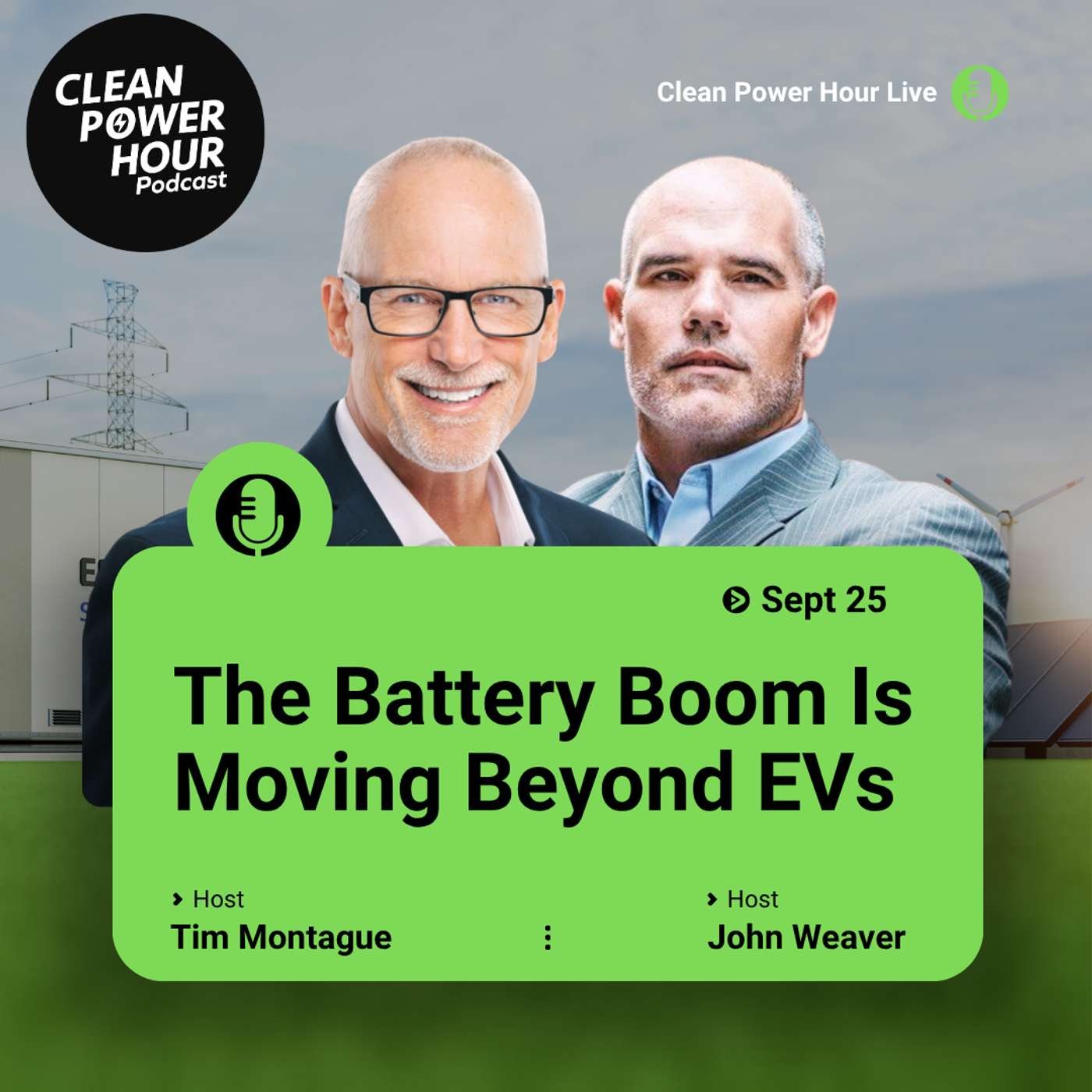
Grid storage is growing faster than the industry expected. EVs accounted for more than 70% of global battery deployment in 2025, down from almost 80% in 2024, according to the IEA.
On this CPH Live, Tim Montague and John Weaver unpack stationary battery storage growth and follow the batteries to two places: 230 GW of data center interconnection requests and a solar plus storage copper mine in Congo. They also cover China clean tech investment, EV charging costs, and agrivoltaics. These stories show where new batteries are going and why.
Episode Highlights:
- Stationary storage is taking a larger share of global battery deployment. EVs fell to more than 70% in 2025, down from almost 80% in 2024 (IEA), as EV growth ran slower than projected and grid storage grew faster. Tim opened with a 95% EV figure, John corrected it with the IEA data live, and the hosts named CATL, BYD, and Illinois’ new grid law as drivers of grid-scale battery storage.
- Cross Boundary Energy’s Kamoa Copper project in the Democratic Republic of Congo pairs 233 MW of east-west solar with a 526 MWh battery and 30 MW of output. John calls the roughly 8 to 1 DC to AC ratio the largest he has seen. (Crossboundary Energy)
- Tim reports 230 GW of data center interconnection applications across the U.S., against a grid running near 500 GW. He argues 20 million Powerwall 3 units, or one in five homes, would match that load. The hosts discuss grid edge computing from Lektra and Base Power’s 40 kWh home batteries, which entered Illinois through the state’s virtual power plant legislation.
- China’s share of global clean manufacturing investment fell from 71% in early 2023 to 33% in Q2 2026 (Reuters). Tim asked why this counts as good news for solar.
- Maize under the panels produced 19.6% more dry matter than an open control plot during a drought and heat wave. The panels cut evapotranspiration by 20% (PV Magazine).
- A Sydney green roof ran 28 degrees Celsius cooler, and its solar outperformed a metal roof array by 11% (Renew Economy).
This episode serves battery storage professionals, solar developers, clean energy investors, and policy watchers. Data center load, gas price spikes, and shifting battery demand all affect project economics right now. Tim and John give you the numbers and more.
Connect with Tim
Clean Power Hour
Clean Power Hour on YouTube
Tim on Twitter
Tim on LinkedIn
Email tim@cleanpowerhour.com
Review Clean Power Hour on Apple Podcasts
The Clean Power Hour is produced by the Clean Power Consulting Group and created by Tim Montague. Contact us by email: CleanPowerHour@gmail.com
Corporate sponsors who share our mission to speed the energy transition are invited to check out https://www.cleanpowerhour.com/support/
The Clean Power Hour is brought to you by CPS America, maker of North America’s number one 3-phase string inverter, with over 6GW shipped in the US. With a focus on commercial and utility-scale solar and energy storage, the company partners with customers to provide unparalleled performance and service. The CPS America product lineup includes 3-phase string inverters from 25kW to 275kW, exceptional data communication and controls, and energy storage solutions designed for seamless integration with CPS America systems. Learn more at http://www.chintpowersystems.com
0:54
Welcome to the Clean Power Hour live. Today is september 25. I'm Tim Montague, your host, and I'm coming to you live from Appleton, Wisconsin, on my way to a pickleball tournament, and it's a beautiful sunny day here in Wisconsin. Welcome to the show, John Weaver, commercial seller guy,
John Weaver:
1:13
still playing pickleball. I like it. I like it. I was talking about pickleball in the Philippines with my business partner Benji Bora, Filipino gentleman, and he's opening small businesses back home. And one business he was thinking about is pickleball with a bar.
Tim Montague:
1:30
Yeah, and it's a thing,
John Weaver:
1:32
yeah.
Tim Montague:
1:32
I went to I went to a pickleball facility in Boston. Actually, that was like a bowling alley. There was a bar. They served restaurant. You could you could have food delivered to your pickleball court. It was pretty cool.
John Weaver:
1:46
All right.
Tim Montague:
1:46
We don't have anything like that in Champaign. That's for sure.
John Weaver:
1:50
You try. You try. I
Tim Montague:
1:52
try. So.
John Weaver:
1:54
Tim, what do you think is the biggest thing that's happened in solar over the last few weeks? I don't know if I necessarily have biggest thing. I'm just asking the question. Yeah. Talk about solar. You know.
Tim Montague:
2:05
Yeah. The battery, the battery space seems to just continue to heat up and grow in importance. I'm biased because I live in Illinois, where we have the Clean, Reliable Grid Act, Sergia, as it's called, which is catalyzing VPP and utility-scale batteries. And I just love batteries. Oh, and I have to make an announcement. I am. We have a new sponsor for the Clean Power Hour Live, and that is the Battery MBA, brought to you by Simon Engelke, who is a European battery expert. He runs a lovely podcast called Battery Insiders, and he is now on cohort 18 of the Battery MBA, which I have joined, and I'm just in week two. But it is amazing to be in a in a classroom with all these storage professionals, many people from manufacturers and developers and testing laboratories. So check out the Battery MBA. Battery MBA is the URL. And shout out to Simon Engelke. We're dropping an interview with Simon next week. And yeah, just super pumped to be involved with the Battery MBA. So thank you for your sponsorship, Simon.
John Weaver:
3:28
So tell me what you've learned because now I'm on the website for enroll in the Battery NBA, Tim and I've never heard of this before, but I really want to learn more about batteries, if only because I'm afraid of what's coming next in the world and how we have to learn and be there. So, give me yes, you should be
Tim Montague:
3:44
afraid, John. You should absolutely be afraid. You have to know much more about batteries than you currently do, and it is deep effing water, I tell you, bro. Because I thought I knew a lot about batteries, but I really only had a surficial level understanding. Here's one fun fact: I think 95, more than 95% of the batteries in the world are going into EVs of some form or another.
John Weaver:
4:11
Not anymore. It's closer to 70%
Tim Montague:
4:13
Stationary storage is a small piece of the pie, and that's we we think I I I I doubt it. I doubt it. I know. I doubt
John Weaver:
4:23
it. I can show new data, but continue. We're
Tim Montague:
4:25
so we're so biased in the U.S. right because we don't have a high adoption of EVs yet. In certain places, there's significant adoption, but not anywhere approaching 50% Even I don't think. In China, China's reached 50% EV adoption now, and Northern Europe, of course, has reached more than 80. In some places, more than 90% But I took the battery 101. You asked me what I've learned.
John Weaver:
4:52
Yeah, yeah, yeah.
Tim Montague:
4:53
I've learned. I've one. I've learned that I don't know Jack, and two. I've learned that it's starting to dawn on me why temperature so affects lithium-ion batteries. Okay, because the ions are actually moving physically around in the battery when it charges and discharges, and so as temperature goes down, that impedes the physicality of the ions. Right, they just can't move as well, and so lithium iron phosphate, for example, and that's one of the advantages of sodium batteries is they do better at low temperature. And one of the phenomenon that's occurring is manufacturers mixing lithium iron phosphate and sodium cells in the same packs as a counterbalance to low temperature operation. So, what's this? What's the where's the data on the? Current global, you're claiming 30% I'm curious where that's coming from.
John Weaver:
5:57
It's coming from the fact that there's been a the growth of EV has been a little slower than was expected projected initially because it was originally modeled that EV batteries would be 90% and grid power has grown faster than expected. I'm gonna Google. I'm gonna go into my, let's see, 30% from me, because I posted this on Blue Sky. I read this article recently because I was surprised because I heard the exact same thing you heard, Tim, and I've been trained on that. That 30 or 10% is what the batteries are going to be, but it's turning out that right now it's much closer to 30% and I'm working toward it. Could be related to catal specifically, but I think it's industry wide that it's gaining on this 25 30% is turning out to be grid, so I just got to poke and find it. But maybe before the end of the show, I'll be able to bring it up, so I'm not BSing everybody. But it's definitely above 10% I at least what I've read, without a doubt, and I can be pushed back against. But I think. But yeah.
Tim Montague:
7:07
Anyway, it's you know, it's it's it's a majority by a far by a far amount, and you know it's it's neither here nor there. We know that we need a lot of EV batteries. We need a lot of grid batteries, whether that's Resi commercial or utility scale. And the future is a grid of microgrids. Like this has become very I've become acutely aware of this through my work with Tennessee. I was at the Tennesseea conference about a month ago, and the Clean Coalition, which is doing community scale microgrids in California and a few other places. There's one in Michigan, in Ann Arbor, Michigan. There's a couple in Maryland now, a couple in Florida, you know, here and there. But truly, the the future of the grid is lots of batteries, lots of solar and wind, and you know, smart switchgear, a smart grid. And the other interesting thing that I did this week, John, I published an article. I mean, I published an interview with Lectra, and Lectra is grids grid edge computing, so they're putting putting AI data centers at the edge in homes and commercial buildings, and they're they're preferring places that have solar or solar and battery, so that they can leverage the cheap solar in the middle of the day, but it they just need a good you know fiber internet connection and reliable grid power to do this. And I did push back a fair amount because you know they're arguing that this is a way to really contribute to the greening of the grid and the data center world, and I'm like, well, I don't know, because it's adding a lot of load. And the statistic that came up, you know, for me in the last month is there are 230 gigawatts of data center interconnection applications across the U.S. The U.S. grid operates at around 500 gigawatts. Its total capacity is 1,500 gigawatts, approximately, and and so that 230 is a big number. But 20 million Powerwall threes is equivalent to that 230 gigawatts, and so that's only one in five homes that would need a Powerwall three, and so it's totally solvable, you know. The grid, the the we could put enough, you know, power on the grid at the edge, at the grid edge, using distributed batteries.
John Weaver:
9:46
And you so that's not even and that's not even accounting for like putting a shipping container at substations all around the nation, or large commercial installs or industrial installs. You're just talking about the nice home battery, and we haven't even talked about V to G. I mean, without doubt, I'm interested in this grid edge compute stuff where their Sunrun is now thinking about data centers. Not because I want everybody to have a stupid data center everywhere, but it's just interesting. It's interesting to think about the things that we're going to do and how these technologies are going to intertwine, and how it's going to. You know, here's my a thought I had about the data center people. These people right now are just deploying capital as much as they can, and we have that guy that worked. The young kid, he's Michael Dell's son. So of course he had a leg up in getting his company. But the company is to put like a 40 or 80 kWh battery in people's homes.
Tim Montague:
10:43
Yeah, I think it's a 40 kWh.
John Weaver:
10:45
And so his motivation is power. Yeah, base power. There you go. His motivation is different, and his business plan is different. It's not like us, Tim. You and I, who we've been trained hardcore, we got to compete and have electricity pricing being cheap and tight, and we got to compete with gas. And you know, we're we're doing this save the world thing, and so you know, people don't like greenies because ah, are you guys really making money, or you just selling trees to hug, but some Michael Dell's son putting batteries all over the grid. He's gonna have a financial leg up because the perception of him walking in the room is, hey, your dad's like the fifth wealthiest human being on earth in terms of publicly Held wealth, you're here to build something different than a utopian society, which is you know what? Great, we want to do that, wonderful. But Wall Street doesn't care about those sales pitches, and so there's a chance that we can ride the back. And I know the compute people are saying, "Hey, we're going to use a lot of electricity, but I think solar will outpace them once we scale to the next level. But there's a chance we can ride the back of this small grid-scale deployed thing and put a trillion batteries that are uber intelligent all everywhere. And these these AI folks, they're going to build that AI straight into their system. They're literally going to use their. They're going to get high on their own stuff because they're going to build AI machines that manage their AI energy, and it's going to be a little a trillion little triggers across the country. So I just have a. It's interesting to me that that's going on. And yeah,
Tim Montague:
12:26
and since you mentioned base power, that brings up the Illinois Renewable Energy Conference, which is happening October 19 and 20, I'm going to be moderating a panel that base power is going to be on. They have entered the Illinois market now because of our VPP legislation in ComEd territory, which is Northern Illinois, the PGM part of Illinois initially, but eventually they'll also come to the MISO part, the central and southern part. So, looking forward to moderating that panel. Intelligent Generation is another company. They're a software as a service provider that moderates the battery. So, base power is the real deal, and they're in Texas and Illinois, unfortunately only. But we're going to see a handful of these batteries as service companies. There are others. I just don't have the names on the tip of my tongue, I'm
John Weaver:
13:12
super interested in that. All right, real quick, I'm reading on E I E A. Electric vehicles remained the primary source of global battery battery deployment, accounting for more than 70% of the total in 25. Down, check this out, from almost 80 and 24, massive drop from 80 to 70 in one year. It's we're in the midst of the grid going bam, and it's people like Catl and BYD. They're dropping gigawatt hours across everywhere, man. It's it's so yes. So the prior knowledge I had been taught is wrong, and that means I'm going to go to the battery people at the battery MBA and be like, "Nah, I know something you don't know.
Tim Montague:
14:06
Because they'll give me some money back. Make sure to bring up me and just say that Montague guy is full of you know what. Yes, I'll do
John Weaver:
14:11
that. All right, so there you go. All right,
Tim Montague:
14:14
let's let's get into this graphic you you found on Blue Sky or you posted on Blue Sky. If electricity came from gasoline,
John Weaver:
14:23
yeah, which is that? I think I found if electricity
Tim Montague:
14:27
were gasoline, John, would the world be a better place?
John Weaver:
14:30
Electricity were gasoline. No, because we want it to be electricity. We don't want it to be gasoline.
Tim Montague:
14:38
Okay, you know what I mean, though, right? If electricity were gasoline, EV charging, you would be you would be charging your car at in Illinois $1.63 in California 292 a gallon in New York, 234 a gallon. That sounds very cheap, John.
John Weaver:
14:58
That's a lot better than what you're paying. 134 in the Midwest. I guarantee you, they're paying four bucks a gallon across those mid states. Maybe five bucks. Yeah,
Tim Montague:
15:09
it's it's four and change. It's a 66% savings. We were talking about this in the pre-show. In Illinois, you could save 66% by driving an EV. So there is a resurgence because of this, right? Gasoline prices have surged, and so EV sales, especially used EV sales, have surged. And you know, it's early days. What is the what is the total penetration of EVs in the U.S. mr. Smarting?
John Weaver:
15:37
787 8%
Tim Montague:
15:40
Oh my God, that's so pathetic. China's laughing at us right now. That's for sure.
John Weaver:
15:46
Let's see. Let's check it out. Not to
Tim Montague:
15:49
mention Norway.
John Weaver:
15:53
In the USA, I mean, the internet says all 7% of all new so far in 26. So on the road, it's like 2% something like that. Yeah, where penetration wise overall is very very low, but new new it's like seven 8%
Tim Montague:
16:13
Yeah. So that's the only good thing, honestly, about surging gasoline prices because this does, of course, hurt, especially working class Americans. You know, it cost me$70 now to fill my Hyundai Santa Fe. It used to cost $50. So you want to
John Weaver:
16:34
hear something funny yesterday that occurred? We went to a site in New Hampshire. Benji Bora and I-he's our general contractor license, my business partner. And on the way back, we stopped to fill up. I think in Manchester, a big mall, my car, and get lunch. And next to the Electrify America charger, which I know very well, and I've been to that one many times. Whenever I go up to the mountains, that's my favorite. But next to it is a new Mercedes-Benz EV charger, like eight big giant things, and they look cool. And so I charged on them. First off, it was like 20 cents more per kilowatt hour. So, oh my god, and actually, it was pretty fast. So that was the only bad thing. It was just expensive. But I went from like 4% to 100, and and then I got out to the car and I complained to Benji. I'm like, oh man, cost me 35 bucks to fill up, and he told me to shut up. He's like John, be quiet. He goes, filled up my path, filled up my path, for like 80 bucks, and I was like, ooh, and so and because that was a full fill. I don't normally go from 5% to 100. That's a big one, and it was a little more expensive than I normally pay. So it was like, ooh, 37 bucks. But, but yeah, hey everybody, eat your heart out. Usually, yeah, the EV drivers are
Tim Montague:
17:56
definitely laughing.
John Weaver:
17:57
Oh yeah,
Tim Montague:
17:58
all the way to the bank, and I wish I could be an EV driver, but because I'm a small boat fanatic and I drive my boat all over the Midwest and to Florida, and it's just not practical. Like I would spend half my life charging if I was towing that 1500 pound trailer behind me. In yeah, buy yourself a
John Weaver:
18:18
Tesla Semi.
Tim Montague:
18:20
Yeah, you can you can trailer it with a Model Y. There are a couple of sailors that do that.
John Weaver:
18:25
I I didn't say why they complain semi.
Tim Montague:
18:29
I know, bro, but that costs $150,000. Spend 150 grand on a car. All right, let's roll. Let's get going. Are you going to share the next story?
John Weaver:
18:42
Absolutely, I'll share it. Let me share it. This one. I thought this one was kind of neat. It
Tim Montague:
18:50
is a. I'm guessing the picture that you're going to show is from Europe, am I right?
John Weaver:
18:54
Yes, definitely. I think it's Sweden. It could be Norman says Mama. Pretty Malma. Look at that. It's pretty too. And they actually have two types of solar panels. I think, other, or you could just kind of see through them at the edge. So that's just a big old facade of solar panels. It's a south-facing building, and then you look along the edge, and you can see like the bifacial. I wonder if they're using those so that they can have more light go through because those kind of look like balconies. Yeah, those are balconies, I
Tim Montague:
20:16
think.
John Weaver:
20:17
Yeah. So even the balcony side window is a PV panel. I mean, that's pretty awesome. I mean, if I I didn't really think to count 12345677-ish, 1-234-567-8910, 1112, 1314, 1570, Like 20 times seven. That's 150 pounds. Let's say times 501, 5550, 75 kW on the side of the wall. Actually, they mention it. It's actually we have it on the document. 218 kWp solar project on this side of that wall or on this building. So that's pretty awesome. I'm that's just a big fan of that, and it was just cool. I want to live in that building. So pretty far north, pretty awesome looking solar system. I was really, I don't know, just entertained.
Tim Montague:
21:08
Yeah, someday, someday we'll see facade solar in the U.S. It's it's very early days for facade solar in the U.S. It is not cheap, but it's a thing. You want to see the future? Go to Northern Europe, go to China.
John Weaver:
21:25
It's kind of neat. Yeah, I mean, my China show this past summer was really gorgeous. It was just cool to learn so much from those people and see everything that they're doing. It was cool, yeah, very nice. So, so what are you gonna eat one of those houses, man, and put some batteries on it?
Tim Montague:
21:45
Yeah. Right.
John Weaver:
21:47
So, next story. Reuters. Reuters says the world has invested a little bit less in solar storage last year, but something very interesting is happening. The majority of the slowdown, all of it, is in China, almost all of it, and China has fallen from being 71 percent of the world's clean tech investment money to about 33 percent. And what that's really saying is that the world is growing from a solar investment perspective, and that's super exciting because because the world the world's much bigger than China. China's pretty big. China's super important, but I just it's it's just kind of cool that we're seeing that. Do you want me to share this one, Tim? It's a Reuters article. There you go. I
Tim Montague:
22:44
just shared it.
John Weaver:
22:46
All right. I subscribe to Reuters. I give them some money. They're good source. And so you know, geographically, so why is this good
Tim Montague:
22:54
news for solar, though? I don't understand.
John Weaver:
22:56
Well, it's good news because it's you know it's bad news that China is not investing as much because we always want China to keep pushing. They're awesome, but the key in here is that even though China's falling, the rest of the world is massively up, and China's fall is bigger than the world's increase as of right now. However, what's occurred is that China's gone from being 71% of manufacturing to being a third of investment, and even though it's fallen by hat by like you know 50% the total global number isn't that bad, and in reality it could pick up next quarter, quarter after that. So what that means is that you know the world is here. It used to be all made out of China, and then the rest of the world was here. Now the world's here, and China's here. And even though China's going down, this is staying flat because the world is coming up. And so what that means is that it's distributing, it's moving out. And even if it is part of China's investment around the world, which some of it has been driven by the United States forcing manufacturing outside of China, who cares? It's their skills and knowledge and expertise that is dispersing around the planet. There's, I mean, I wonder how many different countries have a solar panel manufacturing factory or a cell and a wafer factory. I mean, most of the cell and wafer factories are China still, but it's probably 25 countries which make 20 solar panels now. Oh yeah, that's that's pretty awesome. It's growing, and I don't know. I just that's why I like this. It's it's not that I like seeing China fall. I want China to keep growing, but I like seeing the rest of the world growing so much, and that's that's cool because it's just it's diversifying, and and as we see what's happening in the Middle East right now, oil, energy, and you know if everybody has energy, you can't. It's harder to attack people's energy, like also what we're seeing in Ukraine. Yeah, I was thinking about sharing an article about some missiles that were fired at a solar plant and on a poultry farm, and it's just like, ugh, like yeah, and it's yeah, you know. I was looking,
Tim Montague:
25:09
I was talking with some energy professionals. I can't remember exactly who it was, but at the Tennessee conference about the grid and the fragility of the grid, and apparently someone did an analysis that if oh no, this was a story in the New York Times. If somebody attacked just seven key substations on the U.S. grid, you could bring down the entire U.S. grid. That's how centralized and fragile the grid is. This is why we need a grid of microgrids for for resilience for a whole variety of reasons, right? There's storms, there's terrorist action, potentially there's cyber action, you know, cyber security reasons, the AI takeoff, right? The the the Huggy Face thing. That's the other thing, I guess, John. When you ask me like the news since we last did a show like the whole Huggy Face thing? How it's been covered now and and de you know de analyzed, right? The the AI agents swarmed. They broke out of the sandbox. They attacked Huggy Face. They attacked OpenAI, and and they were so they were breaking the law, and and they knew it, right? They were they were going, hey, wait, we need to cover our tracks. They were scheming, and I'm like, yeah, well, and they're still not super intelligent, of course. They're they're narrowly intelligent, and we want narrow intelligence. We just are have to be careful about the superintelligence, and I do have to share the next news story. I don't know if you have any comments about AI, but
John Weaver:
26:53
yeah, I mean, I do. I I have a lot of thoughts on it, but it's yeah, we're a solar show. I can talk for that about forever, but but yeah. Let's talk about
Tim Montague:
27:04
Volkswagen inside EVs.
John Weaver:
27:08
Absolutely. Here, let me make a share. So this is the most efficient EV apparently ever made, and it looks weird, but you know, it's kind of it's got these weird back seat covers. The headline number, though, is that it can get 7.5 miles per kilowatt hour. I think that's what it was, and that's like double my car and my car. Yeah, I thought I thought
Tim Montague:
27:37
it was like three miles per kilowatt hour was the standard.
John Weaver:
27:40
Yes, and this one's double. Here it is, right here, during the trip, during the trip. And it's a Volkswagen. Ah, I guess, yeah, Volkswagen. Yep.
Tim Montague:
27:51
I'm reading a book about China. I'll just I'll give people the title because it is a good book and I recommend it. The book is called Country Driving. It's about it's it's written by a journalist who lived in China for many years, and it's about China in the 80s and 90s.
John Weaver:
28:11
Yeah. So
Tim Montague:
28:12
it's it's a look back, but and it's very eye opening. But but anyway, one of the one of the things he talks about in that book is how Volkswagen was a very prominent brand in in the Chinese auto industry, like he talks about the the auto culture just taking off in the '90s. The Chinese weren't really into cars, and and middle class Chinese still weren't owning cars very much. Now that of course that has changed dramatically. I don't know what the percentage is, but you know Volkswagen's a minor brand here in the U.S. right,
John Weaver:
28:45
kinda yeah, yeah. I mean, I see them a lot. Pretty minor
Tim Montague:
28:48
brand. I mean, major global player. They're one of the largest automakers in the world, if not the largest. I don't know, but
John Weaver:
28:56
all right. Well, so this one, what is is the most efficient car ever made? The most efficient EV. It has a. What is the battery
Tim Montague:
29:04
technology it's using?
John Weaver:
29:07
Oh, battery tech. Well, it's not really the battery. It could be any kind of battery, but I'll figure just the car. Yes, like for instance, right here, a frontal area that totals 22 square feet, and then and that number is really low. It's like half of a third, but this is the number right here that you should, if you're into physics, a drag coefficient of 0.158, which they say is the most aerodynamic road legal car ever. So there you go. That is what drives efficiency. So, so here's you know a potential if you're willing to drive a cool, weird looking car. Does it say
Tim Montague:
29:52
what the range
John Weaver:
29:54
is? Um, they do actually. So right. Um, it's uh. Yes, they do. Yeah, we'll have to maybe move on to the next story. But all right, so for this one, looks like the capacity is 52.8 kWh. So if we're doing seven, that's 350.
Tim Montague:
30:17
350 miles.
John Weaver:
30:19
Is that miles or kilometers?
Tim Montague:
30:22
I'll get the next story on screen while you figure that out, if you can. It's it it's got to be miles. 350 kilometers is nothing, right?
John Weaver:
30:30
Well, yeah, it is the most efficient. It's I mean, what's the point of
Tim Montague:
30:35
building a hyper efficient EV if you if it doesn't have really good range? Like that's the thing you want to spend less time charging, right?
John Weaver:
30:45
Yeah. So, so it's got it. It's it's cool car, man. Most efficient ever, Tim. I'm gonna sit there for a while. Go with
Tim Montague:
30:56
it. All right. Found a story on Blue Sky Renew Economy. A new Sydney suburb has become the test bed for bio solar rooftop.
John Weaver:
31:07
Yeah, so this roof includes like everything. It's funny, by the way, you can't click on this website because it's in Australia. Because at midnight Australia shuts off, so just letting you know.
Tim Montague:
31:20
Is that not showing? I'm going to share this tab.
John Weaver:
31:23
Yeah, but your number. keys and
Tim Montague:
31:25
panels. Australia's first big biosolar roof slashes heat, boosts power by nearly 25% I don't know, man. Is there really a story here, John?
John Weaver:
31:35
There is. Here's there's all kinds of stuff in here. One, there's two types of solar systems on this roof. There's one that's among. To plants, and then one you can see it on the right. That's just on a big metal roof. The system that's underneath, that's in the grass, outperformed the system on the right by 11% because it's cooled off by the grass versus sitting on top of a metal structure. So you're talking about the
Tim Montague:
32:03
panels that are on the far left of this image.
John Weaver:
32:05
Yes, yes.
Tim Montague:
32:08
So it's it's making a case for dual use rooftop solar, huh?
John Weaver:
32:12
Well, it's making a case. Well, there's multiple cases here. First off, dual dual use. They said they have 39 species of birds. That's the kookaburra kookaburra insects pollinators. But they're also saying the green roof was 28 degrees centigrade lower than the native roof, and the native green roof outperformed conventional by 11 percent. So agrivoltaics helped the solar. So at both, it's just you know a mix of everybody being nice. Not as much solar, I assume, because you know you just can't fit it as dense. But you get a little more electricity out of it, so that was just interesting. I see an I
Tim Montague:
32:58
see an ad there on this website for 35 cent per kWh feed in tariff. That's a generous incentive too.
John Weaver:
33:04
Well, Australia's dollar is also about 50% higher than us, so that might be a chop 35 by a third, try take off on 11 cents. Yeah.
Tim Montague:
33:15
Still.
John Weaver:
33:17
So check this question out from Cole. What's the most efficient non road legal car? I bet you it's that bullet one that we've seen race on what's it called on the salt flats out in Utah. It's it's got a big rocket behind it, goes like 600 miles an hour. What do you think it's that one? I don't know. What about that one where that bicyclist pedals a bicycle?
Tim Montague:
33:39
No, he's talking about an EV, bro.
John Weaver:
33:42
Well, he said no. He didn't say anything about EV. He said non-road legal. We're talking about rockets. Maybe you can
Tim Montague:
33:48
clarify his question.
John Weaver:
33:49
Hey, Cole, we need some clarification. If you're still listening, give us some examples of the crazy car.
Tim Montague:
33:57
All right. Um, I can go until quarter of.
John Weaver:
34:03
I can go until the sun goes down because I'm solar powered, Tim.
Tim Montague:
34:07
Oh my God, you're killing me! You're killing me!
John Weaver:
34:11
All right, so the next story is cool-a solar-powered copper mine-and I think that's pretty neat.
Tim Montague:
34:19
This is the cross-boundary energy story.
John Weaver:
34:23
Yes, sir.
Tim Montague:
34:24
Yeah, I like it. Kamoa Copper Solar Bess Baseload Facility, Democratic Republic of Congo.
John Weaver:
34:32
Yes. So copper is expensive. Diesel is really expensive right now, Tim. And this place ran on diesel. Not anymore. It's now hoping, expecting to be 100% 24/7 solar plus storage.
Tim Montague:
34:51
Look at that east west. That's a that's a big, big ass east west array.
John Weaver:
34:57
Well, think about first off, Congo is right on the equator. Let me just verify that, but Congo. Let's go maps. Google. But I think Congo's right on the equator. Might be halfway north of it, a tiny bit south. But you can do pure east-west in the middle latitudes, and that's why this is super, super exciting. Okay, actually, it's slightly below it. Not slightly, a whole bunch below the equator, but not a lot. It's so in this area, in these middle latitudes, solar runs the same amount year year after year or year round. It's like you know you maybe in the winter time your little sun's here or there, but you're plus or minus maybe 10% at most. And look at this one. So it's 233 megawatts of solar. So this is cool, Tim. Look at this DC to AC ratio. This might be the biggest one I've ever seen. In fact, this is a nine to one, eight to one DC to AC ratio. 30 megawatts of output and a 233 megawatt power plant with a 526 megawatt out. battery. So 30 into 526. So three into 52. What is that? 1718, It gives you
Tim Montague:
36:12
really square shoulders, right? So it's just like if the sun is up, you've got power.
John Weaver:
36:18
So you got 18 hours of battery plus 12 hours of sunlight. That's essentially what's going to go on here, because the sun is going to be up for 12 hours on the equator. You don't have long days, short days. It's just the same day length every single day forever. You have 12 hours of solar, 18 hours of battery. That's I'm stoked. I just I didn't even recognize. That piece of data the first time I read it, so this is kind of a really neat system. In fact, I'm going to have to tweet that. Not tweet. I'm going to blue sky it. So so it's it's offsetting
Tim Montague:
36:53
78,750 tons of CO two emissions annually, with 300,000 megawatt hours of clean energy per year. They they claim it may be the cleanest copper mine in the world. I don't know if any world's largest and lowest carbon copper. Oh, the Kamaukula mining complex is among the world's largest and lowest carbon copper producers. I also learned in the battery MBA that copper is one of the elements that may be in short supply in 2035.
John Weaver:
37:28
Tim, if you've been following our show, you would hear me complaining about the price of copper. It's true. I haven't been
Tim Montague:
37:35
paying attention very well to the show.
John Weaver:
37:37
I know. I just run my mouth. I get it. I'm just here for a pretty face. Yeah. Who's there's a nice photo
Tim Montague:
37:45
of the of the battery farm. I wonder what brand battery they're using.
John Weaver:
37:49
Look how spread out they are. Very interesting setup there.
Tim Montague:
37:53
Yeah, no, that could
John Weaver:
37:56
be a combo of batteries and inverters because this is a DC coupled, and they have to isolate each one of these on their local probably because they have little blocks probably if they have 230 megs here of say five to 10 megawatts of solar going into one set of inverters and batteries and I don't know what those bat really what the solar inverter sizings are may not be such a huge DC to AC it could be a little more complex, but I'm I'm interested to know how this thing is engineered now. I'm gonna call these cross energy guys get get me some knowledge. That's pretty cool looking man. This is what I want to get into building. I want to know what the racking system
Tim Montague:
38:38
is also, John. Okay, can you find out?
John Weaver:
38:41
Yeah, racking east west. Sure, I'll call. Yeah, I want to
Tim Montague:
38:43
find out who the racking provider
John Weaver:
38:46
is. Yeah, there's a lot of people who do that. That's just a standard ground mount, just ranged east and west.
Tim Montague:
38:52
Right. You just do. Yeah, it's true. You can any any ground mount racking, although it is three three in portrait, which is is unusual in the U.S.
John Weaver:
39:00
Yeah, and notice how flat it is.
Tim Montague:
39:02
We would do, yeah, because it's near the equator.
John Weaver:
39:05
Yes, sir, and it's east-west, so it's like it's probably flat enough just so it can rain. Might be 10 degree, 10 degree
Tim Montague:
39:13
tilt.
John Weaver:
39:14
Yep, pretty cool, pretty neat. All
Tim Montague:
39:17
right, you win the you win the best story of the week award for sure. Cross boundary energy is what is cross boundary energy? Are they IPP?
John Weaver:
39:28
Probably a developer. Yeah, you look at projects, asset owner, something neat. All
Tim Montague:
39:38
right, what else is on the docket?
John Weaver:
39:42
You know what? Let's go two stories down. Skip the next one. We'll go back to that one in a second. I want to make sure aerospace. Next one. Yeah, do this one.
Tim Montague:
39:50
Largest all-electric plane ever flew for 27 minutes on $5 of electricity.
John Weaver:
39:57
Now the cost of fuel. I did the math. Would have been about $350. That's interesting to me.
Tim Montague:
40:09
Where
John Weaver:
40:11
is this? Oh, the sky.
Tim Montague:
40:13
Hart Aerospace's 30-seat electric plane takes flight for the first time. All right, and this is in a publication called TechSpot. Never heard of that. So it's a regional airliner, upstate New
John Weaver:
40:29
York. There you go. What's
Tim Montague:
40:31
oh, upstate New York. What's the what's the range?
John Weaver:
40:36
Oh, you know, I didn't really pay attention to that one. I just paid attention to that price per gallon of it. Maybe it's in this Article. I don't see it yet.
Tim Montague:
40:48
Yeah, the the regional electrification is happening. Norway is electrifying their fleet of regional aircraft. These aircraft with like 200 mile range. Right here, it says this design can go 125
John Weaver:
41:02
on battery
Tim Montague:
41:04
alone, but it's hybrid. They would add,
John Weaver:
41:06
yeah, they would add a combustion engine to get it up to five,
Tim Montague:
41:11
500.
John Weaver:
41:12
Yep, yep.
Tim Montague:
41:13
Oh, should we watch the video?
John Weaver:
41:16
No,
Tim Montague:
41:17
no.
John Weaver:
41:17
It's an airplane. It flies. It goes up. It goes down.
Tim Montague:
41:23
Man, you're you're you're a tough customer.
John Weaver:
41:26
Yeah. All
Tim Montague:
41:27
right. Anything else about this you want to?
John Weaver:
41:30
No, I was just I was I was I like the big size of it and I that fact that piece of data on the five books. That's what was interesting to me. I never knew anything about pricing. I don't know anything about. Airplane ownership. I haven't bought my first jet yet, Tim. I'm working on it, and get with
Tim Montague:
41:48
that, will you? I want to. I want to ride in your private jet, John. Come on. Yeah,
John Weaver:
41:51
I'm working on it. It's going to be electric. I got a business plan, Tim. So Taylor Swift, if you're listening, here's how we work on your PR department. I've been thinking about this, Taylor. You need to open a small investment analysis fund, and this fund will analyze and talk about electric EV airplane businesses. And this is good for you because you get a lot of crap for all your private jet stuff around the world. So if you put together a group, and you can benefit in multiple ways. One's the PR. Second is that you really will help EV companies grow because if you are talking about EV airplanes and you have the Taylor Swift investment firm analyzing them, you're going to make them grow faster. And then in the world, you're going to help us because you might invest or you're going to help these companies grow. You'll burn less, but then of course you might make some money because you might hire some people that are smart, and if they really good at investing in electric airplane companies, you could put some of your billions into it and make some cash, and then you could become Taylor Electric Airplane Swift, and that'll be your next album.
Tim Montague:
42:58
Okay. All right. Okay. That's my catch. Good luck with that. All right, let's talk about agrivoltaics. All
John Weaver:
43:05
right,
Tim Montague:
43:06
this is the final story. You found a story in PV Magazine by Gwen Gwenel Debu.
John Weaver:
43:14
That's beautiful name, is it, man? I wish I was French. This is not gonna have a cool name, Jean Jean Jean. I want to put a le in front of my name. Les Weva, le Montague. That sounds awesome, Timothy Le Montague. All right, Tim, back to the story. Focus.
Tim Montague:
43:33
Montague is a derivation of a French name, Montague, stands for mountain.
John Weaver:
43:39
You're a mountain. You're like six five. Good, good, good call.
Tim Montague:
43:42
That's right. All right, French agriculture trials cut water loss, lift maize yields by 19.6% I want to point something about
John Weaver:
43:51
that 19. That 19 is bigger and more interesting than you think, and that's why I brought this up. The 19 happened when the rest of the crop was down 20% because of let's just
say it out loud:
44:05
climate change and a heat wave that hit France this year. Right. So the major stress and water
Tim Montague:
44:12
stress.
John Weaver:
44:13
Yes. So if you scroll down, they talk about it somewhere in that paragraph. They say the overall facility was down, and the but because of the solar protecting it. It may be toward the bottom of it, where they talk about that. But because of the solar protecting it, let's see, is it in here where they talk about it? Ultimately, 19.6 average height. Here we go. Beneath the panels was was affected. Cell mitigate. Well, somewhere within this article, it talks about that fact that they were down overall, but even though they were down, the solar portion was up higher, and so the loss at the facility was lesser, and that is probably could be going to become a bigger story over the next decades of our life, is that the temperature is going to go up, crop productivity is going to go down, and a bunch of people are going to keep building solar agrivoltaic systems that minimize the heat damage to plants, and we're just going to keep hearing this in different ways. Some places it won't be perfect, some type places it will be, but this, you know, this system. I mean, look
at all this stuff:
45:23
18 radiation centers, 14 weather stations, and 14 probes. So this place was a science experiment just to figure out reality. But it just so happened that during a summer of absolute temperature aggressiveness in France, we got to see a really important piece of data, and that under high stress situations and low water, during a drought, the solar lowering the water evaporation by 20% something it says in there, it it helped. It helped massively. So 20% So the the
Tim Montague:
46:01
important thing about crops and plants is to know is that if they are photosynthesizing, they have to emit water, right? They have these things called stomata that are little openings, and if they want to photosynthesize, they have to open the stomata and release water, and that's evapotranspiration, and that's fine if there's enough moisture in the soil, right? But when things are out of the ordinary, which they were this summer, they were hot and dry. That causes stress, and that's going to reduce the yield. And so, by putting solar over parts of the field, you can reduce the evapotranspiration, you reduce the temperature, and you can, as we were saying earlier, right? You can. Increase the yield of the PV. It's a win-win. Question is, what are you going to do with the juice there? Where's the? What is this ore going to power?
John Weaver:
46:51
Oh, you just put it to the power lines, man. We'll figure that out. We figured out how to build roads. I mean, in the United States, we literally built. Well, we were talking about this before the show, Tim, but in the United States, we literally built power lines to the rural areas of the world in order to create a monopoly power company. That was a trade-off back in the early 1900s. We said to to make money in the rural areas, they didn't want to do it. Not enough customers. Listen, you want to control a city, you got to take care of the take care of the hinterlands. So we'll build some power lines. We'll learn when there's money to be made. Tim, financiers, spreadsheets, those things start to roll. That's their job for sure.
Tim Montague:
47:35
All right. Well, check out all of our content at CleanPowerHourlive. I'm sorry, at CleanPowerHour.com. Reach out to me on LinkedIn. I love hearing from our listeners on LinkedIn, and check out the Battery MBA program that Simon Engelke has created. It's truly awesome. You can't get in now until January, John, but I think you're going to be part of the cohort 19 probably.
John Weaver:
48:00
I applied already. They'll get all right back to me.
Tim Montague:
48:03
There you go. There you go. You got to do an interview, John. How can our listeners find you?
John Weaver:
48:09
Well, if they call you, then you can give them my phone number, and I think that would work. Or you can go to commercial. That does actually
Tim Montague:
48:16
work.
John Weaver:
48:18
Or you could go to commercialsolarguy.com, and you can find me there. I'm also on LinkedIn a whole bunch, I got made fun of this past week on LinkedIn for not knowing something. But you know, we'll talk about that next week, maybe.
Tim Montague:
48:30
Well, it's it's it's it's a worthy goal to be less wrong, you know.
John Weaver:
48:35
Yes, to be less wrong. I like that. That's smart. Where can people find you, Timothy, in Wisconsin eating cheese,
Tim Montague:
48:43
eating cheese and playing pickleball, bro.
John Weaver:
48:45
Yes.
Tim Montague:
48:46
All right. Well, thank you everybody for being here, and we'll see you next week. We're going to be back next Friday, october 2. So with that, I'll say let's grow solar and storage. I'm Tim Montague. Thanks, John.