
A battery only earns its keep when it can connect to the grid and get to work. What does it take to turn better battery technology into a viable energy project?
In episode 373 of the Clean Power Hour, Tim Montague speaks with Dr. Simon Engelke, founder of Battery Associates and Battery MBA and host of the Battery Insiders podcast. They explore the technology, economics, and expertise needed to scale storage across the grid, transportation, and emerging industries.
Drawing on his Cambridge PhD in lithium-ion batteries and his work advising and training industry professionals, Simon explains why chemistry is only part of the story. Utilization, manufacturing scale, maintenance, investor confidence, and grid access all shape whether a battery project succeeds.
Tim and Simon discuss:
• Stationary storage and mobility: where Simon sees demand growing and how vehicle-to-grid programs can put parked EV batteries to work
• Battery technology explained: LFP and NMC cathodes, silicon anodes, sodium-ion batteries, and what changes when the electrolyte becomes solid
• Manufacturing scale: why increasing production can drive battery costs down through learning and process improvements
• Vanadium flow batteries: Tim raises G&W Electric’s experience, while Simon discusses pump and seal failures he has encountered and the challenge of proving a bankable business case
• Project economics: why cycling, utilization, operating reliability, and a track record matter to developers and investors
• Interconnection bottlenecks: Simon describes investors in Germany ready to deploy batteries that cannot yet connect, leaving assets idle while they continue to age
• U.S. manufacturing: Simon’s view that repurposing automotive battery factories could temporarily expand stationary storage supply, with EV demand changing that equation
• New applications: how data centers, drones, humanoid robots, and electric aviation are expanding the conversation beyond solar and EVs
• Battery careers: why engineers, solar professionals, business leaders, and people from other disciplines need to understand the full battery value chain
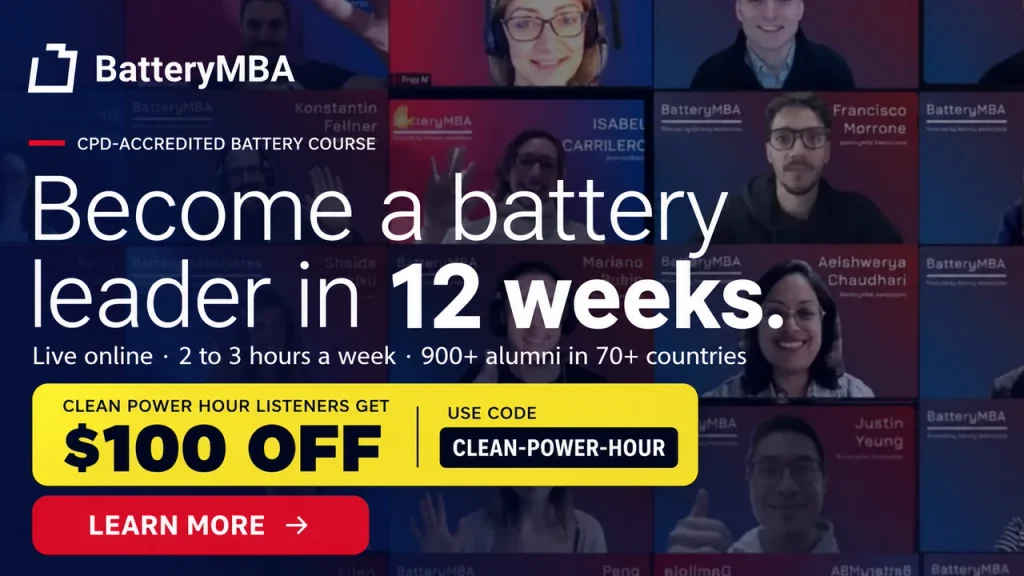
• Inside Battery MBA: a 12-week online program built around live industry experts, office hours, and collaborative case studies, with group enrollment options for employers
Simon also shares a Battery MBA case study exploring how a data center battery could serve both as backup power and as storage for an island grid. His message to professionals: start with the skills you enjoy using, then look for where they can contribute to the battery industry.
For solar, storage, and microgrid professionals, this conversation connects battery innovation with the practical decisions behind project deployment, workforce development, and long-term business strategy.
Learn more about Simon Engelke:
Battery Associates | Training, Consulting & Insights
BatteryMBA | CPD-Accredited Battery Course
All Battery Insiders podcast episodes
Connect with Tim
Clean Power Hour
Clean Power Hour on YouTube
Tim on Twitter
Tim on LinkedIn
Email tim@cleanpowerhour.com
Review Clean Power Hour on Apple Podcasts
The Clean Power Hour is produced by the Clean Power Consulting Group and created by Tim Montague. Contact us by email: CleanPowerHour@gmail.com
Corporate sponsors who share our mission to speed the energy transition are invited to check out https://www.cleanpowerhour.com/support/
The Clean Power Hour is brought to you by CPS America, maker of North America’s number one 3-phase string inverter, with over 6GW shipped in the US. With a focus on commercial and utility-scale solar and energy storage, the company partners with customers to provide unparalleled performance and service. The CPS America product lineup includes 3-phase string inverters from 25kW to 275kW, exceptional data communication and controls, and energy storage solutions designed for seamless integration with CPS America systems. Learn more at http://www.chintpowersystems.com
0:50
They’re installing the biggest batteries on this planet, and you know why they’re doing it, because they know they need all of this fuel for mobility applications. They’re willing to invest hundreds of millions, you know, and they want to bring these batteries online, but they can’t connect it, which then means this is a terrible business case because if it’s just sitting around, batteries degrade very, very slightly over time. Then also all the humanoid robots need batteries. One of the reasons they cannot walk that far is because of that battery. So yeah, it’s really this key technology. But anything really around you, from mobility, energy, is depending on it or needs it as a technology. And then also all of these cool new things we want from AI, robotics, etc. This future we envision, even airplanes, requires batteries.
Tim Montague:
1:35
Join clean energy leaders from across Illinois at the 2026 Illinois Renewable Energy Conference, October 19 and 20, in Bloomington Normal. Explore the policies, technologies, and partnerships shaping Illinois’ energy future, with sessions covering solar storage, grid resiliency, workforce development, and more. I’ll be there both days and look forward to connecting with you. Register today at IllinoisRenewableEnergyConference.org. The
intro:
2:07
clean energy industry is moving fast. The deals are getting bigger. The technology is evolving, and the stakes have never been higher. Welcome to the Clean Power Hour, the podcast for solar, storage, and microgrid professionals who want to stay ahead of it all. Each week, your host Tim Montague, industry advisor and president of Clean Power Consulting Group, brings you unfiltered conversations with the leaders actually building the energy transition. Now here’s your host Tim Montague.
Tim Montague:
2:42
Today on the Clean Power Hour, batteries. My guest is Simon Engelke. He’s a subject matter expert. He’s the host of the Battery Insiders podcast. He’s the founder of the Battery MBA, and he is the principal at Battery Associates. Welcome to the show, Simon.
Simon Engelke:
3:00
Thanks for having me, Tim. Great to be here.
Tim Montague:
3:03
Storage is the most important technology in clean energy right now. Batteries firm up solar. They steady the grid. They power EVs, drones, and data centers. Simon has worked on batteries in the research lab and across industry. He earned his Ph.D. in lithium-ion batteries at Cambridge. Today, he trains engineers and leaders at some of the biggest automakers in the world. Simon, start at the beginning. What pulled you into batteries, and what are the three hats you wear today?
Simon Engelke:
3:34
It goes quite a bit back for me on batteries. I think it was during during school in high school. I was looking at different technologies, and batteries just really fascinated me because I saw it as one of, as you just mentioned, one of the key technologies for this generation. It’s essential, right, for energy storage, for the grid, but also for mobility and all these kind of fun applications we have with us, like phones and headsets and drones and all these robotics to come. And yeah, so I studied physics and chemistry, and I was very fortunate actually to go to the U.S. to the Berkeley National Lab in in California next to I mean in Berkeley, and there I really was exposed to doing some research on sodium iron batteries, where this wasn’t a topic at all. My my researcher there, like my supervisor, she was a big believer in sodium iron batteries, and I was very excited about the technology. But it took many many years or almost decades now to to really become more relevant, which is quite exciting now to see. And yeah, so I think it’s just a really fascinating topic to be involved in because it really touches a lot of different disciplines from technical, which is my background and my PhD in Cambridge and in the UK on lithium-ion batteries, but also you know business is a big topic. You just spoke about revenue stacking, right? It’s a really important topic because there’s a lot of money which has to be deployed to make this scale. And then also geopolitics, right? Policy. There’s a lot of interesting aspects we can see around the world. Probably many of you have read this in the news. So yeah, I think it’s just one of these topics which is really fascinating, and it’s not just in one country; it’s global, and that really brought me then to start Battery Associates, where the idea was there’s a lot of knowledge out there, but a lot of the knowledge related to batteries is an industry. I mean, of course, there’s brilliant researchers. I was very fortunate to be in research myself, to meet researchers and professors around the world, and but I think if you just think about the scale and about the resources available, industry is really the one picking up and really driving the pace. In my opinion, of course, there’s still great research being done by professors and they do spinouts and things. But just from the scale, if you look at some of the big battery companies, like you know the 40,000 plus or so PhDs they have, compared to. Research lab, which is quite big, if they have 20 to 40 researchers, it just gives you an idea of of scale and why this industry is pushing it. So my idea was let’s do industry training, one for people like me who you know did their PhD and try and understand how to be relevant in the real world, but also for people in industry who want to understand what state of art and really understand the full value chain, and that’s what the battery MBA became. It’s an industry-led program, which is taken by many of the big automakers, also in the U.S. There’s a lot of interest in the U.S. a lot of good uptake in the U.S. for this kind of training. So this is a 12-week online program. Other things we’re doing is consulting. Here we have been helping, especially automotive companies around the world, but also energy companies on their strategy related to batteries, and there’s so many decisions you want to make right because it’s very expensive from experience if you do them wrong, and we have seen this with our customers. If you don’t know what you’re doing, and that happens to be if it’s a new topic for you, you come from solar and suddenly you want to install batteries, but you don’t understand all the implications from you know running them efficiently, but also in the end, you know, you have to recycle them somehow. There’s a lot of hidden costs, so you will want to be smart about that. And then the third thing is our insights arm, where the Battery Insiders podcast is part of it, which I’m super excited to be here with you today. And this is really about all of our ideas to make knowledge more accessible. We’re running an annual Battery Day event, which is coming up in the first of October, which is also free to attend. So yeah, here we are trying to bring some of this knowledge to wider masses for anybody interested out there.
Tim Montague:
7:20
So if I was to take a battery MBA with you, what do I walk away with? What what am I then prepared to deliver to the economy?
Simon Engelke:
7:31
Great question. It really depends on where you come from, right? So maybe the main groups would be some people, maybe more technical in industry, like maybe an automotive company who wants to, you know, grow, understand the full value chain of batteries, right? So you don’t want to just know how to assemble cells, but you actually want to understand what kind of technologies out there, what kind of chemistries are relevant, and what’s maybe the thermal behavior, right? So if you put these cells together, how does cooling look like? Maybe you understand why do some battery chemistries get more expensive because the geopolitics involved in certain regions maybe restrict export, or you know there’s many of these aspects, and I think that’s something. If you come from a technical side, often they come because they’re trying to understand better the full value chain, not just their small part they’re working on, and they also want to understand what’s the business side of it. Often, and they want to go into leadership, right? So many people come with a lot of drive. We interview every single person for a reason. Over 900 people now we had over the last five years in over 70 countries, and we have seen remarkable success of these participants who went to leadership and run now their own companies or are really driving certain you know organizations. And then other aspects will be a lot of people join who are new to the battery world. So you might be from solar, right? And now suddenly everyone tells you, okay, solar is not enough anymore. You need batteries too, so we hear this a lot, and especially in the U.S. And yeah, or like data centers, same thing, right? You’re running a data center, you want to build a data center, and suddenly people tell you, “Oh, power is a problem. Batteries can be helpful, but how, right? So they come to us to learn how do batteries work in their world, and yeah, I think those are probably the two major ones we have now.
Tim Montague:
9:17
The Clean Power Hour is brought to you by SDE Sinclair Designs and Engineering, fixed tilt and carport racking design, engineering, permitting, and manufacturing all under one roof in Michigan. No outside vendors, no waiting in someone else’s queue, just fast turnaround and steel that ships when you need it. Ask Ag Energy Co. in Illinois or Sunrise Solar in the Mid-Atlantic. They’ll tell you what it’s like to work with the Sinclair team. SDE Everything in-house. Visit Sinclair-Designs.com. Designs.com. Here’s how I see the grid: a battery lets a grid operator discharge and absorb power in an instant. More utilities now put storage at their substations. I was in Tennessee recently. Municipal utilities there are starting to use batteries to shed load when severe storms hit. Solar developers want storage too. A solar array alone will never deliver power around the clock. Add a battery, and the project gains value. So we have two big buckets: stationary storage on the grid and mobility, the electrification of transportation, Simon. What is the state of play in each? Which technologies lead today, and where are things shifting?
Simon Engelke:
10:42
Yeah, no, it’s really important to to understand and segment the market in this regards. So you mentioned it on the energy storage side. That’s one of the biggest drivers. Right now, particular in the U.S. right. So this is really exciting. There’s even regions who don’t, you know, and that’s one of these things where just makes financial sense. That’s where we have to get to, right? I think the early stages of batteries. There’s been a lot, you know, government support and you know support schemes, and they’re still important. They have been important. That’s one of the reasons why China became leading because they put literally over 200 billion into batteries, right, and subsidies and things like that. So you need that to kick it off. But the good thing is there’s certain applications, especially in the stationary side, where you just can’t make good money right now in the U.S. So that’s why this is happening. So that’s where there’s this, you know, almost gold rush for people to try and install. It’s more difficult in other regions. We just have seen this again in Germany, where there is restrictions on how much you can put up. You know, over 10 megawatts, it gets more difficult. So that’s a challenge, right? Where if there’s utilities and others telling you not to install or not to connect your batteries, that’s of course a big issue for from a financial perspective, because you need them to run, and that’s important. It’s about utilization. You want to get your cycles, so so that’s really important. But technology-wise, now we have these systems, right? That’s what Tesla does. These mega packs, but also of course a lot of their competitors. There’s many solutions now in the market, and they’re getting better and better. There’s many monitoring solutions, so that’s great. You mentioned automotive, of course, is a really big one. I think Europe is a bit-it’s bigger right now in U.S. Sorry, in Europe and China or Asia. U.S. is taking a bit of a step back for now. I would think it will happen, right? There’s no better technology. I think it’s very obvious, long range and things like that. So this is fast charging. So I think it’s fair enough. You know, I think the U.S. is taking a bit of a slow approach now through the Inflation Reduction Act. The U.S. was really pushing it down and was probably one of the fastest developing countries in the battery side and from installing factories, etc. But now it’s a bit slower. Will happen to get bigger, and we see this now in Europe, right? So it’s just you know step by step, and there’s this critical mass. We’ve seen this in Norway, you know, when you get I don’t know what is it, 98 or something percent of from new registration. So that just you know you really change your system, and then it gets interesting because then you have synergy effects between both, right? I think we can’t look at these in isolation, you know, mobility, vehicle to grid, really directly then becomes you know your big battery on wheels, and then it gets very interesting because if you don’t just use your batteries you install, but you also use all of these vehicle batteries, there’s a lot of capacity actually in that terawatt hours. You can do a lot of cool things with that, which is really smart from a grid perspective and also from a cost perspective, and your literally your car can make money for you. We have this in Europe, we’re in the UK, and also I think in Germany we have programs now where if your car is allowed to charge and discharge during the night, it can actually start trade electricity for you. So you charge for free or even make money by just having a vehicle and have it in your garage and let it charge and discharge and stabilize the grid. So there’s some really interesting business cases there as well, and and maybe the last thing is just of course there’s a lot of exciting new applications, data centers. The one we just had a really interesting webinar on that. It’s been really hot debated in the battery BA. We brought some great people in from Meta and others to to really explain us what’s the latest. I’ve seen Google, Amazon, all of them hiring lots of battery people. So always happy to see you know my friends getting good jobs, so yeah, so that’s that’s exciting. And then of course, robotics, drones. There’s no drone pretty much without batteries. I worked, and we have been advising on some of the drones in the past, military drones. There has been a lot of inquiries in the past, and we have seen all of them switching to batteries for multiple reasons, from hydrogen and others. So yeah, of course. Then also all the humanoid robots need batteries. One of the reasons they cannot walk that far is because of that battery. So yeah, it’s really this key technology. But anything really around you, from mobility, energy, is depending on it or needs it as a technology. And then also all of these cool new things we want from AI, robotics, etc. This future we envision, even airplanes requires batteries. Maybe that’s the last thing, because I hear this so often. People like, wait, airplanes and ships? Yeah, it’s happening. We see smaller airplanes already electrifying, and if you look at what’s coming from China, also, but also in the U.S. and other regions, fascinating stuff. Really happening, really quick.
Tim Montague:
16:04
Yeah, I was in Norway recently, and I rode on two electric ferries. One was fairly long distance; it was like a three and a half hour ride, and it’s just a lovely experience. It’s much quieter, and of course, there’s less air. There’s almost no air pollution, so it’s it’s a good thing. Okay, so lithium iron phosphate is the big dog in the room. NMC seems to be fading away. It has a lot of thermal runaway issues, and then of course sodium is coming on. Are there are there more than those three technologies that are like mainstream now? In stationary and mobility,
Simon Engelke:
16:46
yeah. I mean, you just described the biggest buckets of chemistry, right? And you could say NCA. That’s kind of the slightly similar version. You know, you could put in the same bucket as NMC. That’s what Tesla will be using as Panasonic. But you’re right. I mean, LFP is one where China really pushed it. They really went, you know, on this technology, and back then, you know, 10 years ago, five years ago, wasn’t as powerful. Now it is pretty powerful. So you just described battery chemistries, right? So from a chemistry perspective, iron phosphate, and then there’s a few other ones. For example, there’s essentially any component in the battery, you kind of can try to improve, right? And you have two anodes, sorry, two electrodes, one anode, one cathode, in the battery. The most standard one would be you just mentioned what
you just mentioned:
17:32
LFP, NMC, etc. That’s the cathode, right? That’s one component of the battery. Then you can also, and that’s usually we describe our battery by the cathode because it’s so important. It’s also the most expensive part of the battery, but you also have the other side, the anode, which is often graphite, the standard. But then you can put silicon in there. You might know a few silicon startups, and they’re really hot right now because of drones. Because you want to increase range, so you want to increase the anode capacity as well. So there’s a bunch in Silicon Valley and others, Amprios, for example, for space, etc. Drones. Then you can also there’s some other nitrogen oxide, for example. You can do super fast charging. So there’s some some cool technology there. Then also, I think what’s important we have of course things like solid state. So here we’re essentially trying to replace the liquid electrolyte, which is this liquid we have shelling our ions between our anode and cathode, our lithium ions, for example, in lithium-ion battery, or our sodium in the sodium-ion battery. So that’s a liquid usually, and there’s been polymers where you kind of have a more viscous right medium in between. And the next step is then kind of to do also a solid, which is the solid-state battery where you create, you turn essentially your liquid into a solid, and you have this in between. You have a solid channeling your ions. Of course, they’re not channeling electrons. That’s what you know. That goes outside. It closes our circuit. So yeah. So there’s a lot of technologies, and that’s really fascinating for me as a technology background. That we haven’t hit our ceiling yet, and yeah, the improvements we’re seeing. You know, it’s it’s a learning curve. Like same with solar, you have seen certain percentage of learning curve every year. This has been a reason why five years ago or so, Elon, right with Tesla Battery Day. They really, you know, were the proponent of we need more capacity because more production means costs go down. That’s what part of our learning curve is, right? And that’s the same what we have seen for solar. We just want to double, essentially, keep doubling, you know, our output, and that will reduce our costs. And that’s why, you know, it’s still now it’s very important that we keep, you know, increasing the capacity if we can, because it will just mean that it will get cheaper and better over time.
Tim Montague:
19:35
The Clean Power Hour is brought to you by CPS America, maker of North America’s number one three-phase string inverter, with over 10 gigawatts shipped in the U.S. the CPS product lineup includes string inverters ranging from 25 kW to 350 kW. Their flagship inverter, the CPS 350 kW, is designed to work with solar plants ranging from 2 megawatts to 2 gigawatts. CPS is the world’s most bankable inverter brand and is America’s number one choice for solar plants. Now offering solutions for commercial, utility, ESS, and balance of system requirements. Go to chintpowersystems.com or call 855-584-7168 to find out more. I did a interview recently with a company here in Chicago called G and W Electric, and they installed a vanadium flow battery, and they swear by it. They have done a lot of math, and they think the the op. is lower for vanadium flow than for lithium iron phosphate. Do you hear others making that argument?
Simon Engelke:
20:53
Yeah. Again, the good thing if you do a PhD, you’re allowed to play around with lots of different things in the lab. So I also dabbled around redox flow, and for me, made sense because I was looking to hydrogen before went into batteries. So you know, from a flow perspective, there’s a fuel cell, right? So you have a fuel cell essentially in between. The issue there, what I’ve heard again, you know, I came from academia. From academia, make a lot of sense. In our lab, we created organic electrolytes for these redox flow batteries, which then you don’t have vanadium anymore, which would be nice. So really cool research, also in Cambridge, what happened there, and you know some really great publications. The issue is once you go into the real world, the first thing what I heard is from people in the field is these pumps break down. Right, so you have pumps, you have moving parts. And just pumps break down. This has been a big issue. So a lot of the VDOGS flow battery installations I came across and I visited a couple. They were down. They were not running because they had sealing issues and the pumps broke down, things like that. So that’s moving parts, which is what why batteries are so attractive because we’re removing these moving parts. Right? It’s all kind of in the box. So that’s the biggest issue I think is VDOGG flow. Otherwise, you know, we need some technology. We have to figure out how we go more hours, right? Like batteries have been at two hours now, four hours. Maybe it can go eight hours. Let’s see. But of course, we need something for you know longer term, like longer duration storage. And redox flow was an idea there. I think the biggest comparator right now to redox flow is probably still pumped hydro because a bit of similar principle. We just pump hydro up with redox flow. You just pump from one side to the other. There’s other approaches like iron. You know we have iron oxide batteries. There’s some in the U.S. You also have some interesting technologies. Others building cranes and moving concrete blocks up. If you look at the energy density, it’s not the highest. So anyway, so there’s a lot out there, right? And people come up as creative solutions. I mean, all for it. You know, I think it’s great if people do things like startups and trying to figure out new cool ways to do things. My learning has been it’s all about scale in the end, right? I care about scale. I care about impact, and I found lithium ion or iron battery, sodium ion, etc. being the biggest leverage there. I think it’s just something we can truly scale. It’s you know we can produce it globally, and that’s why I think it’s a very Useful technology,
Tim Montague:
23:25
but does does G and W’s argument hold water? Do you think that vanadium flow can go head to head? Because what gets installed in the real world is what is economic, and I just don’t see a lot of flow batteries getting installed. I have nothing against the technology. The footprint, the physical footprint, is quite a bit larger, and that can be a constraint. But I’m just curious, like from where you sit, because you do have a pretty unique point of view. I want to hear what your perspective is on flow.
Simon Engelke:
23:58
Yeah, again, you know, I sympathize with anybody trying to commercialize the technology. Again, I looked into it myself with Australia at the time. Vanadium flow, VDOX Flow. I’m the same with you, right? Like there’s usually a reason why things don’t get adopted, and it’s business cases. I see it in Europe. We have still some of them getting a lot of government grants. That’s one. You know, these companies. I think that’s how they can survive. Otherwise, I think it’s tricky. I don’t know the unique economics, but I haven’t, yeah, I haven’t seen it to be a great business case. I’ve seen great balance sheets for batteries, so for you know for stationer batteries, and that’s in the end, that’s where the money goes, right? And I mean, these are big installations. You have to get money from third-party investors. Often, they will look at the balance sheet. They will look at the reference cases. They want to see what happened, you know, for another project you did before or someone else did. If there isn’t much for Redux flow, it makes it harder to get the money.
Tim Montague:
24:52
So, you speak to a lot of you know founders, investors, developers, and policymakers. What’s one concern you hear repeatedly behind closed doors, or that you have yourself, that isn’t getting enough attention in the public eye today.
Simon Engelke:
25:08
Yeah, I think there’s two, right? I think one, I think for North America, I mean, we get a lot of really nice messages, literally, from people telling us, “Don’t give up on us. Especially from the automotive side, right? And so I think there is the people willing to do the work. It’s harder for them now. A lot of these energy companies, like automotive companies, now becoming energy companies, like Ford Energy in these. I think that’s not necessarily bad. I think you know it’s a business case. Go for it. I’m I’m all for expanding. I just yeah. I mean they have to use the capacity for now for something. Energy again is one way you could make money, so it does make sense, and you can be closer to your consumer with energy at home. And again, Tesla do the same, so I think it’s it’s fine. So I think in the U.S. it’s I think there’s a lot of people out there who want to, you know, use batteries and they want to scale, be it an energy storage, but also in automotive and other applications. So I’m very hopeful about the U.S. I think you have been driving us. Like the world, honestly, has been waking up when the Inflation Reduction Act came. Like everyone, like everyone, want to go to the U.S. Like everyone I know, no one wants to stay wherever they were. So this was great. I think maybe it wasn’t the best how they have set it up. I think it’s been maybe a bit more wasteful than it could have been financially. So again, I think there’s reasons why why things got adapted. But again, I think it’s important to put money into the right places. The second thing being, again, you know, so much of this is connected to policy, and I think people just don’t appreciate that. Again, as I mentioned earlier, you know what I heard recently about in Germany that you can’t bring on. Your systems. I’m talking to big investors. They’re willing to invest hundreds of millions. You know, they want to bring these batteries online, but they can’t connect it. Which then means this is a terrible business case because if it’s just sitting around, batteries degrade very, very slightly over time. There’s calendar aging. So that’s different to maybe another you know vehicle. You have maybe, you know, it can be oxidation as well, so it could be bad too. But long story short, if you deploy a battery, you want to use it. So if right, but when you say they’re having a hard time getting interconnection, why is that? Why why is it hard to interconnect? I’m still, to be honest, trying to get to the fully to the to the bottom of this because it just seems very strange, but I trust these guys. They’re you know they’re serious about this. Kind of arguments I’ve heard is that people are worried about you know the influence they can have on the grid, because if you have a you know a larger battery, let’s say 100 megawatt megawatts or something, if you don’t do it right, you could of course kind of mess up things in the grid. Of course, that’s not the strongest argument because, I mean, if you do it right, you can be very, very helpful to the grid, and of course, that’s all about management. So maybe it’s more about that you have to guarantee, or you know, that these people know what they’re doing, and they, you know, maybe you have to certify them in some way. I don’t know what it is. I’m sure they would be happy to do whatever it takes to kind of confirm to the grid that they know what they’re doing and they’re going to be help rather than you know making it more difficult, but I think that’s at least argument I’ve heard so far. That I think it’s really about awareness. I think same with the grid, and that’s the thing, right? To be honest, we’re changing an energy system. Energy system has been very centralized. Batteries also enables that you could have a decentralized energy grid, which is something not everyone’s going to benefit. They could also benefit, and I think it can be done in both ways. But I think there’s yeah there’s a lot of different opinions and different interest groups. I think I could think of.
Tim Montague:
28:36
Now picture a different grid: buildings with their own solar and batteries, virtual power plants pulling home and vehicle batteries, storage at substations and in new utility scale projects, a grid of microgrids. This costs money, and the investment is worth making. The grid we have is fragile. CO2 sits at 430 parts per million and climbing. The weather will get more extreme. A distributed grid protects lives and protects the economy. So, who’s making the case to slow this down?
Simon Engelke:
29:10
I mean, again, you know, money talks, and I think the, I mean, again, you know, from a personal side, even I was talking to a family member a few days ago, and she was telling me that you know they live in the U.S. now, and they had a hurricane, and the family had to go into the cellar, and you know, like a tree hit their house, and now they have to you know rebuild it. It’s very expensive, sort of stress on the family. Luckily, nobody got hurt. But hearing these things is crazy for me, right? I mean, here, luckily in Germany, we don’t have that. We have now heat waves, right? That’s something, and people have to get used to having air conditioning. Almost no one in Germany or has an air conditioning at home. Unfortunately, through the facts you mentioned, we have to get air conditioning. In New York, I’ve seen now they offer you, I think, a free battery or a very cheap battery to at your home, so you can connect it to your AC, so you kind of can charge it during the night when you don’t need it, and then during the day, you can run your AC on the battery. So there’s great programs. That’s a great policy, I think, in New York, what they’re doing. But yeah, I think in the end of the day, you know, there’s still a lot of fossil fuels to be sold. There’s still, you know, these things. I mean, on the other hand, you know, Middle East. I’m going there once in a while. They’re one of the biggest drivers right now on batteries. They’re installing the biggest batteries on this planet, and you know why they’re doing it, because they know they need all of this fuel for mobility applications, and it’s you know they want to sell it, they don’t want to use it themselves, so they want to run completely renewables because they have tons of sun, and they have you know can install batteries, etc. And then you just want to sell the oil. Why use it? It’s better economical case to sell it than using it yourself, and that gives you an idea, right? Like, you know, where how things are moving.
Tim Montague:
30:52
The technology keeps moving. CATL is going long on sodium ion, so lithium is no longer the only option. Manufacturing is the gap. The U.S. will depend on imported batteries for years, and onshoring is moving slowly. Policy is uneven. Texas, Illinois, Massachusetts, and New York have strong virtual power plant rules. Much of the country does not. Simon, what does this market need more of? And for young professionals or energy veterans sharpening their skills, where should they focus?
Simon Engelke:
31:27
I think you just raised two really interesting aspects and two interesting points. So first, you mentioned you know we have these new chemistries coming. I would also argue 95% of people probably or more, probably 99, probably don’t care and and don’t know. I mean, think about this. Do you know what’s the battery chemistry of your phone? Probably not. I actually know what’s the battery chemistry of my phone. To be honest, I don’t know.
Tim Montague:
31:53
I don’t. I don’t. I assume it’s LFP, but I don’t know.
Simon Engelke:
31:57
Probably not. To be honest, there was LCO before, but I also don’t know. Maybe NSE. That’s the thing, right? Like we we want to use it. We want to know this technology works. It’s there for a good price point, right? I want to look at the sticker price. I want to look at the warranty I get, 20 years or so, right? Ideally for storage. So I think that’s the thing where it’s a for most people it’s a black box. I mean, we are here to educate. It’s not just a black box because if you a professional treats it this way and you don’t use, you know, like maybe maybe cheap supplier from somewhere which doesn’t provide you with all the safety nets you should have, and you kind of can DIY it. You know, things can go wrong. So I think that’s the thing, right? But again, I think for most people, it’s okay to be a black box because, and that’s what people like us and others are here for, right? To massive corporations to make sure that these things are as safe as they can be, and if things go wrong, we have seen it with some of the phones, for example, that these things get fixed, and that’s very important. These are massive, you know, industries. I think the second thing is capacity U.S. I think that’s very interesting. I’ve seen latest numbers, and it goes up and down, of course, but there’s even forecasts which could mean that we have enough capacity in the U.S. to provide energy storage systems because if all of these automotive factories are repurposed, there’s a big drive to do a lot of this now into stationary battery production. Actually, could have potentially enough and even surplus of capacity in the U.S. But that’s just going to be for intermediate time because once you have also capacity needed again for EVs, again it doesn’t work the math, right? It’s just because you would artificially kind of inflate this production for stationary very quickly because you repurpose existing lines. You asked about like what what people should do. I mean, everyone has their own kind of approach. My personal approach is there are certain things I really enjoy doing, right? I enjoy talking to smart people like yourself, talking to learn from others. I love kind of teaching and learning, so that’s why education kind of is something we’re very passionate about. Again, I know other people; they’re very into communication, so they now do a communication for battery companies, OEVs. I know others; they’re chemists, so they’re doing like really cool chemistry for batteries. I know others electric engineers; they’re now really doing exciting, you know, inverter technologies and things. And so my kind of almost argument is that almost any profession I can think of, there’s probably a battery angle, and I’m happy to prove and be proven wrong, but it’s really one of these technologies where you can you know come with whatever, and then figure some way to probably apply this to batteries. Is there enough of a market for you in your city or your I don’t know right? But I think if you’re passionate about this and you want to be involved with whatever background you have, I feel there is some angle to be involved. The
Tim Montague:
34:41
Clean Power Hour is brought to you by SDE Sinclair Designs and Engineering, fixed tilt and carport racking, design, engineering, permitting, and manufacturing all under one roof in Michigan. No outside vendors, no waiting in someone else’s queue, just fast turnaround and steel that ships when you need it, ask Ag Energy Co. in Illinois or Sunrise Solar in the Mid-Atlantic. They’ll tell you what it’s like to work with the Sinclair team. SDE Everything in-house. Visit Sinclair-Designs.com. If you want more of Simon, listen to Battery Insiders on all the major podcast platforms, and take a look at the Battery MBA. We need more niche programs like this one, Simon. As we wrap up, what do you want to put the spotlight on?
Simon Engelke:
35:33
I think, from my perspective right now, again, I mentioned it’s. I would love to create more scale effects, and one thing how we’re doing this right now in the Battery MBA. It has been a lot of individuals who have joined over the years. Again, 900, right? A lot of interviews to be done. Even, of course, many more than that. And then, what what just happened over the last weeks actually is we finally got some of the biggest corporations to send much larger groups, right? And signing up many people over a year. We had again 25% of our customer base is in the U.S. so you know we’re big, you know, big, big, you know, partner, and we would love to do more in the U.S. What we have seen now is in Europe we have one of the biggest automotive makers. They are really committed now to send larger groups. They just Discord. They’re starting. There’s really big players in India who are also starting to send quite big larger groups now. We’re talking to a lot others. I would love more this in the U.S. as well. I would love to help write these organizations to stay at the forefront in batteries because, again, it will stay relevant. Now it’s data centers. Next it’s drones. Then it’s robotics. Then people going to realize, oh wait, you know we don’t want to be dependent from outside. Fuels, so let’s do it ourselves. So then EVs might come back, energy storage will be relevant over time, anyways. So again, there is a big market in the US. So I would love to be a you know stay a relevant partner, but also become even bigger partner with the Batter MBA, for example, as group signups and things, and really, but also as our strategy arm, right? Like help these organizations to you know, position ourselves for the next decade, not just maybe for two years or five years, but really how you’re going to play an important part in your economy, but also in the global economy over the years to come.
Tim Montague:
37:15
Well, talk about the economics a little bit. What is the investment for a company to enroll their employees, and is there is there some kind of a volume discount?
Simon Engelke:
37:26
100% Yeah. So individually, right now the course fee is 2000 or like$3,300, roughly. It’s about 2900 euros or whatever it is in dollars at the day, but around$3,300 for 12 weeks. You know, you do it next to your work. So people usually, you know, people like Tesla, they’re busy people, but they still manage to do this program because it’s about two to three hours a week, the minimum. You can also spend 20 or 30, but let’s say the most spend maybe four or five per week. You you can do it in all kinds of different time zones. Then, from an investment, you mentioned it. Yeah, there’s group discounts. They’re starting at five people, and we can be rather aggressive if you send larger groups, right? And usually people sign up. Usually people buy a number, let’s say 25 plus whatever seats, and they buy them over over one year’s time. Then they get 25 codes, and you can. There’s a portal for each company, bigger company we work with, and then your employee can just you know put in the code. It’s already paid for, and they can take the program. And we give you some analytics in the end to make sure that people actually took the program. So yeah, and of course we usually you know we can if you pay upfront, if you get larger numbers, we can give you quite some nice discounts there. And then as a student, I’m participating in some live virtual courses. I’m also given access to a library, right? Yeah. So currently, and that’s something we do discretionary. Again, we really care about the live content, but yeah, you can also there’s also some ways to access some some recordings as well. But again, I think the big differentiator of this program is that it’s life. It’s not just you know something someone came up with once and then you know it sticks around for years. You mention it. We are crazy enough to every four months rebuild the entire program. It doesn’t mean that you know it’s a completely you know the topics are completely different, but it means that we bring in the latest, you know, experts we can find on this latest topics we think is relevant for you to know, and that’s across the entire value chain. We also have office hours where we make sure that you also have all the other relevant knowledge. And here, our team, of course, we have spent five years. We have spent 160 lectures learning about this. We also have spent maybe 600 plus office hours. So we, as a team, have seen a lot. We also, of course, enabling AI these days. So our team is enabled with AI to really give you insights you might not can come up with yourself. Or to be honest, my biggest challenge right now is how can we stay more relevant than AI? And I think the only way to do this is that we have industry insights AI cannot get access at this point, so I think that’s the thing, right? You have a trusted environment where you can, you know, discuss things. Of course, NDAs, everyone has their own, right? So don’t share anything confidential. But industry best practice, there’s a lot to be learned from each other as well. But of course, our lecturers as well. So every participant also is asked to do a small mini presentation, so that’s to be learned. And then one cool thing we launched about two three years ago is our case study track. And here the story is essentially, you know, I was at Cambridge, had a good friend. He was an MBA there. He was helping in the MBA program, and essentially I bought all the case studies from Harvard Business School and all the business schools, and I looked through them, and I realized most of them are quite outdated, because again they’re maybe year old. But again, the battery world is so fast. So then the idea was, why don’t we? One, we help people to understand the case study method. We actually do case studies. We still buy case studies from other business schools for that to train them with that, and they have this as a reference. But then we actually develop case studies with these people on the case study track. About 50, 60% usually do it in the program, and that’s cool because then suddenly you work together with people from different disciplines on one common topic. The most recent case study we presented-we had an open presentation. We do this sometimes if we like the case study-was about data centers off grid, right? And use the the the battery for the data center actually as a UPS, not just as a UPS, but also actually as a as a battery for the for the island. And then again, this was a cool use case because someone lived on this island, and they were like, you know, let’s let’s work on this. And then they found some other people who were you know installing batteries, you know, and. Again, they did some cool job to build this case study. So we have now over 90 case studies. You can just go on battery dot MBA, and then on there you actually find the case study summaries, and you can just look around. And it’s fascinating, and there’s so much knowledge we now generated with you know this program, and that’s something now we’re working with AI and all of these tools to really make it much more accessible, make it super easy, because my dream is really that you know the people we can enable become the superhumans related to batteries, right? And that you know people were with us, trained with us. These are the people we can talk to, and they’re really at the forefront of this technology.
Tim Montague:
42:20
Very cool. Battery MBA. Check it out. I want to thank Simon Engelke for coming on the show. Check out all of our content at CleanPowerHour.com. Tell a friend about the show. That’s the best thing you can do to help others find this content. Reach out to me on LinkedIn. I love connecting with my listeners. And besides the Battery MBA website, Simon, how can our listeners connect with you.
Simon Engelke:
42:44
Yeah, please LinkedIn. The same thing, Dr. Simon Engerke. That’s where you find me. Yeah, would love to connect. It’s always really great to hear from people listening to this podcast. A lot of good ideas and mentors and business partnerships came from this. So really appreciate you having me on today.
Tim Montague:
42:59
All right, I’m Tim Montague. Let’s grow solar and storage. Thank you so much, Simon.
Simon Engelke:
43:03
Thanks for having me.