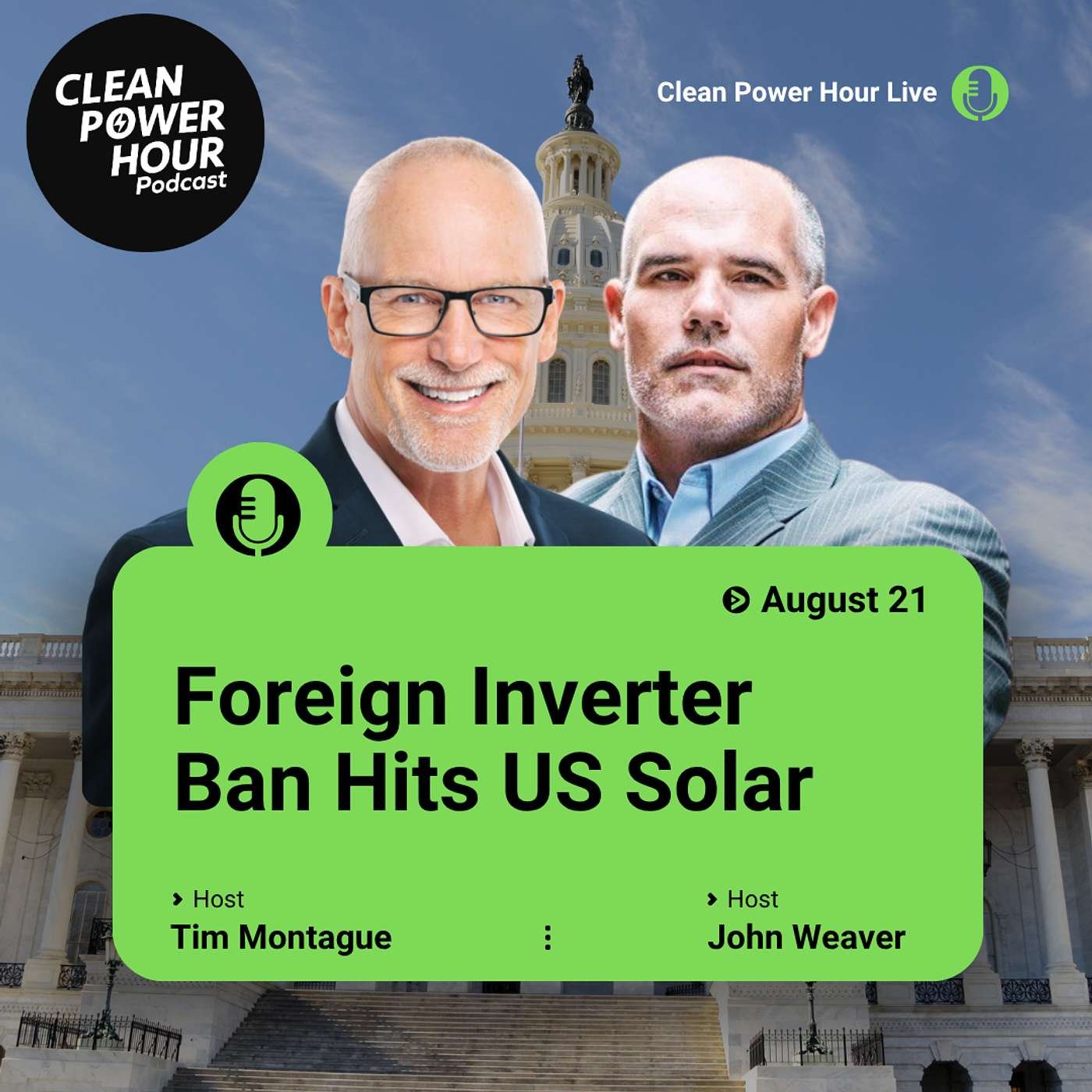
The Federal Communications Commission’s new ban on foreign-produced solar inverters left the industry without clear answers on warehoused stock, firmware updates, and grid cybersecurity risk.
On this episode of The Clean Power Hour Live, hosts Tim Montague and John Weaver break down the foreign inverter ban alongside new Section 232 solar tariffs that set a 38 cent per watt minimum price on modules. They also cover a Reuters report on Chinese electric truck exports climbing as diesel prices spike across Southeast Asia, a 30% efficient perovskite-silicon solar panel from Tandem PV headed to market this fall, and a phishing scam using fake zoning invoices to target solar contractors. Recorded live on August 21, 2026, this episode covers solar policy, battery storage, and grid security in one sitting.
EPISODE HIGHLIGHTS
- FCC added foreign inverters and communication devices to its Covered List on July 28, citing grid cybersecurity risk from remote firmware updates. (PV Magazine)
- Section 232 solar tariffs raise panel costs. New tariffs set minimum import prices of 38 cents per watt for modules, 22 cents for cells, and roughly 14 cents for wafers. (PV Tech)
- Chinese electric truck exports climb amid Iran war fuel spike . (Reuters)
- Tandem PV ships a production-quality 30% efficient perovskite-silicon panel (PV Magazine).
- Enphase launches the IQ Battery C80 commercial battery. The 80 kWh AC-coupled unit delivers up to 40 kVA of continuous power and targets small commercial and industrial demand charge management projects. (Enphase)
- Octopus Energy customers earn nearly 100 million pounds in solar export payments. (Solar Power Portal).
- Security alert: fake zoning permit invoices target solar contractors. John shares an AI-generated phishing email built from public permit records, disguised as a $6,700 town zoning fee. (Blue Sky)
This episode is built for solar installers, project developers, and policy watchers tracking how tariffs and cybersecurity rules are reshaping equipment sourcing. With Section 232 tariffs taking effect in December and the FCC inverter ban already in force, procurement decisions made this fall carry real cost and timeline consequences.
Connect with Tim
Clean Power Hour
Clean Power Hour on YouTube
Tim on Twitter
Tim on LinkedIn
Email tim@cleanpowerhour.com
Review Clean Power Hour on Apple Podcasts
The Clean Power Hour is produced by the Clean Power Consulting Group and created by Tim Montague. Contact us by email: CleanPowerHour@gmail.com
Corporate sponsors who share our mission to speed the energy transition are invited to check out https://www.cleanpowerhour.com/support/
The Clean Power Hour is brought to you by CPS America, maker of North America’s number one 3-phase string inverter, with over 6GW shipped in the US. With a focus on commercial and utility-scale solar and energy storage, the company partners with customers to provide unparalleled performance and service. The CPS America product lineup includes 3-phase string inverters from 25kW to 275kW, exceptional data communication and controls, and energy storage solutions designed for seamless integration with CPS America systems. Learn more at http://www.chintpowersystems.com
0:51
Welcome to the Clean Power Hour Live. I'm Tim Montague, your co-host. Today is august 21, 2026. It's starting to be fall here, and that's a lovely thing. And I want to welcome my co-host to the show, John Weaver. It's good to see you, brother.
John Weaver:
1:10
Living in New England has taught me how to make use of the word
Tim Montague:
1:16
fleeting.
John Weaver:
1:16
Fleeting, fleeting, as in the fleeting summer warmth. You just said that fall coming made you think of that, and just reminded me of how New England summers go by so quickly versus in Florida, where summers are nine months long. And so yes, the. Summer's going away. So it's a New England thing to notice summer going away. Doesn't happen in Florida. In fact, you you hope for it to go away just a little bit.
Tim Montague:
1:46
Yeah, there's a crispness in the air in the morning and the evening, and our days are still quite warm. We're having a nice streak of warm, sunny weather for the next week. It's sunny and 80 or 84, and I picked the right time to go to Norway, John, because I went to Norway last week and it rained every day here. We got 12 inches of rain in I think seven days. So the flooding in the farm fields, but it's not catastrophic. It's just a lot of a lot of moisture, and I had a lovely trip with my son Finn and his girlfriend Kara, and we went to Oslo, Tunsberg, and Oleson, Norway, all very different but historic places, and I most importantly got to ride on an electric ferry, which I'm going to show you a photo of. What have you been up to, though, brother?
John Weaver:
2:40
Building solar.
Tim Montague:
2:42
What a concept!
John Weaver:
2:44
Yep, that's what we do every day.
Tim Montague:
2:46
That's so boring, John.
John Weaver:
2:48
What about batteries? I do some batteries too. Company, I'm actually I'm wearing a nice shirt and nice slacks today because I'm going to Newport, Rhode Island, to hang out with a couple of employees that are in town. We have a we have an intern, Zach Powell, who's his last day is today. He's a master's degree MBA student at University of Providence, and he was working for the sales team this summer, and so we're going to go down as a team and give him a pat on the back, say thanks a lot, and buy him a beer. and And then Newport, Newport, Rhode Island, beautiful place. And what's next
Tim Montague:
3:22
for him?
John Weaver:
3:24
Oh, he's going to finish his master's degree at Providence, and then you know start to think about what's next because he's a he just graduated with his bachelor's, and now it's time to move on.
Tim Montague:
3:36
Yeah. So this
John Weaver:
3:37
is that. This is what you were. Yeah. This is the
Tim Montague:
3:41
this is the Gaia Gai Dongid Fiord Three. We went to the Gaidongid Fiord, which is a very cool place, and we rode on this ferry. It carries about 100 passengers, and you can see. I'm going to give you a close up here. But in the back of the boat is three are three big batteries. They just sit back there like motors might on a regular boat, and it's a lovely thing because the boat is quiet and there's no stack pumping out air pollution that you might breathe if you were standing on this deck, which we were for a good portion of the three-hour ride from one from Gaidanger back to Oleson, where we were staying, and it it it was a very a very lovely trip. And Gaidangerfjord is a World Heritage site, so they actually have some very strict environmental regulations, and I and I read a plaque that said by 2032, all ships visiting the Gaidang area have to be carbon free. So they're incentivizing the electrification of transportation in Norway. You know, as you know, John, Norway is one of the furthest along countries in the world, I think 80% of new car sales are pure EVs, and you see a lot of Teslas, but you also see a lot of Chinese EVs, and that was a difference from a few years ago. I saw a few Chinese EVs, but now I saw a lot of Chinese EVs. So watch out for those Chinese EVs. They're very good and very popular. I also rode on a Chinese electric bus, which was quite good. Although the seat wasn't the most comfortable. Here's a close-up of the batteries, and that label there just says 8000 kilograms. So yes, it is very heavy. And then I I did look at the label, and each one was like 900 kilowatt hours, so we're looking at three megawatt hours of batteries, and that gives the ferry enough range to make it from Guyanger back to Oleson with 100 passengers. I'm no expert on, you know, is it realistic for a bigger ship? I could show you. Maybe a bigger ship like this, the Hertütten, which is a small cruise ship. This still runs on you know fuel oil, and you see it has a smokestack. Eventually, these boats will get electrified, right? This is like a medium range boat. It goes up and down the coast of Norway. I took this boat several years ago, maybe actually several decades ago now, and that's a lovely ride when the sun is when the sun is shining. But anyway, cool cool trip to Norway, and I highly recommend it if you want to check out the future, as I like to say. You can, as an energy professional, you can visit the future, John. I don't know if you knew this by going to Northern Europe or to China, although you have been to China yourself. So
John Weaver:
6:41
I've seen it there. Yeah, it's what's neat about all the electric stuff happening Norway is that it's backed by what is it 90 plus percent hydroelectric.
Tim Montague:
6:51
That's correct. Yeah, their grid is already green with hydroelectric power. They have a lot of waterfalls and lakes, and so it's it's it's a it's ironic and it's a double edge, right? Because Norway is wealthy because of fossil fuels. They have a huge oil industry on in the North Sea, and they've built up this sovereign wealth fund, which is some trillions of dollars, and they use it for public benefit. Although they're very caught, they're very conservative. They, I, we had a dinner with with one of my family members there, and he said they can only use 3% of the sovereign wealth fund to, you know, for the betterment of society, and they build roads and bridges and hospitals and schools, and they do have free healthcare and free education, which I think is a very smart thing to do. But no place is perfect. I choose to live here. I could live in Norway. I did live in Norway for three years, and it was very interesting. But I prefer the lifestyle ultimately that we have here in America, and I hope that we can hold on to that.
John Weaver:
7:56
Oh, one interesting one
Tim Montague:
7:58
interesting factoid, I guess, around electrification. You know, electrification transportation is happening partially in Northern Europe because elect because fossil fuels are expensive. In Norway, gasoline is $8.50 a gallon, not 450, which we have now experienced here in Illinois, which is horrendous. Oil prices have gone up in the U.S. right?
John Weaver:
8:23
And Norwegian prices would make you go nuts,
Tim Montague:
8:25
right? And so, what you would do if you were driving a vehicle in Norway, you would buy an EV because it's much more economical to do that. Here, it's not. It's still. It's painful, but it's not quite painful enough that everybody goes. Oh, I'm getting an EV now. There is a resurgence in, especially the used EV market in the U.S. because of Donald Trump's war in the Straits of Hormuz, which, in my opinion, is just A a food ticket to the fossil fuel industry. It's just a way to give them profits, but I don't know. I don't really know, and I know they ostensibly say, "Well, we're stopping them from being a nuclear a nuclear power and dropping the bomb on us, but I don't think that's a legitimate threat.
John Weaver:
9:11
Probably not.
Tim Montague:
9:13
So anyway, when fossil fuels are expensive, you do get that is an incentive. Just like if electricity is expensive, you have an incentive to go solar, or solar and battery. Now,
John Weaver:
9:25
well, actually, if we want, we could cover an article about how trucks, electric trucks, are picking up in terms of sales across Southeast Asia because the price of diesel's through the roof. Yeah, and you know that's great. My opinion. You know, sorry. Well, let's
Tim Montague:
9:42
let's do it. What's the story?
John Weaver:
9:45
All right. Well, let's just here. I'll share. I'll share it right here then. So all across Asia. Let's see if I could share share my screen, share screen. Let's pick a window over here to Reuters. So what's occurring is that Reuters has put out an article saying that the war in Iran has been a boon for Chinese e-trucks, and an export surge is occurring. And what we can see is that in March, 2500 trucks were exported. It was showing an increase. It was you know like it was showing an increase. I mean, it was down from the end of the prior year, so it wasn't like peaking. But now, the number of trucks exported in June was 5400, and compared to June of last year, it was 1700. That's three-ish, three plus 3000 plus 2151, That's three times 300% What. Exported last year, and it said diesel prices are up 48% Here's right here, diesel prices are up 48% in Sri Lanka, 57% in the Philippines, while only 15% higher in China. In the U.S. it's up like 50% maybe not 100, but I know that shipping some solar panels from Texas to Massachusetts costs twice as much as it did a year ago, and so here's where you can see where all those trucks are going. Southeast Asia is just taking in a massive number of trucks, and they're dealing with this diesel issue a lot. And those markets are tight markets. Now I like this line right here. I wanted to point this one out. Before the oil prices rose, buyers in these countries, these Southeast Asian countries, might have needed 28 months to recoup their EV truck investment. Now it's 18 months, less than two years, whereas before it was, you know, two and a quarter years, two and a third years. So now we're at a year and a half, and that means it's just dropped 50% more than 50% At 50% we've been 14 off. That would have been and not exactly 50% but almost a 50% drop increase, almost a doubling of the ROI increase is actually how it would be said. So
Tim Montague:
12:14
yeah,
John Weaver:
12:15
you know, a little bit of war sucks, but I'm sorry, everybody. However, it's leading to trucks that are EVs, and if we can push, you know, everything I say that everything I read says that the low hanging fruit, once it becomes economic, is going to be trucks because they're going to be like 50% of transportation, 70% and not necessarily of mileage, but of actual fuel use because of how heavy each one of those trucks are. Like electrifying one EV truck is worth like 20x a car, because an EV truck runs 24/7, a car runs 5% of the day, and they're bigger trucks. So it's like because they're you. You mean a commercial
Tim Montague:
12:56
truck?
John Weaver:
12:57
Commercial truck. Yes, sir. Yes, sir. Yeah, I'm talking big trucks, and that's what this article was on. It was on commercial vehicles.
Tim Montague:
13:03
Yeah.
John Weaver:
13:03
So yeah,
Tim Montague:
13:04
makes sense. I think medium range commercial vehicles will be some of the early adopters. Those fleets, you know, if I was a FedEx or an Amazon, I would be electrifying my fleet. I know Amazon is an investor in Rivian, and you do see some EV Rivians around. I don't see a lot here in Illinois, but I saw one up in Wisconsin this summer, and
John Weaver:
13:27
regularly in mass. And the first one I ever saw was in Chicago.
Tim Montague:
13:31
Okay. Yeah, I don't go to Chicago enough. I will be going to Chicago September nine and 10 for RE Plus Midwest. So if you're going to that show, reach out to me. I'd love to see you and have coffee or a beer or just meet on the trade show floor. I'm also going to be doing some filming. If you're listening to this and you have a good story to tell about the Illinois solar and battery market, I'm making a documentary about that. So reach out to me. And with that, let's move on to some other news, John.
John Weaver:
14:05
So you want to do funny news or two pieces of slightly news?
Tim Montague:
14:10
Let's do some funny news. It's Friday. I am in a good mood. I'd like to hear some good news.
John Weaver:
14:17
All right. So, funny news is pachyoderm management. I'm sure you. I should. I should know
Tim Montague:
14:26
what a pachyoderm is, but what is a pachyoderm?
John Weaver:
14:29
I'm gonna find out very shortly. So there's. smart animal. It's a neighbor of ours. They they get upset sometimes if you don't manage your cables. I'm gonna point that out. So this is a cable management story, Timothy. Oops. Oh, there's some music. Oh, pachyderm is
Tim Montague:
14:52
an elephant. Yeah. Yes,
John Weaver:
14:53
and so if you don't manage your cables, pachyoderm will knock over your system. That is that is
Tim Montague:
15:01
too funny.
John Weaver:
15:02
If you pay attention early on, you see that right there. The foot, the cable is around the foot of the baby elephant.
Tim Montague:
15:09
Oh,
John Weaver:
15:10
that's the mom elephant, and she's like, "Hey, what's up? She's stepping on the cable, and then she's like, "All right,
Tim Montague:
15:17
I'm pissed. You're in trouble. All
John Weaver:
15:24
right,
Tim Montague:
15:25
wow.
John Weaver:
15:26
So, pachyderm management, Tim. That's a so bollards and cable management, and then I don't know how did they attach that unit to the ground? It looked like there were no bolts. It looked like it was just sitting there on the pad. So you know you definitely got to bolt your stuff down.
Tim Montague: Lesson learned:
15:48
bolt your EV charger down. To the ground, yes, that sounds good.
John Weaver:
15:53
Taste of pachyoderms specifically, you know. Oh, that was cool. I
Tim Montague:
16:48
I will have to say, I wrote on one of the other electric ferries. I rode on a shorter, a shorter, a smaller ferry, but it was a car ferry that was electric, and I saw the charging system, and it was semi robotic, and it it it had like a robotic arm that lowered down, and then you know it fell into like a funnel so that it could find its way to the port. Because you know, with with a big, I mean, the cables were like this fat, and there were four of them, I think.
Unknown:
17:17
Oh wow! Now
Tim Montague:
17:19
this this was especially, I mean, the reason the charging was so important, is because it's like a constant back and forth. That ferry's just going boom, boom, boom, boom, boom. Makes sense. But yeah, all right. Well, that was funny. Pachyderm management.
John Weaver:
17:39
So, first two pieces of news are challenging ones.
Tim Montague:
17:46
Foreign inverter ban.
John Weaver:
17:47
Foreign inverter ban, man.
Tim Montague:
17:49
Yeah, and I'm curious: has the dust settled on this yet? Because I've heard a lot of conflicting and confusing news. I mean, this is Ryan. I'll put this on screen. This is this is Ryan's story from july 28, right after the full ban was announced. But well, what's the what's the basic story?
John Weaver:
18:12
So basic story is that the FCC, which is a whole different arm of the government, is now stepping into solar inverters, and they're banning really they're banning inverter and communication devices against everything in the United States from China origination, and and it's not even China; it's just foreign. Like notice that top word, foreign produce. So anybody, everybody, any inverter that's manufactured outside of the United States has now some complexities. Now there were a lot of questions about the nuance of this. Is it a our existing approved inverters okay? Could a firmware update invalidate your approval? Are are inverters you know just there are just a lot of questions that we don't know answers to. At least I haven't seen the technical updates and guidance on it. But you know, it's it seems like there's any new inverter right now isn't coming into the country. It seems like a new inverter, a newly completely new out of the box inverter that doesn't that hasn't been UL or FCC approved. So if
Tim Montague:
19:23
you've if you've safe harbored a bunch of inverters that are sitting in a warehouse somewhere in the U.S. you're good.
John Weaver:
19:30
Maybe, for instance, what if one of those inverters got updated with firmware? Is one of the questions. Yeah, the question is of risk of companies of countries that have a desire to mess with our grid to hack stuff and whack it up. I mean, there's a neat story I just read about the Russians hacking the Polish grid recently, where they just went in via open password ports and started messing with stuff. So that's what this is about. is It's about hypothetically protecting ourselves against grid attacks, and then a firmware thing could open a hole, is what you know. I'm hearing smart people say, "This is just a discussion, and and so I don't know, maybe, maybe not. And for instance, there's another layer. Christian wrote somebody whose name I'm allowed to say because he he's not commenting publicly, but smart people, and they've even put out opinions on this, I think. The FCC doesn't technically approve an inverter; they approve subcomponents. So, does this apply? Does it not apply? You know, do they now have to reapprove every inverter? Because technically, no inverter ever has been approved, so it's it's it's an unknown. And the way you started off talking about it, saying, "Do we have any real updates? is really a great question. I haven't seen much. I haven't read personally any of the updates since the initial release and the initial analysis. So I only have one update, which is sort of kind of an update. Wood Mac says that by next year we could be making 60 to 70 gigs of inverters domestically, which is surprising and interesting. But you know, right now I'm buying domestic contact inverter. By next
Tim Montague:
21:20
year,
John Weaver:
21:21
next year, dude.
Tim Montague:
21:23
Wow.
John Weaver:
21:24
Yeah, I did not something I expected, but I will say I've been buying domestic content inverters in phase, Solar Edge to meet that 10% tax credit thing, and
Tim Montague:
21:36
yeah,
John Weaver:
21:37
I know the effect on me is limited, but we're a small CNI guy. This is really about the 40 gig. Gigawatt utility scale market, and I have less insight into that stuff.
Tim Montague:
21:48
Yeah, I mean, of course, last year, right, with the O Triple B, we got Fiak, foreign entities of concern, and that and that did start a train rolling that gave developers and asset owners more caution around products made in China, North Korea, Russia, and of course in the solar space that means China mostly, and so that has hurt companies like Chin Power Systems. Thank you, Chint, for being a major sponsor of this show and platform, and we'll see where the dust settles. It certainly is incentivizing John for I mean domestic manufacturing, and that's a good thing. Basically, if America can get its act together and become a manufacturer again, like we are a service economy largely, we are no longer a manufacturing economy. There was a time in the 50s, 60s, and some of the 70s when we really were, but you know we are making solar panels and maybe we'll make inverters. Solar Edge, as you said, is making inverters. There's also Selectria. They have a factory in Buffalo Grove, Illinois, in northern Illinois. So I was talking with an installer about a project in Michigan that hopefully will come out on the pod, where they got racking made in Michigan. They used first solar modules from Ohio and then inverters from Illinois by Selectria. So that's kind of cool that you could have a solar field made with components all made in the Midwest, and will the other major you know Chinese companies like SunGrow, etc. and Chint reshore or onshore manufacturing? That's TBD. There's a lot of pivoting going on. You see how Canadian Solar has rebranded and is trying to keep up with foreign entities of concern and domestic content requirements, right? And rebranding themselves as CSI,
John Weaver:
23:58
CSI Power,
Tim Montague:
23:59
CSI Power. So we this is a very dynamic situation, I would just say, and the dust is not settled, but it is interesting. And my concern, John, is that it creates more friction for the renewable energy industry. Oblique did create friction; it didn't create as much friction as as some people thought initially. So there has been some good news lately that you know pre versus post O triple B and what is the impact? It's not as gruesome as some anticipated at first, but it is reducing the amount of solar and wind being installed in the U.S. And you know we want to make the energy transition. It was noteworthy for me returning to Chicago, John. When we got to the airport and we walked out to get picked up by Kara's lovely mother. Thank you, Kara's mother, for picking us up at the airport. The air pollution, the air pollution at the airport was horrible, and I never noticed that in Scandinavia. Like the air was much cleaner at the airport, and that's because they're running on electric trains and cars much more than we are, and we are definitely creating a lot more air pollution, and that's not good for human health. And we we forget that it's in the background, but fossil fuels kill 6 million people at least a year globally. It's a huge, and I heard an interesting analysis about nuclear and and yeah, nuclear accidents are dangerous. Fukushima, it it falls
John Weaver:
25:35
to kill like 100 Chernobyls every year,
Tim Montague:
25:39
right? So the the relative impact on human health of the nuclear industry is much smaller than the fossil fuel industry, and we need to keep that in mind. And so, from a safety perspective, nuclear is relatively safe compared to burning natural gas and oil.
John Weaver:
25:55
I don't even want to say relatively; it's very safe. I mean, we've had a couple of issues, yeah, but I don't know. I mean, we could talk about that for a long time. I like nuclear. Nuclear is cool. Yeah,
Tim Montague:
26:06
Chernobyl. Chernobyl was closer to a much bigger disaster than Fukushima was actually. If it if if they'd had a true like well a a more severe meltdown than they had like China syndrome right if the if the nuke over overheats and melts down to the to where it's super hot, and then there's like a reverse explosion of hot steam. the The impacted area could have been much bigger than it was. It was big. I went to Norway in 1986 for the first time, and I was celebrating my 40th anniversary of going to Norway when I went to Norway. This summer, that summer they had to cull the reindeer herd in Norway because of the fallout from Chernobyl, culling in as in killing them and then just bulldozing them into the ground because they didn't want humans to eat the meat. So anyway, I digress. We should probably move on.
John Weaver:
27:05
I mean, yes. Concurrently, 6 million people died last year, and that's and
Tim Montague:
27:14
that's yeah, and that's why that's one of the one of the best reasons to make the energy transition.
John Weaver:
27:21
Right now, 10s of 1000s of people are on death's doorstep right this instant moment, and they're going to die shortly. And a few 10s of 1000 others are joining them right now. Yeah. So let's go to the next article where we increase tariffs on the price of solar panels.
Tim Montague:
27:39
Section 232 may offer limited prospects for U.S. solar wafer capacity by Will Norman in PV Tech, PV Tech. Okay,
John Weaver:
27:50
PV Tech.
Tim Montague:
27:51
I'll get this on screen.
John Weaver:
27:53
It's in my second favorite magazine land. Them in Solar Power World. I got to put them as number two because PV Mag, of course, is number one.
Tim Montague:
28:02
Okay, so yes, Section 232. What is what's what is Section 232?
John Weaver:
28:08
All right. So first, Section 232 came out last week. We've been waiting on it all summer, maybe even since the spring, and it's a global. It's a new tariff on everybody. Every solar panel coming into the United States minimum price 38 cents. Every solar cell, I believe 22 cents. If you scroll down a tiny bit, every wafer probably going to be in the 14 cents. Yeah, 14 cents a watt. And all of this is now a new tariff added onto everything from anywhere in the world, not just China, and this is because you don't get premium access. Sorry, Tim, I pay for that. I pay for a lot of magazines. I like that. But the whole world, and this is to combat, and I understand it. This is to combat the Chinese technique, which I actually, in hindsight, think is great, where they make new factories around the world, so they can then export to the United States products and other markets. And I actually I love it because can you give
Tim Montague:
29:12
a can you give a concrete example?
John Weaver:
29:15
Sure, Southeast Asia, Malaysia, Taiwan, just there's four Vietnam and Laos; those four countries were all directly invested in by major Chinese manufacturers, and then they built factories and started exporting to the U.S. And there's others as a way as a
Tim Montague:
29:37
way to avoid tariffs, right?
John Weaver:
29:39
As a way to avoid tariffs for products directly exported from China, so mainland China. Now, what I like about this is that we're now dispersing solar expertise globally. Of course, the U.S. is still pissed because our manufacturers are being undercut by state-driven incentives, but we're dispersing solar expertise around the world. I like this because that's just that knowledge we wanted to proliferate, and it's beautiful. So cool. We had an effect of moving the solar manufacturing industry outside of China, and now it's in at least 10 or 20 different countries around the world. With India coming on as just being awesome. I mean, I share an India story every other show. Market for solar, and they're now the world's number two solar manufacturer. They're going to have like 250 gigawatts of manufacturing capacity. Sure thought you
Tim Montague:
30:36
broke up there for a sec.
John Weaver:
30:38
Oh, India! Sorry, sorry. No, well, what company?
Tim Montague:
30:40
What company?
John Weaver:
30:42
The country, the country of India, you know, India's
Tim Montague:
30:45
India is going to have 250 gigawatts of solar manufacturing capacity,
John Weaver:
30:49
like next year.
Tim Montague:
30:51
Yeah,
John Weaver:
30:52
that yeah, I can share that. We get added to the thing. And the U.S.
Tim Montague:
30:55
is going to have 50 or 60 gigawatts.
John Weaver:
30:58
Just modules too. With India, it sells, which is much more valuable than just modules, and they're moving toward wafers and moving toward poly.
Tim Montague:
31:08
But so these these tariffs on solar cells that were just announced, the theory is that it will incentivize onshoring of solar cell manufacture in the U.S. Right,
John Weaver:
31:21
that's the theory, and as this article, it says that wafers though because of the dynamics of the pricing and the cost and how they're being tariffed this is the second party I've heard say this statement that it may not incentivize wafers and polling it may mess up the market because they haven't structured this well so at a minimum. The price of our modules are going up, and it just like the prior tariffs, which have all been horrible before the OB before the IRA, and they didn't drive new manufacturing. These new tariffs might not drive manufacturing. Yeah, yet again,
Tim Montague:
31:59
that's the thing. It's super complicated, and it's and it's a it's a very gross tool. It's it's a club when you need a scalpel, and so I my take is it's just more friction for the clean energy transition, which is ultimately the Trump's admin the Trump administration's goal to to continue to prop up the fossil industry, which already has plenty of subsidies, probably to the tune of 10x what we subsidize the energy, you know, clean energy transition. But that's you know that's the way it is, right? We have a mob boss in Washington who wants to support his rich buddies, and the fossil industry is behind him 100% and donating to him and enriching his family. And until that administration is gone, we're going to have that problem. But we have two two and a half more years, right?
John Weaver:
33:00
Yeah, I yeah. All right,
Tim Montague:
33:04
get used to it. Get used to it. But but solar. The good news is solar and batteries are unstoppable. And the factoid that I love that was pointed out on the Prof G Pie the other day. He interviewed an expert whose name escapes me. A woman from Scotland. She had a lovely Scottish brogue too, but she pointed out that internal combustion engines are 80% inefficient. So 80% of the energy that that in in your ice vehicle, in my ice vehicle, you drive an EV. You're one of the good ones, John. I'm still one of the bad ones. In my internal combustion engine vehicle, 80% of the energy goes to heat and friction. In an EV, it's reversed, and 80% of the energy goes to moving the vehicle. And so, EVs are not only cleaner, but they're much more efficient. And so, as as we see this expansion of the need for energy with AI, compute, electrification, blah blah blah blah, right? It's just it is going to be healthier and safer and more efficient when we get when we move away from fossil and biofuels like corn to ethanol. Super inefficient. 40% at least of our corn crop goes to ethanol, thanks to the farm lobby, which is super powerful. It was ironic. I was having breakfast with a gentleman who is a farmer here in Illinois, and he had no he had no idea why the ethanol, corn to ethanol, was such a thing in Illinois. But it's called money in Washington.
John Weaver:
34:43
It's a challenge. All right, let's move back to good stuff, Tim.
Tim Montague:
34:48
Okay. How
John Weaver:
34:48
about a 30% efficient solar panel that might be on sale in like a month or three?
Tim Montague:
34:59
So, okay, this is in PV Magazine. I can actually get this to show on screen. That's good. I know
John Weaver:
35:06
the author of this story too. He's a good guy.
Tim Montague:
35:08
Well, tell us the the the actual name of the story and the author.
John Weaver:
35:12
All right. So the name of the story is here. Let me open it up. World the world's most efficient solar panel goes on sale later this year, and it was written by a very handsome fellow named John Fitzgerald Weaver.
Tim Montague:
35:27
I love it.
John Weaver:
35:29
And what's happening is that this is a 4t perovskite silicon solar panel, and what 4t means,
Tim Montague:
35:39
yeah, is
John Weaver:
35:40
that perovskite is in the glass, and it wires itself to a standard, regular whatever you want. At least with this company, solar panel.
Tim Montague:
35:53
So they're making perovskite glass that you can just bond on top of a regular PV module.
John Weaver:
36:01
They're replacing the standard glass, though, so it's not just like smacking it to a module. They're just you know your standard glass. It's just being switched out. That's it.
Tim Montague:
36:10
Yeah, that's cool. What is the name of the company? This is Tandem PV. Oh,
John Weaver:
36:15
Tandem PV.
Tim Montague:
36:16
Yeah, I had them on the show a couple years ago now.
John Weaver:
36:19
Yep, I just had a great interview with their CEO. So what's occurring is that they are shipping right now what they would call. You might want to scroll down. You can see it, but they're shipping right now what one might call production comparable, production ready modules. They're kind of they're moving through things. It's a moving through the. Final things, the details. But right now, what's happening is that the final modules that are close, super close, is the way the guy's pitching me, Scott. Super close to being the last product. What they would say is that later in the fall, he he wouldn't say summer. He pulled off the summer, but in the fall, he expects to be able to selling for revenue modules that will be deployed, and he expects these modules after a certain amount of time to be defined as bankable. And then here's the
key:
37:16
this is what everybody says, and I should have started
off with this:
37:19
the degradation value that he expects to put into his contract is less than 1% a year. He also states that right now they have modules that have been deployed for almost a year that haven't degraded at all. So they think they have worked and fixed the true. We don't truly know because of 1% degradation. If you're thinking about here's a here's a new thing for us to think about, Tim. I realized this a few months ago. So let's say I have two solar panels. One degrades at 2% and I don't know if this math is correct, but just for the sake of our conversation, one degrades at 2% one degrades at point 2% Add that up, that's 2.2. Does that mean our average degradation is actually 1.1 for 30 years? I don't know exactly, but maybe. So I'm wondering what we're gonna see when a when a real perovskite silicon tandem comes out, and they say degradation is X because that X number is for the whole module, but the silicon is gonna go slower than the perovskite is my assumption. So so I don't know what this means yet, but it means something, and smart people with spreadsheets are calculating it. and And in about three months, somebody's gonna have it in the field, and we're gonna get a picture of it. And this guy Scott, he he was we had great conversation, good 30 minutes. He said, "Listen, man, we're looking to get get our knowledge out there and show off our gear. So he's gonna be reaching out to say me, Pete, you know the solar power world. Maybe you should give him a nudge. You know, give him a call. Fall, say hey, we want to get you on the show after you've shipped your first revenue generating module. That's that's, and then we need to send them a case of wine from Sonoma. What is Scott's last
Tim Montague:
39:22
name? I can't remember.
John Weaver:
39:24
Scott Warden.
Tim Montague:
39:26
Scott Warden.
John Weaver:
39:27
Wharton I think is his name. It's in the article. Let's check it out.
Tim Montague:
39:29
I don't think so.
John Weaver:
39:31
All right. Wharton. Yep.
Unknown:
39:35
Oh.
John Weaver:
39:36
CEO Scott Wharton.
Tim Montague:
39:37
Oh, interesting. Okay. Maybe they have a different CEO than they did when I interviewed them a couple years ago, or I'm thinking of a different company, I can't keep all these. You know, the one of the frustrating things is that expression "tandem, right, is actually a phenomenon. Also, it's like calling your Company automobile, or combustion-I don't know. But anyway, yeah. So prov skites are cool. They're interesting. We had Joel Jean on the show, right? And
John Weaver:
40:18
Swift. That's from Swift.
Tim Montague:
40:20
Swift. Yes. Swift. Is it Swift? It's not Swift current, but Swift Solar.
John Weaver:
40:27
Is it Swift Solar? Because there's Swift Current
Tim Montague:
40:29
Energy, but yeah, Swift Solar. Solar,
John Weaver:
40:31
yeah, Swift Solar.
Tim Montague:
40:33
And I think they're making a 3t product, right?
John Weaver:
40:40
Maybe, 2t. I would think, but I don't know. Oh,
Tim Montague:
40:44
maybe it's 2t. Yeah, I don't know.
John Weaver:
40:46
Yeah,
Tim Montague:
40:47
you of all people, John Weaver, should know this. You're such you're such a geek for solar PV. Does does perovskite qualify as PV though? It's not right.
John Weaver:
40:59
Photovoltaics, yeah. Photovoltaics, the science of photons and electricity. Yeah, but but thin film
Tim Montague:
41:07
isn't PV.
John Weaver:
41:08
Yes, it is. It's photons and electricity. Oh, just it's
Tim Montague:
41:13
it's uh it's not crystalline PV. Yeah, okay.
John Weaver:
41:17
Correct. Correct. Photovoltaics has little to do.
Tim Montague:
41:20
So so is perovskite crystalline or something different.
John Weaver:
41:25
Is it a crystal? I. It's a. Ooh, it's a rock
Tim Montague:
41:29
because it's kind of it's kind of analogous to thin film.
John Weaver:
41:34
It is. It without a doubt. It is. It's more of a spray-on product. It's absolutely a thin film versus, say, silicon rock. But um. Yeah, yeah. Good question, Tim. Very good questions. We're gonna have to learn some new stuff. Hey, you want to talk about some batteries now?
Tim Montague:
41:48
All right, it's about tim more batteries. Enphase is
John Weaver:
41:53
releasing a CNI battery, and I think I'm gonna put it on a site. I need to get my guy Bob Montaguero. He's my Enphase sales guy. He's awesome. I've known Bob for a long time. Bought my first commercial inverter from him down in Miami, but Enphase is putting out an AC coupled 80 kW unit with 40 kW of power, and I like this unit because I'm doing work on smaller CNI locations, and they need some demand charge management, and so I'm interested in this product, and so that's why I liked it. Commercial batteries are so expensive, and I don't know if it'll work. But Illinois, your state, Tim, a project that we're working on actually. So thank you for connecting me with-is it a 360 or 360 electric?
Tim Montague:
42:40
360 electric. Yeah.
John Weaver:
42:41
Thank you for connecting us with 360 Electric, they're working with Amaran to get us an inspection with the utility at our site. And this site, the customer is talking about demand charge management and solar, and we're thinking about doing end phase there because the customer wants to pay the extra for domestic content. They know the rough price adder, and they really like the simplicity of an end phase install at street level, because all the inverters and the extra gear is up on the roof, and so street level you only have one or two boxes. So, so they're aiming for it. And with that, this is just a new battery. Commercial batteries are great. Every time I see one, I get a little psyched. There's a SunGrow battery that's a 125 250. I would have loved to be more involved with, but now I'm worried about Fiok and all that stuff. So, so I don't know where to go with these smaller size CNI batteries. So seeing this just made me get a little excited.
Tim Montague:
43:36
And is Enphase making batteries though that qualify as domestic content?
John Weaver:
43:43
I have no idea yet. However, I do know that the incentive is separate, so you can have your solar incentive get domestic, and your battery can just be standard 30.
Tim Montague:
43:54
It says the C 80 is expected to be U S made at U S facilities and be Fiat compliant. Fiat compliant, ironically, doesn't guarantee domestic content, right? So,
John Weaver:
44:07
but read the second sentence. So, if you look at it, says certain projects eligible. Eligible. So, what that really probably means is that if your project has everything else strongly domestic content, this at a lower percentage, sort of like the way we do modules from some groups would work and make a sense and figure it out. So,
Tim Montague:
44:33
yeah,
John Weaver:
44:33
we'll see. So, do you do it? Do
Tim Montague:
44:36
you do a lot of projects with end phase inverters?
John Weaver:
44:39
Not a lot, but we've been doing more recently because of domestic content historically? We have been doing a lot of SMA, very simple prior Solar Edge plus SMA with rapid shutdown requirements. Depending on the project, we had a lot of Selectria, Yaskawa, but recently we've been moving toward Enphase. They have some characteristics which are really nice. Again, all the hardware being on the roof. We're doing a apartment complex, and you know we would have had three or four solar edges because of the sizing that we would have had to been two or three, and that's just a lot of gear. So there's there's pluses and minuses for each system, but but I look forward to an end phase.
Tim Montague:
45:25
Yeah,
John Weaver:
45:25
that's pretty great.
Tim Montague:
45:27
And that's on that's on a commercial project, right?
John Weaver:
45:30
That is yes. Well, that's on the project you're helping me with, Tim.
Tim Montague:
45:33
Multi family,
John Weaver:
45:34
multifamily low income housing. Yes, sir. Hey, so I got a. This is our first ever session of a security alert of the week. Everything's of the week for us, Tim. And I want to show you an amazing email that I assume was AI generated. And I want to make sure our developers know that this type of fraud's coming for them, buddy. And holy crap, this one was good. So just click on these documents, either one of them. These documents are fake. Can you click on the image as if you're? Yeah, perfect. So these documents are fake documents, and it was an email that came to us. And if you zoom in, the only give is the email address. It even it's the extension like the real address. Yeah,
Tim Montague:
46:26
it@mail.com's.
John Weaver:
46:29
Yes, the real email address for the town is the first half of the email, the cconk.ma.gov thing, and that's the only give. And if you look at the documents and the second page and everything, they use. Use real information from the public forum because permits are publicly available. Yeah, from the public
Tim Montague:
46:49
records.
John Weaver:
46:50
Yeah, yeah, and the town meeting. So they took real information from the town meeting, and they probably used
Tim Montague:
46:55
AI to do
John Weaver:
46:57
it. Yes, sir, absolutely. And and they sent us an email.
Tim Montague:
47:02
Nice. That's only$6,700, John. You won't mind paying that, right?
John Weaver:
47:07
You want to hear the best part? The reason that we were suspicious of it is that zoning fees are only like usually 1500 bucks for this project or project this size, and so we were like 68. You know, if they hadn't been so greedy, they might have gotten 1000 bucks from us. But
Tim Montague:
47:22
imagine all the hundreds of contractors who've received this scam, right?
John Weaver:
47:28
Yeah,
Tim Montague:
47:30
they're just going through all the permits and sending messages to all the permit applicants. Holy moly!
John Weaver:
47:37
All across the country, man, and and every permit is publicly available. You just you set the robot to start looking. That's what's occurring right now, Tim. So please, contractors, tell your friends, double check that invoice from the Planning Commission. I mean, look at this document. It's even got a watermark. I mean, you know, Tim. One time I got defrauded Craigslist. I was getting a new apartment, and I happened to be traveling, and I had a lot of stuff going on. I'm just like, man, that apartment looks good. They're like, yeah, send the deposit. I was like, great, sent. They're like, all right, now we need last month. I was like, all right, here you go. They gave me like all the PDFs, the lease. It was perfect quality. They used DocuSign. It looked good, man. You know these people, if they were in a real job, they'd be great workers. They don't make as much; they get paid crap. Instead, they get steal 5000 bucks at a pot. But just rough, it's rough. I don't know. You want one more story, Timothy? It's time, kind of time to go.
Tim Montague:
48:40
Yeah, let's do one more.
John Weaver:
48:41
All right, here's a cool one. This are you familiar with Octopus Energy by any chance?
Tim Montague:
48:48
I am. All
John Weaver:
48:50
right. So they're coming to the U.S. They're a U.K. company. They're in Texas these days. We're
Tim Montague:
48:54
talking about the solar power world.
John Weaver:
48:57
Yes, the solar power world. Solar power portal.
Tim Montague:
49:00
Oh, solar power portal. British households earn 100 million pounds from solar in past year. Octopus says yes. Okay, I believe it.
John Weaver:
49:10
So this residential customers who are paid with how they do their energy via their Octopus Energy account. Now I don't know exactly how it works, but you know when you feedback, it's different than net metering, and somehow you know with Octopus they say don't run your electricity now or charge your car now. They give their customers like I love watching their little posts whenever they pop up and when people celebrate. They're like Ah, I just got paid five bucks for filling up my car with electricity, and so that's what Octopus is giving home electricity users kind of just more power to their to their thing, and and because they're a big organization, I guess they also protect on the other side. You know, when prices spike, they have the ability to manage that on the other way because they own batteries, so it's it's just kind of neat. Home energy users are having a significant effect on the big power grid, and I think that's sweet. You know, it started in California with all that net metered solar. It's happening in Australia, so the duck curve in Australia is gone, and it's because of the big grid batteries, and over the last year, 500,000 residential batteries. Now, remember, Australia's 34 million people, so it's not the U.S. which is 10x.
Tim Montague:
50:39
Yeah.
John Weaver:
50:39
So 500 million-that's there's only like 20 million households, so this is like 5% I don't know, quarter, two and a half percent, whatever. A solid chunk have installed batteries and fundamental altered their grid, which was fundamentally altered by solar. So we're now in. We're moving beyond the solar thing. We're now moving into battery and intelligence. Like octopus is showing the intelligence of the grid, the VPP, the distributed power, and batteries are just changing everything, man. So, and octopus
Tim Montague:
51:13
isn't a household name in the U.S. yet, but it's going to be. It's coming to the U.S.
John Weaver:
51:18
It's in Texas. They're doing this. It's in Texas.
Tim Montague:
51:22
They're coming to California. They're coming to a handful of markets. I yeah, they're they're a very modern utility. I don't you know I don't know exactly how they frame themselves or IPP, but yeah, it's impressive. I don't quite understand what. The business model is here to you, though. How, how, how is Octopus using this excess solar electricity?
John Weaver:
51:54
Well, I mean, they're probably selling it to other users somewhere. They're probably storing it in batteries. I mean, they're just a they're you know they figure out when to export it, maybe during high price times, because they definitely tell people to use less during high price times, and they definitely tell people to use more during low and negative price times.
Tim Montague:
52:17
Yeah.
John Weaver:
52:17
So I'm certain that they have their equations. They have their energy. They have an energy trading desk. I mean that's what they are. They have they have professionals who stare at what they got, stare at what the market wants, what they could have, and say, "All right, here's how I cover my cover my office's cost. So they're they're just a big old power company, man, a distributed power company plus other stuff. I'm sure I don't know the whole of them, but they definitely got some distributed shops.
Tim Montague:
52:50
All right, well, that's a wrap. We will be back on september 4, I believe, in two weeks. We do this every two weeks on Friday at noon Central, 1p.m. Eastern. and you can check out all of our content at CleanPowerHour.com. Tell a friend about the show. That's the best thing you can do. The live broadcast is, you know, every we're dropping one of these every other week, but then there's lots of other interviews dropping once and sometimes twice a week, so check that out, and connect with us in Vegas at RE Plus or RE Plus Midwest. So many opportunities to meet us face to face. John, how can our listeners find you?
John Weaver:
53:38
commercialsolarguy.com. That's our website. I'm also on LinkedIn, Commercial Solar Guy John Fitzgerald Weaver, Blue Sky as Commercial Solar Guy. That's the best place. Or you can come to Harvard, Cambridge, and I can buy you a beer.
Tim Montague:
53:56
All right, we'll see you in two weeks. Thanks for being here, everybody. And I'm Tim Montague. Let's grow solar and storage. Take care.