Solar and battery storage are reshaping the energy industry, but policy uncertainty, grid constraints, manufacturing challenges, and equipment reliability remain major issues.
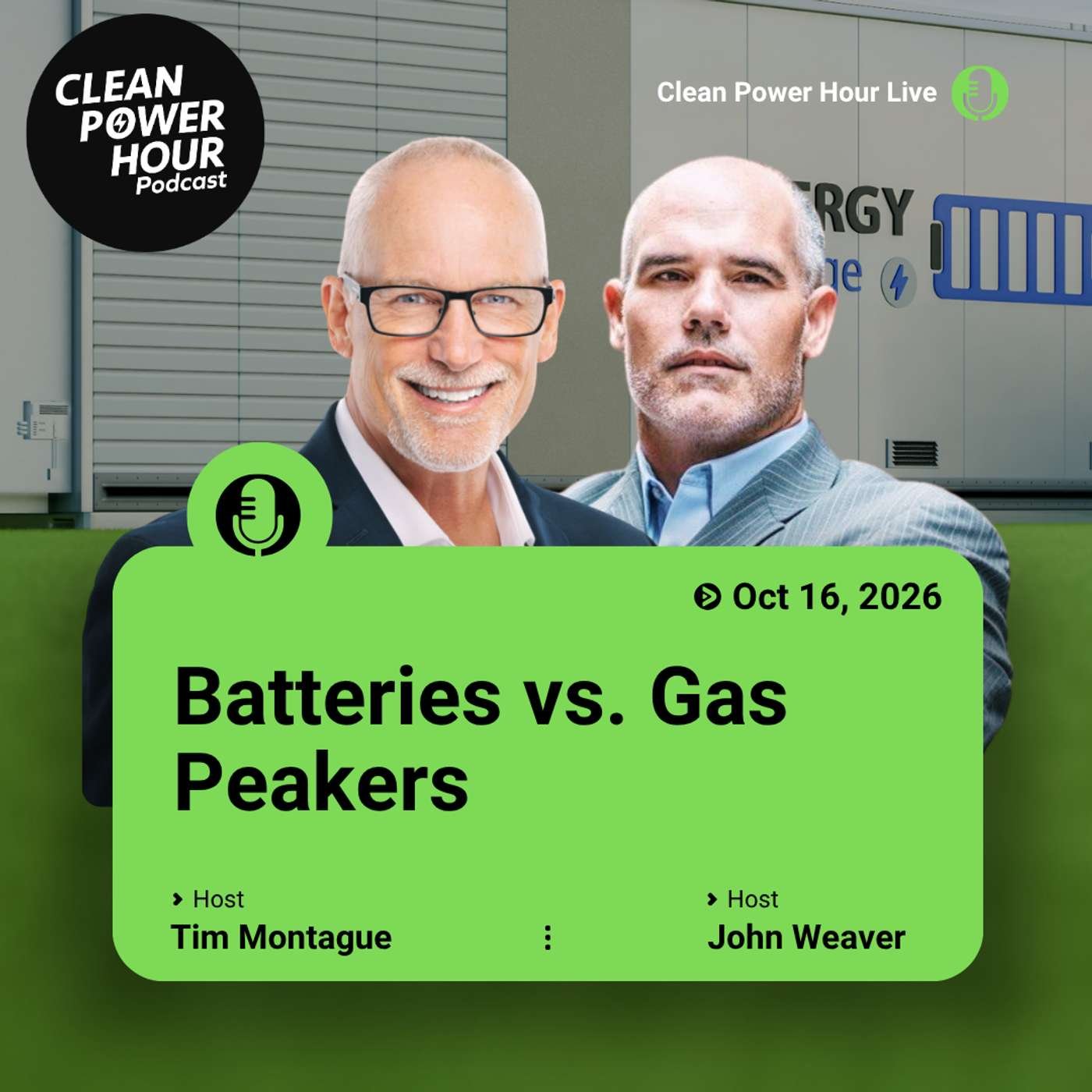
In this episode of Clean Power Hour Live, Tim Montague and John Weaver break down the latest developments in solar, energy storage, and the evolving power grid. They discuss new research showing that four-hour battery storage is becoming cost-competitive with gas peaker plants, China’s restrictions on solar manufacturing technologies, U.S. solar deployment forecasts, and the growing challenges of connecting data centers to the grid.
The conversation also explores solar project quality, the financial impact of equipment failures, and why reliable operations and maintenance will become increasingly important as more developers transition into asset ownership.
Key Highlights
• 4-Hour Batteries Challenge Gas Peaker Economics: New research suggests that four-hour battery storage is now less expensive than open-cycle gas turbines across all 43 markets included in the comparison. (Solar Power World Online)
• The Next Frontier for Battery Storage: As batteries increasingly serve evening peak demand, the hosts consider how storage could reshape other periods of electricity demand and what role wind and other technologies might play. (Ember reports)
• Solar Manufacturing and a Patent Dispute: The hosts examine a dispute involving an American company based in Rochester and a Chinese supplier over patents related to photovoltaic crystal-growing machinery.
• U.S. Solar Deployment and the Tax Credit Cliff: BloombergNEF projections point to several years of strong U.S. solar additions before growth potentially slows as clean energy tax credits phase out. (Bloomberg)
• China’s Solar Market Slows While Other Markets Grow: The hosts discuss projections that China’s solar installations could decline by 29% in 2026 while installations elsewhere increase by 15%. (PV Magazine)
• China Restricts Exports of Solar Manufacturing Technologies: China is reportedly limiting exports of 12 photovoltaic-related technologies, including technologies associated with perovskite-silicon modules and polysilicon production. (Bloomberg report)
• FERC Rejects Most of PJM’s Large-Load Interconnection Proposal: Tim explains why the Federal Energy Regulatory Commission’s decision could add uncertainty to the process of connecting large electricity consumers, including data centers. (Utility Drive)
• Project of the Week: A Nearly 2 MW Rooftop Solar Installation: John shares progress on a commercial rooftop solar project with approximately 1.8 MW of DC capacity and 990 kW of AC capacity. (John Weaver’s LinkedIn)
• Solar Quality Issues Could Increase LCOE by More Than 20%: The hosts review research showing how component failures, inverter downtime, and other system issues can increase the levelized cost of electricity. (PV Tech)
What You’ll Learn
• Why four-hour battery storage is becoming competitive with gas peaker plants.
• How solar-plus-storage could reshape electricity pricing and peak demand.
• What China’s solar technology export restrictions could mean for U.S. manufacturing.
• Why global solar deployment patterns are changing.
• How data center growth is complicating grid interconnection.
• Why solar system quality and ongoing maintenance matter to project economics.
• What developers should consider when evaluating monitoring and energy management solutions.
Connect with Tim
Clean Power Hour
Clean Power Hour on YouTube
Tim on Twitter
Tim on LinkedIn
Email tim@cleanpowerhour.com
Review Clean Power Hour on Apple Podcasts
The Clean Power Hour is produced by the Clean Power Consulting Group and created by Tim Montague. Contact us by email: CleanPowerHour@gmail.com
Corporate sponsors who share our mission to speed the energy transition are invited to check out https://www.cleanpowerhour.com/support/
The Clean Power Hour is brought to you by CPS America, maker of North America’s number one 3-phase string inverter, with over 6GW shipped in the US. With a focus on commercial and utility-scale solar and energy storage, the company partners with customers to provide unparalleled performance and service. The CPS America product lineup includes 3-phase string inverters from 25kW to 275kW, exceptional data communication and controls, and energy storage solutions designed for seamless integration with CPS America systems. Learn more at http://www.chintpowersystems.com
0:55
Welcome to the Clean Power Hour live, coming to you on Friday, october 16, 2026, bringing you the latest and greatest clean energy news. Welcome to the show, my co-host John Weaver. It's good to see you, brother.
John Weaver:
1:10
We don't always have the greatest news. It is a lot of times the latest. Sometimes we have crappy news. I was just listening to what you were saying, Tim, and you know some of our items today are like, damn it, again we got to deal with that again. But other stuff's pretty cool. Well, before I
Tim Montague:
1:25
forget, yeah, the Clean Power Hour Live is brought to you by Commercial Solar Guy and the battery MBA, and you can now get $100 off, John, by going to Clean Power Hour, click on the Resources tab, and click on Battery MBA. The Battery MBA is a great way to sharpen your skills and knowledge in battery development, battery technology, the value stack, etc. And I'm a month into my three month program, so I still have a lot to learn. But they're taking enrollments for January now, and you can get $100 off at CleanPowerHour.com. Go to the resources tab and use the code there. And with that, John, I have one question for you.
John Weaver:
2:16
Which question?
Tim Montague:
2:18
What what rocks your boat in the clean energy industry here in 2026? Like, what gets you up in the in the morning and you go, "Yes, I'm going to tackle this.
John Weaver:
2:31
Owning projects that have a 20-year payback or a 20-year payback with a reasonable revenue that can give my company base pay stability post 2027.
Tim Montague:
2:46
So you are an EPC, but now becoming an asset owner. Yes, and and that includes solar and batteries now, right?
John Weaver:
2:57
Just solar as of yet. The battery one will come next year. Fingers crossed. Still busting my butt getting it, but yes, just solar for now.
Tim Montague:
3:05
Yep.
John Weaver:
3:05
But yes, that.
Tim Montague:
3:07
And the battery project that you're developing that you're going to own is a standalone storage or solar and storage?
John Weaver:
3:13
Solar and storage. So it's going to be a small. It's got 2.4 to 2.5 megawatt hour battery, oversized DC to AC ratio, so capturing just a lot of excess and a really small interconnection. We were limited to 200 kW, and so we just need a big battery to capture it and and work within the program. But we haven't been approved yet. So if you know anybody at DOER, tell them to be nice to us and give us a give us a thought. DOER. Oh yeah, Massachusetts Department of Energy and Resources. They are the ones that will officially approve our submission when we do actually submit it. We have it. We've we've just finished our early reviews. We're now tightening it, and we're we're probably 98% done, but super close to submitting.
Tim Montague:
4:03
And have you settled on technology for said battery?
John Weaver:
4:08
No, we have one or two good quotes. The world has changed a lot since we got those quotes, so we're gonna have to tighten and firm once we get closer. But I don't want to bother anybody and chase too many and talk too many people right now because I don't even have a project. So there's it's I have time. Time is my valuable resource right now, and I got to figure out how to apply it. So talking to batteries and finalizing batteries and going through that stuff-it's just not right now. I know the salespeople want to get it into their pipeline. I get it, but I'm not. Well, I remember. I
Tim Montague:
4:40
remember fondly. We had dinner with EOS, which which is a unique chemistry. It's a zinc chemistry, and I will say that between now and then, or then and now, I have started to notice an uptick in the frequency of EOS in the battery ecosystem here in the U.S. They've been around for a while. They've had some ups and downs, but I think there's a there there now.
John Weaver:
5:09
Yeah, there's a there's a gentleman. The gentleman we ate dinner with, I don't think he's with them anymore. So the sales guy has sales tough job, tough
Tim Montague:
5:16
job selling selling zinc batteries because 95% of the batteries in the U S are are L F P, right?
John Weaver:
5:23
Yeah, I mean when you're the only country company, it's tough.
Tim Montague:
5:28
Yeah.
John Weaver:
5:28
So so yeah, so that's what I'm trying to do
right now. That's my big plan:
5:30
is creating a three quarters financially sustainable company by owning assets, and and that pull me forward. So
Tim Montague:
5:42
here's something for our community to think about, and for you to think about. You know, I would love to host a webinar, live panel discussion. On the topic of batteries as a service and the the platforms that can control those batteries, I had a conversation recently with a company called Wattmore, which I didn't know about. They're out of Colorado. They're in that space. They have announced a partnership with EOS. That it's not an exclusive, but you know there's there's half a dozen at least of these companies out there. Voltice is one. Intelligent Generation is one. Electricity, Rodan, another company I'm in the process of getting to know. Company out of Canada, and many people have never heard of Rodan, but many have. So anyway, if you're listening to this, reach out to me. I'd love to put together a panel discussion on this topic, and we would, you know, get a group of of geeks who are more geeky than you and I, even John, and and have a discussion about this because it's heady days in batteries, and our first story of the week is about four-hour battery challenges gas peaker economics, meaning that at the utility scale, say 10 megawatts to 100 megawatts, batteries are now cost competitive with gas peakers in some geographic markets, and this is a story in Solar Power World Online, which is based on a report out of Wood McKenzie. Their global report on levelized cost of electricity shows that advancing technologies and market dynamics continue to drive divergent prices. With four-hour battery storage now less expensive than open cycle gas turbines in all 43 markets where both technologies were modeled. That's a handful, but a mouthful. But this is a very cool trend, I think. Right? There's there's both gas and batteries are continuing to grow. I think in volumetrically, right? But there's a there's a cross there's a crossover occurring where batteries are becoming more economic,
John Weaver:
8:00
and that's happening across the world. I mean, the Ember they're doing a lot of good reports right now that are cool, lots of pretty pictures and charts, and they've been showing that overnight solar is getting to be cost competitive in a lot of places, especially places that are near the equator or just middle or lower latitudes.
Tim Montague:
8:23
Yeah,
John Weaver:
8:24
you know, once you get northern latitudes, you know, northern Europe, then you got to have some wind. But all this is known. I mean, I remember the former. I can't remember his title. I don't even remember his name. The only thing I remember is that he worked for Nextera, and he he was saying that after 2020, he doesn't see a reason for the United States to build gas peakers because you know batteries and storage and everything were coming on so fast, and this was a person at Nextera. This was somebody who was seeing it right there. He may have been a touch earlier because the price of gas never went up, or something else. But very shortly afterwards, the price of batteries have collapsed, and all across the U.S. batteries are taking up that evening peak period. I mean, that's that's what's driving them in Texas. That's what's driving them in California. And if we look across the world in markets that have at least a solar, we're seeing wholesale prices fall. And now, where storage is hitting, say Australia, we're seeing evening and California, we're seeing evening periods just destroying gas because gas used to be 3040 cents. Now it's like five, or the evening peak used to be like 3040 cents in cost. Now it costs like five cents. So it's happening clearly. It's happening clearly.
Tim Montague:
9:48
What I found really interesting in this article was this graph here on the screen, which shows prices in Europe, North America, and China, and not in all markets, but but in in in for example, coal and natural gas, and there and nuclear, there's a very big difference. PV has a less of a difference. Four-hour storage has less of a difference. But in some technologies, there's a huge difference between Europe, America, and or North America and China. And and that is that is a juxtaposition too that you you see how PV is very tight on the far left right they're very clustered and then four hour storage also quite clustered and
John Weaver:
10:47
then well one reason that gas in the U.S. Is just fundamentally different than anybody else. Is that the U.S. is, I think, the largest extractor of gas in the world. We're also, I think, the largest exporter of liquefied natural gas. So when, and and we're the only country that's doubling the price of our solar hardware with import tariffs. So, when you put those equations together, the U.S. is a different market. Our gas prices are insulated from the world's liquid natural gas pricing. So, Europe right now, you should see solar plus storage destroying gas peakers, even just maybe even catching up with overnight gas too, because now wholesale pricing is gaining on eight, 910, cents a kilowatt hour. So there's, you know, that's a good time to start using storage with wind when you have wind that would be getting shut off. So this is just a progression, though. I the the thing that excites me more about This is wondering, and we we started to see hints of it in California. I haven't paid attention for a few months, but wondering how how the money invested in these units to get into the evening peak period now that the evening peak period is being saturated and taken over by gas or taken over by batteries, and so the price is going down. With all of that happening, how do we? How is that going to roll into the other hours of the day? So there's already a morning peak period that solar and storage is starting to take because as you know, there's a there's a morning peak and an evening peak. People wake up, people are going to sleep, and that's when the demand goes up. Solar comes a little bit after that, and you know, so you have these two peak periods. But now I want to know about the big flat band that starts maybe around 10 o'clock and goes all the way until six a.m. because that's the one we need to attack next. And you know, in the daytime, it's just eaten all day long by solar because we have that big ass big old curve. Sorry, but in the nighttime we don't have enough. We don't have the consistent wind yet. Maybe we'll start moving our hydro overnight instead of in the daytime. Something, but I'm just wondering how how that structure is gonna gonna work out. I'm interested. So the gas peaker movement, wonderful. What's next? How's it going to roll next? I want to see it.
Tim Montague:
13:18
Yeah. Well, yeah. I I I think I think batteries are the answer. So,
John Weaver:
13:26
of course, yes.
Tim Montague:
13:27
For now, I agree. I mean, there there will come other technologies. You know, just like we've seen linear generators burst onto the scene, you know they're a low carbon technology. They're not as low carbon as batteries, but they're a low carbon technology. And now I've started to see them in the news being used in some very large projects. So, because of supply chain, it's hard to get gas turbines, for example. If you're building a data center and you need a gigawatt of supply, you're going to look at all options. All right. Well, let's talk about this. The next story. This secret dispute.
John Weaver:
14:11
So I don't know what's going on here, but some birdie told me I should look at this and be conscious of it. But some company is delivering 10 gigawatts of crystal pullers and 10 gigawatts Of wafer slicing hardware into Texas, and I know of another company who's talking about building a 10 gigawatt solar facility. Yeah, we we
Tim Montague:
14:46
reported on said company last week or two weeks ago.
John Weaver:
14:51
So I somebody has hinted to me that maybe somewhere within this conversation is a hint at the Texan work that's going on, and I haven't been able to work too far deep into it. But if there's other smart people that find stuff out, it'd be pretty interesting. But this might be hints of the Tesla battery or the Tesla manufacturing facility, and I guess I don't know who's going to own it, Tesla or SpaceX, but whomever. And this seems to be related to companies who make polysilicon machines and wafer machines. And somebody elbowed me to look at this. Some of the stuff regarding in this is related to like Ja Solar or J A now whatever
Tim Montague:
15:37
J A Solar.
John Weaver:
15:39
Yeah, well they're no longer J A solar. They dropped to solar.
Tim Montague:
15:41
Oh,
John Weaver:
15:42
they're just now Ja or J A or whatever. I like Ja better because you can say it really because
Tim Montague:
15:47
they're solar and batteries or
John Weaver:
15:49
yes, yes, because now they all. For energy solutions, that's that's what we do now, Timothy. No longer just you know horsepower at noon. So so I'm just interested in this. I'm watching it. You might see coverage coming from PV magazine from somebody who actually researches it and works on it versus just me who's like, oh cool, check it out. But but that I just wanted to point it out because I thought it was kind of cool.
Tim Montague:
17:06
Yeah. So the bottom dollar though is there's a patent dispute regarding some machinery used in PV crystal development, and there's an American company based in Rochester that's suing a Chinese supplier over patent infringement, right?
John Weaver:
17:27
Yep. And this could
Tim Montague:
17:28
come back to bite. I guess it could come back to bite American manufacturers.
John Weaver:
17:35
Uh, it could. Yeah. I mean, if you can't get access to a certain hardware because of technology, then yeah, absolutely. Um. Now that I was just looking at this more as the hint of ooh something cool might be happening that we're looking toward, and this is like you know at the edges of it how these things are working, but yeah, this on a different level it could potentially affect manufacturers. I've only I think we only have Dow Corning. Who's making Dow Corning and or Corning and what's it called? Q Cell. Are those are only polysilicon sources in the U.S. It may be that Q Cell is getting it from Corning, in which case we only have one source. But but anyway, I just thought that was a neat little thing. Somebody brought it up with me, and and that so so cool. I just I hope we build a 10 gigawatt facility. That would be awesome.
Tim Montague:
18:32
All right, the next story you're going to have to share this on screen because it's a Bloomberg story. U.S. clean energy set to reach new highs as tax credit cliff looms.
John Weaver:
18:42
Yeah, yeah. I was just showing that Bloomberg's projecting that we're gonna hit about. Let's me let me find my screen here. Bloomberg is suggesting that we're gonna hit about 4849, gigawatts of capacity in the United States. Actually, technically, in the next two years, this is that their cool chart. They, you know, you can see kind of a flatness right across these three. But if you start in 24, that one's about 52 gigawatts. If you combine the 45, the five, and the two, but then we come over here. We're at like 48 gigawatts, 49 gigawatts, and then here it's slightly lesser, 49, but slightly lesser. So we have three years of almost 50 gigawatts of solar, or two years before Bloomberg thinks it might tail off a little.
Tim Montague:
19:38
Yeah,
John Weaver:
19:39
in the long term, they see it growing again, but you know, my that makes sense, right? The the
Tim Montague:
19:44
ITC the 30% ITC on solar is going away at the end of 2920, 20. Well,
John Weaver:
19:53
technically at the end of 27, but for those who are safe harbored, yeah, and I think it's 2030, isn't it?
Tim Montague:
20:00
Well, I think it's the end of 2029, but and 2030. 2032 for batteries, yes,
John Weaver:
20:09
and it's actually 2033 for batteries. Now they extended it. Oh, the yes. So everything else within the ITC goes through the end of 20. Yeah,
Tim Montague:
20:18
I I say this often in my meetings with clients and and interviewees, that we're in a boom because of the phase out of the ITC, and then there is a bust after the boom, and hopefully that bust won't coincide with the bubble bursting in the AI economy because that's going to be a rough down downturn. We will survive most likely the AI bubble burst, but I listened to a great TED talk last night when I couldn't sleep, and he just went through all these different booms and busts, starting with the British railroad boom in the 1800s, and it's just like yeah, it's very common sense that there's going to be a a boom and a bust, and nobody can predict exactly when the bust happens. We're in the boom; that's already happened. AI is some big percentage of of the U.S. stock market growth now, and it's a huge percentage of the infrastructure investment that's happening in the U.S. and we will we will overbuild and then it will collapse and then and then we'll rise up again underneath it just like the internet right there was an internet boom and a bust and we still have an internet economy and as long as the robots don't take all. Our jobs, all as well.
John Weaver:
21:46
As depressing, Tim. Jeez,
Tim Montague:
21:50
I, I, it's it's the it's it's it's the way of the world, and you know there is a silver lining to this. We have to live every day to its fullest. You just don't know what tomorrow brings.
John Weaver:
22:06
I agree.
Tim Montague:
22:07
What's our next story? It is
John Weaver:
22:09
a projection of tomorrow. China for 2026 is projected.
Tim Montague:
22:19
Oh, this is another Bloomberg story, right?
John Weaver:
22:21
Yep, but I wrote it on PV Mag, but Bloomberg is seeing that China, on a global level, is going to be down 29% this year. Everywhere else, up 15% But what that is going to lead is that globally, we're going to deploy about 10% 11% less in 2026 of solar than we did in 2027, we'll more than make up with that and say battery capacity, but that's not the same thing. But battery capacity does enable a lot of solar, maybe a similar amount that we're not installing. But it's just it's an interesting little point of where we're at as China. You can see this interesting little chart here. Let me widen this a little bit. You can see China here is peaked maybe last year, 373 gigawatts is roughly what that was, and this is still 250-ish gigawatts of solar being deployed. You know, it's just above 252, so it's not like they're not going to install the most more solar than anyone else in the world, but they might only be 50% of the world's solar versus say 80% which maybe it's good, maybe it's not. I don't know, but you know it does mean that we might not hit a terawatt anytime soon, which really makes me a little sad, but such is life. But I just thought this was interesting. That the most interesting piece is China's down 29, the world is up 15% and that's cool. That's positive. And and then here's a second chart. I'm going to get to write an article on this soon, but let's see. Open image a new tab. Let's so this chart is investment in well this one's focusing on collocated solar and storage, but global new investment in renewable energy, and the thing about this chart that I think is the most interesting is this bottom one, small scale solar, small small scale is simply not utility. Even though Jenny Chase at Bloomberg says it's a little blended, but if you look closely here in these last three calves, you know once we got past second half 24 utility was massive, but h1 25, small scale is the biggest. In fact, it's the largest globally. Again, here second half maybe they're equal, and then maybe onshore wind equaled, but we're back in h1 2026. Small scale solar is the world's largest global new investment sector. Now, part of this is related to the fact that small-scale solar costs more-2030, 50% 100% more. But I don't care. It's revenue that's moving through, and it's moving to labor, it's moving engineers, developers, whatever it is, and it's it's the number one, and I want to explore that more, and I'm interested in it. Jenny Chase said that small scale was growing more consistently or faster than utility scale. It's a different chart that I have in my inbox. It's not in my article, but it shows going out pretty much. Utility scale has not. It's reached you know really big numbers. Similar, you know how China's number was really really big, and then it just kind of goes out flat for a while. Utility scale was really really big in terms of capacity. You know, small scales like 80% 70% of it, but it starts growing going out. Whereas utility scale, they're seeing. Hey, maybe we've maxed out the rate at which utility scale is going to be deployed. So that just was interesting to me. And of course, I'm biased towards small scale solar because I like small scale solar. I do small scale solar. I want to get into medium size, up to 20 megawatts. That's my 2029 plan, but um, but yeah. So and then and then in 2030 is
Tim Montague:
26:29
when John takes over the world.
John Weaver:
26:32
No, no, it's gonna take a little longer, a little longer. 2035.
Tim Montague:
26:41
Yeah, I think that's. I think that's very cool. I wonder if the colocation aspect of that study is is why distributed is is going head to head with utility. But I don't know.
John Weaver:
26:55
Well, yeah, I thought about that too because then it's going to remove. But if you look at the so I don't have it on the screen right now, but if you actually look at that chart, the volume that's collocated here, I'll share it with you. It's tiny. It's just it's growing fast. That's why the article showed it off. But here, so collocated, it's this fuchsia color right here. So look here, it's really not that big, but it's probably you know 50% batteries. No, no, probably 33% batteries, 66 solar. So maybe it could pull them close, maybe even them. You know, it'll get close, um, but it's not you know fully pulling it. So, so that's so that so those other so the yellow
Tim Montague:
27:49
bars are just solar alone.
John Weaver:
27:52
Yeah, yeah, yeah. So, so the the light yellow is small scale, big scale.
Tim Montague:
27:58
Yeah.
John Weaver:
27:58
Then we have wind, wind, and then collocated, and that's that fuchsia. What about what about
Tim Montague:
28:04
standalone storage? Because there's going to be a lot of that too, I think.
John Weaver:
28:08
Yeah, but for some reason it wasn't put into this chart. I don't know why.
Tim Montague:
28:12
Yeah,
John Weaver:
28:12
it just yeah. Maybe this is just energy, and they're not defining standalone as energy in this case. I don't know. I thought about that at one point. Standalone, because standalone solar is probably going to be, I don't know, half utility scale or quarter of it. It's going to be a big chunk. Not going to be nothing. So you know, I'm sure that there is definitely an effect of the co-located taken over a bit, but it's not fully there. So, do you want me to talk about this next one? I thought this one was interesting.
Tim Montague:
28:53
Well, yeah, you got to put this on screen. 12 photovoltaic technologies related to polysilicon manufacturing, wafer manufacturing, and cell Manufacturing, China is limiting their export, right?
John Weaver:
29:09
Yes, yes, and I got into the details. Actually, Michelle, who works for us, she's Chinese, and so I needed her help to get in and actually read these because I don't I don't get them. It's it's hard to get it the translation stuff to get where I want, but there's technologies that they're not allowing to be exported. That includes perovskites. That includes certain things related to polysilicon. This is, I mean, we're conscious of this. We've seen it. It's actually probably related to Tesla. I think Tesla was trying to get Maxwell to give them a perovskite silicon.
Tim Montague:
29:54
Do you want to put the Bloomberg story on screen?
John Weaver:
29:56
Oh yeah, sure. Sorry, pardon me. That that those are the 12 technologies in that list. But but here's the story from Bloomberg. So, so China is going to restrict several solar technologies. Is the article along with other items, and they talked about 12 specifically. Now the article goes to a Chinese website, so that's why I had to like get it on the blue sky and translate it. Yeah. And the 12 technologies include technology that can make perovskite and silicon modules, as well as technology related to the production of polysilicon. So those are the two two main chunks that were mentioned here. And then you know it's there's also like Topcon and other things, so copper electro plating, thin film deposition for HBC and. Why do you
Tim Montague:
30:51
think? Why do you think China would want to limit the export of these technologies?
John Weaver:
30:59
This is the energy war, man. This is the leading energy technology on Earth. People who have this will have countries that can weather events such as blockades of the Middle East.
Tim Montague:
31:16
Wouldn't if you were if you were making that technology though? Wouldn't you want people to buy it and prop up factories? The alternative is then everyone has to buy your stuff from China, right? Would you
John Weaver:
31:29
rather sell them the cars or the car factory? I'd rather sell the cars because once they have the car factory, they don't need you anymore. I'd I'd rather slow them down a little bit. If I'm a GOP. Politically minded manufacturer, I want to. I don't want to give up too much too fast. Yeah, I mean that's my thought here. Yeah, they're keeping this. Yeah, it could be either a little bit longer.
Tim Montague:
31:54
It could be, and I don't. I don't think that's going to stop people from making solar technologies, though. Right? Look at look at the tandem boom that's happening, and that's that's going to have some unique machinery that's made elsewhere, not in China. They're they're making it in China too, but they're making it in Los Angeles, right?
John Weaver:
32:21
Yeah.
Tim Montague:
32:21
So, Yeah, who knows? Who knows? I mean, it's so it's so interesting how China has just they created a long term plan. They invested a ton of capital in building their clean economy. They're still building a dirty economy too. They're building coal plants. They're they're building natural gas plants, but you know I think they've reached 50% of of EV sales now. Some big percentage of new cars are electric, and if you want to buy solar panels, 70% of them are made in China, so. But we're on showing. We're we're we're. I mean, as you well know, John, we're we're making 50 gigawatts or so of solar panels in the U.S. now.
John Weaver:
33:17
We're assembling 50 gigawatts, which is what this prior article is very interesting and related to, because we're not yet making the poly, we're not yet making the wafers. Yeah, we're importing. We're
Tim Montague:
33:29
importing the wafers and cells.
John Weaver:
33:32
Yes, but we're progressing. And but there's a reason that people want to do this nowadays. This is the. This is this is the future, dude. This is how people are weathering the storm of geopolitics now, and this is a start of it.
Tim Montague:
33:50
Yeah. Well, I I hope you're right. I hope I hope we are going to weather the storm, but only time will tell. All right, FERC rejects most of PJM's large load interconnection plan. Yeah,
John Weaver:
34:07
what does this mean? This was your story. You got to help me here. Does that mean they're not going to allow as many data centers?
Tim Montague:
34:13
Yeah, let me get this on screen. Because while you're
John Weaver:
34:16
working that, I'll mention last Tuesday, this past week, I was in a town meeting in Seekonk, Massachusetts. We were working on zoning to get a a small carport in a in a parking lot approved. It was more of a formality, but in this meeting, there there were two public things before us: town town law changes and stuff, tiny things. Well, the first one was tiny. The second one was the town of Seekonk voted to ban data centers right in front of me, and a vote of six to nothing. I don't think it's very real because there's like no space in the town of Seekonk apparently. But yeah, yeah. Well, I mean, one of the guys he said that he's like he goes, yeah, we did a paid over the whole
Tim Montague:
35:08
town with a data center. Yeah, I mean, he
John Weaver:
35:12
he said something like that. So, but it was interesting. There were like 1015, people in the town meeting, and they were all there for this thing, and and there was some joy there. And I think we got some dirty looks, Benji and I, because we were all dressed, you know, trying to be professional and stuff. People were probably like, "Are you here to defend the data centers? And I was like, "No, lady, we're here to do solar. All right, where are you putting the solar? So, so it's interesting. So, what is this large road interconnection plans? What don't they? Well, it's
Tim Montague:
35:42
not entirely clear. My takeaway is that the need for capacity remains strong, while the rules for connecting new demands remains unsettled. So PJM made a proposal to FERC. FERC is the overlord, and FERC said we don't like this, and one of the reasons was it didn't give states enough control. I I perceive it as more friction, honestly. But even though the Trump administration is seemingly pro AI and pro no regulation on AI, which would which would say to one if that they would want to incentivize quicker interconnection, right? And but but PJM is faced with a you know a wave of applications. Right, that they have to negotiate with other things going on in the economy. Right, they can't just give all the interconnection to to the data centers. Right, there's other things that need interconnection to the grid. So, yeah, it's it's just not clear. But the proposal was large customers without matching new generation could connect if they accepted curtailment ahead of grid emergencies, and and that was one of the one of the key components. This curtailment piece, and FERC said this intruded on state authority. So, in general, I think the the the bring your own theme is a a rising theme, right? States are saying we want you to come to our state, but we want you to bring your own power so that you don't cause spikes in the cost of power locally, which it is already doing, right?
John Weaver:
37:52
Yep.
Tim Montague:
37:52
Data centers are causing power prices to go up.
John Weaver:
37:59
It's um, it's it's fun to watch this evolution of our power grid and this stuff, I remember the when this gentleman I can't remember his name Terry Norris, I think he used to work for a long time ago. He worked for the big group out west, Cypress Creek Renewables, as a developer, and then he moved to a group in North Carolina, and then he maybe worked for the state, and now he works for Google, and I think he works for Google. I know he works for Google because he's the one that wrote the paper along with someone else that said if data centers would allow themselves to self curtail during complex moments, like 27 times a year, for an hour or three, then you could get 99% 90% integrated with zero grid upgrades or some minuscule number, saving 90% whatever it was. Yeah. And so I remember that, and now we're getting to watch how batteries are just being put at data centers to manage that 123 4% of the time, which is sort of like a gas peaker. It's the exact same thing. We're also seeing people put gas peakers at these things because of speed to market, speed to power, which is this neat little terminology I've learned, and balloon energy for some reason-not for some reason, but for another reason, is part of this speed to power game. Is getting a bunch of these units plugged into the gas grid versus the
Tim Montague:
39:32
electrolyzers.
John Weaver:
39:34
Yes, it's another thing. So just watching all these little things dance. Electrolyzers. Is that
Tim Montague:
39:39
what they are, or no? Oh, fuel cells. Sorry. Fuel
John Weaver:
39:42
cells. Yes, but I think a fuel cell includes an electrolyte. The the
Tim Montague:
39:45
opposite. Well, a fuel cell converts a fuel to electricity, so you put in methane or you put in hydrogen, and out comes electricity. And in this, and and in most cases, it's natural gas that they're burning, and the emissions are non-trivial. So we have to be careful about fuel cells.
John Weaver:
40:04
Yes, and in this case, they're burning gas from the grid, which is slightly well. I don't know. They're not burning gas from the grid. They're separating gas from the grid. But I don't know if there's a difference. If the difference, there are the emissions are the
Tim Montague:
40:19
emissions are lower when you run gas through a fuel cell than when you run it through a combustion engine. That's that's the difference. It is it is healthier. the The effluent is healthier, but it is still generating greenhouse gasses. the the the The thing that stands out for me is a project in southern New Mexico called Jupiter. If you just Google it, Jupiter data center campus, it has it's using these bloom fuel cells, and the emissions of that one campus are greater than the city of Albuquerque, which is the largest city in New Mexico. Now Albuquerque is a city of 250 300,000 people. It's not a huge city,
John Weaver:
41:06
but whatever. But still, but
Tim Montague:
41:08
still, so yeah, we want AI data centers because you know I like ChatGPT and Claude is my best friend. You know, so we we got to keep them around. We want them to not take over the universe, but more importantly, we don't want them to stop the net zeroing of the economy by 2050, which is still possible. I don't know how likely, but it's still possible. I take a stand for greening the grid by 2050.
John Weaver:
41:43
All right.
Tim Montague:
41:44
I don't know if I'll be alive in 2050, John.
John Weaver:
41:47
Send you to the moon. Do you want to do project of the week?
Tim Montague:
41:53
I would be. I would be like 90 years old. Yeah. What the heck?
John Weaver:
41:58
Project of the week, man. Gotta show it off for me, please. It's nice.
Tim Montague:
42:06
Really,
John Weaver:
42:07
I like it. You know what that thing is? I like this picture because it's from afar. This oh, this is
Tim Montague:
42:14
your shiny metal Friday.
John Weaver:
42:16
Yes, shiny metal Friday.
Tim Montague:
42:22
You show off.
John Weaver:
42:23
So not yet. It's working.
Tim Montague:
42:25
Okay. Here we go. So
John Weaver:
42:26
there it is. There it is. So you can click on that image. So this is a cool picture. I thought because it's from the street. But what this is, it's a CT cabinet. Those pipes you see, they're going over a door, which you can't even see because the CT cabinet is massive. On the other side, where the CT cabinet's going, you'll have the main AC panel, the disconnect. But this, if you go like the next picture or two, those are the pipes coming out of the back of the CT cabinet that are going to go into the wall.
Tim Montague:
42:55
Yeah.
John Weaver:
42:55
Then they'll go into the building, and then right into the back of a panel that's on the right on the opposite side of that whole set of gear, and there's, I believe, six going in and six going out, or it's, I think it's six in and six out, but there's like two or three sets. How big is the solar
Tim Montague:
43:16
project?
John Weaver:
43:18
Uh, 990 kW AC, just short of 1.8 megawatts DC.
Tim Montague:
43:24
Wow! So two megawatt solar project, two megawatt DC solar project. You're looking at what you're talking about. It's a big piece of gear, and
John Weaver:
43:35
CT cabinet.
Tim Montague:
43:36
There's probably not room in the electrical closet on the other side of that wall, which is why the cabinet goes on the outside of the building.
John Weaver:
43:45
Yeah, we well absolutely yeah. I mean, and this is just cabinet number one. There's going to be about three or four more others, but yes, that electric room is mostly full.
Tim Montague:
43:54
Yeah,
John Weaver:
43:54
and absolutely prefer to be outside in this case.
Tim Montague:
43:59
Well, it's easier to access, which is nice.
John Weaver:
44:02
Yes, I mean it is in the weather, which means today we're not working there, which is disappointing because we would like it's because it's moving along nice. But you know this is this the building we got, and we're maxing out that roof. I'm gonna have a picture soon where you get to see that whole roof filled up really nicely.
Tim Montague:
44:21
So that that lift that's installed there. Is that temporary or permanent?
John Weaver:
44:27
Yes, that's a temporary. Yeah, where you can see along the bottom. You can't see it yet because it's not in place. But in a different picture, we have it. But along the bottom, you can see a rail that is for the unit to rest on. That's got angled bolts going into the concrete. The concrete wall is solid. See that big old white pile of stuff that's on the ground.
Tim Montague:
44:47
Yeah,
John Weaver:
44:48
that's that is from drilling holes in the concrete. Yeah, that was the wall. That's we had to get. Yeah, we had to get a structural approval just to make sure that the number of holes we were making weren't too much, and you know that type of stuff. So, so this is my project of the week. It's moving along. So it shifted hard into electrical, as racking and modules are racking and modules. We have it at like 99% plus on the roof. We're just we're touching up and are you
Tim Montague:
45:17
using that concrete ballast? No racking. Not
John Weaver:
45:20
on this one. This one is DCE solar.
Tim Montague:
45:23
Okay.
John Weaver:
45:25
Yeah. So the it just the timing, the sizing worked out. DCE just fit better with this particular site. Costing was a little stronger, and it's just so square. And this is just a giant square roof. That the way DCE's product works, it's just very interesting. So it just fit perfectly. This is a 1-234-567-8910, nine or 10 big chunks of solar, and the the square nature of DCE really just kind of fit well.
Tim Montague:
45:59
Cool.
John Weaver:
46:01
So what do you think? One more story, or yeah, let's do one.
Tim Montague:
46:04
Let's do one more. Quality issues or
John Weaver:
46:10
Helio or price floors? What's your emotion? You want to know about quality and extra gear on the roof, or do you want to know about pricing and what the floors are? I mean, technically, the price floor doesn't apply to us because this is global pricing, and in the U.S. we have tariffs smacked all over us. So
Tim Montague:
46:29
yeah, let's talk about the quality issues raised. PV systems LCOE more than 20% Everybody
John Weaver:
46:36
know what LCOE is? Levelized cost of electricity. So
Tim Montague:
46:40
story in PV tech. So essentially,
John Weaver:
46:46
the failures of components, the downtimes of inverters, and the other negatives will lower the amount of electricity you generate and increase the cost to get it working, which effectively makes the price of the energy you are allowed to sell to be financially viable, 20% higher, which is a lot, whole lot, 20% huge.
Tim Montague:
47:16
Yeah, and and there, I mean, there are many signals, and I was curious what Heliovolta is, so I looked it up. It looks like they're an O and M company.
John Weaver:
47:29
Yeah, yeah, they do a lot of research.
Tim Montague:
47:32
But there's a there's a lot of data coming out of the field, right? That that solar projects are underperforming. You you always have a model, and that's what you know. The project finance is written around that model. It says you're going to produce so many megawatt hours, right, of electricity, so that you can bank on that revenue, and then the projects are underperforming. Not all projects. It's a spectrum, right? But we need to be very cost. I mean, we need to be quality conscious in this industry, right? There's, there's too many projects that are underperforming. Do they say what percentage of projects are underperforming?
John Weaver:
48:24
Well, it's actually right where you were. One in 10 had critical issues. 87 had a major, but major corrective doesn't mean the site's down, of course. Yeah,
Tim Montague:
48:34
one in 10 had critical issues, and then 87% had major issues. Wow!
John Weaver:
48:41
And a major might be, you know a chunk of trackers not moving properly, so it has an effect. So it can still it can still produce, but you know it's an issue.
Tim Montague:
48:56
Did they talk about where the projects were that they were including in this? These were
John Weaver:
49:02
U.S. and Puerto Rico for Helios. Yes, they focus. So they've put out some interesting reports recently, including one that I really was interested in, where they talk about the rapid shutdown devices. All this extra hardware that we're putting on the roof. All this extra hardware causes you got to deal with stuff because if you have extra gear up there, extra stuff that's running, extra pieces of metal, this is extra stuff to break, and all this extra hardware drives issues. So, oh, I I subscribe to PV Tech, Timothy. I can jump in there for you, but they said that one line that I really liked. They said our modeling reveals that the gap between an A-rated system and an F-rated system would drive the LCOE by 20%
Tim Montague:
49:59
Yeah.
John Weaver:
50:01
So you know that's a that's a chunk, and they said and and they had a nice little scoring system. So an F rated system has an LCOE that jumps by 21% A B would be a 7% increase. So if you're A, you're only up to 4% So so that let's you know you can have up to 4% loss, but that's still 4% higher LCOE. It's not 4% loss. It's 4% higher LCOE. So you tell this customer, hey, I'm going to save you 500,000 a year, but you're only actually going to save them 484, 6440, Cole, what's Going on, that's nice comment. Thanks.
Unknown:
50:46
Yeah,
John Weaver:
50:47
good for my self-esteem. So yeah, so you want to keep these things running, man? I'm thinking about it nicely hard right now. As you know, as I become an asset owner and I'm trying, and I'm going to become economically dependent on solar power systems. My, I'm gonna.
Unknown:
51:03
Well, you already are
John Weaver:
51:04
money. Well, that's true. That's true. Her well-being depends
Tim Montague:
51:10
on solar,
John Weaver:
51:11
self-esteem, everything, dude. All of it. It's all tied into this damn job. But are
Tim Montague:
51:16
you in the O and M space yet, John?
John Weaver:
51:18
At the very edge of it. But yes, we are. We have three or four regular O and M companies customers who have portfolios that we're working for, and soon I'm going to be my own O and M company because I hope to have about four to five megawatts of projects owned by the end of next year. Right. We have
Tim Montague:
51:37
a we have a comment from Jason also. One of the big challenges with smaller systems. Is ownership thinking that solar does not need any attention, combined with the financial viability of third-party monitoring for smaller systems? Yeah, I mean, I think it's still a little bit of the wild west with monitoring, and I mean, I know a few monitoring platforms, and there's there's more to come. There's well, what's the
John Weaver:
52:07
gentleman that comes on your show? I just forgot his name. Deet no Deet no. What's his name? Uh, he comes on your show. He makes a beautiful denah Denawats. Oh, Denowatts.
Tim Montague:
52:18
Yeah.
John Weaver:
52:18
Yes. Jeez, Jeez. Dieta Watts has a good solution. But they're not cheap. Yeah, but it's not cheap like what was just said. You know, for a small system, you're still talking like what Jason just said. Third-party monitoring, financial viability. That Denowatt still costs 10 G's plus if you want like a real nice system on your roof.
Tim Montague:
52:39
Yeah, and Denowatts is really for small utility community solar. So for for smaller systems, for small CNI or residential, you would you would lean towards something else, maybe a Sun Boy. I don't
John Weaver:
52:57
even know what that one is. Interesting. What does that one cost?
Tim Montague:
53:00
I I don't a penny a watt, something like that.
John Weaver:
53:04
Interesting. Yeah, monitoring is important. So,
Tim Montague:
53:08
there's Watch.io. Have you looked at them?
John Weaver:
53:12
I've heard of them. I heard of them. When you were talking about that list of companies, including Wattmore, as part of the solar project that I'm talking about, the Solar Plus Storage, I have a list from Selectria of approved third-party EMS companies, I guess is that B. Yes, that's going to be an EMS energy management software company.
Tim Montague:
53:34
Okay. So
John Weaver:
53:34
including Battalion Energy, who's run by the team that used to be at Energy Toolbase. Okay. So Battalion Energy's on that list, and so when you do that show, I can give you give you a couple names too, if you want. Yeah,
Tim Montague:
53:47
send me that list. That's interesting. Oh
John Weaver:
53:49
yeah, yeah. It's a it's the the group that was approved by Selectria and their solar plus storage DC coupled system.
Tim Montague:
53:56
Cool. All right, all right,
Unknown:
53:58
Tim.
Tim Montague:
53:58
Check out all of our content at Clean Power Hour dot live. Sorry, cleanpowerhour.com. Tell a friend about the show. That's the best thing you can do, and meet with us in Vegas. Are you going to Vegas, John?
John Weaver:
54:11
I will be in Vegas.
Tim Montague:
54:12
Yeah, we're going to Vegas middle of November, so it's coming up. So come to Vegas and hang out with us on the show floor or after hours. And John, how can our listeners find you?
John Weaver:
54:25
commercialsolarguy.com. You can give us a phone call 5084999 stun because we have a cool number because we're cool like that. But commercialsolarguy.com or my email john@commercialsolarguy.com. You could also come to Cambridge and I'll buy you a beer.
Tim Montague:
54:43
That would be very old school to email you, but with that, I'll say let's grow solar and storage. Thanks so much. We'll see you in two weeks on the 30th.