
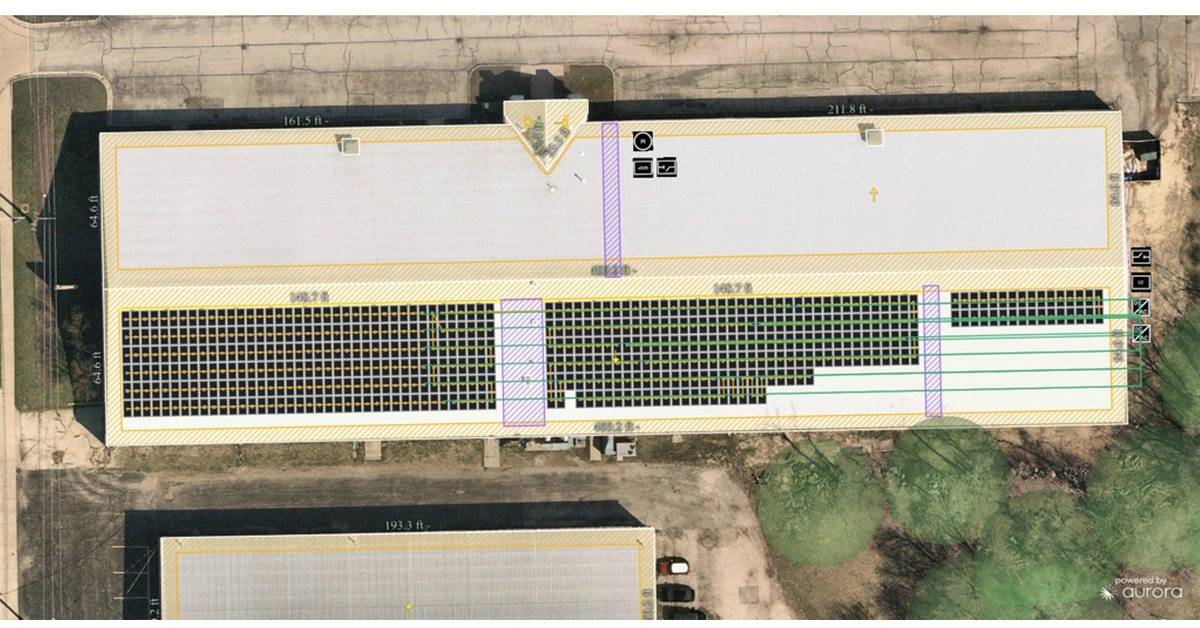
The 54,000-square-foot Victory Pickleball looks ordinary from the parking lot. Inside, fifteen indoor pickleball courts host leagues, lessons, and open play seven days a week. Hiding on the southern roof is a 250kW solar array, while on a pad behind the building, a 2.12 MWh lithium iron phosphate battery is finishing commissioning. Together, these two assets are reshaping the energy economics of a class of building that almost never gets solar attention: the indoor recreation facility.
The owner and technology entrepreneur turned pickleball developer, Tim Ancona, did not invest his time and resources in this project to make a statement. He did it because the math worked. “The state of Illinois and federal incentives stack nicely and give me almost free electricity,” Ancona said. “That’s a pretty good deal. And the battery gives me more free electricity because it offsets the delivery charges, and it promises an income stream.”
That is the core lesson: Solar pays the energy bill by offsetting supply charges. Storage pays everything else.
The system
The rooftop array is 254 kW DC, 200 kW AC and flush mounted, using 472 monocrystalline modules at 540 watts each and two 100 kVA three-phase string inverters tied into the building’s 480Y/277V service. The system was sized to net annual production against the facility’s pre-project load. Modeled year-one production is roughly 308 MWh against a baseline annual consumption of about 309 MWh. On an annual energy basis, the solar offsets close to 100 percent of the facility’s original electrical load. The building remains a customer of the grid every day, but on the meter at year-end, host load and PV production effectively net to zero.
The battery is a separate animal. A 530 kW, 4-hour, 2.12 MWh system sits behind the meter and runs under a third-party aggregator’s dispatch. It is not there to firm the solar. It is there to harvest four distinct revenue and savings streams that solar alone cannot touch.
The value stack
The owner is monetizing the battery in four ways. First, monthly demand charge reduction. The model shows roughly a 13kW shave on average billed demand, and a much larger 595 kW reduction in capacity-tagged peak load. Second, transmission charge reduction, tied to peak load contribution measured during the regional grid’s coincident peak hours. Third, capacity market savings, where the avoided peak translates directly into reduced annual capacity payments. Fourth, frequency regulation, where the battery bids into the regional wholesale ancillary services market and earns revenue for ramping up and down on grid signals.
This is the part of the project that drives the headline financials. With solar only, the modeled simple payback was 4.3 years, with a 13.6 percent IRR and roughly $216,000 of 15-year net savings. Adding the battery raises capital expense by about $1 million but compresses simple payback to 2.3 years, lifts IRR to 21.3 percent, and grows 15-year net savings to roughly $1.06 million. The battery is the financial multiplier, not the solar.
Read the full article at nacleanenergy.com.