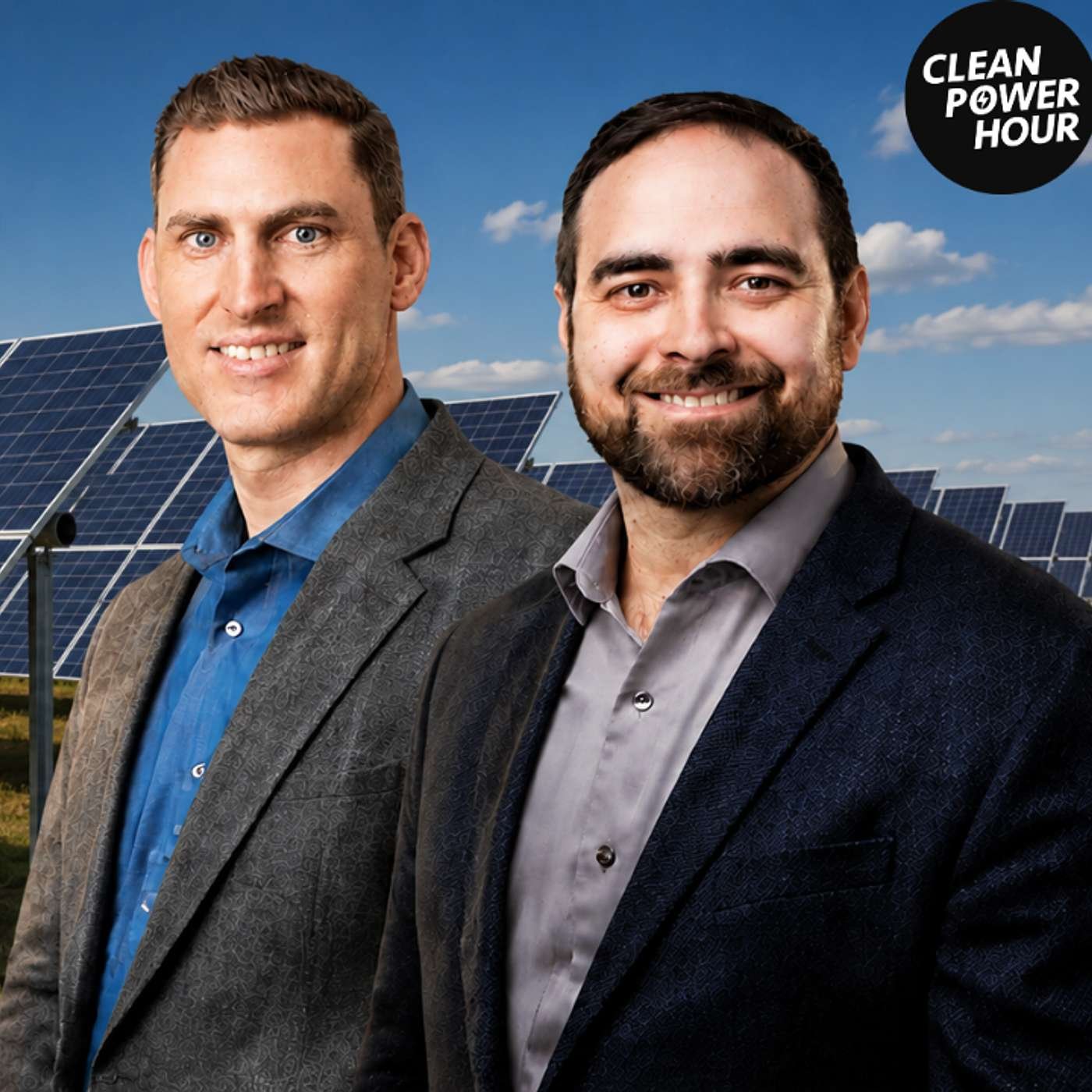
Solar asset management inside a 35-year ownership model: CJ Colavito and Jay Smith of Standard Solar explain what it actually takes to own distributed generation projects for decades, from evaluating tracker and inverter reliability to redesigning inverter specs around eventual failure.
In this episode of Clean Power Hour, Tim Montague sits down with CJ Colavito, General Manager of Integrated Project Teams, and Jay Smith, VP of Operations and Maintenance and Asset Management, to discuss what they have learned from developing, building, owning, and operating commercial and community solar projects.
The conversation goes deep on one of the biggest challenges facing the solar industry: how to balance cost, performance, reliability, and long-term asset value.
Tim, CJ, and Jay also discuss:
• Why thorough project diligence can reduce delays, change orders, and budget overruns
• Standard Solar’s integrated project team model and its focus on execution excellence
• The challenges of rooftop solar and why project scale matters
• Connector reliability, wire management, and lessons from thermal events
• What Standard Solar looks for when selecting tracker technology
• Tracker reliability, maintenance, snow shedding, and hail protection
• Standard Solar’s approach to inverter selection and long-term reliability
• Why inverter failures can have a much greater financial impact than the initial equipment cost
• The importance of manufacturer support and warranties over the life of a project
• How changing supply-chain and foreign entity requirements are affecting equipment decisions
• Adding AC-coupled batteries to existing community solar projects
• How Standard Solar is adapting its business as the solar market and technology continue to evolve
The episode comes at an important moment for the industry. As solar portfolios grow and assets age, the focus is increasingly shifting from simply adding megawatts to ensuring those assets can perform reliably over the long term.
Listen to the full conversation for an inside look at how an experienced solar owner-operator thinks about technology, reliability, O&M, project execution, and the future of distributed solar.
Connect with Guest
Connect with Tim
Clean Power Hour
Clean Power Hour on YouTube
Tim on Twitter
Tim on LinkedIn
Email tim@cleanpowerhour.com
Review Clean Power Hour on Apple Podcasts
The Clean Power Hour is produced by the Clean Power Consulting Group and created by Tim Montague. Contact us by email: CleanPowerHour@gmail.com
Corporate sponsors who share our mission to speed the energy transition are invited to check out https://www.cleanpowerhour.com/support/
The Clean Power Hour is brought to you by CPS America, maker of North America’s number one 3-phase string inverter, with over 6GW shipped in the US. With a focus on commercial and utility-scale solar and energy storage, the company partners with customers to provide unparalleled performance and service. The CPS America product lineup includes 3-phase string inverters from 25kW to 275kW, exceptional data communication and controls, and energy storage solutions designed for seamless integration with CPS America systems. Learn more at http://www.chintpowersystems.com
0:51
As an industry, we need to work. We need to look at the inverter product specifically based on reliability, like third-party, independently audited reliability, and then you have to bake that reliability into your financial assumptions. No developer is going to do that. No developer wants to do that, but that's the reality, and that's how these systems operate.
C.J. Colavito:
1:11
So two out of the three, when we have an inverter go down, or if we have a thermal event, how much I paid for that inverter is minuscule compared to the impact, to our lost revenues, to the cost of the truck rolls, to the reputational damage that could be caused, to everything. So,
intro:
1:31
the clean energy industry is moving fast. The deals are getting bigger. The technology is evolving, and the stakes have never been higher. Welcome to the Clean Power Hour, the podcast for solar, storage, and microgrid professionals who want to stay ahead of it all. Each week, your host Tim Montague, industry advisor and president of Clean Power Consulting Group brings you unfiltered conversations with the leaders actually building the energy transition. Now, here's your host, Tim Montague.
Tim Montague:
2:05
Standard Solar's been building distributed generation since before most of the industry knew that what DG stood for half a gigawatt of safe harbor modules, 400 operating assets, dozens of funds, and a company that just tore down its own org chart to build them better. Today, two of
the people who run it:
2:23
CJ Collavido, general manager of integrated project teams, 18 years in, and Jay Smith, who runs operations and maintenance, which means he owns their projects for the next 35 years.
C.J. Colavito:
2:38
C.J. Collavito, general manager of integrated project teams. This is a position I took over about a year and a half ago. Standard Solar decided to go through a significant reorganization, where primarily we were looking at destroying, tearing down silos between various
departments:
2:55
engineering, construction, transaction management, in coordination with business development and field operations and engineering, to create cross-functional teams where you have the same project engineer, the same project manager, and the same transaction and diligence specialist engaged from early stage diligence before we acquire a project, looking at all the fatal flaws, the issues, understanding the story behind the project before we decide to acquire it, and we prepare it for investment committee approval, and then that team carries it all the way through design, construction, commissioning, and final completion before we transition it over to operations and maintenance, because they are no longer separate departments with separate management. We have a cross-functional team that provides a lot more ownership, accountability, collaboration, and teamwork throughout the whole process. Rather than managers pushing, I want to focus on this technical issue or or that issue, we're looking at the whole picture. How does this affect the returns on the project? How does this risk really manifest itself within the long-term operations? Is this a significant construction issue or not? So it allows us to be more efficient, do more effective work up front during the diligence phase, which makes the design and construction phases much much smoother and go easier, and then we see less delays, less change orders, and less overruns on on budget than you would if you didn't have that thorough diligence and the engagement of the folks who are living with the project through the entire life cycle at the beginning, so we I was with I joined Standard Solar back in 2008. I've been with the company just shy of 18 years. For 15 of those years, I was the head of our engineering department under various titles. A year and a half ago, we looked at this reorganization to improve the way we develop and design and construct projects and work with our EPC partners to improve the results on on our our diligence and how thorough it is, our budget performance and our accuracy of estimating schedules and getting systems online when we say we're going to get them online.
Tim Montague:
5:11
I mean, it sounds like there's no looking back. Generally, you seem enthusiastic about that reorganization, but when you look back at that process, what what did you have to overcome? What were the challenges that you overcame to get to this new place?
C.J. Colavito:
5:30
Organizationally, it's really a challenge. From seeing, we were always engineering, construction, transaction, and business development. But now it is cross-functional teams. We are all on the same team. We don't call it construction anymore. There is no construction. There's an integrated project team. The project engineer has equal responsibility to support the project manager throughout. Entire life cycle. The project manager is not pointing the finger at somebody who. Why did you buy this project or how did you miss this issue? They're engaged at the beginning. We're looking at the budget, saying how can we establish a budget with an EPC before we buy the project. So when I buy the project, we know what it's going to cost us to build because I'm working directly with the firm that I'm hiring to build it. I am negotiating my agreements with that EPC while I'm still diligencing the project. I am bringing them to my site visit when we're looking at the site to determine what it's really going to cost to build. So it's a completely changed approach where we have one team all working together under single management, not different managers, and they own the project through the entire life cycle, all the way till continuous operation, and then we transition it to the operations and maintenance team. And Jay's team has done a really good job in helping to coordinate and engage with us, so that we're not throwing it over the wall with whatever might be broken. We're completely building a system. We're completely commissioning a system, and we're engaging with them. The QAQC team actually sits in our O&M group, so they're involved during the design process, looking at issues that might come up before we even build it. They're engaged during the construction process, auditing the quality control of the installation and the means and methods. So it's very integrated. And rather than having a centralized engineering group, we have engineers in our integrated project teams. There's engineers in O&M. There's engineers in our development, engineering, and design groups, and we have engineering in in our quality and business information technologies group, where Standard Solar is deploying a complete quality management system, similar to the way you do in a manufacturing environment, we're actually pursuing ISO 9001 certification as an organization. I came from manufacturing in my career before Standard Solar, and I never thought about applying those same principles to a development, design, and construction process. But they have systems, and it does apply. And we're looking at formalizing our processes, documenting our processes and our work instructions, standardizing the training for individuals based on their roles, and becoming certified, so we say we know what works, we know how to do this, we're documenting it, we're training everybody, and then we're creating a culture of ownership throughout the entire lifecycle. The process.
Tim Montague:
9:14
The Clean Power Hour is brought to you by SDE Sinclair Designs and Engineering, fixed tilt and carport racking, design, engineering, permitting, and manufacturing all under one roof in Michigan. No outside vendors, no waiting in someone else's queue. Just fast turn around and steal that ships when you need it. Ask Ag Energy Co. in Illinois or Sunrise Solar in the Mid-Atlantic. They'll tell you what it's like to work with the Sinclair team, SDE everything in house. Visit Sinclair-Designs.com. That reorg has a downstream owner. Everything CJ's teams build eventually gets handed to Jay, and Jay has it for three and a half decades.
Jay Smith:
10:02
Yeah. So Jay Smith, VP of Operations and Maintenance and Asset Management at Standard Solar. So my job is to run our solar projects basically for the next 35 years. So been with Standard Solar for a decade, but the O&M space is really interesting and exciting.
Tim Montague:
10:18
And why do you gravitate to O&M?
Jay Smith:
10:22
I I started out as an installer, actually in this industry, as a residential installer, and I got naturally kind of pulled into O and M, and an opportunity presented itself here. And I really find my liking in the O and M because it's day-to-day problem solving, and it's always interesting. You're always looking for that. How do we make this better? How do we find that improvement? With the engineering, you're looking at one little box, and you're saying, "What can I fit in the box? In this case, now we have to look at our outside situations.
Tim Montague:
10:50
We we visited one of your projects yesterday called Glassy Wing, in the eastern eastern shore, and I was impressed that you knew that there were donkeys at the site. So, how much does Standard get in the field?
Jay Smith:
11:05
Well, we have a small team of O&M technicians. We've got seven guys operating small group in California, and then a local group here based out of Maryland, Rockville. And their job is primarily to focus on reliability. Their job is to focus primarily on system performance for the assets in the region, and we're looking to expand that because historically, what we've had is we had a local team, and they were doing everything. They do all the inverter fixes and all the annual preventive maintenance inspections, and we'd rely on third parties. Now, what we're looking at is how do we leverage our team resources, which we have probably combined about 120. Of solar and electrical experience within that team of seven, we want to leverage their attention to detail, their knowledge, their technical resource to go look out and see these projects. So when you say like, "Hey, I know there's donkeys on those sites, I want to know that my guy is not some third party I hired to go look at an asset to tell me, give me that report, and say,"Yeah, everything's good, but we really need to fix this. Because when I get a report from a third party, I'm either going to get well, you could get three flavors, but you could get a report that says everything's good, check the box. You get a report that says, "Hey, everything's not good, pay me a million dollars, or you could get the good scenario, which is what I'm looking for, but it's hard to judge when you're dealing with O and M providers. You never know who's going to be on that job site that day. What's what's the training level? We put in programs in place to try to manage that, but it's very difficult. becomes a logistical kind of nightmare. We want to take ownership of the performance. We want to take ownership of the long-term status health of the project.
Tim Montague:
12:46
So is this bad news for the O and M companies?
Jay Smith:
12:49
Well, actually, I think it's better because what we're what our model is what we're working towards now is decentralizing our reactive maintenance. So it'd be a lot of TNM. We may even have opportunities to look at being premier reactive providers, but the preventative structure-the way we've looked at it-I don't believe it works for our distributed space.
Tim Montague:
13:14
What do you mean, preventative structure? Yeah.
Jay Smith:
13:16
So, so most O&M providers nowadays, they when you go to service a DG asset, you may get a provider that can service as a like a turnkey, or you may get a TNM type service or TNM plus preventative maintenance. And historically, a lot of the providers in the markets, you have some that are interested in just the TNM, but most are interested in preventative maintenance because it's a reliable revenue stream, and they also service the reactive. What I'm saying is, is that, hey, I still need you for my reactive, but I I can't rely on you for the preventative. That may that may be challenging, definitely for some in the O and M industry. But
Tim Montague:
13:55
because the standards are becoming so
Jay Smith:
13:57
that's right. But but the idea being is is that we could look at expanding and we can give reliable work. Here's our requirements. Here's what our expectations are. You're going to be our go-to. You're going to be our number one in line or number two in line for those calls. We have backups. We we have a you know in any site we may have two or three different O and M providers that we can call in at any point in time, and they're all qualified and all vetted to be able to say, hey, can you get out there tomorrow? No, I can't. Okay, I'm gonna go to number two. So,
Tim Montague:
14:28
Standard Solar builds mostly on the ground now, but the rooftop portfolio taught them something the rest of the industry only learned last year. Are you still developing rooftop solar?
Jay Smith:
14:39
Yeah, we are
C.J. Colavito:
14:40
small. We do have some rooftop solar in development, but Standard Solar has focused our efforts on two megawatts and larger, and not really accepting projects below a megawatt, even with small exceptions, because of resource constraints and interest in growth and further development. Yeah,
Tim Montague:
14:57
it takes just as much effort really to develop two megawatts probably as 500 kW. So, why bother? Or five megawatts-that's
C.J. Colavito:
15:05
500 kW. So yeah, yeah.
Jay Smith:
15:07
I mean, there's still value in the rooftop space. A lot of the industry is pushing to community solar, so we've kind of really adapted for that. And focusing on the, you know, focusing on the community solar kind of takes away from some of the rooftop stuff. Plus, when you get like talking about the scale, you know, two megawatts.
Tim Montague:
15:27
Unless it's New Jersey, right?
Jay Smith:
15:28
Well, that's true. Yes, but it's it's it's hard to find those rooftops. And we did we've done portfolios across the U.S. for big, you know, providers, Fortune 500 companies. And when you're trying to figure out, hey, is this roof going to work? Is that roof going to work? Is it behind the meter? What's my export limit? A lot of these warehouse facilities don't have much load, so you can you may have a roof that's got the capacity, but it's it's that you need that perfect merit in front
Tim Montague:
15:54
of the meter, right?
Jay Smith:
15:56
Yeah.
Tim Montague:
15:58
You know I've tried to make that pencil a few times in Illinois, and it's just hard to get the the rooftop owner excited about that lease payment. It's
C.J. Colavito:
16:05
not enough money. It's relatively taking some risk by having a lot of activity on the roof. You're putting a system on the roof. There have been issues. I'm sure you've heard about rapid shutdown devices, and that's a risk that people have to face. So rooftop solar has its fair share of complexities, and without the scale, it's hard to make the numbers work the same as they do for ground mount systems. Have you
Tim Montague:
16:30
moved away from rapid shutdown devices?
C.J. Colavito:
16:32
We never use rapid shutdown devices as described by SolarGrade and was it Helitics? Yeah. We have only used optimizers through primarily Solar Edge, and we have not had thermal event issues with their products. They're not in the same category as rapid shutdown devices. We don't use devices that don't have continuous communications back. We don't use devices that are only designed for rapid shutdown. We have a very specific and particular technical specification on how we want our systems built and our wire managed. All of the things that you see in the reports from SolarGrade about how to manage connectors is something that has been built into standard solar's policies and technical specifications for more than a decade. So when they release that, we're like, and everyone asked us why we don't have fires, and we said, "Well, everything in this report that you're talking about our best practices we've already been doing, because we recognize you don't intermit connectors, you don't leave them out in the sun and rain, you make sure that you protect them before they get plugged together. Wire management is critical on every project, and we make sure that installers are certified to work with the products that we are using, particularly with SolarEdge, because there's you have to really understand how that works to do it right. Otherwise, you'll mess it up. So we've looked at all of those things. We understand what those requirements are, and we knew them before the industry had their crisis of connector failure. We don't see very many connector failures. Occasionally, you'll see someone that didn't tighten them up properly, that didn't seat the connector into the housing properly, or where they didn't meet our requirements for wire management. But we don't really have an issue with connectors like other folks do because we had already adopted best practices long ago from our own direct experience on, on, common sense, real field issues, and trying to always strive towards the best, safest, most reliable systems.
Tim Montague:
18:41
On the ground, the question is trackers. 96% of megawatt-scale ground mount in this country now moves. Nobody has run one for 30 years. Let's talk about ground mount technology first and foremost. What do you look for in technology partners?
Jay Smith:
18:59
I mean, financials are key. We're also QAing the product and how it operates. So, one of the big things we, I want to say, we we started doing what trackers about five years ago, six years ago, kind of thing. In earnest, we first trackers more than 15 years ago. But the the things we were really focusing on there was again that kind of reliability aspect. It needs to price well, but then also, what's the company financials, underlying company financials? Because when we take that to the bank, we're looking for is that is that warranty going to hold? Is the company going to be around to support the product? And we've pulled away from products because it's not a. We we see the reliability issues we see kind of those component level failures. We're looking for those one and done, if you will. Like, can I can I deploy this asset or this type of racking system and have all the bells and whistles I need in one shot without having to go back and tinker and you know have a lot of spare parts or a lot of replacement parts, so we see that with like array technologies, we use the what is HZ Dirt track three. We've used we deploy that on hundreds of our projects, and then we've had a few other assets that are out there. But we've from a from a single asset tracker perspective, we pulled away from a lot of those, like the the game change solars, the I don't know FTC. We've seen
C.J. Colavito:
20:30
a very low between the best performers and the next group, and we're just not interested in working with the other group. A tracker that is not reliable and doesn't track performs far worse than a fixed tilt system. Right. So you spend a lot of money. It's fine. Or or pointing the wrong way. Yeah. So trackers that aren't tracking properly are just not valuable to us. So reliability is absolutely essential for trackers. And right now we're seeing Next Tracker and Array Technologies as being two highly reliable tracker solutions that we can trust and and have seen good performance from almost every other tracker. I actually wouldn't say almost. I would say every other tracker we've tried has not been reliable for us.
Jay Smith:
21:16
I mean the claims are always very reliable, but then when you put it in practice, you know the issues start to come out, and even and even the products that we use. I mean, like we have those issues. Trackers are moving parts. I mean, when I started this industry, was always, you know, hey CJ, I'm going to sell you a solar system, and it's going to work for 20 years, and you it's maintenance free. Well, when you have a tracker, you know, it's it's moving parts, and bearings break, and. Shafts fall out, and you know you have to you have to fix that stuff. You have to lubricate gears, you know. So those kinds of things add to the dynamic. But
Tim Montague:
21:51
a very seasoned solar professional once told me that he saw trackers going away when solar panels became cheap enough. Maybe six years from now, this was a couple of years ago, and he had like an eight-year horizon. But I'm curious, you know, trackers swept the field, right? In in just a couple of years, and now they're 96 percent, I think, of you know megawatt plus scale ground mount solar in the U.S. But it's also on some level, a grand experiment because it is still there aren't a lot of 20-year-old projects out there yet, right? Is is is the tracker going to hold up for 30 years? Do you think
Jay Smith:
22:35
that's a really good question? I don't know. I give my perspective on this. I think the tracker largely fit a niche for EPCs owner operators or financiers to come in and bid the project to provide max yield to win the deal. We saw I think a lot of that up north where you can take benefit for dumping snow, so if you do a fixed tilt, we saw potentially like two or three or 4% yield improvement just be by that nature of being able to dump snow. Fixed tilt, it's going to sit on there, you're done, no production kind of thing over the winter time. You
C.J. Colavito:
23:20
should do a really high tilt, which yeah, yeah.
Jay Smith:
23:23
But converse of that, and it's interesting you bring that up because we, you know, one of the first projects I worked on in Standard Solar was in D.C. and the biggest thing we were working on was maximizing capacity. It didn't matter what orientation; it was maximizing capacity on the roof, because it was all about getting kW that was going to yield more KWH that was going to be applied towards a high rate, and I think that's where I think rubber meets the road. Is that eventually rates are creeping up enough where they're very likely could see a scenario where trackers, at least in our in our market, maybe maybe could not be a factor. But I don't know what your perspective
C.J. Colavito:
24:03
is. My opinion is that the difference in cost between a tracker and a fixed-to-state system for the materials is so small that if your site works for a tracker, if you have the terrain, if you have the soil conditions, if you have the space, you're going to go tracker every single time. And I don't actually see it going away because people have gotten so good at deploying it and building it. You don't spend that much extra to get the tracker, and if I have the space, if I'm not space constrained, and I my topography is not really bad and my soils are not super difficult, tracker is going to provide a better value. We've looked at it time and time again, that the trackers you get more yield. You're getting more yield, and the cost increase is is not making creating an imbalance in that equation. Right. So where I see going away from tracker is where you have space limitations, where you have terrain challenges, where you have soil challenges. We have observed high reliability from the Array Technologies tracker, and if you deploy it correctly, it works. There are some markets where it's not as good. Up north, where we see very cold temperatures, we really only want to see AC power trackers because we don't want to rely on batteries that are going to be more sensitive to low temperatures, and if the tracker works, it's a it's a better solution today. And I don't think module prices are going to change that. Module prices are already down below what we ever thought they would be. I mean, I'm seeing folks offer me modules in some scenarios less than 20 cents a watt. It's not about that. It's about the labor and the balance of system materials. I'm going to start spending more money on wire soon.
Jay Smith:
25:51
Wanted to segue a little bit into like the hail because hail is like a big thing right now, particularly for utility scale, and it's creeping into our our O and M space as well. If the tracker does provide a benefit in that capacity, wherein you have that ability to stow away from hail. Right. Whereas fixed tilt, and if we're just going capacity, you're probably jamming it in low tilt, most susceptible risk to hail, and that's a big that's a big concern. And likely, probably, I would you know, I mean, to your point, if panels get cheap enough, maybe it doesn't matter. But Jim brings
C.J. Colavito:
26:28
up excellent points from an operational standpoint. Shedding snow and avoiding hail damage are things that fixed tilt is never going to be as good at as trackers. Yeah, and unless you're really stuck with space constraints in an area. That is not exposed to severe hail and not exposed to significant snow, trackers are going to continue to come out better. So we've seen that as a very effective and good solution to manage hail. And you have to look at the entire Midwest. If you take Texas and you go vertical north throughout the whole U.S. that is the deep hail zone, and it even extends out and will continue to extend out through the Mid-Atlantic and Northeast. So unless you're in the Southeast or Southwest or Northwest, you're going to have hail that you have to deal with. You're going to have snow in the Northwest. They have some snow as well, but it's these more traditional utility scale spaces that don't have hail and don't have snow, where fixed tilt may make more sense later, but if you're not space constrained, you probably can still go traffic. The
Tim Montague:
27:35
Clean Power Hour is brought to you by CPS America, maker of North America's number one three-phase string inverter, with over 10 gigawatts shipped in the U.S. The CPS product lineup includes string inverters ranging from 25 kW to 350 kW. Their flagship inverter, the CPS 350 kW, is designed to work with solar plants ranging from 2 megawatts to 2 gigawatts. CPS is the world's most bankable inverter brand and is America's number one choice for solar plants. Now offering solutions for commercial, utility, ESS, and balance of system requirements. Go to chintpowersystems.com or call 855-584-7168 to find out more. They bought half a gigawatt of modules to beat the tax credit clock, which raises the question everyone in this industry is asking in 2026: What happens when the runway ends? So everything is just honky dory.
C.J. Colavito:
28:41
Oh, I mean no hunky dory, but we're continuing to innovate, and because it's such a rapidly evolving industry, continue to find opportunities to innovate. And there's opportunities for improvement in processes, cutting out complications, and making things work. So, right now in 2026, it's an extremely active and vibrant industry. We're seeing large pipeline and lots of urgency to get things moving. Standard Solar made a large safe harbor module acquisition on the order of a half a gigawatt of modules, which is a lot in the DG space. Yep. And so we're well positioned to coordinate with our partners on that. We see a runway that takes us through most of 2028, supporting projects with those safe harbor modules, and we are quite frankly surprised at how many of our development partners had their own safe harbor methods, and our our safe harbor equipment that we have available is not being used on all of the projects. There's a good swath of the portfolio that doesn't need standard solar safe harbor equipment. So we're seeing that really stretch because of that time that we bought. It's allowing the industry to now adjust to the OBBB, the new marketplace, being able to recognize which markets are going to be the most competitive. We're going through a significant change at Standard Solar to streamline our processes, define our processes, focus on excellence of execution and speed of execution. In an IPP world, time is so important, quality is important, and time is important. So we have to get things in service quickly and be able to do it efficiently without throwing money at it. So in order to do that, we have to be efficient with our processes. We have to diligence projects quickly. We have to understand fatal flaws. We have to identify issues at the beginning because they're much easier to fix on paper than they are to fix in the field. Or even worse, after we're done building it, and we throw it over to Jay and say,"Hey, Jay, this mostly works. Here's a pile of. So we're learning a lot about that, and that's helping us to get a lot better at execution excellence. And we're gonna see-we're already seeing significant improvements. And I think that with financing financing efficiencies, with labor efficiencies, with better processes and how we're doing it, we see that the rise in electricity rates, driven by you know a lot of growth of electrical demand in the United States and improvements in our processes, will cover the gap that is left by the investment tax credit, and we're going to continue to operate. There will be some markets that don't work and other markets that flourish. Energy storage is a huge growth area. I expect that the solar will be able to refocus a lot of our efforts and grow in the energy storage spaces. You know, the investment tax credit for energy storage extends well beyond where it extended for solar PV. So we see a much longer tail on energy storage. We see. That we want to focus on distributed energy storage, but distributed energy storage takes a lot different form than distributed solar. We'll see standalone storage often in the 20 megawatt two to four hour range, and we'll also see some smaller distributed storage in the you know one to five megawatt two to four hour range typically, and we're looking at it both coupled with PV, AC and DC coupled, and standalone without solar. So we're very bullish on storage. Key markets that we're focusing on now are states where you have ability to get contracted revenues. In order for us to finance the storage, which has been very challenging up till recently, is having contracted revenues. Going pure merchant is extremely risky because prices are high, numbers work, everybody dives into the market at the same time, and what do prices do? They plummet, and you can't bank on that unless you have contracted revenues. So you need to be working with an offtake, or you need to have some sort of incentive, or you have to have a very small amount of your capital stack that's coming from merchant revenues, so that you can put a tag on that financing.
Tim Montague:
32:53
Yeah, talk about that. What is the opportunity for bolting on batteries to community solar projects?
C.J. Colavito:
33:01
So what we're looking at is where we have community solar existing with an existing interconnect, and as Jay said, if I'm going to retrofit battery on a project, if I want to do DC coupled, it's a complete tearout of the entire AC system. I have to replace the inverters. It's it's very complicated. If we do AC coupled, then I if I decide to build a battery AC coupled, it only charges from the solar, so I don't create a new load on the grid of four or five megawatts, which is a big load that I have to study. And I don't export more than my previously approved maximum interconnect value. Now I have no impact on the interconnect and the study that was already done. I can charge from the PV, and then I can participate by extending the hours of operation or selecting the hours of operation, but that's mostly energy arbitrage because instead of generating right as the sun shines, I'm shifting that generation to another time. I could participate in some capacity markets, but those are generally uncontracted or merchant revenues. So it really depends on the market, depends on what makes sense, and it depends on the interconnect and what's going on with your PV. But you also have to have additional space or space that you could get within your lease at the existing site in order to make that work. So we do see projects where we could lease additional area, or there may have been excess area available to add some storage. But what a five megawatt, four-hour energy storage system is is probably what six containers. So it takes some space,
Tim Montague:
34:38
and paint us a picture in terms of overall effort, whether that's capex, yeah, let's just talk capex, solar batteries, 2026, 2027, 28. How is that shifting?
Jay Smith:
34:58
You may know better than me. I don't. Well, is it one to one
Tim Montague:
35:01
today, approximately, or batteries are expensive.
C.J. Colavito:
35:05
We are not seeing anywhere near one to one. Batteries are still special. They're not. There's a lot of development. There's a lot of talk, but there's very limited markets where you can get contracted revenues that you can finance. Additionally, right now on the complications in financing energy storage, unless you were very engaged in the market previously, and you bought a bunch of transformers or other safe harbor activities. You're exposed to fiat effective control and material assistance requirements to be able to participate in the investment tax credit. And with those foreign entity of concern requirements, there are some challenges with financing. Until you can get a tax credit insurer comfortable that you meet the requirements for material assistance and effective control, they cannot be financed, and that's only just now breaking through unless you safe harbor them. So there has been a reluctance from the investor community to participate in some of these projects until maybe a month ago, and what we're seeing is that there are challenges in the supply chain. There's very limited number of energy storage manufacturers that can meet the Fiak material assistance requirements, and the current administration is continuing to amp up pressure on effective control and concerns. I recently saw a memo about concerns of Chinese products, namely inverters, losing their FCC licenses to communicate. And concern about Chinese manufactured or Chinese owned companies, where you have inverters that could they could potentially take control of the inverter and turn it on or off or change its operational scheme. So these are things that we're battling against, and there's a lot of great products coming from China that we want to use that have good manufacturing processes, established supply chains, and product support, and they perform well. And so we have to look at alternatives, which creates additional risks.
Tim Montague:
37:17
That last point about Chinese supply chains matters most where Standard Solar's been loudest: inverters. Jay audits thermal events like an NTSB investigator, and CJ has opinions about what happens when one fails at noon.
Jay Smith:
37:32
I mean, first and foremost, I think going back to our discussion about the roof mount, where we look at reliability, we take inverter thermal events very seriously at this company, like third-party independent audits, I expect root cause. I expect a fix. I expect a timeline to a fix. Like we've gone after companies and and demanded they remove their product from from our services or from our portfolio because it's deemed defective because of thermal offense, and I think it's a maybe a little bit of an industry problem, maybe a little bit of a technology problem, maybe specific company problems. I don't know exactly, but I see a trend. The trend is is that similar with modules, a little bit of race to the bottom on the inverters, you're getting slightly inferior product, likely because it's designed. I mean, could be designed hastily or using ineffective equipment. We are incentivizing this industry to maximize DCAC ratios. Historically, that's what we've been. Now, maybe we're pushing away from that, but we were maximizing DCAC ratios. You're stressing that inverter, and I always I always talk with superintendents and electricians and engineers throughout my entire career here, here and as well as other other companies about how you operate a system reliably. When you know you talk about under the terms of the National Electric Code, continuous use being like four hours. Well, solar is operating maximum capacity in the summertime. What 810, hours, right? That that is thermal stress that typically is not accounted for. NEC doesn't protect you from that. Inverters manufacturers say, "Oh, that's great, but when you're landing cables, connectors, it's hard. It's in the environment. The fan may be broken. There's dust in the filters. Whatever, you're going to have issues, and and it starts with component failure. Starts with fans breaking, and then it and then it propagates to capacitors blowing, IGBTs failing, and it's all a thermal situation. It's that's the issue. Is the industry needs to understand that we have to build a reliable product that's going to operate for the life of the of the warranty and ideally further. Yeah.
Tim Montague:
39:51
Well, Brian Wagner is famous for saying, though, I make a product that is guaranteed to fail. Every inverter is eventually going to fail. That's that's the simple fact of life and physics, right? It's doing that super heavy lifting, but there is a spectrum of quality, and there's a spectrum of your of performance, and there's a spectrum of service, and there's a spectrum of price. And many people say, well, you can only get two out of three. Well, I think I think where do you? So so my my
Jay Smith:
40:22
my O and M hat, taking my developer hat on this is that as an industry we need to work. We need to look at the inverter product specifically based on reliability, like third-party independently audited reliability, and then you have to bake that reliability into your financial assumptions. No developer is going to do that. No developer wants to do that, but that's the reality, and that's how these systems operate.
C.J. Colavito:
40:46
So two out of the three, when we have an inverter go down, or if we have a thermal event, how much I paid for that inverter is minuscule compared to the impact to our lost revenues, to the cost of the truck rolls, to the reputational damage that could be caused, to everything. So when we're looking at inverters, yeah, we don't want to be ripped off, but we care more about quality, reliability, reputation of that partner, and technical functions and capabilities. So we're looking at what is the inverter doing, what's its its capacity, how does it integrate with our designs? Let's look at the suite of products out on the market, and then identify a subset of those products that meet our technical requirements, and then dive into who has the best total package for quality, reliability, safety, and stewardship to support us as as we're working with their products that are designed to fail at some point. And we assume that we're replacing inverters. If we don't buy the extended warranties, we're assuming a year 10 replacement, and then again near year 20. We're actually one of the things we've talked about recently is buying the extended warranties, which we had never done before for a full 20 years, to be in partnership with that inverter manufacturer to have them replace those inverters if they fail before the 20-year service life, and we're going to start to see which manufacturers are going to belly up to the bar and say, "I'll give you a 20-year warranty, and I'm going to stand behind it. And we're going to work with the firms that have been here, and we know we're going to be here for that term.
Jay Smith:
42:17
We're going to pass on projects that have inverters that don't meet our requirements, and we're
C.J. Colavito:
42:21
going to decide to replace them, yeah, and build it into our models. So we'll replace them and build it into our model and to our cost to acquire the project. And if that doesn't work, then we're not going to buy it because we know it's going to fail. We've had so many bad experiences. We know specific inverters we just don't want.
Jay Smith:
42:41
And our worst performing assets are the assets that have inverters with no effective manufacturer available anymore. It's third. It's all. It's all basically third party.
Tim Montague:
42:50
Yeah.
Jay Smith:
42:50
And and that's the problem. And these inverters are seven years old. And I'm already looking at replacing a whole project.
Tim Montague:
43:01
So, looking at your existing portfolio and looking ahead, who are your? I mean, you know that interview we did in Vegas a couple of years ago with Brian Wagner about how you worked with Chint to develop a very specific 250 kW inverter, you know, in your niche, is that is that still your go-to for ground mount? Still our
C.J. Colavito:
43:30
favorite? Yes, it is. It is our favorite. They're not perfect, but they do respond to us, and we have far less failures from that product than we do the rest of our portfolio. It's it's a better performing product. This is
Tim Montague:
43:46
the 600 volt. The
C.J. Colavito:
43:47
two CPS 250 600 volt. We like it. We want to use more of it. We don't always get to use it, and sometimes utilities are punitive when you're talking about switching inverters. But we try when we can. Some of these concerns about Fiak and animosity against Chinese related products is concerning because we think it's the best product on the market today for the ground mount application for distributed generation string inverters. We know that there are other good products out there. The SMA was it Peak Three? Yeah, is a good product, but it's at 150 kilowatts. It's a very different cost perspective. It's not because the cost of the inverter is because it's 150 instead of 250. Yeah. So I have a significantly increased number of circuits coming from inverters back to switchboards. Now I have more breakers and more breaker failure to deal with, more labor to install that, more combiner boxes, more combiner box feeders, the whole and more inverters to mount, more combiner boxes to mount, more breakers to wire. Yeah, the cost of the inverter is not the problem. It's all of the other costs that that inverter brings that make it a more difficult scenario, so it's hard to balance that against what we're getting from a 250 kilowatt capacity. So are you pushing? Are you pushing
Tim Montague:
45:13
into the 350 then too? No, because they
C.J. Colavito:
45:15
don't have a product that meets our requirements. The 350 is all strings go directly into the inverter, and it has multiple MPPTs, which are other sources of failure. You create overload on the individual MPPTs rather than the unit as a whole. It constrains your design. It doesn't allow you to optimize your DC to AC ratios, and you may have various DC to AC ratios within an individual unit, which is very hard to manage from a design standpoint and a thermal management standpoint. Also, if my DC strings go straight to the inverter and plug straight into the inverter, what happens when that inverter fails during the day and I'm feeding in 400 kilowatts of DC power in full sun into a failed inverter? There is no disconnect. There might be a DC disconnect on the side of the inverter. By the time you realize that that has failed, that's melted, or not operable, or not safe to operate. So we have designed a specification that requires a separate combiner box with a remote with an operable disconnect that is at least 10 feet away from that inverter, because they're designed to fail. We know they're going to fail. If I know it's going to fail, why would I build a system that has no disconnect switch? I have to sit there and watch it burn with a fire extinguisher in hand until the sun goes down. That's a bad situation. So we will not deploy inverters that have direct. String inputs for ground mount systems anymore, because there's no way to stop the failure once it has begun, and it could become an issue. We haven't had any propagate, but we don't want to get to that issue, and it's not safe. So we want a disconnect switch that is apart from the inverter that allows us to turn off that DC power, we can turn off the AC power apart from the inverter. Now we've isolated it. We can go remove it, service it, and it's safe. That's safety and reliability, and that's the ability to replace and manage inverters that you know are going to fail when you have a 35-year service life system.
Tim Montague:
47:19
Why are you the only guy who's beating this drum? I don't. but
C.J. Colavito:
47:25
I don't. I'm constantly expressing this, and CPS is listen, and people love that inverter. We're not the only ones buying it. Oh,
Tim Montague:
47:32
for sure, yeah.
C.J. Colavito:
47:34
But people do it in different ways, so I wish more people would listen to this because we know it's going to fail, and some of them don't fail catastrophically with flames and smoke. A lot of them don't. But if something failed in that inverter, and you're still feeding a lot of power into it, your chances of causing an event are much higher.
Tim Montague:
48:01
You know, before you had that product, though, you were you were probably installing a lot of 125s, right? And
Jay Smith:
48:08
oh, we had we had our films. And the
Tim Montague:
48:10
roll, the first rollout of the 125 was was quite rough. Oh, it was. And but you worked through that. Let's talk a little bit about that. Well, that's
Jay Smith:
48:19
I think that goes back to the working with the supplier. Like CPS has been a good partner for us. We've had issues, but every time we have an issue, they come to the table and they're ready to fix it, and they're ready to fix it as quickly as reasonably possible. We don't get that from every manufacturer. Some manufacturers are more interested in rolling out more product or improving their product line or new product line, I should say, rather than focusing on existing assets, and we have we have issues right now. Like we have extremely high failure rates. We have products out there that we that still have thermal events and don't have a plan to fix because the manufacturer is divested of that product line. So that's where we look at it as like, okay, what is this manufacturer going to do? Are they going to be a good partner for us? But we do recognize, like C.J. was saying, we don't always get to make the decision, you know, with what inverters are coming in. Us as the owner operator, right? If there's a project we have to buy and you know it's it's good value, we're going to look heavily at that, and we're we very well may invest in it, even if it's got inverter product we don't want. When
Tim Montague:
49:27
you look at your fleet, how many different brands of inverters are you managing today? Do you
Jay Smith:
49:32
think make model or both?
Tim Montague:
49:34
Just the the make
Jay Smith:
49:37
make. I think we got about at least 10. I think maybe more.
Unknown:
49:42
Wow.
Jay Smith:
49:42
Yeah.
Tim Montague:
49:43
Not easy
C.J. Colavito:
49:44
transformers.
Tim Montague:
49:45
And from a design perspective, your preferred then is the virtual central.
C.J. Colavito:
49:49
Absolutely, it's easier to maintain. It's easier to build safely. If we know they're going to fail, and we need to keep the inverter separate from a disconnect switch, now I have my virtual central inverter banked together. I have my disconnect switches lined up at the end of my rows with the combiner boxes. I can throw them whenever I want to service that. And if one does fail, now I can build a system that allows us to have a fire break around that combined rack of inverters, so that that's not going to propagate. I can build a five foot or a 10 foot radius around that much more easily than I could with a bunch of distributed inverters. You know, we're not going to be the company that had the new the the next wildfire that they call the solar fire or the solar farm fire. They name all the fires out west. They better not name one after any of us. And we want to start leading the industry towards thinking about safety and reliability from a lot of different aspects-not just people, but property and catastrophic loss-and if we can do small things to help make our systems safer and more reliable for a 35-year operation, then we're going to do that. And a virtual central puts us in the best position to be able to do that. Not to mention, from an engineering standpoint, there's been dozens of white papers that clearly show it's the better approach for string inverter distributed generation systems.
Tim Montague:
51:12
The Clean Power Hour is brought to you by SDE Sinclair Designs and Engineering, fixed tilt and carport racking design, engineering, permitting, and manufacturing all under one roof in Michigan. No outside vendors, no waiting in someone else's queue. Just fast turn around and steal that ships when you need it. Ask Ag Energy Co. in Illinois or Sunrise Solar in the Mid-Atlantic. They'll tell you what it's like to work with the Sinclair team. SDE everything in house. Visit Sinclair designs.com. So when you think about that half gig though of solar panels that you're hungry to deploy, because if you don't, right, they're not doing you any good. Yeah, is that going to be? Is it going to get split between acquisitions and development, greenfield, and repowering? Is some of the some of that asset going to go to repowering? Because the the repowering drum is certainly beating. You know, I had Matt Murphy on. Maybe you guys know him. Repowering community solar up in Massachusetts, bolting on batteries so that you don't have to grow the interconnection. You can use the same interconnection. I love that. And you know, he told me, "Look, today it's Massachusetts. Tomorrow it's New York, Illinois. You know those other markets. You look back 10 years. The solar panels were pitiful, right? The wattage of solar panels 10 years ago is not anything to get excited about. We're going to make
C.J. Colavito:
52:50
great panels, by the way. They're just lower efficiency compared to today. I mean, the
Jay Smith:
52:55
panel the panels still work. That's that's the thing about it. So finding a recipe where you can deploy a battery in that scenario, keep the panels working because the panels will continue to operate. The hard part I think we find is is the integration because when you're when you're trying to integrate the the old PV system, the old inverter technology, now you're trying to put a battery asset in there. Are you looking at DC coupled? You're looking at AC coupled. You have to look at your interconnect, right? That's where we see some of the challenges. But I think the the the thing that's we really need to focus on in the industry is how do we you know how do we deliver those long term values? To your point of, it's got to be done at a reasonable cost. So there's a technology aspect to it, but to your point, there's also the partner aspect to it. O and M, you know, I've been in the O and M industry over here, running this team for three years or four years, and I would go to you know big solar O and M conference, and you'd meet the utility guys and the Resi guys on the O and M side, and it was like 200 people. You're like, how how can you go to RE Plus and see 10s of 1000s of people and everyone's trying to sell you something, but you do, you meet the people that are actually boots on the ground maintaining this and it's you know could fill this office you know it's it's crazy that's matured and and that is going to continue and to your point that repowers that's going to be, I think, a whole separate industry. You're going to have situations and you have opportunities where you can take an asset, you can do a full rebuild, right? Almost wouldn't even call that a repower, but you could do that. Take all the panels, maybe you could put new panels up if they can fit on the rack. The problem now is panels are getting much larger, so existing racking configurations honestly fit. So that's where it's like, what's the give and take? So there are opportunities wherein you know in some cases you have assets that maybe you know damaged by severe weather or something. You might be able to claim some form of insurance and use that. Some of those proceeds potentially repower. We're looking at some of those strategies.
Tim Montague:
55:06
I guess when you think about where you've been, I mean, you've been here for a decade now, and where you're going, how are things going to be different or better in five
Jay Smith:
55:18
years? We are focused on the market. We are focused on, and we're driven by by that, frankly. So, markets is going to change and dictate, as we talked about with the batteries. You know, we look at basically the batteries being an integral part of kind of what we do. So it doesn't really change, I think, the the current structure, but I think it it's an add-on, right? And so we're probably going to see more of that. We're looking at the opportunities for utility scale projects. We're you know we're already geared for that because we already basically do it. We just at a smaller scale.
Tim Montague:
56:01
It is a temptation. It
Jay Smith:
56:02
is a temptation for sure, but it's a slippery slope. So, you know, because we have a we have a strong niche and we've developed that pretty well. You know, we can be pretty competitive in our space and and you know support those reliability type type initiatives. I I wonder if it really, I mean, you know, going back to kind of our mission vision, we want to be that front foremost, you know, leader in the industry, primarily DG space, and I feel like we are that. Where it kind of extends into other areas of the market, I think you know time will tell. But we want to continue.
Tim Montague:
56:37
There's really nowhere else for you to go. It seems like, but the
Jay Smith:
56:40
market keeps changing, and that. That's the thing we we have to continually adapt. I mean, CJ and I talk about this all the times with inverters and the technology. The inverter technology changes every two years, and so every two years we're looking at, okay, do we have our design the way we want it? Is it optimized for the configuration we need for reliability in the future? So that's not necessarily going away unless someone makes up a new product that everyone just uses that and only that you know okay that's where we could hang our hat on but because everyone's driving the market in the you know downward pressure type thing more capacity lower cost etc etc that's kind of where we're we are.
Tim Montague:
57:22
I hope you enjoyed this episode. I put a lot of heart and soul into this show, and the best thing you can do to support the show is help others find the content. So tell a friend today; could be a colleague, could be an aspiring energy professional. I really enjoyed my trip to Maryland to interview CJ and Jay at Standard Solar. We also did a great show with Sunrise Solar, so check that out. That also is already on the pod. All of our content at CleanPowerHour.com and connect with me on LinkedIn. Visit with me at a trade show. I'll be going to Vegas in November, but I go to many regionals as well. So reach out to me on LinkedIn. And with that, thanks for being here. Thanks for being a listener. It means a lot to me. Cheers.